Irrevocable Trust Agreement for the Benefit of Spouse, Children and Grandchildren
Overview of this form
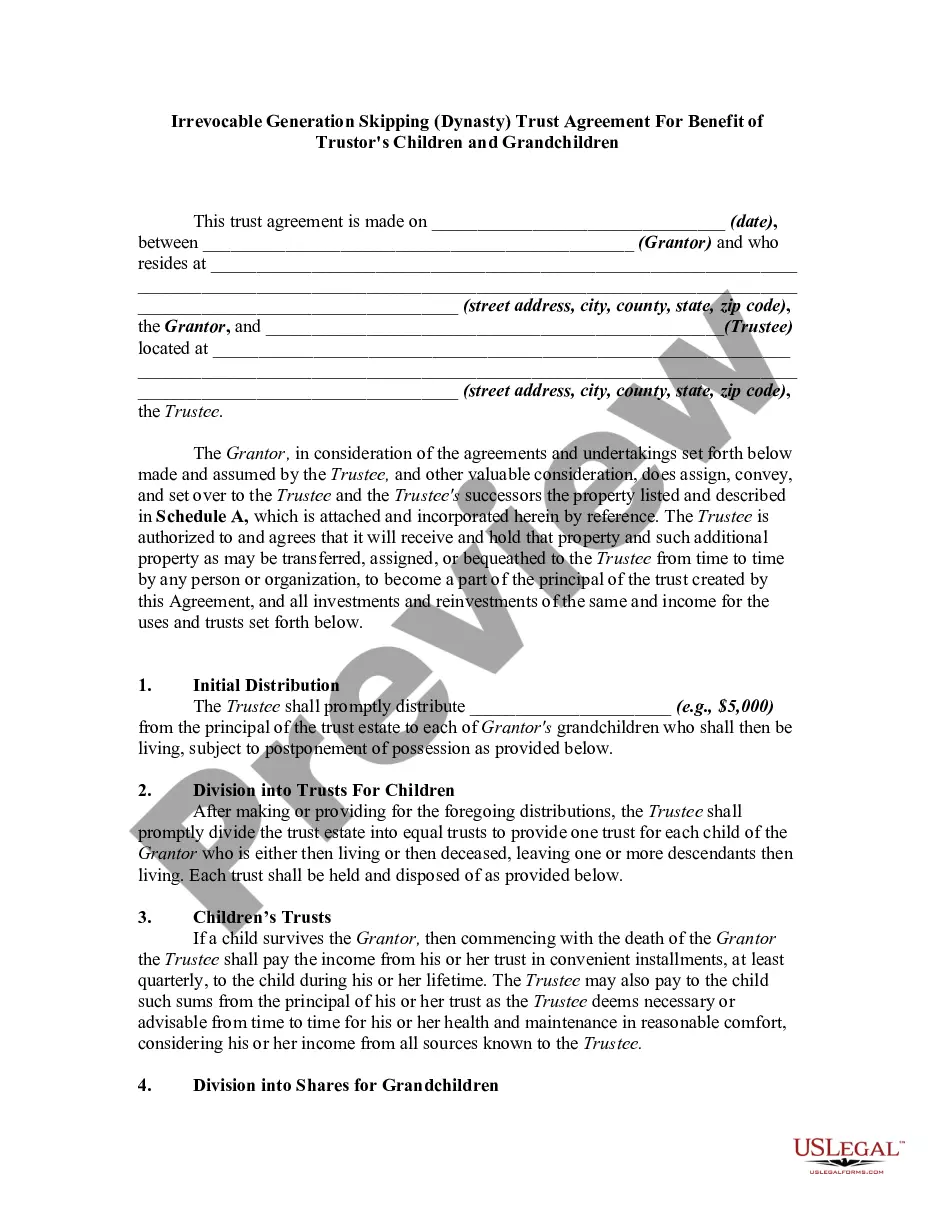
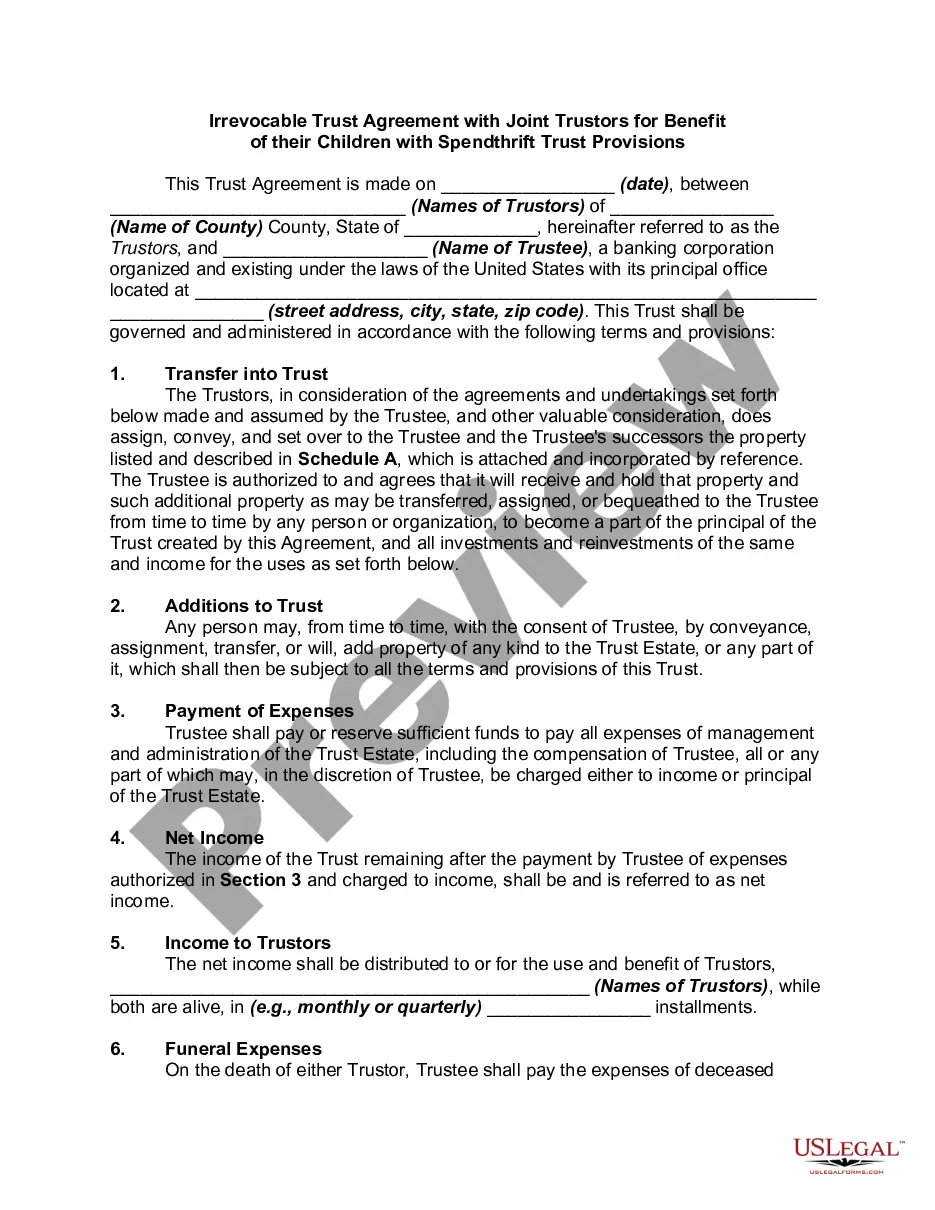
The Irrevocable Trust Agreement for the Benefit of Spouse, Children, and Grandchildren is a legal document that establishes a trust benefiting the trustor's spouse and descendants. This agreement allows the trustor to permanently transfer assets to the trust, which prevents any alterations or revocations once established. Unlike revocable trusts, this trust provides greater asset protection and can help in estate tax minimization, ensuring secure financial support for designated beneficiaries.
Key parts of this document
- Identification of parties: Names and addresses of the trustor and trustee.
- Transfer in trust: Declaration of assets being transferred into the trust.
- Distribution of income and principal: Guidelines on how income and assets should be distributed to beneficiaries.
- Irrevocability clause: Specifies that the trust cannot be altered or revoked after creation.
- Trustee powers: Details the powers and responsibilities granted to the trustee.
- Provisions for successor trustee: Outlines what happens if the original trustee resigns or is unable to act.



When to use this form
This form is useful when an individual wants to ensure that their spouse, children, and grandchildren are financially supported after their death. It is ideal for those who aim to protect their assets from creditors and ensure that their beneficiaries receive their intended inheritance without delay. Additionally, it can be beneficial for estate planning purposes to reduce estate taxes and avoid probate proceedings.
Who this form is for
- Individuals who want to create a trust that benefits their immediate family.
- Anyone wishing to provide long-term financial security for their descendants.
- Persons with significant assets that they wish to protect from creditors.
- Individuals seeking to minimize estate taxes and streamline asset distribution upon death.
Steps to complete this form
- Identify the parties involved: Fill in the names and addresses of the trustor and trustee.
- Specify the assets: Clearly detail the property being transferred into the trust.
- Outline distribution terms: Enter the terms for how income and principal will be distributed to the beneficiaries.
- Determine the successor trustee: Name a successor in case the original trustee can no longer serve.
- Review and sign: Ensure both parties sign the trust agreement and have it notarized if required.
Does this document require notarization?
Notarization is required for this form to take effect. Our online notarization service, powered by Notarize, lets you verify and sign documents remotely through an encrypted video session, available 24/7.
Get your form ready online
Our built-in tools help you complete, sign, share, and store your documents in one place.
Make edits, fill in missing information, and update formatting in US Legal Forms—just like you would in MS Word.
Download a copy, print it, send it by email, or mail it via USPS—whatever works best for your next step.
Sign and collect signatures with our SignNow integration. Send to multiple recipients, set reminders, and more. Go Premium to unlock E-Sign.
If this form requires notarization, complete it online through a secure video call—no need to meet a notary in person or wait for an appointment.
We protect your documents and personal data by following strict security and privacy standards.

Make edits, fill in missing information, and update formatting in US Legal Forms—just like you would in MS Word.

Download a copy, print it, send it by email, or mail it via USPS—whatever works best for your next step.

Sign and collect signatures with our SignNow integration. Send to multiple recipients, set reminders, and more. Go Premium to unlock E-Sign.

If this form requires notarization, complete it online through a secure video call—no need to meet a notary in person or wait for an appointment.

We protect your documents and personal data by following strict security and privacy standards.
Typical mistakes to avoid
- Failing to include complete and accurate descriptions of trust assets.
- Neglecting to name a successor trustee can lead to issues in asset management.
- Not reviewing state-specific laws which may affect trust validity.
- Overlooking the need for signature and notarization where required.
Why use this form online
- Convenience of instant access and download.
- Editability allows for personalization to suit individual situations.
- Reliability of forms drafted by licensed attorneys ensures legality.
- 24/7 availability enables completion at your own pace.
Legal use & context
- The document is legally binding once executed by the involved parties.
- It protects assets from creditors, ensuring they are used for intended beneficiaries.
- Irrevocability offers assurance that the terms cannot be altered post-creation, safeguarding the beneficiaries' interests.
Looking for another form?



Form popularity
FAQ
Set guidelines on how you'd like the money to be used. Release funds at key milestoneslike graduating college, getting married, or turning 35over your grandchild's lifetime, rather than all at once. Help protect the inheritance from potential depletion due to lack of financial literacy or other financial challenges.
What assets can I transfer to an irrevocable trust? Frankly, just about any asset can be transferred to an irrevocable trust, assuming the grantor is willing to give it away. This includes cash, stock portfolios, real estate, life insurance policies, and business interests.
When you transfer your assets into an irrevocable trust, you relinquish control of them. The trust is now the owner of the assets, which you'll retitle or register in the trust's name. The assets are no longer yours, and have no bearing on your wealth, the value of your estate, or your tax liability .
Irrevocable trust: The purpose of the trust is outlined by an attorney in the trust document. Once established, an irrevocable trust usually cannot be changed. As soon as assets are transferred in, the trust becomes the asset owner. Grantor: This individual transfers ownership of property to the trust.
The main downside to an irrevocable trust is simple: It's not revocable or changeable. You no longer own the assets you've placed into the trust. In other words, if you place a million dollars in an irrevocable trust for your child and want to change your mind a few years later, you're out of luck.