Option to Lease Residential Property
What this document covers
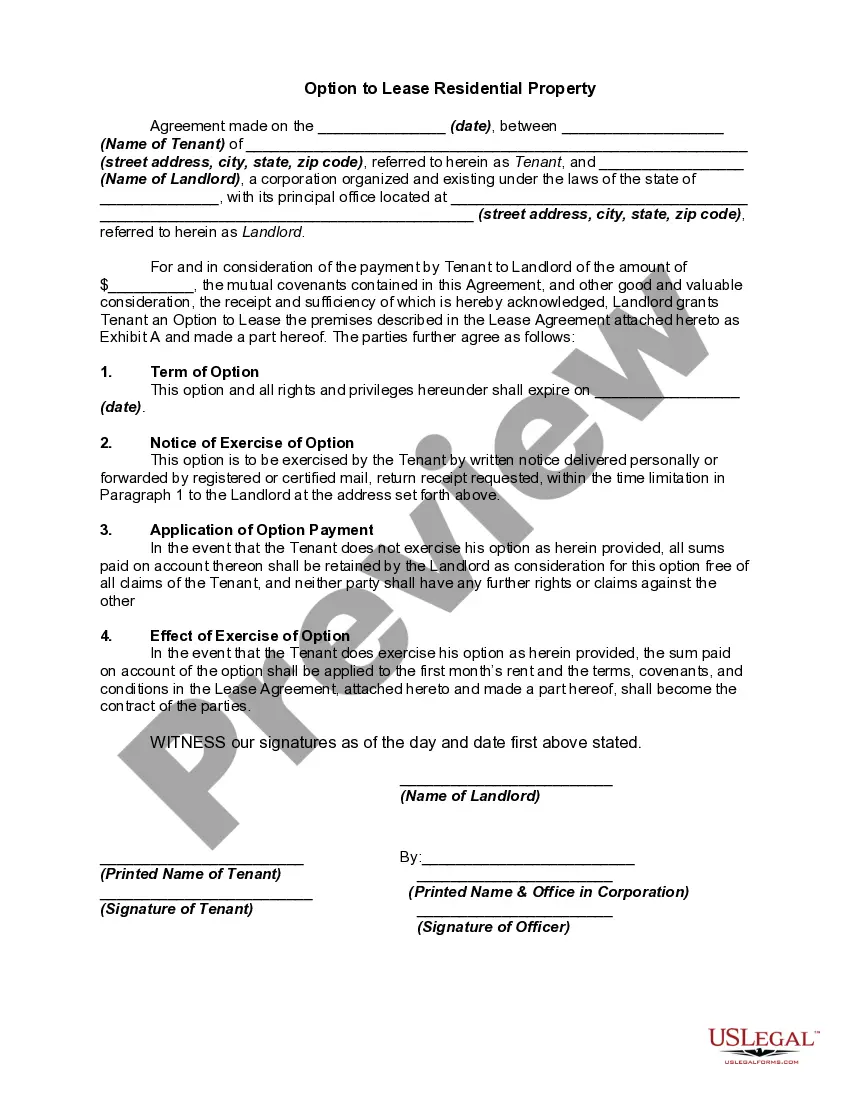
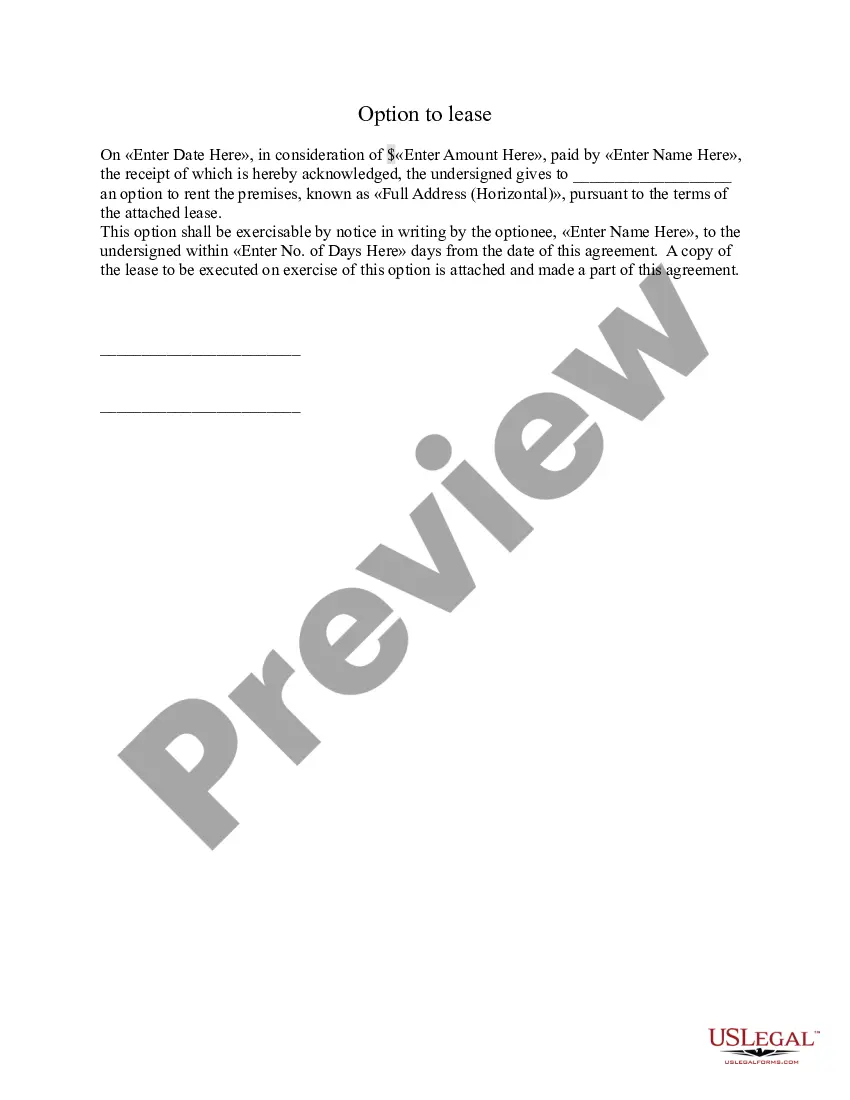
The option to lease residential property is a legal form that grants the tenant the right to lease a property at a set future date. This form allows tenants to secure a property while enabling landlords to hold it off the market for a specified time. It serves a unique purpose compared to a standard lease, allowing a tenant to make a decision later while providing some financial consideration to the landlord for taking the property off the market.
Form components explained
- Parties involved: Identification of the tenant and landlord with complete addresses.
- Payment: Terms regarding the option payment made by the tenant to secure the option.
- Term of option: Duration during which the tenant can exercise the lease option.
- Notice of exercise: Instructions on how the tenant must notify the landlord if they wish to proceed with the lease.
- Application of option payment: Clarifies what happens to the payment if the option is not exercised.
- Effect of exercise: Details how the payment applies to the first month's rent if the option is exercised.
When to use this document
This form is typically used when a tenant wants to secure the right to lease a property in the future while giving the landlord assurance that the property will not be rented to anyone else during the option period. It is beneficial in situations where a tenant might need additional time to prepare for a move or finalize finances but wants to ensure they have the opportunity to move into the property later.
Intended users of this form
- Tenants who are interested in leasing a property but require more time to finalize their decision or preparations.
- Landlords who want to offer potential tenants an option to lease the property at a later date while receiving some financial compensation upfront.
- Real estate agents facilitating lease agreements who need a standardized option form for their clients.
How to prepare this document
- Identify the parties: Fill in the names and addresses of both the tenant and landlord.
- Specify the payment amount: Input the amount to be paid by the tenant for the option.
- Determine the term: State the expiration date of the option period.
- Provide notice details: Outline how the tenant should notify the landlord to exercise the option.
- Gather signatures: Ensure all parties sign and date the agreement to confirm their commitment.
Notarization guidance
This form usually doesn’t need to be notarized. However, local laws or specific transactions may require it. Our online notarization service, powered by Notarize, lets you complete it remotely through a secure video session, available 24/7.
Get your form ready online
Our built-in tools help you complete, sign, share, and store your documents in one place.
Make edits, fill in missing information, and update formatting in US Legal Forms—just like you would in MS Word.
Download a copy, print it, send it by email, or mail it via USPS—whatever works best for your next step.
Sign and collect signatures with our SignNow integration. Send to multiple recipients, set reminders, and more. Go Premium to unlock E-Sign.
If this form requires notarization, complete it online through a secure video call—no need to meet a notary in person or wait for an appointment.
We protect your documents and personal data by following strict security and privacy standards.

Make edits, fill in missing information, and update formatting in US Legal Forms—just like you would in MS Word.

Download a copy, print it, send it by email, or mail it via USPS—whatever works best for your next step.

Sign and collect signatures with our SignNow integration. Send to multiple recipients, set reminders, and more. Go Premium to unlock E-Sign.

If this form requires notarization, complete it online through a secure video call—no need to meet a notary in person or wait for an appointment.

We protect your documents and personal data by following strict security and privacy standards.
Common mistakes to avoid
- Failing to properly identify all parties involved, leading to confusion over rights and responsibilities.
- Not specifying the option payment amount, which can cause disputes later on.
- Neglecting to outline the expiration date, which could render the agreement ineffective.
- Skipping the signature process, which is essential for the legality of the document.
Benefits of using this form online
- Convenience of completing the form at your own pace from any location.
- Editability allows users to customize the form according to their specific needs.
- Access to reliable templates drafted by licensed attorneys ensures legal soundness.
- Immediate download capabilities help expedite the leasing process.
Key takeaways
- The option to lease residential property allows tenants to secure a lease in the future.
- Proper completion of this form protects the rights of both tenants and landlords.
- Attention to detail is crucial to avoid common errors that could impact the enforceability of the agreement.
Looking for another form?


Form popularity
FAQ
Now, let's dive into the four types of leasehold estates. The most common type is known as an Estate for Years. An Estate for Years is an interest in land that arises by contract for possession for a definite, but limited, period of time.
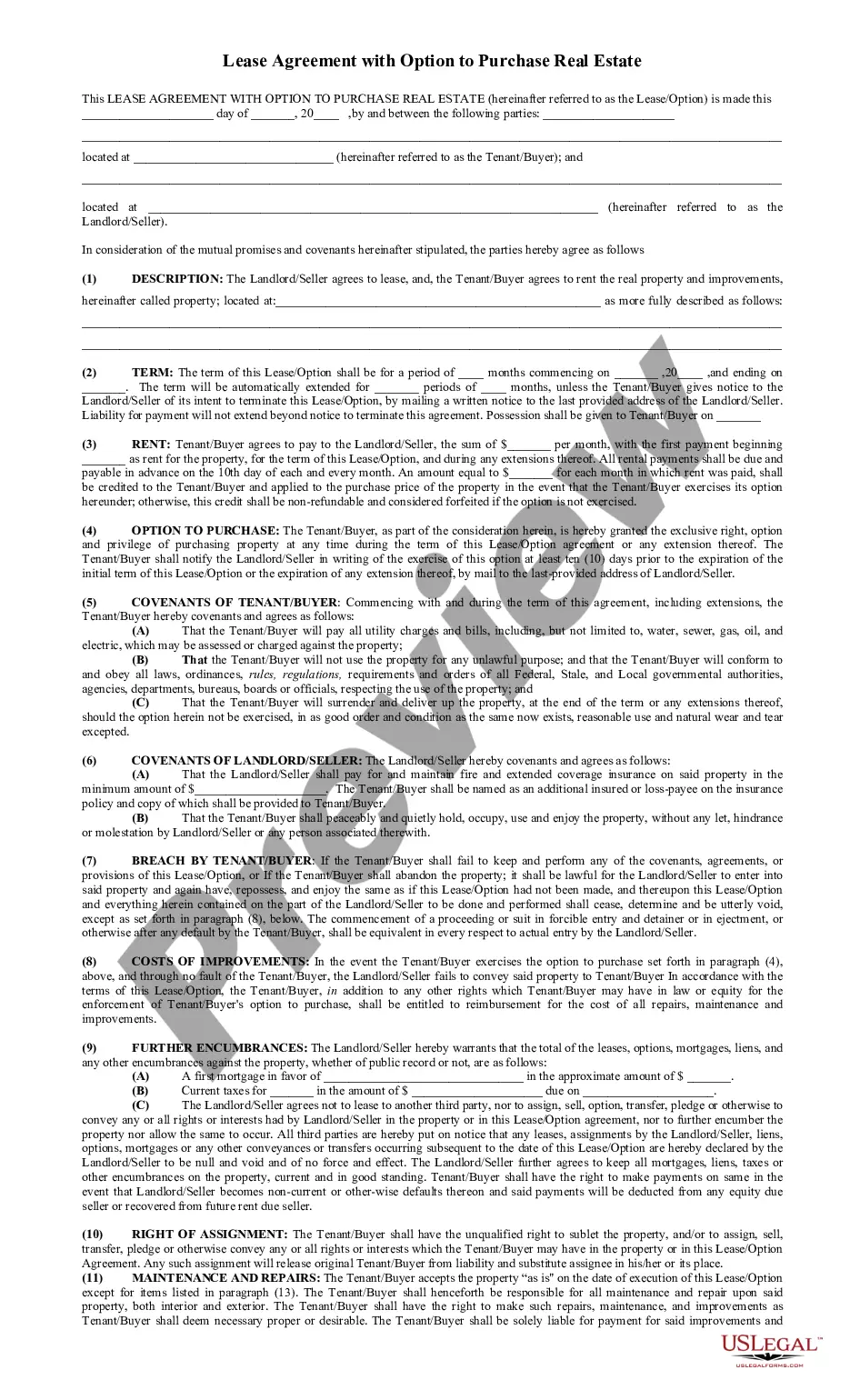
The difference between a lease option and lease purchase agreement is that the lease option only obligates the seller to sell. A lease purchase agreement commits both parties to the sale barring breach of contract or the buyer's inability to secure a mortgage.
Triple Net Lease: The triple net lease encompasses property taxes, insurance, and common area maintenance, with the tenant paying for some or all of the cost of these three things on top of their base rent. It is one of the most common lease types.
Lease-option contracts give you the right to buy the home when the lease expires, while lease-purchase contracts require you to buy it. You pay rent throughout the lease, and in some cases, a percentage of the payment is applied to the purchase price.
A lease-option-to-buy arrangement can be a solution for some potential homebuyers, but it's not right for everyone. If you're not certain that you're going to be able to purchase the rental home at the end of the lease period, you might be better served with a standard rental agreement.
In real estate, the lease-option is a legal instrument between the investor/seller and a tenant/buyer. It involves a lease with a monthly rental amount due, but it also includes an option to buy for a pre-determined price at any time during the agreement.
Most residential leases, for instance, are examples of the gross lease, where the landlord pays most of the expenses, such as insurance, taxes, water, and sewage, associated with the property while the tenant pays rent and those expenses that vary significantly by how much the tenant uses them, such as electricity and
Utilities. Insurance. Property/building maintenance.
I mentioned that gross leases are the most common lease type among consumer-facing types of real estate, but they are often used for other property types, for which buildings are shared among multiple tenants. A gross lease is often referred to as a full-service lease in commercial applications.