Employment At Will Policy
What this document covers
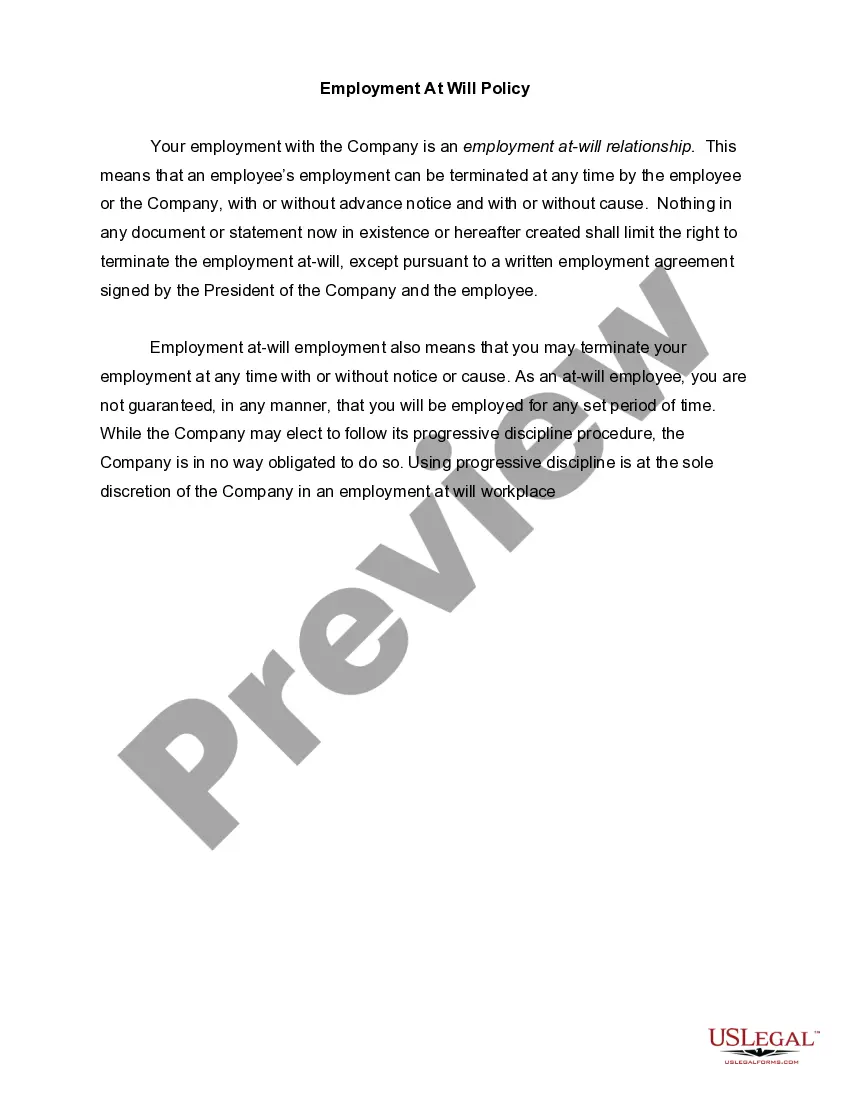
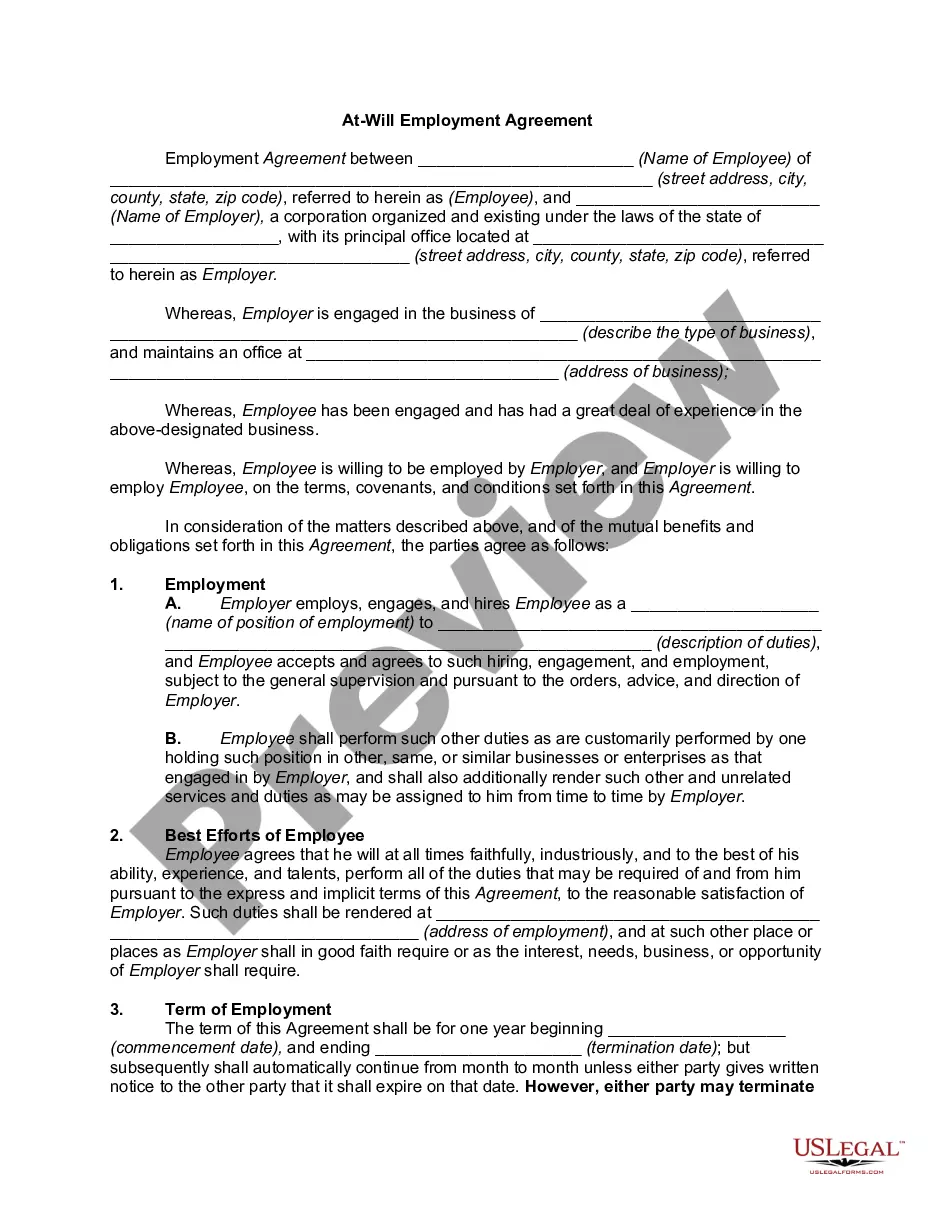
The Employment At Will Policy is a legal document that outlines the nature of the employment relationship between an employer and an employee. It establishes that either party can terminate the employment at any time, with or without cause or prior notice. This form serves to inform employees of their at-will status and clarifies that no specific duration of employment is guaranteed. Unlike an employment contract with a fixed term, this policy allows for complete flexibility for both the employer and the employee regarding termination.
What’s included in this form
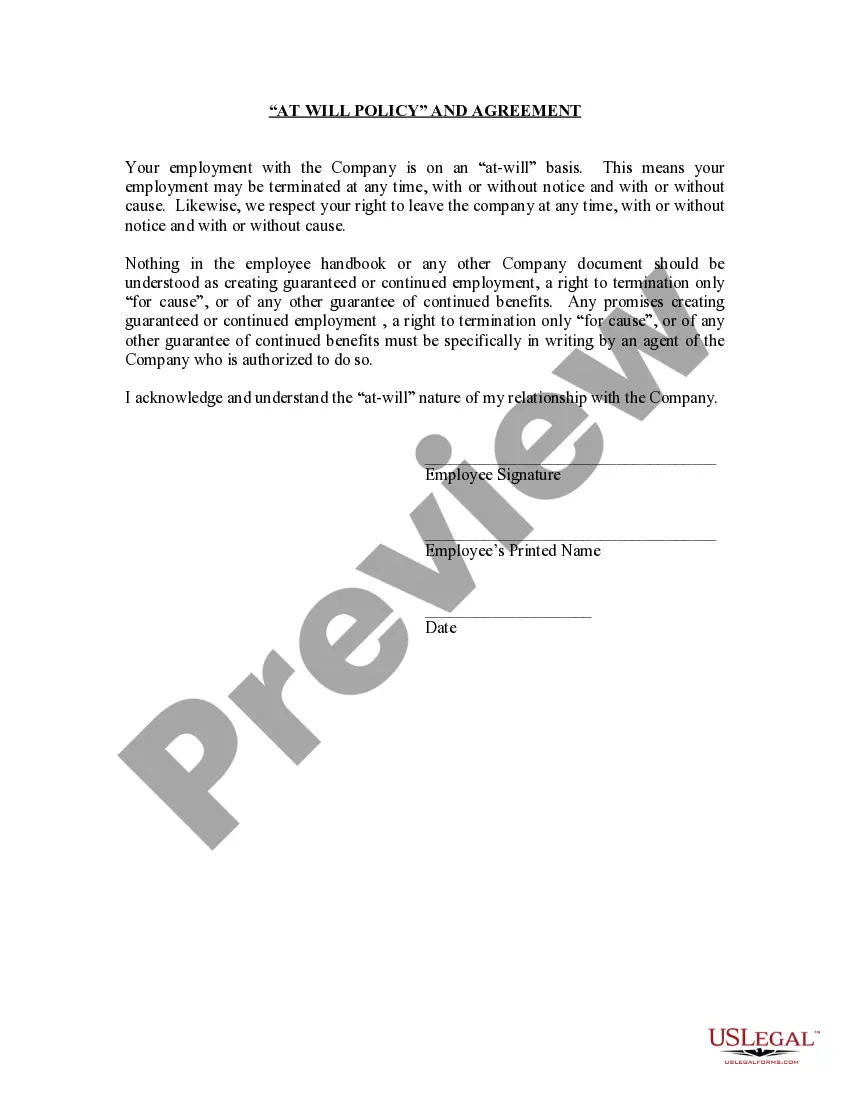
- Statement of at-will employment status
- Rights of the employer and employee regarding termination
- Disclaimer on limitations of employment duration
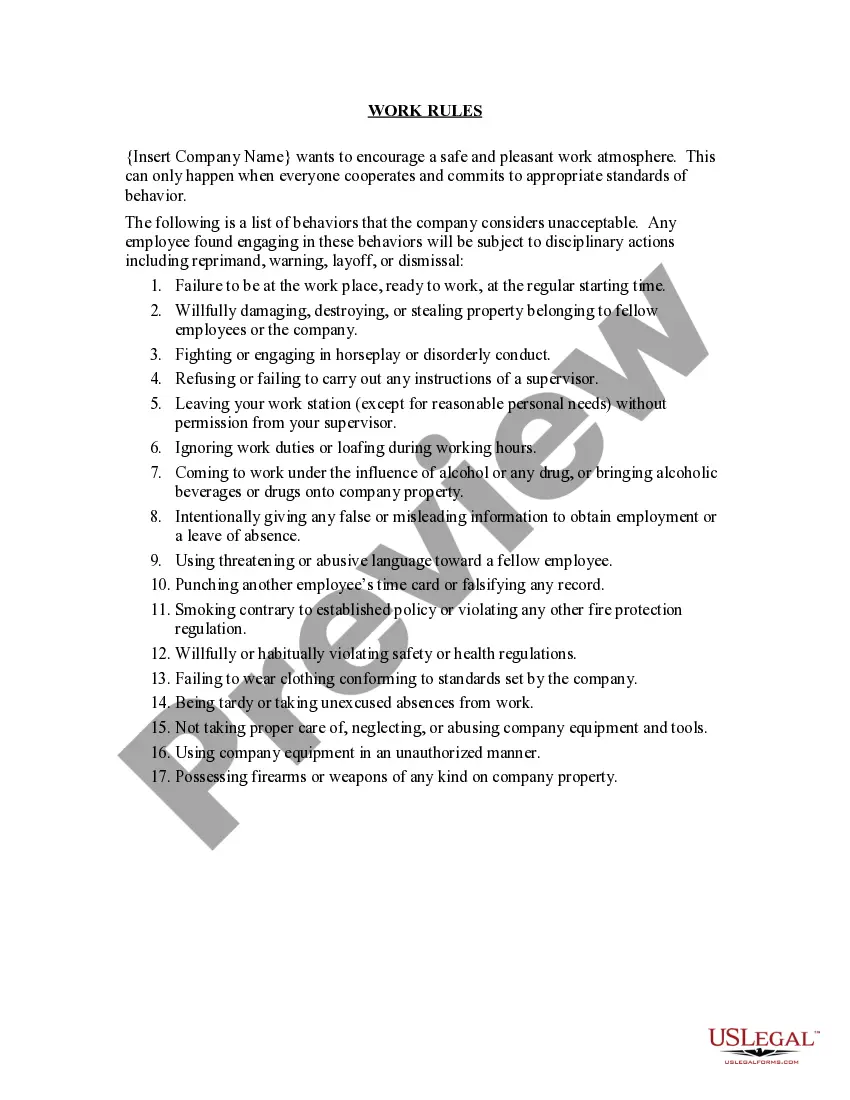
- Clarification on the use of progressive discipline by the employer
When to use this document
This Employment At Will Policy should be used when establishing an employment relationship where both the employer and the employee agree to the absence of a fixed term of employment. It is particularly useful for businesses that want to maintain flexibility in employment decisions or when creating new employee handbooks that include guidelines on employment termination.
Who this form is for
- Employers looking to clearly define an at-will employment relationship with their employees
- HR departments drafting employee handbooks
- Small business owners wishing to inform employees about employment terms
Steps to complete this form
- Clearly state the company name and the employees affected by the policy.
- Ensure that the policy is written in clear, understandable language.
- Include a section that affirms the at-will employment status of employees.
- Specify that any change to the policy must be documented in a written agreement signed by authorized representatives.
- Distribute the form to all employees and obtain their acknowledgment of the policy.
Does this document require notarization?
This form does not typically require notarization unless specified by local law. It is recommended to retain a copy for company records and distribute it to relevant employees to ensure awareness of the employment terms.
Get your form ready online
Our built-in tools help you complete, sign, share, and store your documents in one place.
Make edits, fill in missing information, and update formatting in US Legal Forms—just like you would in MS Word.
Download a copy, print it, send it by email, or mail it via USPS—whatever works best for your next step.
Sign and collect signatures with our SignNow integration. Send to multiple recipients, set reminders, and more. Go Premium to unlock E-Sign.
If this form requires notarization, complete it online through a secure video call—no need to meet a notary in person or wait for an appointment.
We protect your documents and personal data by following strict security and privacy standards.

Make edits, fill in missing information, and update formatting in US Legal Forms—just like you would in MS Word.

Download a copy, print it, send it by email, or mail it via USPS—whatever works best for your next step.

Sign and collect signatures with our SignNow integration. Send to multiple recipients, set reminders, and more. Go Premium to unlock E-Sign.

If this form requires notarization, complete it online through a secure video call—no need to meet a notary in person or wait for an appointment.

We protect your documents and personal data by following strict security and privacy standards.
Avoid these common issues
- Failing to inform employees about their at-will status adequately.
- Not updating the policy to reflect changes in company practices or state laws.
- Omitting the disclaimer about conditions under which the policy can change.
Why complete this form online
- Convenience of immediate access and download.
- Editability to customize the document to meet specific company needs.
- Reliability, as the forms are drafted by licensed attorneys to ensure legal compliance.
Quick recap
- The Employment At Will Policy allows both the employer and employee to terminate employment at any time.
- This policy must be clearly communicated to all employees to avoid confusion.
- Employers should ensure that the policy is in writing to confirm the at-will status.
Looking for another form?



Form popularity
FAQ
At-will employment means that an employer can terminate an employee at any time for any reason as long as it isn't illegal. Employees can also resign at any time and for any reason.
California is an at-will employment state. At-will employment means that an employer can fire an employee for any reason or at any time. They do not need to have a reason or justification for terminating an at-will employee.
At-will means that an employer can terminate an employee at any time for any reason, except an illegal one, or for no reason without incurring legal liability. Likewise, an employee is free to leave a job at any time for any or no reason with no adverse legal consequences.
Under the public-policy exception to employment at will, an employee is wrongfully discharged when the termination is against an explicit, well-established public policy of the State.
California is an at-will employment state. At-will employment means that an employer can fire an employee for any reason or at any time. They do not need to have a reason or justification for terminating an at-will employee.
Under federal law, you cannot terminate someone because of the person's age, race, gender, color, national origin, equal pay, pregnancy, genetic information, religion or disability.
Some states recognize an implied covenant of good faith and fair dealing in employment relationships. Under this exception, an employer typically may not terminate an employee in bad faith or terminate an employee when the termination is motivated by malice.
California's Labor Code contains a presumption that employees are employed at will.Exceptions to employment at will include: Public-sector employees, most of whom are protected by civil service laws and/or by a "memorandum of understanding" between their union and the agency that addresses discipline and termination.