Consumer Credit Application
Overview of this form
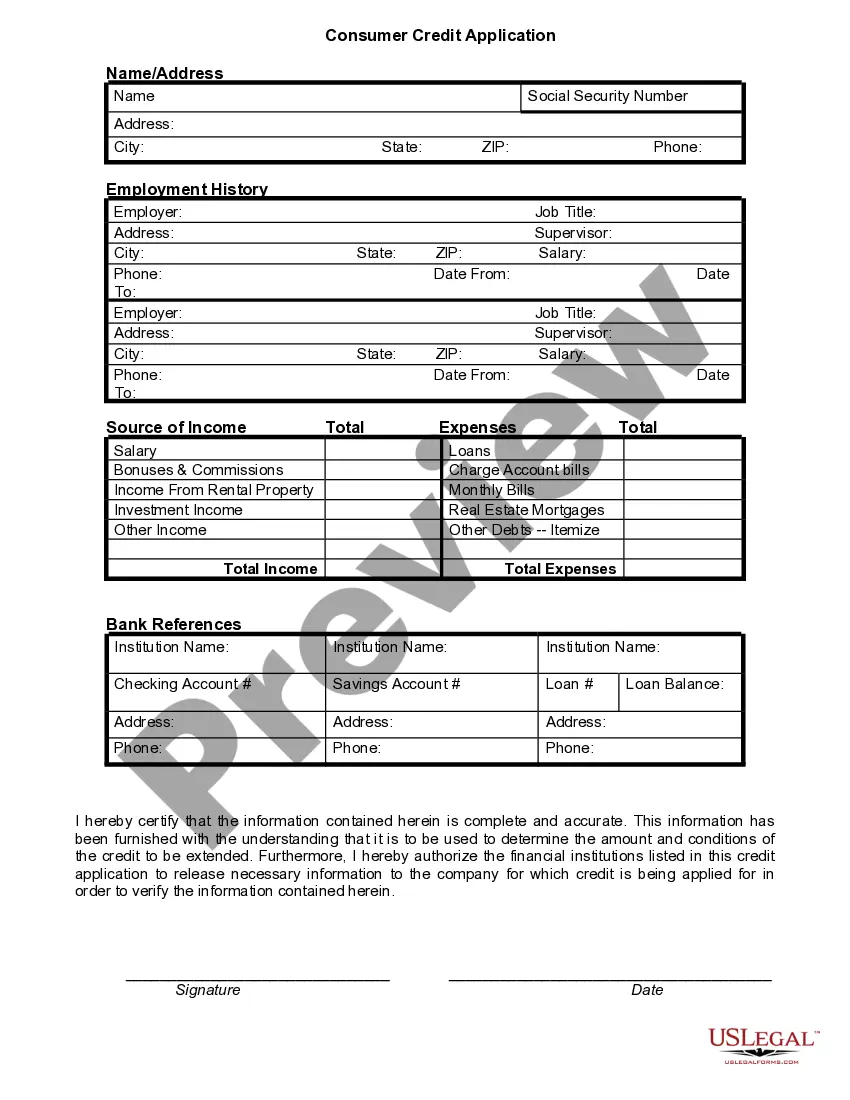
The Consumer Credit Application is a legal document used by individuals to apply for credit. This form requests information necessary for lenders to assess an applicant's financial status and ability to repay potential debts. Unlike other credit forms, this application is tailored specifically for personal, family, or household purposes, ensuring that the goods purchased are not intended for resale or commercial use.
Key parts of this document
- Name and contact information of the applicant.
- Social Security number to verify identity.
- Employment history, including job titles and durations.
- Source of income, detailing salary, loans, and any other earnings.
- Bank references, including checking and savings account details.
- Signature and date to certify the accuracy of the provided information.

When to use this form
This form is typically used when an individual seeks to acquire credit for personal needs, such as purchasing a vehicle, making a major home repair, or financing other personal goods. It is also applicable when applying for a credit card or loan that requires a thorough evaluation of one's financial background.
Who should use this form
This form is intended for:
- Individuals seeking personal credit for household purchases.
- Consumers looking to apply for loans or credit cards.
- People needing to provide financial information for credit assessments.
Instructions for completing this form
- Enter your full name, address, and contact details at the top of the form.
- Provide your Social Security number to help establish your credit identity.
- Detail your employment history, including previous and current positions and salaries.
- List all sources of income accurately, including loans and bonuses.
- Include details of bank accounts to provide a complete financial picture.
- Review the information for accuracy, sign, and date the application to authenticate your submission.
Is notarization required?
This form does not typically require notarization unless specified by local law. It is always advisable to check the requirements for your specific situation.
Get your form ready online
Our built-in tools help you complete, sign, share, and store your documents in one place.
Make edits, fill in missing information, and update formatting in US Legal Forms—just like you would in MS Word.
Download a copy, print it, send it by email, or mail it via USPS—whatever works best for your next step.
Sign and collect signatures with our SignNow integration. Send to multiple recipients, set reminders, and more. Go Premium to unlock E-Sign.
If this form requires notarization, complete it online through a secure video call—no need to meet a notary in person or wait for an appointment.
We protect your documents and personal data by following strict security and privacy standards.

Make edits, fill in missing information, and update formatting in US Legal Forms—just like you would in MS Word.

Download a copy, print it, send it by email, or mail it via USPS—whatever works best for your next step.

Sign and collect signatures with our SignNow integration. Send to multiple recipients, set reminders, and more. Go Premium to unlock E-Sign.

If this form requires notarization, complete it online through a secure video call—no need to meet a notary in person or wait for an appointment.

We protect your documents and personal data by following strict security and privacy standards.
Common mistakes to avoid
- Failing to provide accurate contact information.
- Omitting sources of income or debts.
- Leaving out previous employment details or dates.
- Not signing or dating the form before submission.
Advantages of online completion
- Convenience of immediate access and no need to visit a physical store.
- Ability to edit and save the form before finalizing the submission.
- Access to attorney-drafted templates that ensure compliance and accuracy.
- Secure storage of personal information and easy retrieval when needed.
Legal use & context
- This form is legally binding once completed and signed by the borrower.
- Incomplete or inaccurate applications may lead to denial of credit.
- By signing, applicants authorize lenders to verify the provided information.
What to keep in mind
- The Consumer Credit Application is essential for obtaining short-term personal loans.
- Accurate and complete information is crucial for the approval process.
- Online completion offers flexibility and ease of use.
Looking for another form?


Form popularity
FAQ
The present Unit on 'Process of Credit Application' covers various aspects like features and conditions for credit sales, identifying credit checks and getting authorisation, describing the process of credit requisitions, demonstrate the techniques for determining creditworthiness.
The 3 types of credit are: revolving, installment, and open accounts. These types of credit vary based on term length (fixed or indefinite), payment (fixed or variable), and monthly amount due (full balance or minimum).
Consumer credit is a way for people who spend money on products to get an advance on the money required to pay for the object. The most common example of consumer credit is a person using a credit card. He uses the credit card to pay for goods and services, then he repays the credit card company at a future date.
Once you fill out an application (and turn over your Social Security number), a lender will pull a version of your credit report and/or credit score. They'll use this credit profile and other factors, like your income or debt-to-income ratio, to determine if you meet their underwriting standards.
A consumer credit system allows consumers to borrow money or incur debt, and to defer repayment of that money over time. Having credit enables consumers to buy goods or assets without having to pay for them in cash at the time of purchase.
A credit application is an application filed by a prospective borrower and submitted to a credit lender.A credit application should have all requested details, without which the lender will not be able to proceed with a credit application. Some lenders may charge a fee to process credit applications.
This information is reported to Equifax by your lenders and creditors and includes the types of accounts (for example, a credit card, mortgage, student loan, or vehicle loan), the date those accounts were opened, your credit limit or loan amount, account balances, and your payment history.
A consumer credit system allows consumers to borrow money or incur debt, and to defer repayment of that money over time. Having credit enables consumers to buy goods or assets without having to pay for them in cash at the time of purchase.
A credit application is a request for an extension of credit.Whether done in person or individually, the application must legally contain all pertinent information relating to the cost of the credit for the borrower, including the annual percentage yield (APY) and all associated fees.