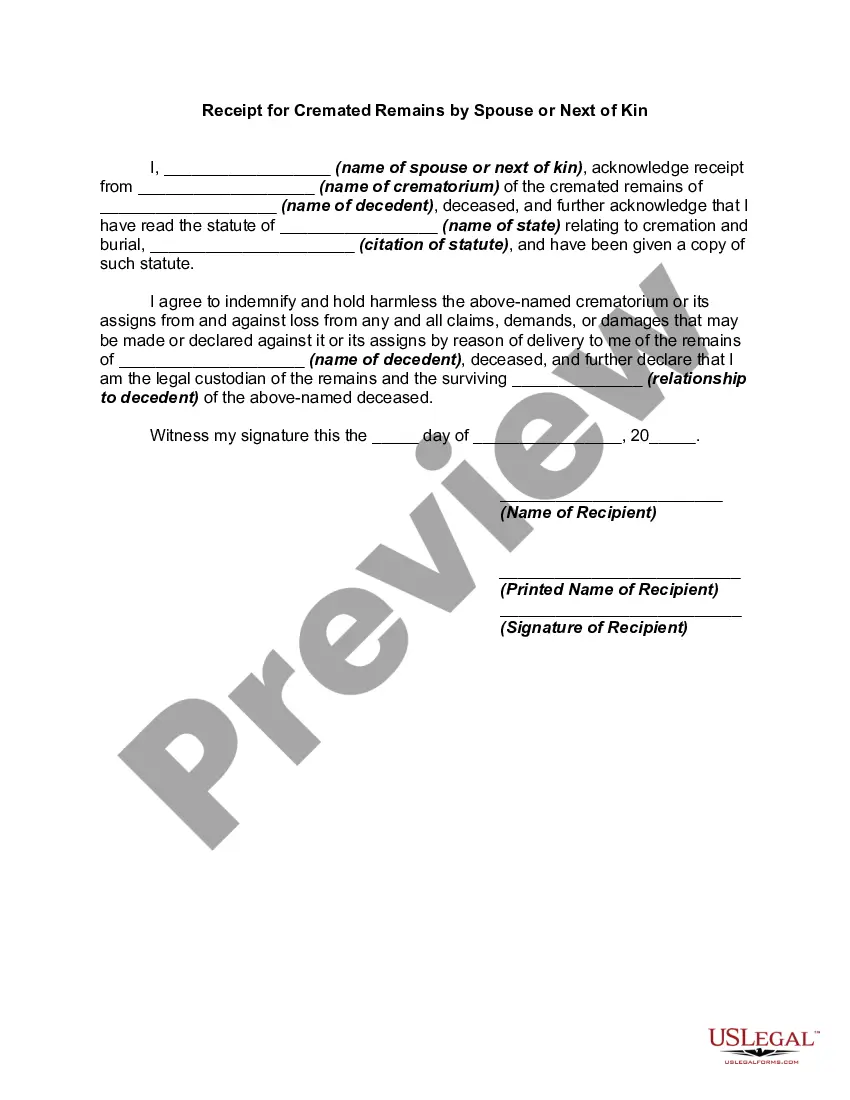
Receipt for Cremated Remains by Spouse or Next of Kin
What this document covers
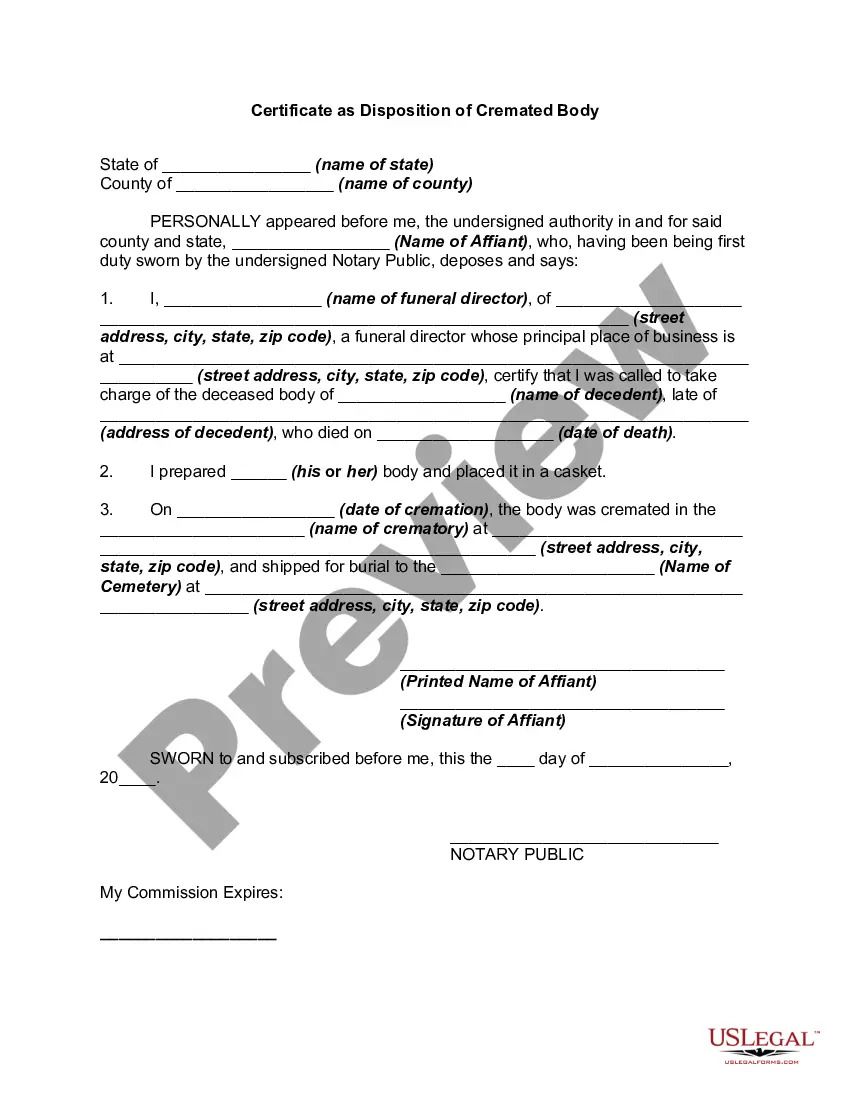
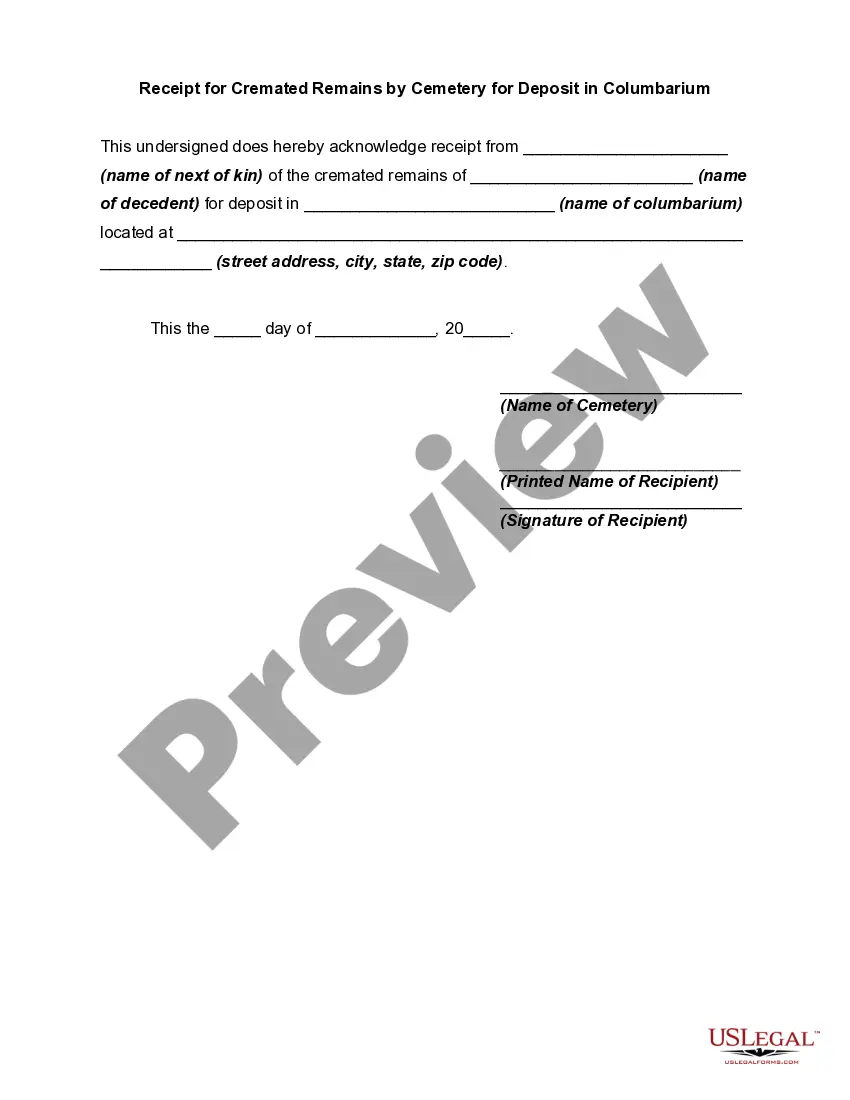
The Receipt for Cremated Remains is a legal document used by a spouse or next of kin to acknowledge the receipt of cremated remains from a crematorium. This form plays a crucial role in confirming the transfer of remains and establishes the legal custodian of the remains, differentiating it from other documents related to funeral and burial arrangements.
What’s included in this form
- Name of the recipient (spouse or next of kin)
- Name of the crematorium
- Name of the deceased
- State statute citation regarding cremation and burial
- Indemnification clause protecting the crematorium
- Date and signature of the recipient
Common use cases
This form should be used when a spouse or next of kin collects the cremated remains of a deceased individual from a crematorium. It serves as essential documentation for final disposition and provides legal acknowledgment of custody over the remains.
Who should use this form
This form is typically used by:
- Spouses of the deceased
- Next of kin who are legally recognized as custodians
- Family members involved in arranging the cremation
How to prepare this document
- Enter your name as the recipient (spouse or next of kin).
- Fill in the name of the crematorium where the remains are collected.
- Provide the name of the deceased person.
- Cite the relevant state statute related to cremation and burial.
- Read and understand the indemnification clause before signing.
- Sign and date the form to acknowledge receipt of the cremated remains.
Does this document require notarization?
Notarization is not commonly needed for this form. However, certain documents or local rules may make it necessary. Our notarization service, powered by Notarize, allows you to finalize it securely online anytime, day or night.
Get your form ready online
Our built-in tools help you complete, sign, share, and store your documents in one place.
Make edits, fill in missing information, and update formatting in US Legal Forms—just like you would in MS Word.
Download a copy, print it, send it by email, or mail it via USPS—whatever works best for your next step.
Sign and collect signatures with our SignNow integration. Send to multiple recipients, set reminders, and more. Go Premium to unlock E-Sign.
If this form requires notarization, complete it online through a secure video call—no need to meet a notary in person or wait for an appointment.
We protect your documents and personal data by following strict security and privacy standards.

Make edits, fill in missing information, and update formatting in US Legal Forms—just like you would in MS Word.

Download a copy, print it, send it by email, or mail it via USPS—whatever works best for your next step.

Sign and collect signatures with our SignNow integration. Send to multiple recipients, set reminders, and more. Go Premium to unlock E-Sign.

If this form requires notarization, complete it online through a secure video call—no need to meet a notary in person or wait for an appointment.

We protect your documents and personal data by following strict security and privacy standards.
Typical mistakes to avoid
- Not providing accurate names of the recipient, crematorium, or deceased.
- Failing to cite the correct statute for cremation in your state.
- Omitting dates or signatures, which can invalidate the document.
Benefits of completing this form online
- Easy access and immediate download of the form.
- Editable fields to ensure accurate and personalized information.
- Reliability and legal adequacy validated by licensed attorneys.
Quick recap
- The Receipt for Cremated Remains is essential for acknowledging custody of cremated remains.
- Ensure all information is accurate and complies with local laws.
- Sign and date the document to finalize the acknowledgment.
Looking for another form?
Form popularity
FAQ
The custody laws for cremated ashes are pretty much the same as for the body. The next-of-kin (or the person designated as executor) has responsibility for the ashes.
The executor can possess the ashes for the purposes of disposal. Where there is no executor, it is given to those first in line -which can get tricky if there are two or more persons with equal entitlement eg children of the remaining parent (next of kin is not an automatic right to dispose of the ashes).
The truth is that you cannot be present during a Direct Cremation.Once the Cremation is completed, your loved one's ashes will be returned to you. While some traditional funeral homes allow families to be present in the room during a loved one's cremation, it is not possible to attend a Direct Cremation.
Does the Body Sit Up During Cremation? While bodies do not sit up during cremation, something called the pugilistic stance may occur.
If your parents were still married when your father died, your mother is legally entitled to his ashes and she can sue to recover them if she wishes.Your family may need to engage an estate litigation lawyer to sue her for what is yours.
No, they can't. Some funeral directors choose to hold ashes until the family pay the bill, but they are not allowed to.And non-payment does happen, funeral costs are substantial and families will often wish to show their respects by arranging a fitting send-off.
It is possible to simply store the ashes at home, with a funeral director or at the crematorium, especially if they are to be kept and later scattered or buried with another family member who is still alive. It is essential to keep a written record of where the ashes are and what is to happen to them in the future.
Because cremated remains are significantly smaller than a body, most cemeteries will allow for the remains of multiple people to be buried in the same plot. If the remains will be buried in the ground, many cemeteries require that the urn be enclosed in an urn vault.
The surviving relatives or the Executor can only have a right to custody of the body or the ashes but this does not mean that the person "owns" them. This also means that they have a moral duty to make the funeral arrangements.