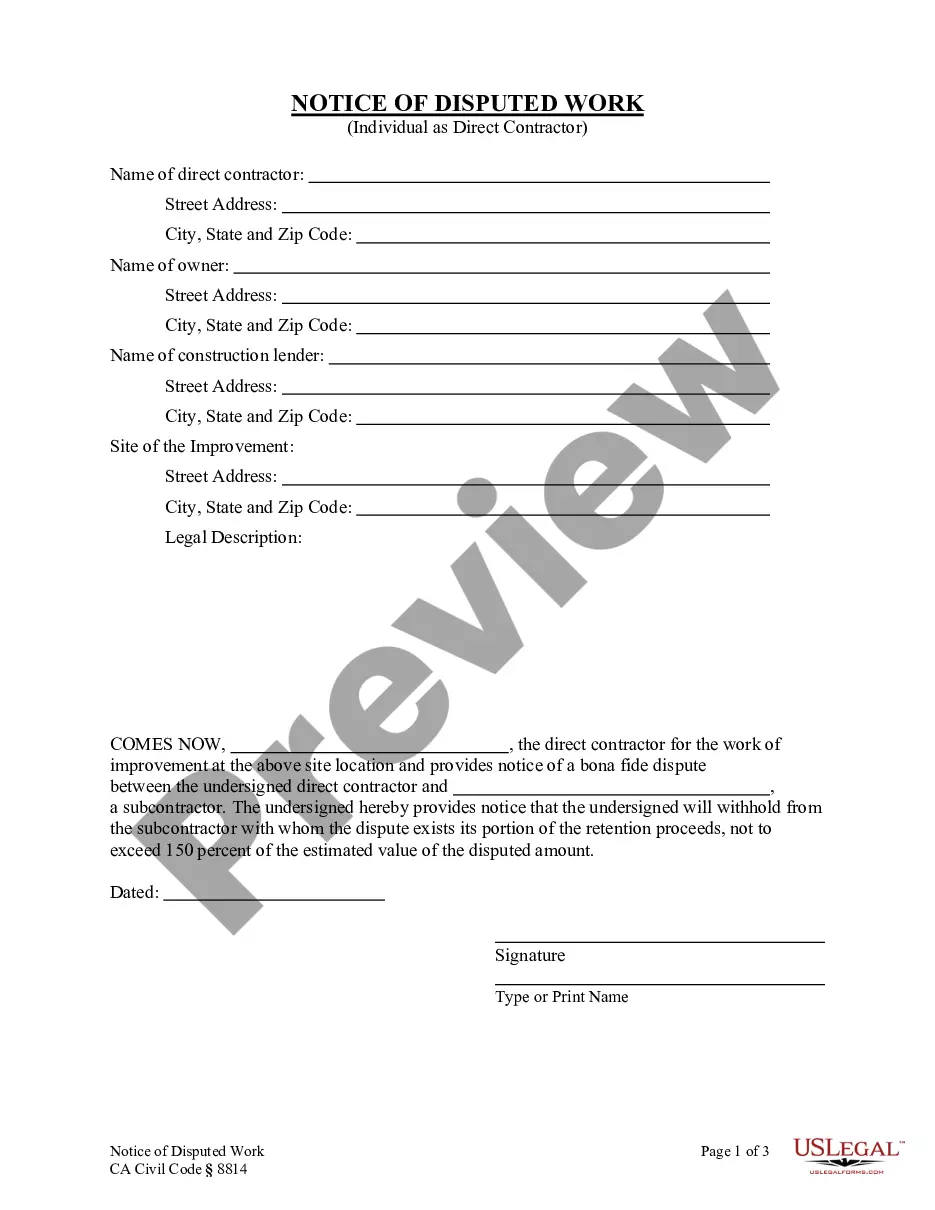
Indemnity Agreement regarding Sale of Industrial Specialty Equipment
What this document covers
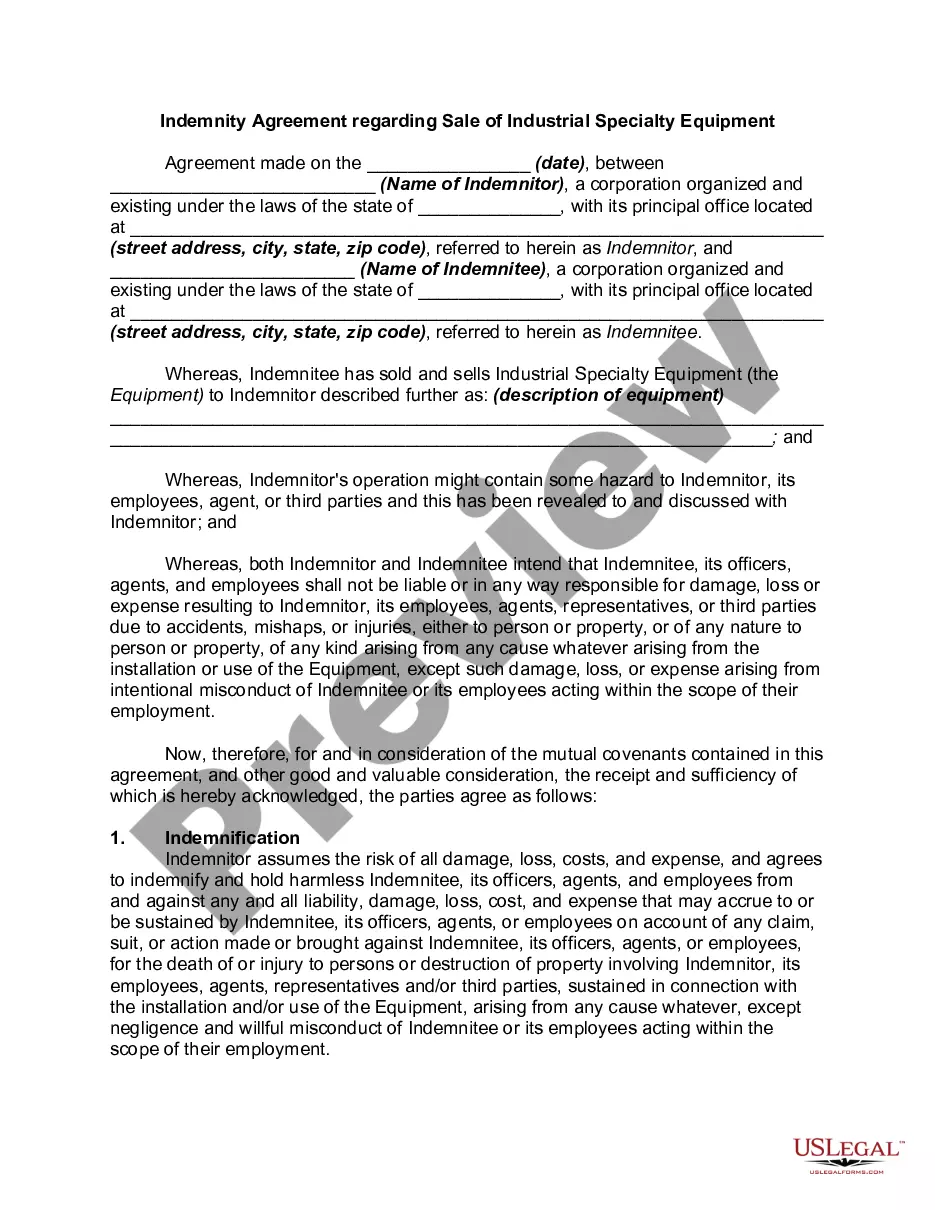
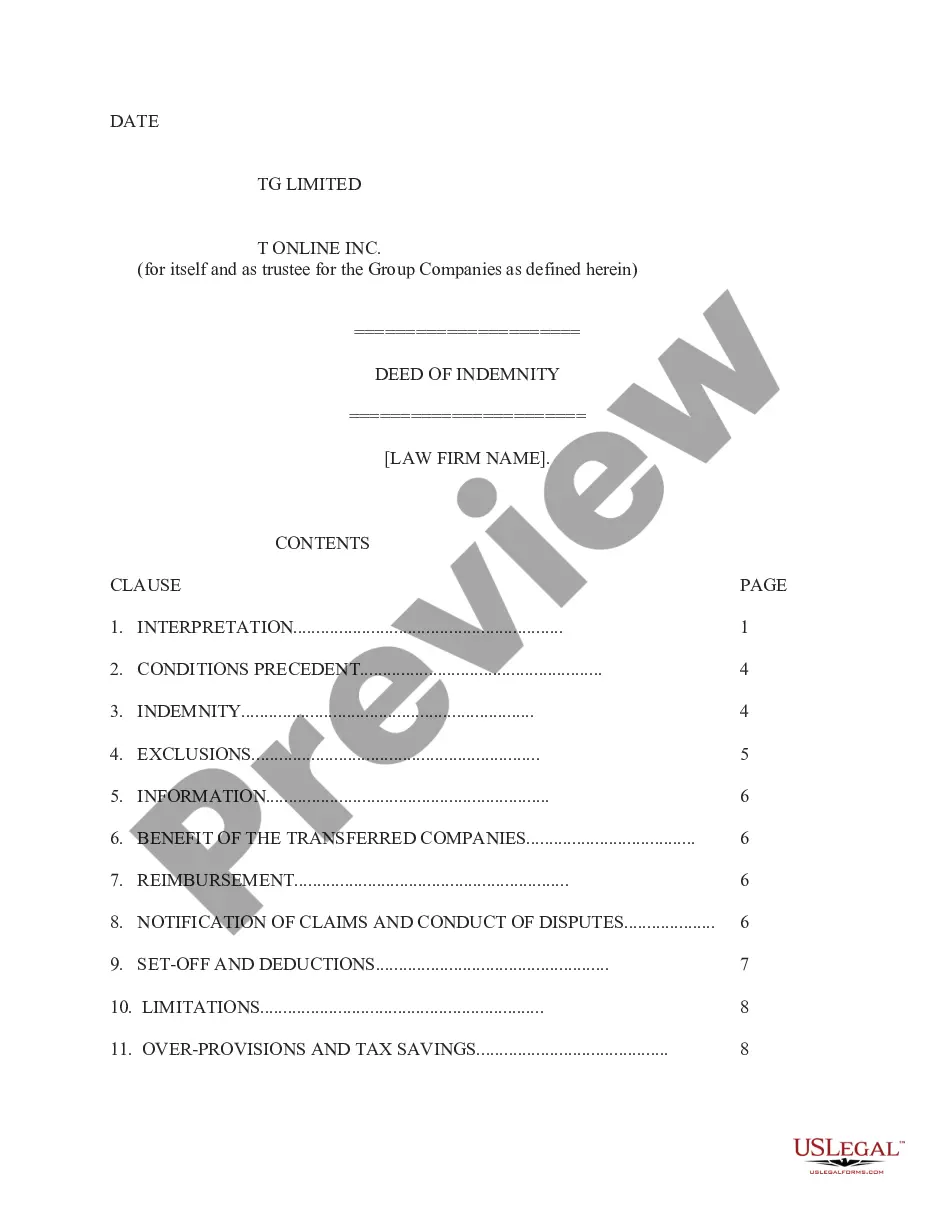
The Indemnity Agreement regarding Sale of Industrial Specialty Equipment is a legal document that outlines the responsibilities of one party to indemnify another against potential losses, damages, or injuries related to the sale and use of industrial equipment. It is crucial for parties involved in such transactions to clearly define the terms and conditions under which indemnification applies, setting it apart from other types of agreements like standard sales contracts or liability waivers.
Key parts of this document
- Date of the agreement.
- Identification of the indemnitor (the party assuming liability) and indemnitee (the party protected).
- Description of the industrial specialty equipment being sold.
- Indemnification clause outlining responsibilities for losses and lawsuits.
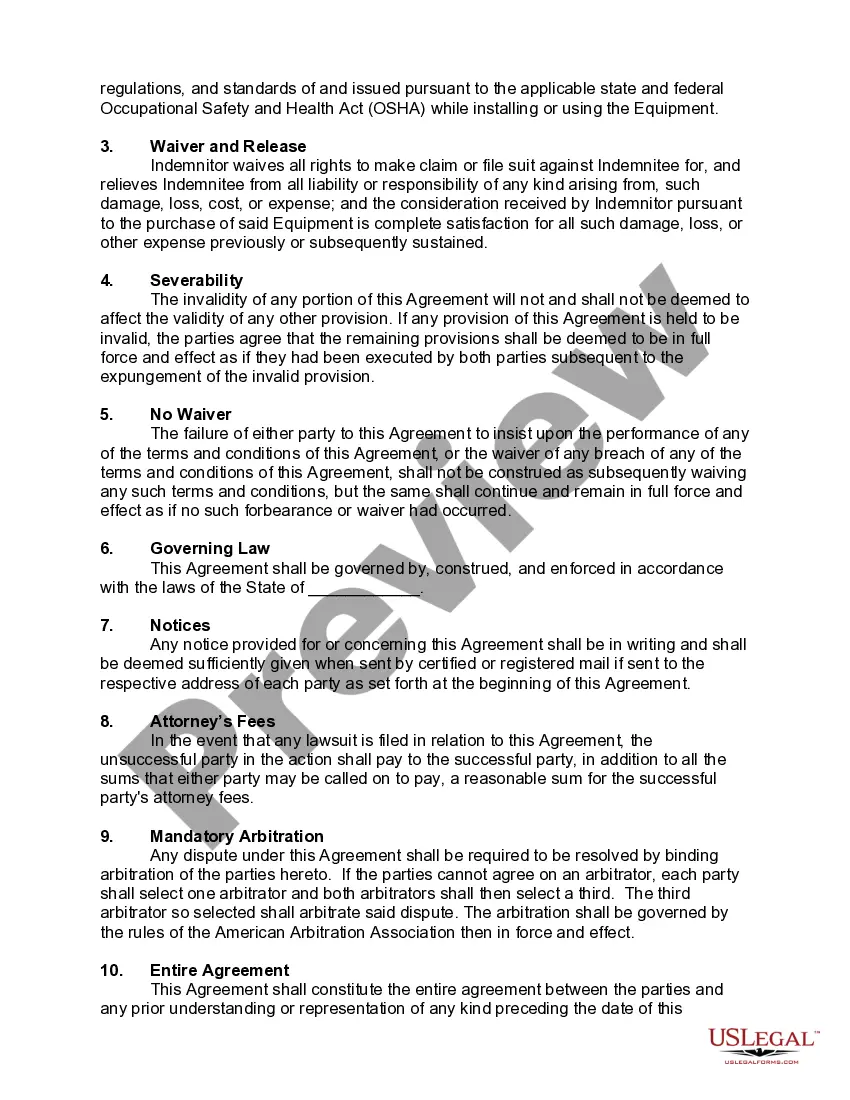
- Compliance with safety laws and regulations.
- Conditions for waiver and release of claims against the indemnitee.
- Governing law and dispute resolution through arbitration.
When to use this form
This form should be used when a party is selling industrial specialty equipment and wishes to protect themselves from liability associated with the use of that equipment. It is particularly relevant in industries where equipment can pose hazards or risks to operators and third parties, such as construction, manufacturing, or transport sectors.
Intended users of this form
This agreement is intended for:
- Businesses and corporations engaged in the sale of industrial equipment.
- Indemnitors who want to minimize their liability associated with equipment sales.
- Indemnitees looking to protect themselves from potential claims related to the use of sold equipment.
- Legal representatives advising clients involved in such transactions.
How to complete this form
- Identify the date the agreement is made and enter it in the designated space.
- Fill in the names and addresses of the indemnitor and indemnitee.
- Provide a detailed description of the industrial specialty equipment being sold.
- Review the indemnification and compliance clauses carefully to ensure clarity on liabilities.
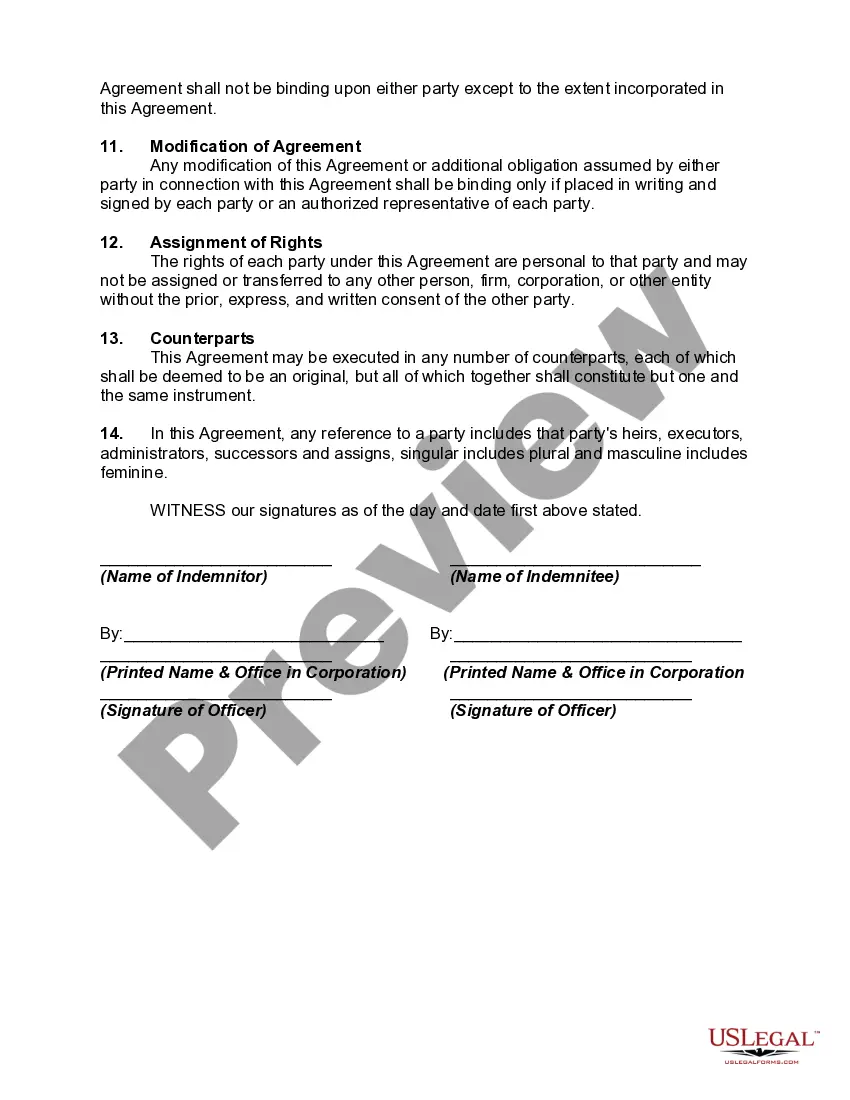
- Have authorized representatives from both parties sign the agreement.
Notarization guidance
This form does not typically require notarization to be legally valid. However, some jurisdictions or document types may still require it. US Legal Forms provides secure online notarization powered by Notarize, available 24/7 for added convenience.
Get your form ready online
Our built-in tools help you complete, sign, share, and store your documents in one place.
Make edits, fill in missing information, and update formatting in US Legal Forms—just like you would in MS Word.
Download a copy, print it, send it by email, or mail it via USPS—whatever works best for your next step.
Sign and collect signatures with our SignNow integration. Send to multiple recipients, set reminders, and more. Go Premium to unlock E-Sign.
If this form requires notarization, complete it online through a secure video call—no need to meet a notary in person or wait for an appointment.
We protect your documents and personal data by following strict security and privacy standards.

Make edits, fill in missing information, and update formatting in US Legal Forms—just like you would in MS Word.

Download a copy, print it, send it by email, or mail it via USPS—whatever works best for your next step.

Sign and collect signatures with our SignNow integration. Send to multiple recipients, set reminders, and more. Go Premium to unlock E-Sign.

If this form requires notarization, complete it online through a secure video call—no need to meet a notary in person or wait for an appointment.

We protect your documents and personal data by following strict security and privacy standards.
Common mistakes to avoid
- Failing to accurately describe the equipment, which can lead to ambiguity.
- Not having the agreement reviewed by a legal professional.
- Leaving fields blank or providing incomplete information.
- Assuming that verbal agreements can replace written terms in this context.
Why complete this form online
- Instant access to professionally drafted legal templates tailored for specific needs.
- Edit and customize the document according to your business requirements easily.
- Convenient download options allowing immediate use without waiting for physical shipping.
- Reliable legal assurance ensuring compliance with relevant laws and regulations.
Legal use & context
- This indemnity agreement is legally binding, provided all parties enter it willingly and with a clear understanding of its terms.
- It is important to ensure that the indemnification clause is adequately defined to avoid disputes in the future.
- Legal enforceability can vary based on jurisdiction, so reviewing local laws is essential.
Main things to remember
- The indemnity agreement specifies which party assumes liability for losses related to the equipment.
- Such agreements are vital in minimizing legal risk in equipment sales.
- Ensure that the form is customized to reflect the specific equipment and transaction details.
Looking for another form?

Form popularity
FAQ
Indemnity is compensation paid by one party to another to cover damages, injury or losses.An example of an indemnity would be an insurance contract, where the insurer agrees to compensate for any damages that the entity protected by the insurer experiences.
Identify Time Periods for Asserting Indemnification Rights. Provide Notice in a Timely Fashion. Notify All Concerned Parties. Understand Limitations on Recovery. Exclusive Remedy. Scope of Damages. Claims Process/Dispute Resolution.
A letter of indemnity must mention the details of both the parties involved in the transaction. These details are, generally, full legal name and complete official or residential address with pin code.
Company/Business/Individual Name shall fully indemnify, hold harmless and defend _______ and its directors, officers, employees, agents, stockholders and Affiliates from and against all claims, demands, actions, suits, damages, liabilities, losses, settlements, judgments, costs and expenses (including but not
Building Blocks of an Indemnification Clause. Typical indemnification provisions will be long sentences with many clauses, legal-sounding words, and long lists of specific details. Insurance Implications and Other Contractual Matters. Other Technical Elements of an Indemnification Provision. Takeaway.
Drafting of the indemnity clause An indemnifier must limit the amount of indemnities that is given while entering into a contract. An express obligation must be imposed so as to minimize the loss, and the duration of time in which the claim can be brought must be limited.
You should look to limit indemnification clauses by narrowing their scope, putting in caps on damages, and clearly defining the indemnifiable acts (i.e. the representations and warranties in the example above). Also consider purchasing insurance as a means to limit your financial risk.
A typical example is an insurance company wherein the insurer or indemnitor agrees to compensate the insured or indemnitee for any damages or losses he/she may incur during a period of time.