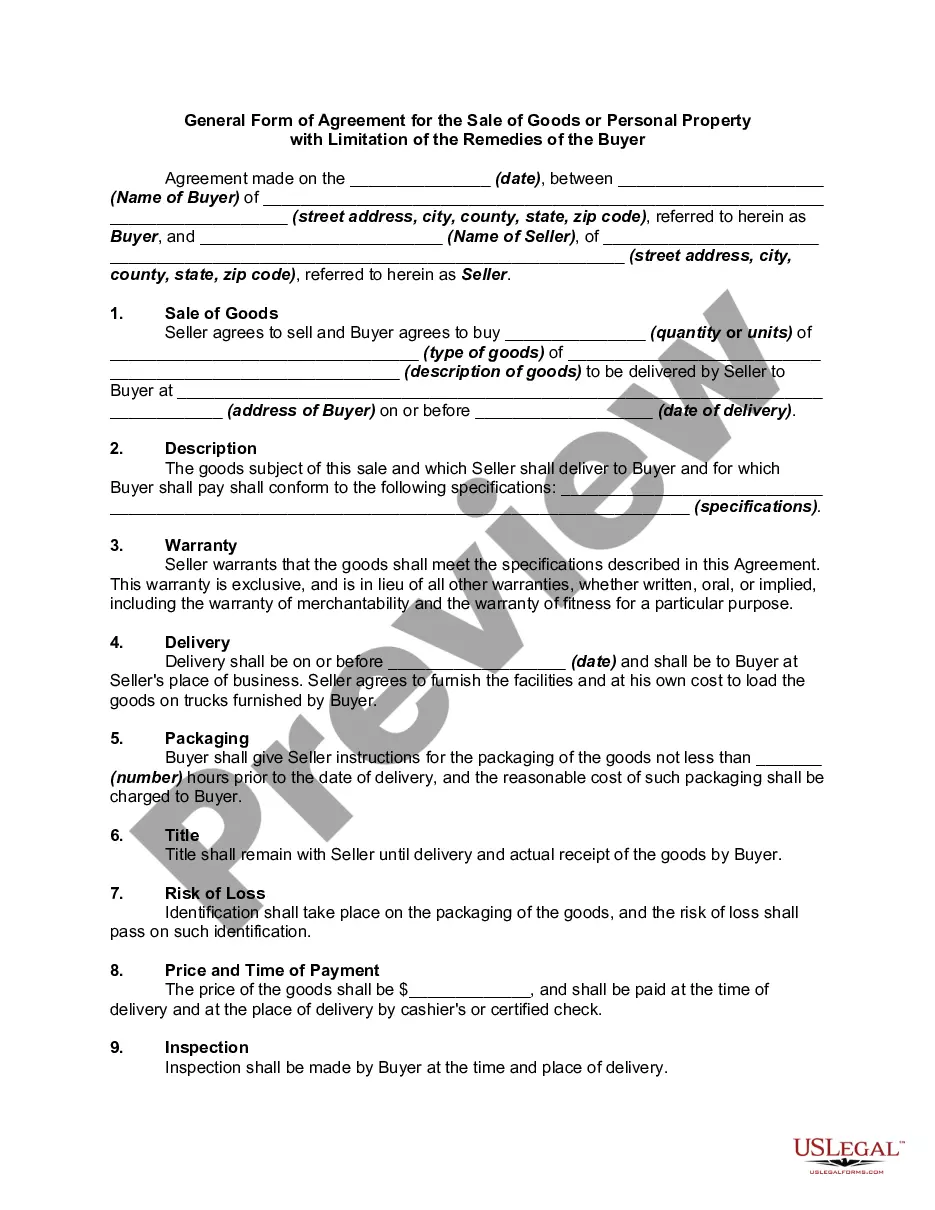
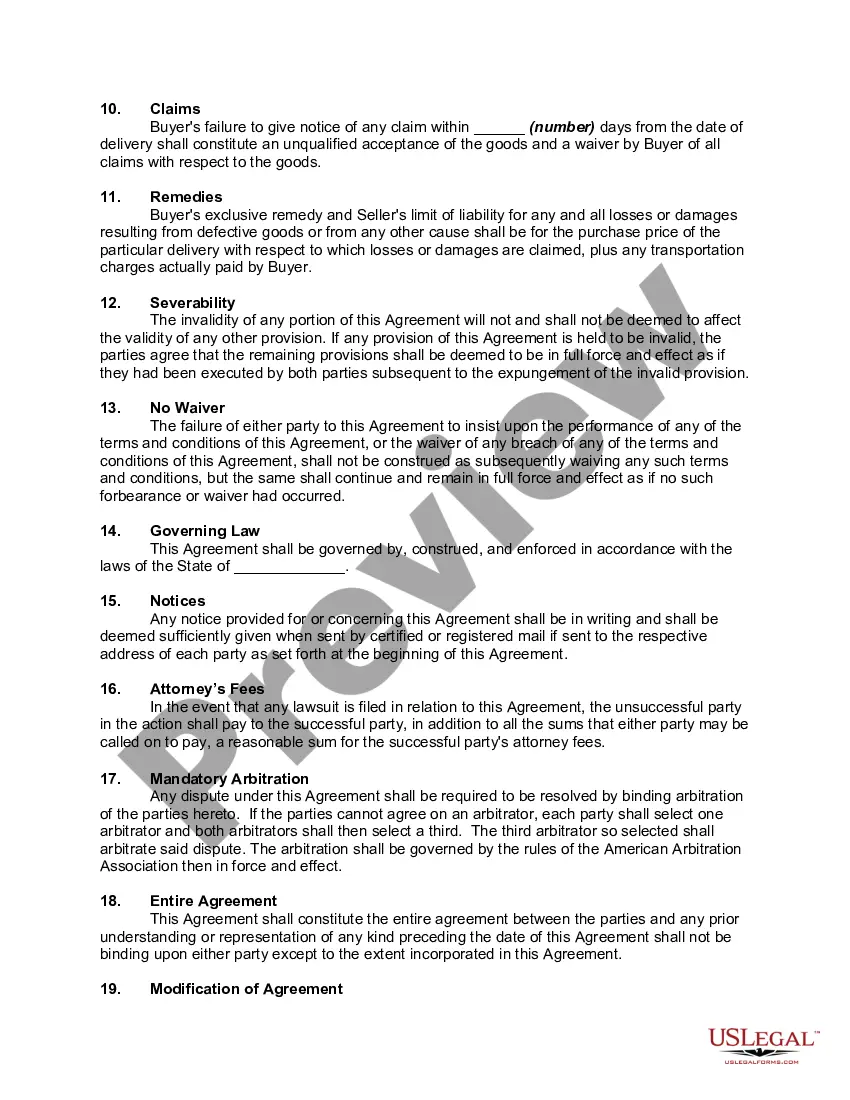
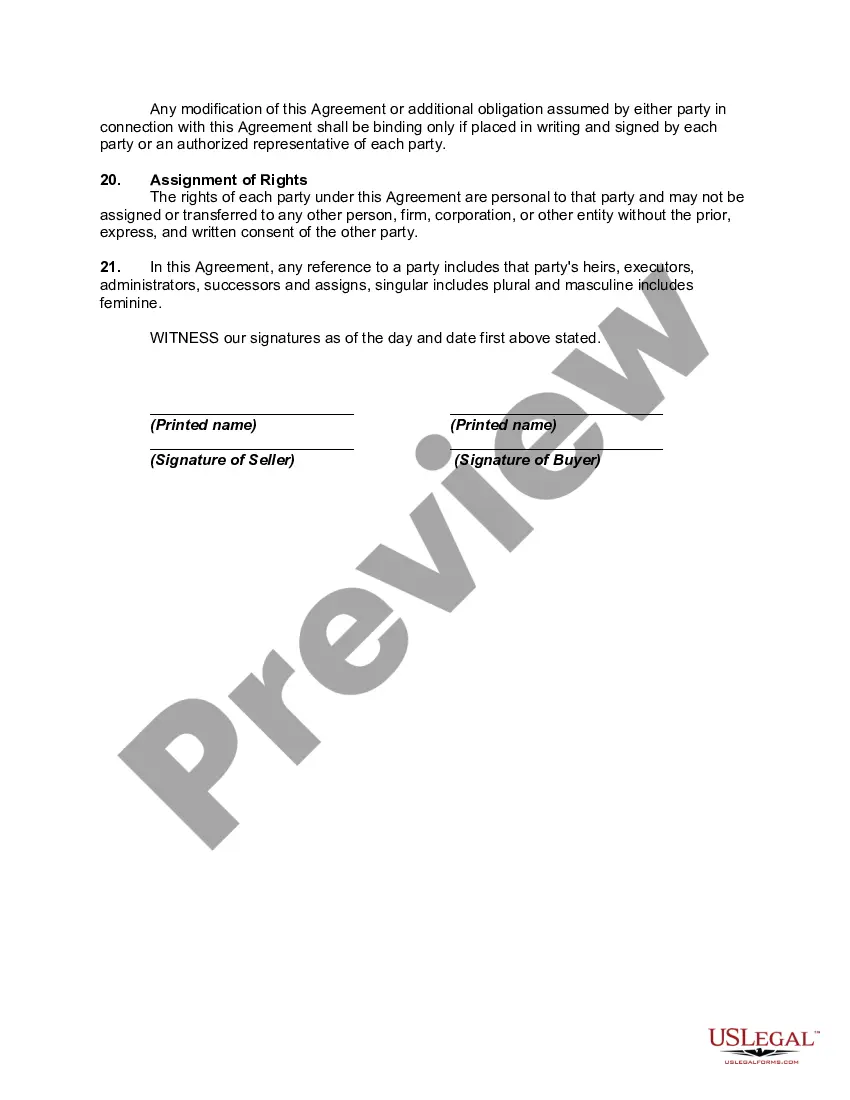
General Form of Agreement for the Sale of Goods or Personal Property with Limitation of the Remedies of the Buyer
Overview of this form
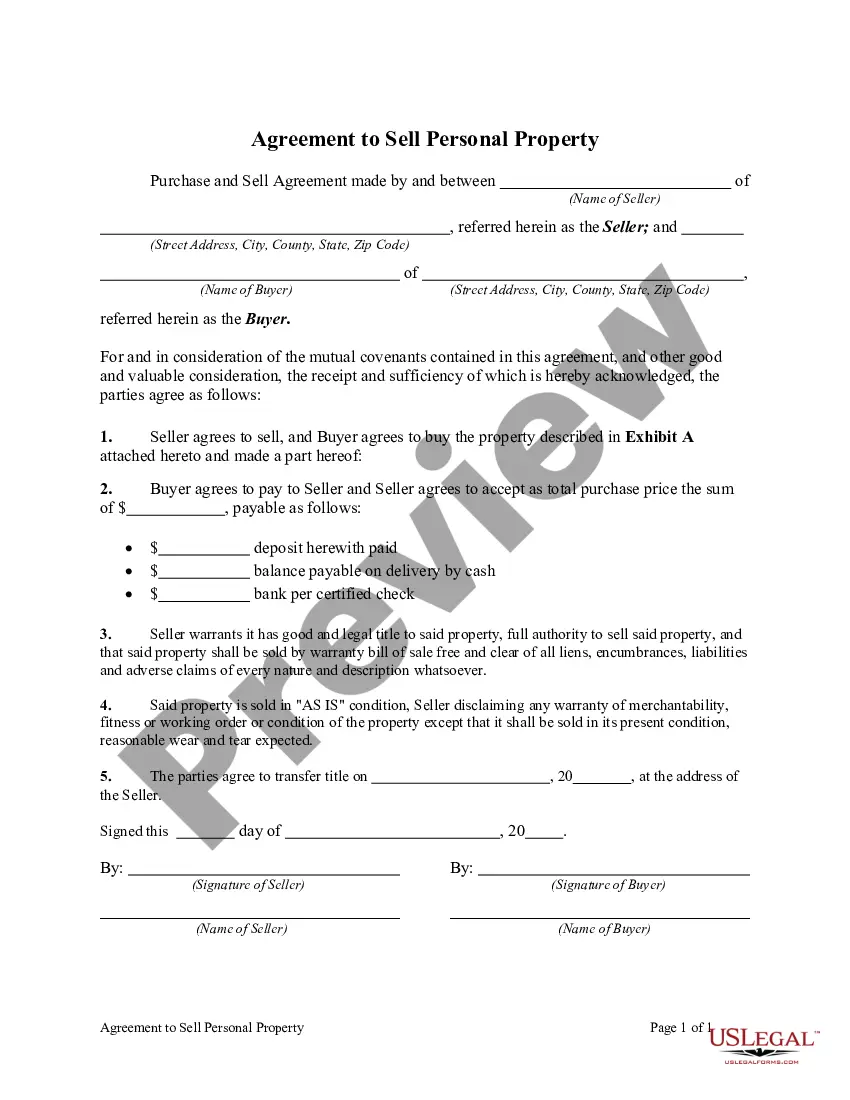
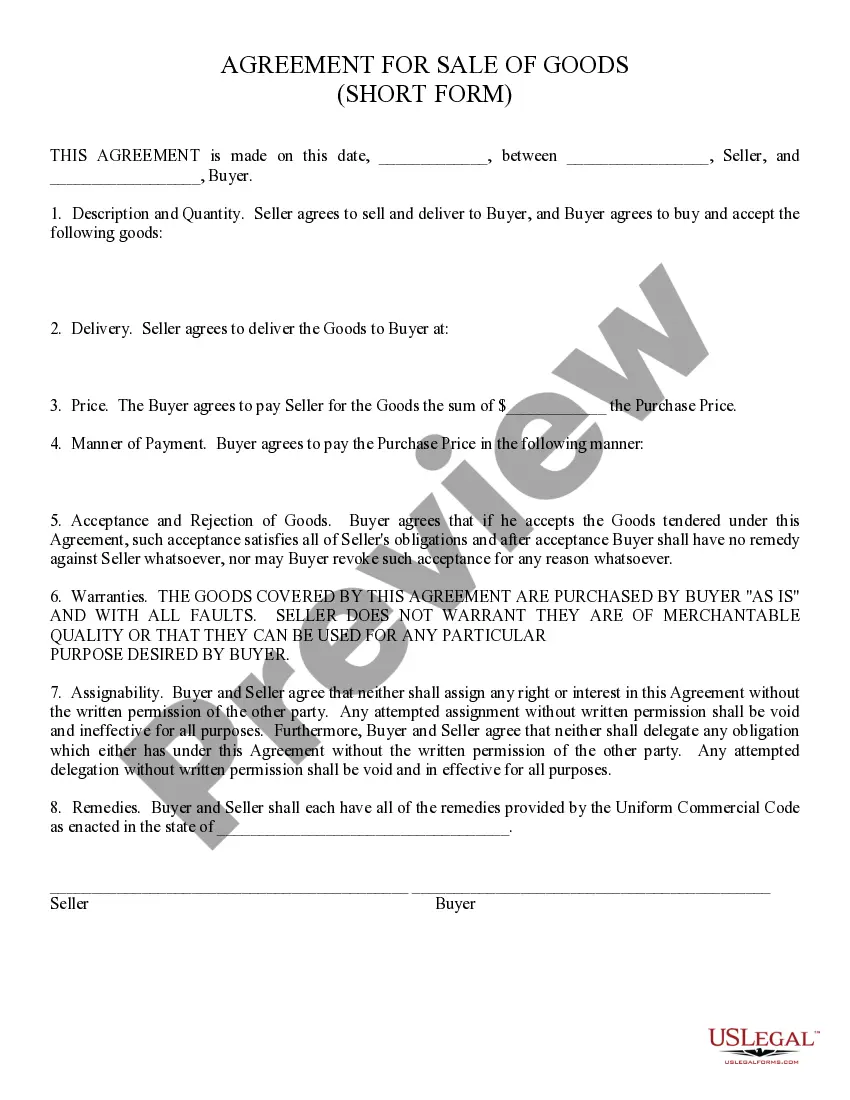
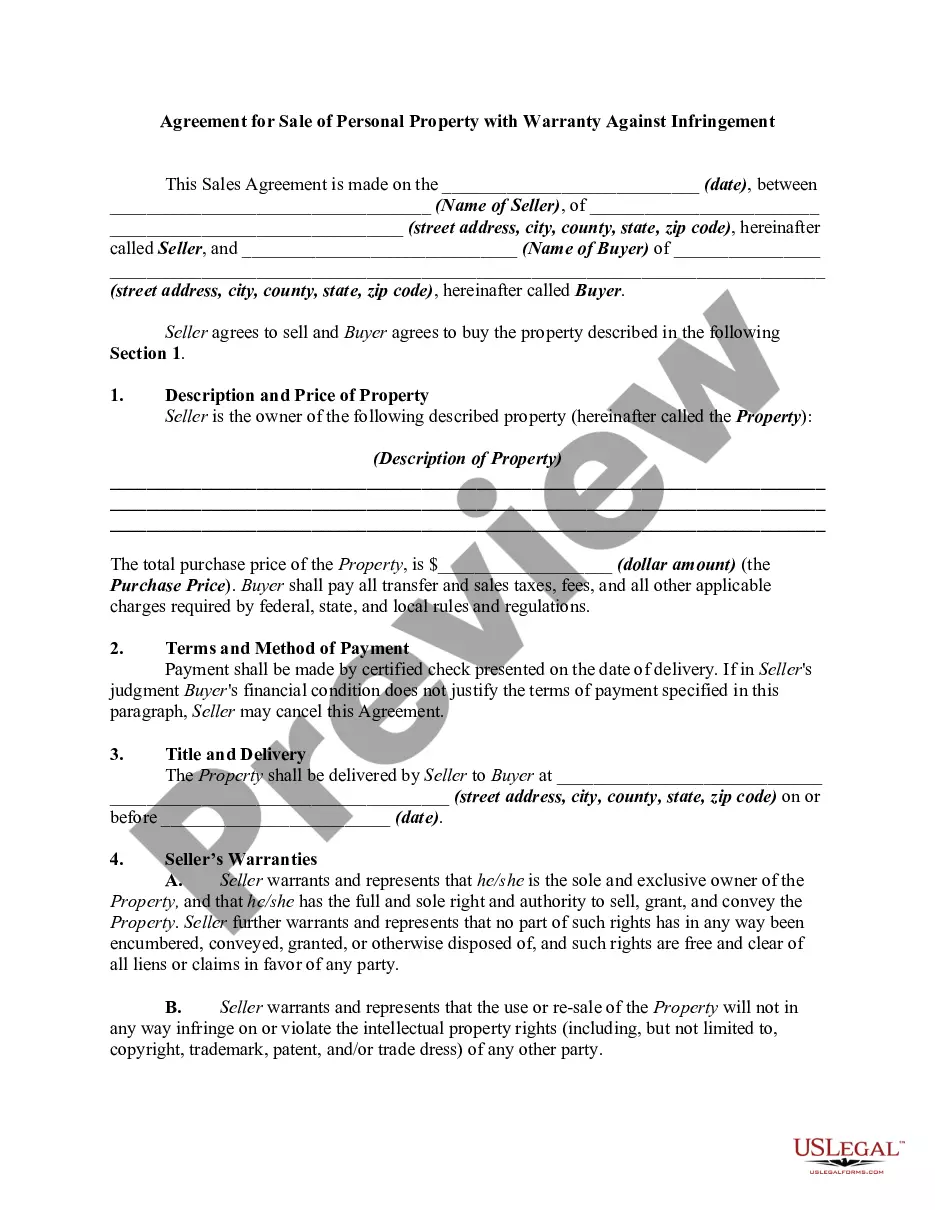
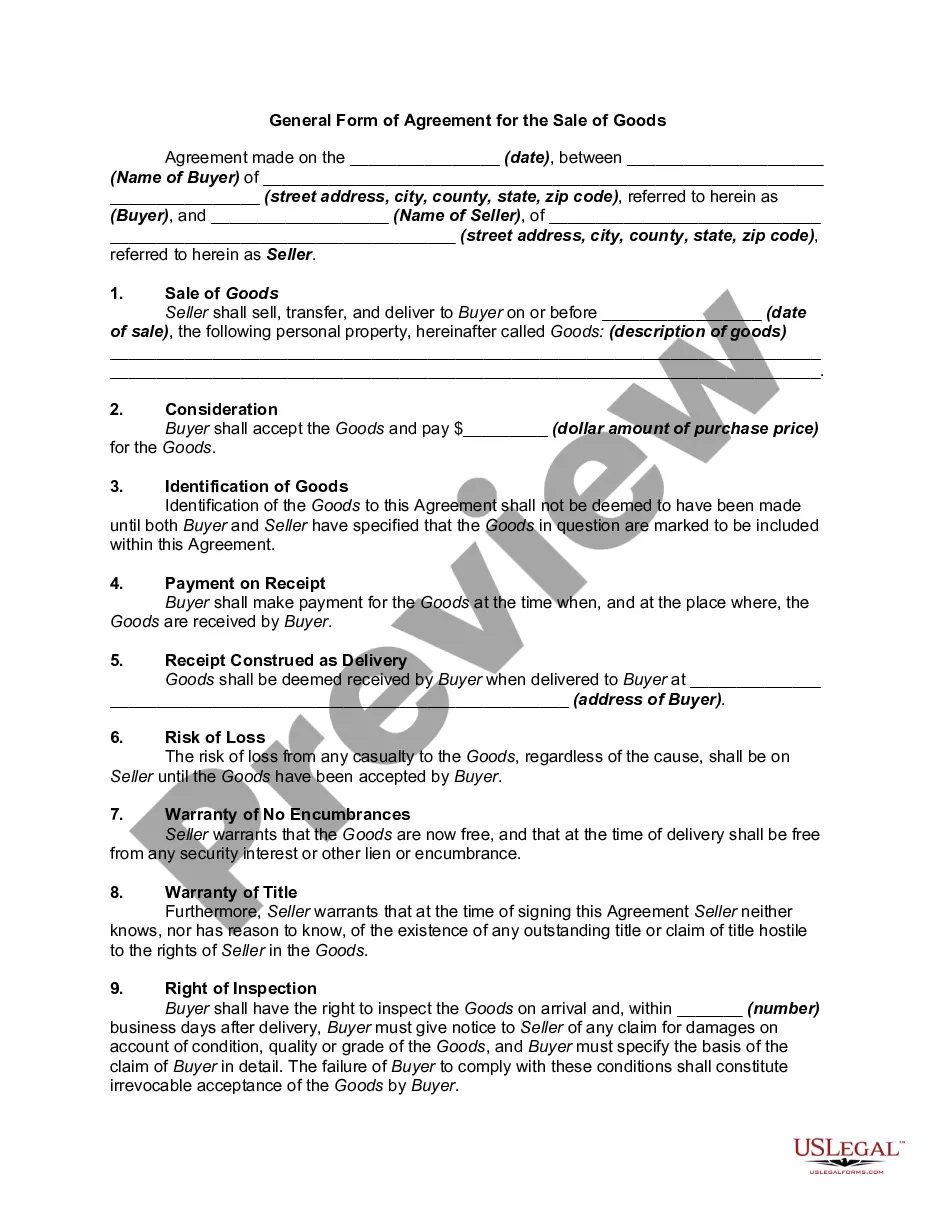
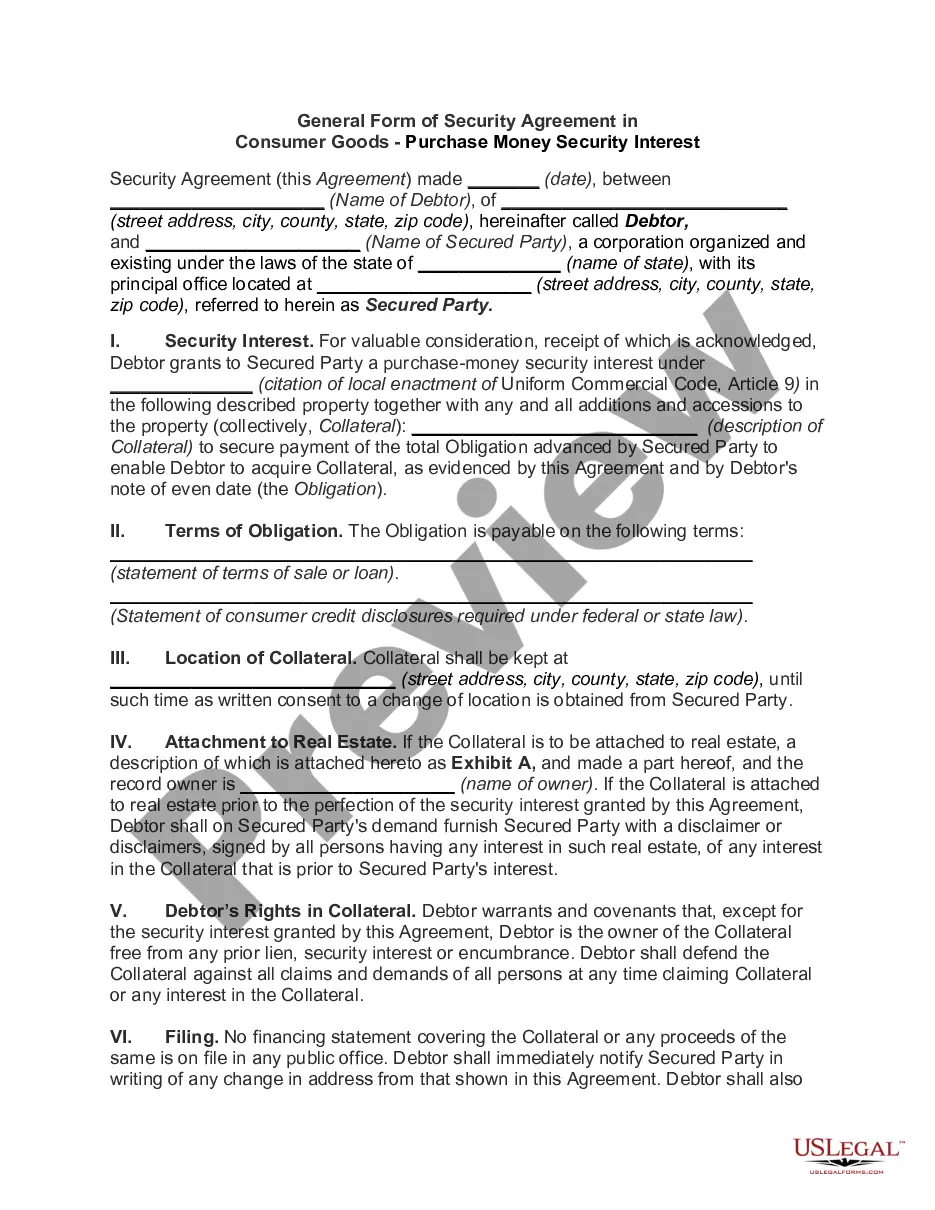
This General Form of Agreement for the Sale of Goods or Personal Property is a legally binding document that outlines the terms under which goods or personal property are sold. It details the obligations of both the seller and the buyer, including payment terms and delivery conditions. This form is essential for ensuring that both parties understand their rights and responsibilities, making it distinct from other simple purchase agreements that may not cover specific terms such as limitations on remedies for the buyer.
Key components of this form
- Identifies the buyer and seller, including their contact information.
- Specifies the goods being sold and their description.
- Outlines the warranty provided by the seller regarding the goods.
- Defines delivery terms, including the date and location for delivery.
- Details payment methods and timing for payment.
- Establishes limitations on the buyer's remedies in case of issues with the goods.
When this form is needed
This form should be used whenever a seller intends to sell goods or personal property to a buyer. It is particularly important in transactions where the parties want clarity around warranties, delivery terms, and limitations on liability. This document is suitable for individuals or businesses buying or selling goods under specific conditions, ensuring both parties are legally protected.
Who can use this document
This agreement is designed for:
- Individual sellers and buyers of goods or personal property.
- Business owners engaged in selling products to customers.
- Anyone needing a comprehensive document to outline the terms of a sale.
Completing this form step by step
- Identify the parties involved by entering their names and addresses at the beginning of the form.
- Specify the goods being sold, including quantity and detailed descriptions.
- Fill in the delivery address and expected date of delivery.
- Define payment terms, including the total price and payment method.
- Review and complete any clauses regarding warranties and limitations of liability.
Does this form need to be notarized?
In most cases, this form does not require notarization. However, some jurisdictions or signing circumstances might. US Legal Forms offers online notarization powered by Notarize, accessible 24/7 for a quick, remote process.
Get your form ready online
Our built-in tools help you complete, sign, share, and store your documents in one place.
Make edits, fill in missing information, and update formatting in US Legal Forms—just like you would in MS Word.
Download a copy, print it, send it by email, or mail it via USPS—whatever works best for your next step.
Sign and collect signatures with our SignNow integration. Send to multiple recipients, set reminders, and more. Go Premium to unlock E-Sign.
If this form requires notarization, complete it online through a secure video call—no need to meet a notary in person or wait for an appointment.
We protect your documents and personal data by following strict security and privacy standards.

Make edits, fill in missing information, and update formatting in US Legal Forms—just like you would in MS Word.

Download a copy, print it, send it by email, or mail it via USPS—whatever works best for your next step.

Sign and collect signatures with our SignNow integration. Send to multiple recipients, set reminders, and more. Go Premium to unlock E-Sign.

If this form requires notarization, complete it online through a secure video call—no need to meet a notary in person or wait for an appointment.

We protect your documents and personal data by following strict security and privacy standards.
Avoid these common issues
- Failing to include accurate descriptions of the goods.
- Omitting critical delivery dates or addresses.
- Neglecting to specify payment methods or terms clearly.
- Not addressing warranty limitations clearly in the agreement.
Advantages of online completion
- Convenient download and accessibility for immediate use.
- Editable fields allow for customization based on specific transaction details.
- Legal reliability, drafted by licensed attorneys, ensures compliance.
Looking for another form?

Form popularity
FAQ
Contract Types Overview. Express and Implied Contracts. Unilateral and Bilateral Contracts. Unconscionable Contracts. Adhesion Contracts. Aleatory Contracts. Option Contracts. Fixed Price Contracts.
The Uniform Commercial Code, or UCC, is a uniform act that covers sales and other commercial transactions.Article 2 is a vast segment of the UCC that specifically addresses contracts for the sale of goods. A good is any movable property identified at the time of the contract.
Article 2 of the UCC governs contracts for the sale of goods. A body of law based on tradition and president.
According to U.C.C. Section 2-201 , any contract for the sale of goods for the price of $500 or more must be in writing. There are, however, certain exceptions to this rule in which an oral contract for the sale of goods of $500 or more will be enforced.
Basically, the broad categories that are not covered are transactions involving the sale of real estate, transactions involving the sale of businesses (although other articles of the UCC can and will apply), and transactions involving "intangibles, such as goodwill, patents, trademarks, and copyrights."
Article 2 of the UCC deals with the sale of goods. Sale and goods have defined meanings. Article 2A of the UCC deals with the leasing of goods. Lease has a defined meaning, and the UCC recognizes two types of leases: consumer leases and finance leases.
UCC Corner: Introduction to Article 2Article 2 of the UCC (MCL 440.2101 et. seq.) governs the sale of goods. Article 2 is meant to provide default rules and gap-fillers that apply where two parties have not comprehensively addressed common issues in a written contract.
Goods: Article 2 of the UCC, which governs contracts, limits its application to contracts involving the sale and purchase of goods in the amount of $500 or more. Merchants: Generally speaking, the UCC applies to agreements in which at least one of the parties is a merchant as it defines that term.
Uniform Commercial Code Article 2 governs the sale of goods. It was part of the original Uniform Commercial Code approved in 1951. Article 2 represented a revision and modernization of the Uniform Sales Act, which was originally approved by the National Conference of Commissioners on Uniform State Laws in 1906.