Affidavit to Disqualify or Recuse Judge for Prejudice - Recusal or Removal
Overview of this form
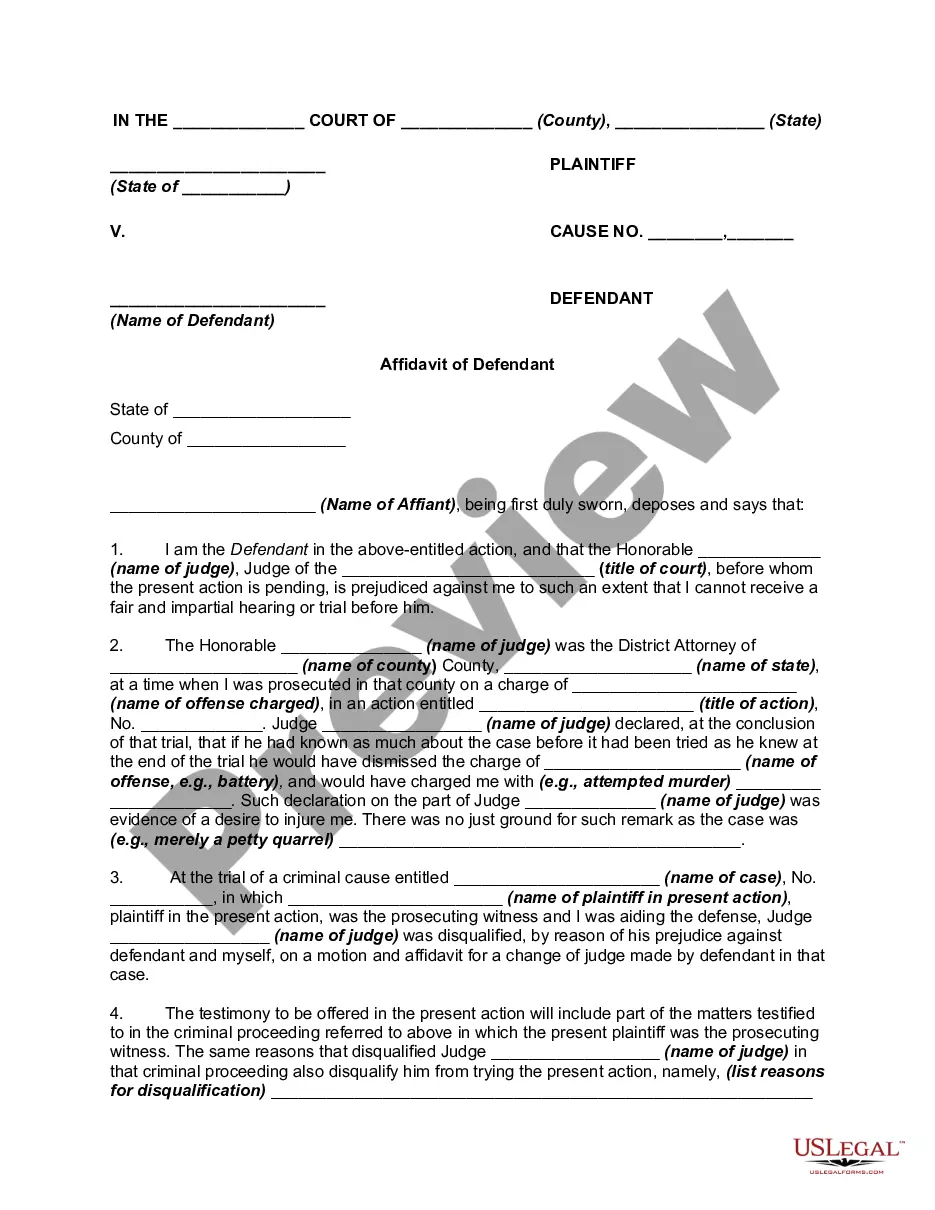
The Affidavit to Disqualify or Recuse Judge for Prejudice is a legal document used to request the disqualification of a judge due to personal bias or prejudice. This form is vital in ensuring that parties involved in legal proceedings receive a fair and impartial hearing. Unlike other legal forms, this affidavit specifically addresses instances of potential bias, allowing individuals to challenge a judge's involvement in their case for just cause.
Key components of this form
- Party identification: Clearly identifies the plaintiff, defendant, and the case number.
- Affiant details: Contains the name and signature of the party making the affidavit.
- Recusal grounds: Specific reasons for requesting the judge's disqualification based on prejudice or bias.
- Prior actions: References to any previous cases where the judge exhibited bias against the affiant.
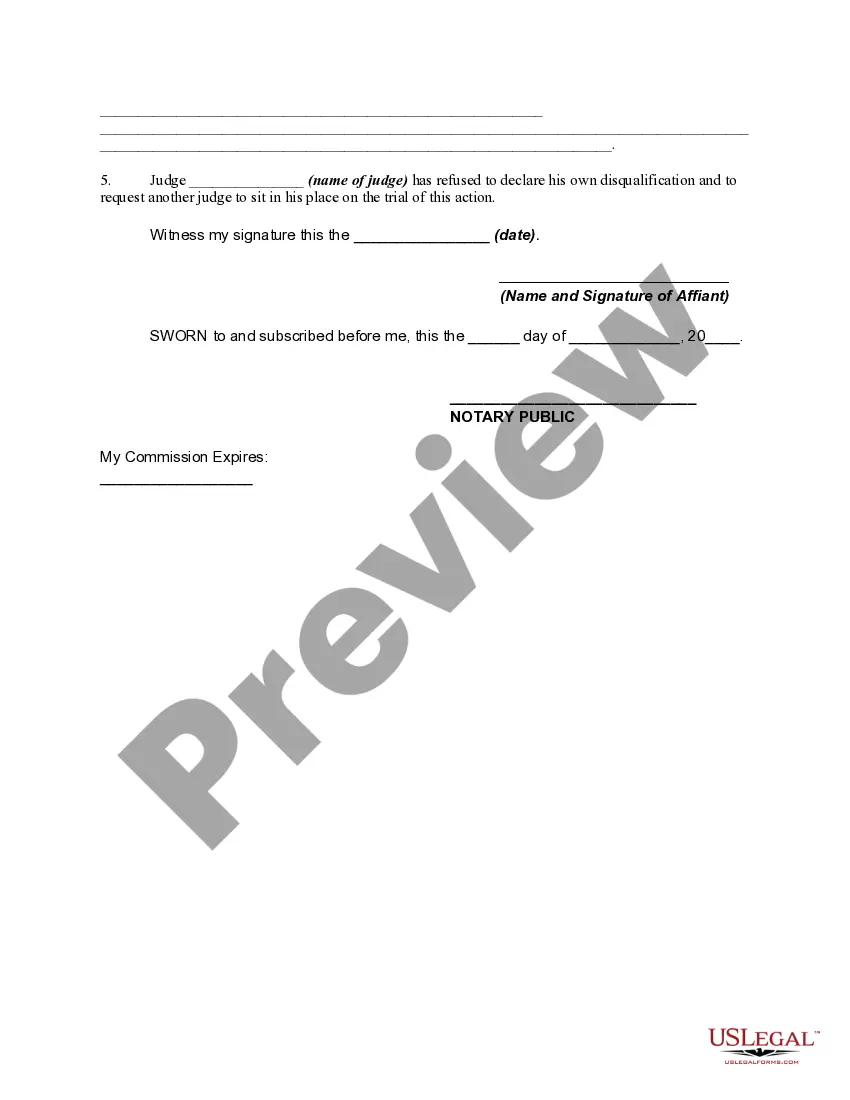
- Notarization section: For the jurat and signature of the notary public.
Common use cases
This form should be used when a party involved in a legal proceeding believes that the judge presiding over their case has a personal bias or conflict of interest. Examples include situations where the judge has prior knowledge of the case, has a financial interest in the outcome, or has served as an attorney for a party involved in the litigation. It is crucial to use this affidavit promptly to safeguard the right to an impartial trial.
Intended users of this form
- Defendants who believe the judge cannot render a fair decision due to personal bias.
- Parties involved in ongoing litigation facing a judge with a conflict of interest.
- Individuals seeking to protect their rights to a fair trial in civil or criminal cases.
Instructions for completing this form
- Identify all parties involved, including the plaintiff and defendant, and enter their names.
- Provide the title of the court and case number at the beginning of the affidavit.
- Clearly state the specific reasons for claiming the judge's prejudice in the designated sections.
- Include any relevant prior case references that support the request for disqualification.
- Sign the affidavit in front of a notary public to validate the document.
Notarization guidance
This form must be notarized to be legally valid. US Legal Forms provides secure online notarization powered by Notarize, allowing you to complete the process through a verified video call.
Get your form ready online
Our built-in tools help you complete, sign, share, and store your documents in one place.
Make edits, fill in missing information, and update formatting in US Legal Forms—just like you would in MS Word.
Download a copy, print it, send it by email, or mail it via USPS—whatever works best for your next step.
Sign and collect signatures with our SignNow integration. Send to multiple recipients, set reminders, and more. Go Premium to unlock E-Sign.
If this form requires notarization, complete it online through a secure video call—no need to meet a notary in person or wait for an appointment.
We protect your documents and personal data by following strict security and privacy standards.

Make edits, fill in missing information, and update formatting in US Legal Forms—just like you would in MS Word.

Download a copy, print it, send it by email, or mail it via USPS—whatever works best for your next step.

Sign and collect signatures with our SignNow integration. Send to multiple recipients, set reminders, and more. Go Premium to unlock E-Sign.

If this form requires notarization, complete it online through a secure video call—no need to meet a notary in person or wait for an appointment.

We protect your documents and personal data by following strict security and privacy standards.
Mistakes to watch out for
- Failing to provide specific examples of bias or prejudice.
- Not signing the affidavit before a notary public.
- Omitting necessary details about the previous cases or actions that illustrate the judge's bias.
Why use this form online
- Convenient access to legal forms from anywhere at any time.
- Editable documents that allow for quick personalization based on specific case details.
- Reliable templates drafted by licensed attorneys to ensure legal compliance.
Looking for another form?




Form popularity
FAQ
If the Judge makes a ruling in a court hearing that a guy feels is bias, then he should contact his attorney immediately to try to bring the matter back to court for a motion to set aside the order or appeal the ruling depending on the state's rules of civil procedure.
Supreme Court justices cannot be easily removed from office. The only conditions that can be grounds for their removal are proven misbehavior and incapacity to act as judge. Article 124 of the Constitution states that by an order of the President a Supreme Court justice can be removed from his or her office.
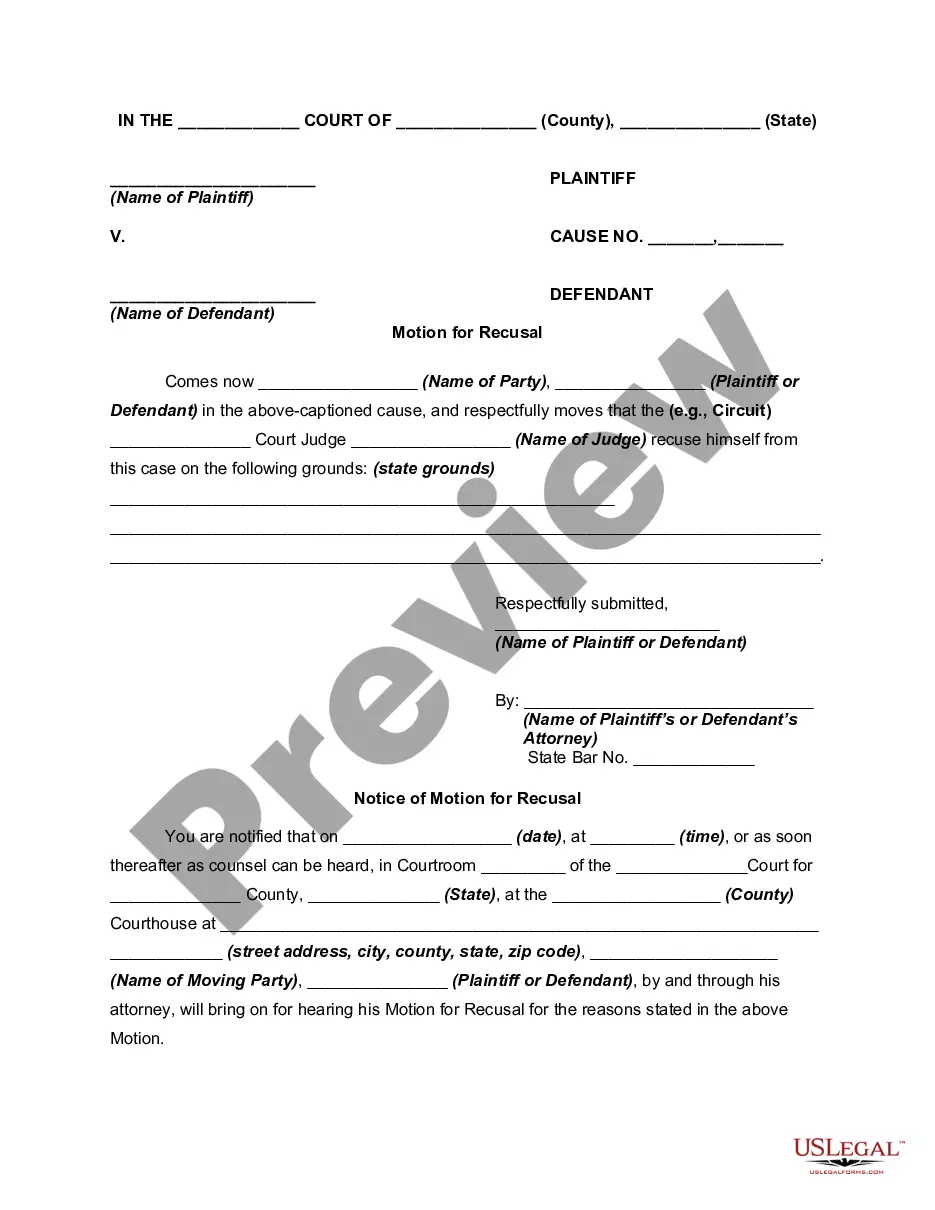
A motion to recuse is a legal motion filed in court that says a judge should be disqualified, or removed, from a legal case for a reason listed within CCP 170.1. The motion can be brought by either a prosecutor or a defense attorney.
If a judge declines recusal even though they were aware that proper grounds existed, then there may be significant repercussions. First, the result of the case can be reviewed by an appellate court, and an entirely new trial may be ordered.
You cannot appeal a court decision simply because you are unhappy with the outcome; you must have a legal ground to file the appeal. If the judge in your case made a mistake or abused his/her discretion, then you might have grounds to file an appeal.
Judicial disqualification, also referred to as recusal, is the act of abstaining from participation in an official action such as a legal proceeding due to a conflict of interest of the presiding court official or administrative officer.
Primary tabs. Judges recuse themselves when they take no part in deciding cases that they would otherwise help decide. The Due Process clauses of the United States Constitution requires judges to recuse themselves from cases in two situations: Where the judge has a financial interest in the case's outcome.
A judge asked to disqualify himself or herself may need to apply the fair-minded observer test in respect of the evidence, in other words, unless the hypothetical observer would reject the evidence as entirely implausible the judge should consider whether, if accepted, it had the relevant quality to raise a reasonable
In writing, Allege specifically the facts and reason for disqualification, and. Be sworn to the party by signing the motion under oath or by a separate affidavit.