Declaration of Authenticity of Copy of Lost Will When Original Will is Lost - Lost Will
Overview of this form
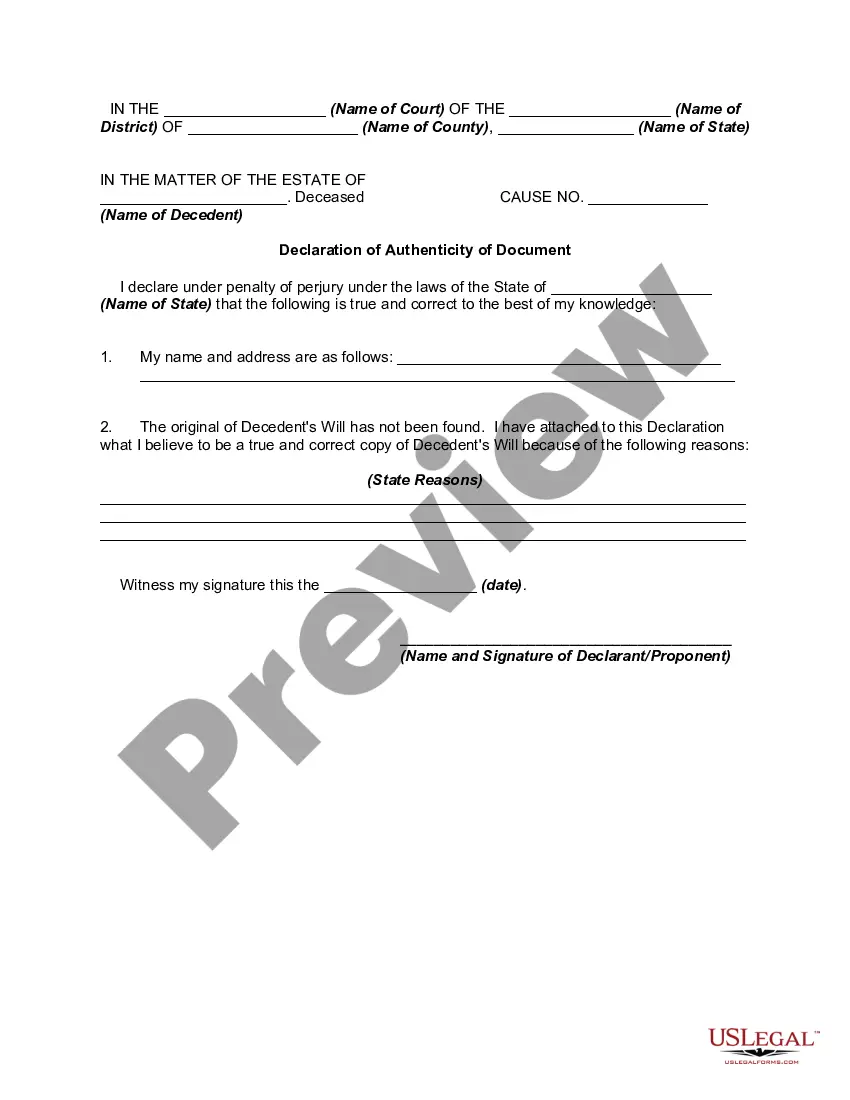
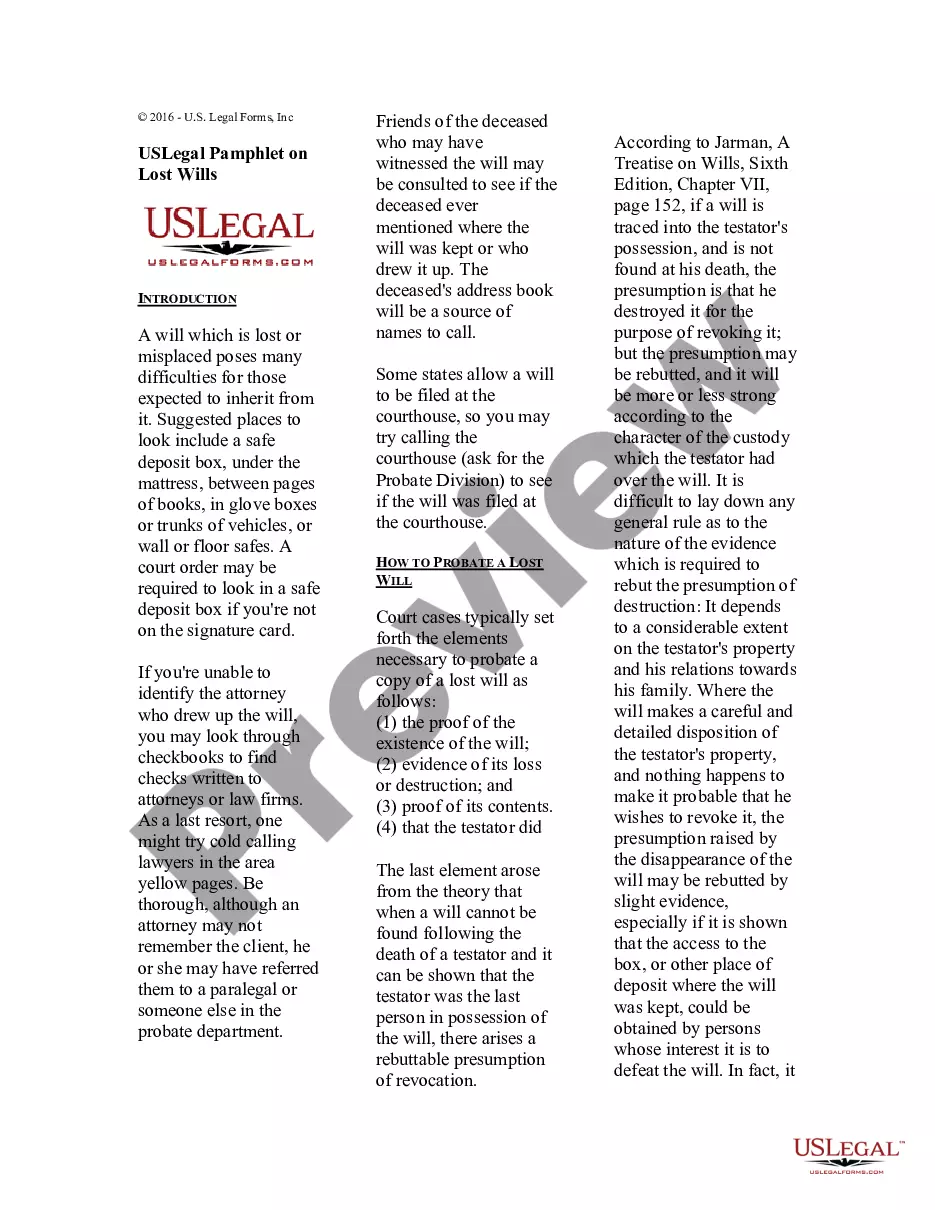
The Declaration of Authenticity of Copy of Lost Will is a legal document that allows an individual to declare the authenticity of a copy of a will when the original document is lost. This form is essential in probate cases where a lost or destroyed will needs to be proven. It serves to validate the contents of a will based on supporting evidence, distinguishing itself from other forms commonly used in the estate planning process.
Main sections of this form
- Declarant's name and address
- Statement about the original will's status (lost or destroyed)
- Reasons for believing the attached copy is authentic
- Signature of the declarant
- Date of declaration
When to use this form
This form should be used when the original will of a deceased individual cannot be found, but there exists a copy that is believed to be valid. You may need this document to initiate probate proceedings or to settle an estate in cases where the will's authenticity must be established for legal purposes.
Who should use this form
- Executors or administrators of an estate
- Beneficiaries seeking to validate a lost will
- Legal representatives involved in probate cases
Steps to complete this form
- Identify the declarant by providing their name and address.
- Clearly state that the original will is missing.
- Attach the believed authentic copy of the will.
- Provide reasons for believing the copy is credible.
- Sign and date the declaration to affirm its accuracy.
Is notarization required?
In most cases, this form does not require notarization. However, some jurisdictions or signing circumstances might. US Legal Forms offers online notarization powered by Notarize, accessible 24/7 for a quick, remote process.
Get your form ready online
Our built-in tools help you complete, sign, share, and store your documents in one place.
Make edits, fill in missing information, and update formatting in US Legal Forms—just like you would in MS Word.
Download a copy, print it, send it by email, or mail it via USPS—whatever works best for your next step.
Sign and collect signatures with our SignNow integration. Send to multiple recipients, set reminders, and more. Go Premium to unlock E-Sign.
If this form requires notarization, complete it online through a secure video call—no need to meet a notary in person or wait for an appointment.
We protect your documents and personal data by following strict security and privacy standards.

Make edits, fill in missing information, and update formatting in US Legal Forms—just like you would in MS Word.

Download a copy, print it, send it by email, or mail it via USPS—whatever works best for your next step.

Sign and collect signatures with our SignNow integration. Send to multiple recipients, set reminders, and more. Go Premium to unlock E-Sign.

If this form requires notarization, complete it online through a secure video call—no need to meet a notary in person or wait for an appointment.

We protect your documents and personal data by following strict security and privacy standards.
Typical mistakes to avoid
- Failing to include reasons for believing the copy is authentic.
- Not providing accurate contact information of the declarant.
- Neglecting to sign and date the declaration.
- Using an outdated or incorrect version of the form.
Why complete this form online
- Convenience: Download and complete the form at your own pace.
- Editability: Easily modify your declaration for accuracy.
- Reliability: Ensure compliance with updated legal standards.
Legal use & context
- This form acts as a declaration when the original will cannot be found, focusing on proving the authenticity of a copy.
- It is important for ensuring that the decedent's wishes are honored in the probate process.
- Using this form effectively helps to prevent potential disputes among heirs or beneficiaries.
Looking for another form?










Form popularity
FAQ
It is a legal document that lets a person declare that a copy of a will is authentic when the original will is lost, enabling probate for the deceased person. It is used when the original cannot be located. The form requires the declarant’s name and address, a statement that the original is lost, reasons supporting the copy’s authenticity, a signature, and the date.
If you have only a copy, you can use this Declaration to attest that the copy is authentic for probate purposes, since the original will is missing. The form requires the declarant’s name and address, a statement that the original is lost, reasons supporting the copy’s authenticity, a signature, and the date—often filed with probate filings.
This form does not prove how to tell an original from a copy; instead, it provides a declaration that the attached copy is authentic for probate when the original is missing. The declarant explains why the copy is believed to reflect the original, helping establish the copy’s reliability for probate filings.
If the original will cannot be found, this form is used to declare the attached copy authentic for probate. It requires the declarant’s name and address, a statement that the original is lost, the reasons the copy is believed authentic, along with a signature and date, to support probate proceedings.
To confirm authenticity of a will copy, use this declaration form. It requires the declarant’s name and address, a statement that the original is lost, reasons supporting the copy’s authenticity, the declarant’s signature, and the date. It is designed for executors, administrators, or legal representatives in probate to establish the copy’s reliability.
This form specifically attests that the attached copy is authentic when the original will is lost, focusing on the copy’s reliability rather than simply noting the loss. It requires the declarant’s name and address, a statement that the original is lost, and reasons the copy is authentic, plus a signature and date, to support probate.