Agreement Between Professional Corporation and Non-Profit Corporation to Treat People who cannot Afford Healthcare
What is this form?
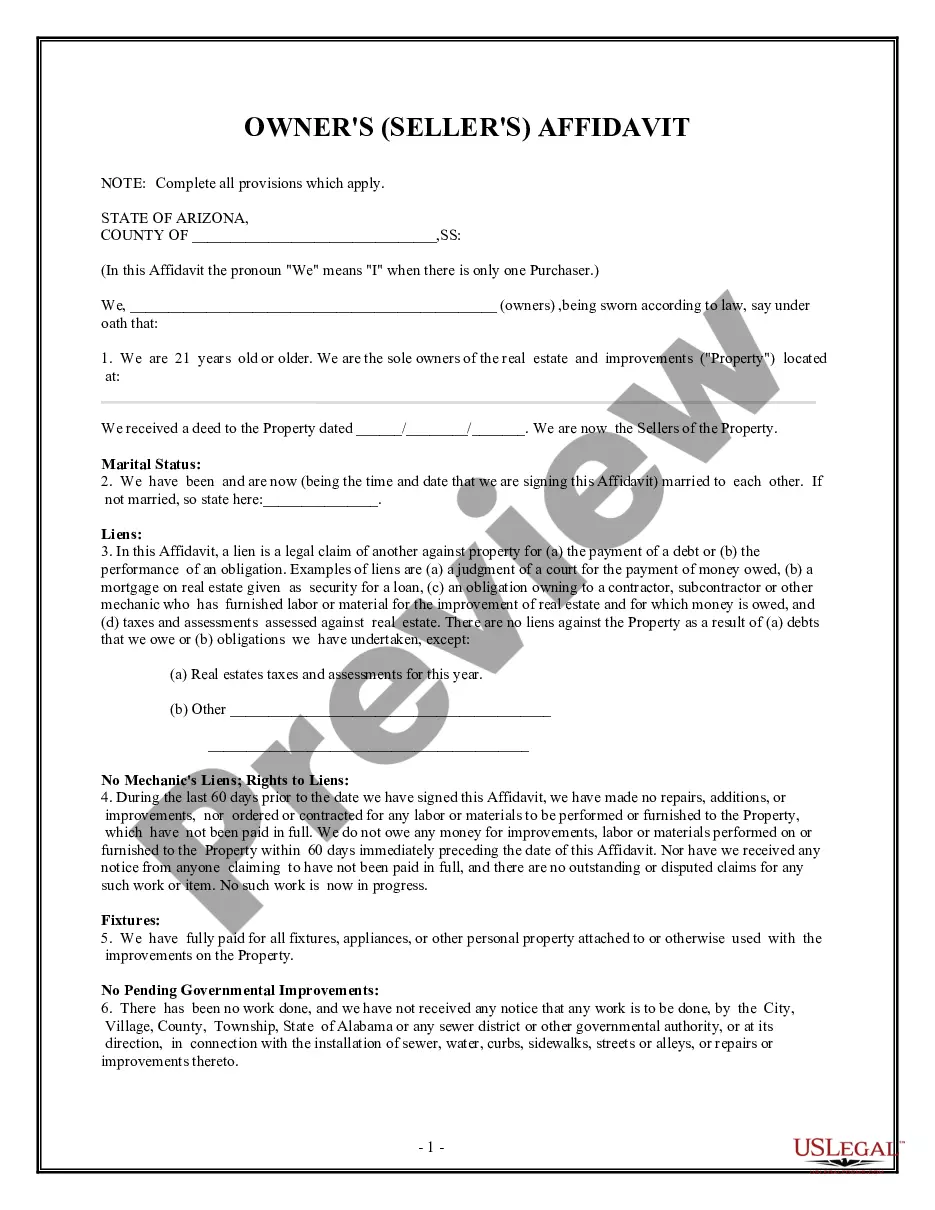
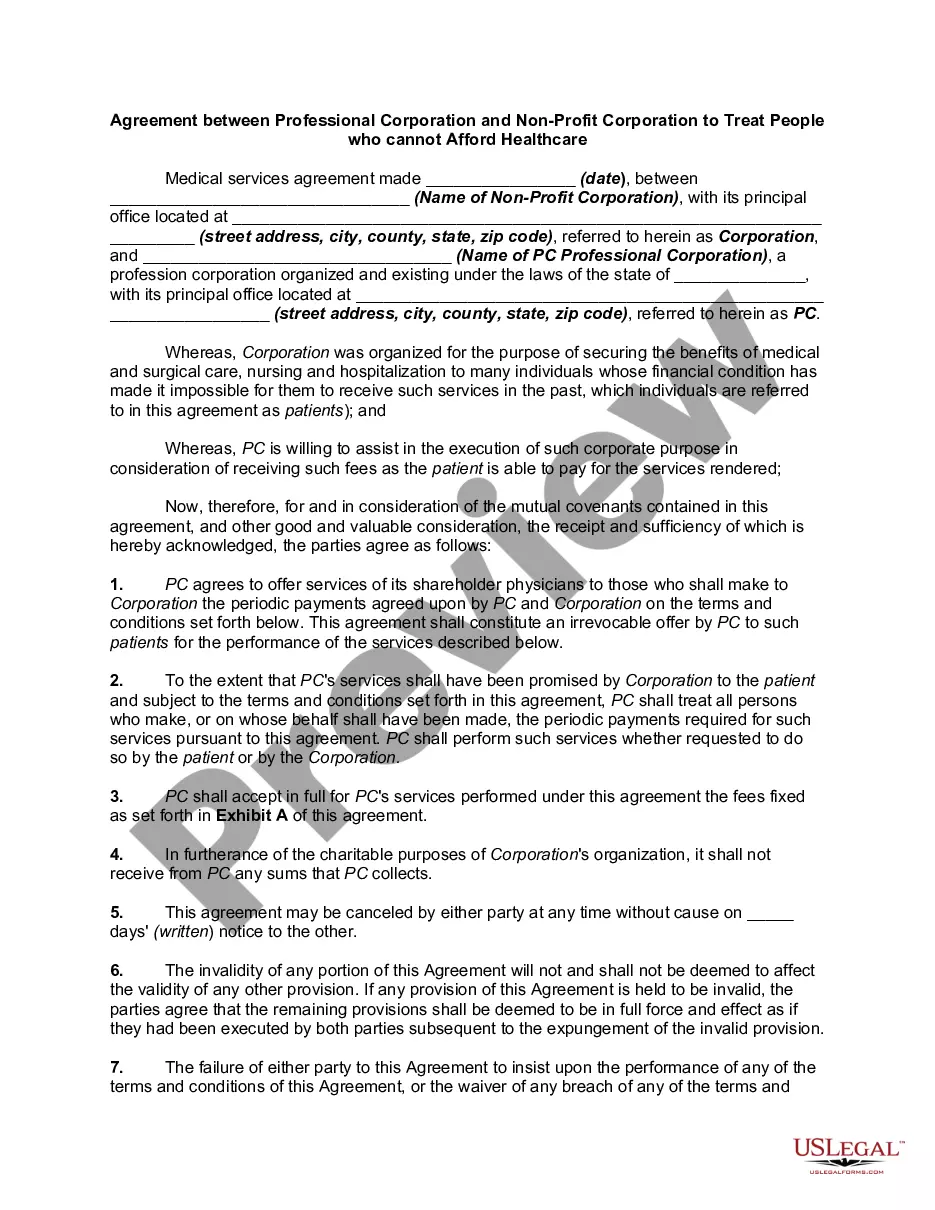
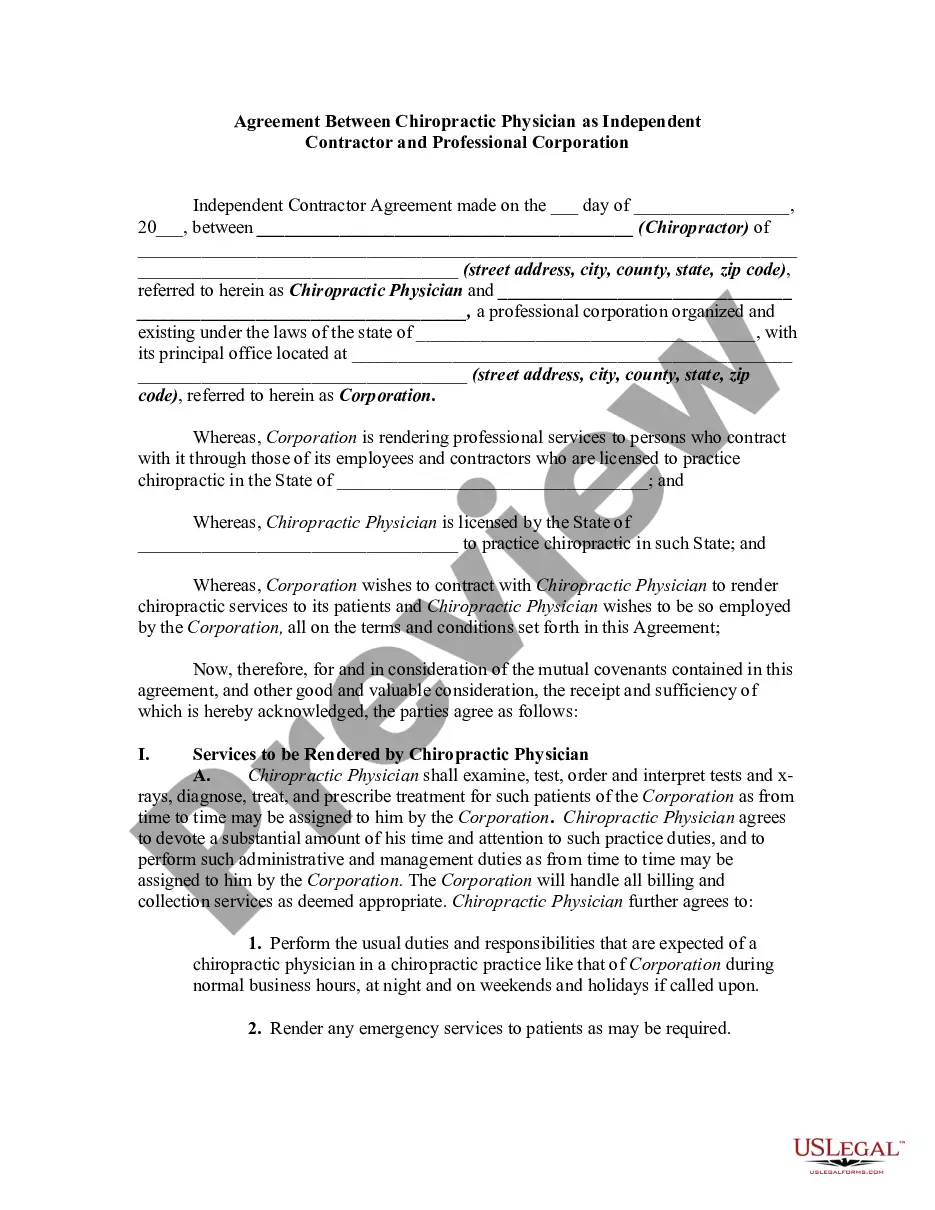
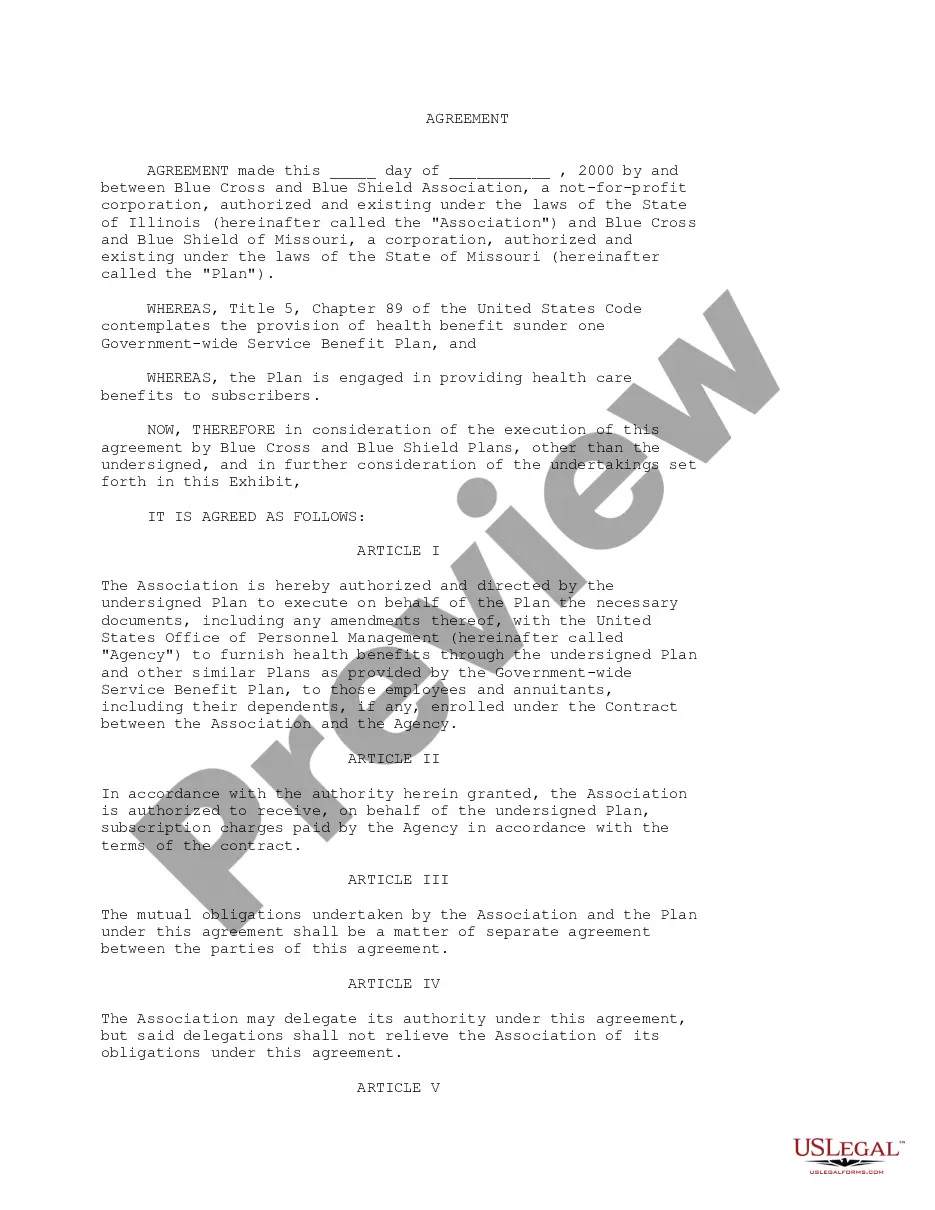
This Agreement Between Professional Corporation and Non-Profit Corporation to Treat People who cannot Afford Healthcare is a legal document that establishes a partnership between a professional corporation and a non-profit organization. This agreement outlines the responsibilities of both parties in providing medical services to individuals who cannot afford healthcare. Unlike general medical service agreements, this form specifically addresses the arrangement between a non-profit and a professional medical provider, ensuring that patients receive necessary care regardless of financial status.
Key components of this form
- Date of the agreement and identification of parties involved.
- Purpose of the non-profit corporation in providing healthcare services.
- Terms regarding the services offered by the professional corporation.
- Fee structure based on what patients can afford.
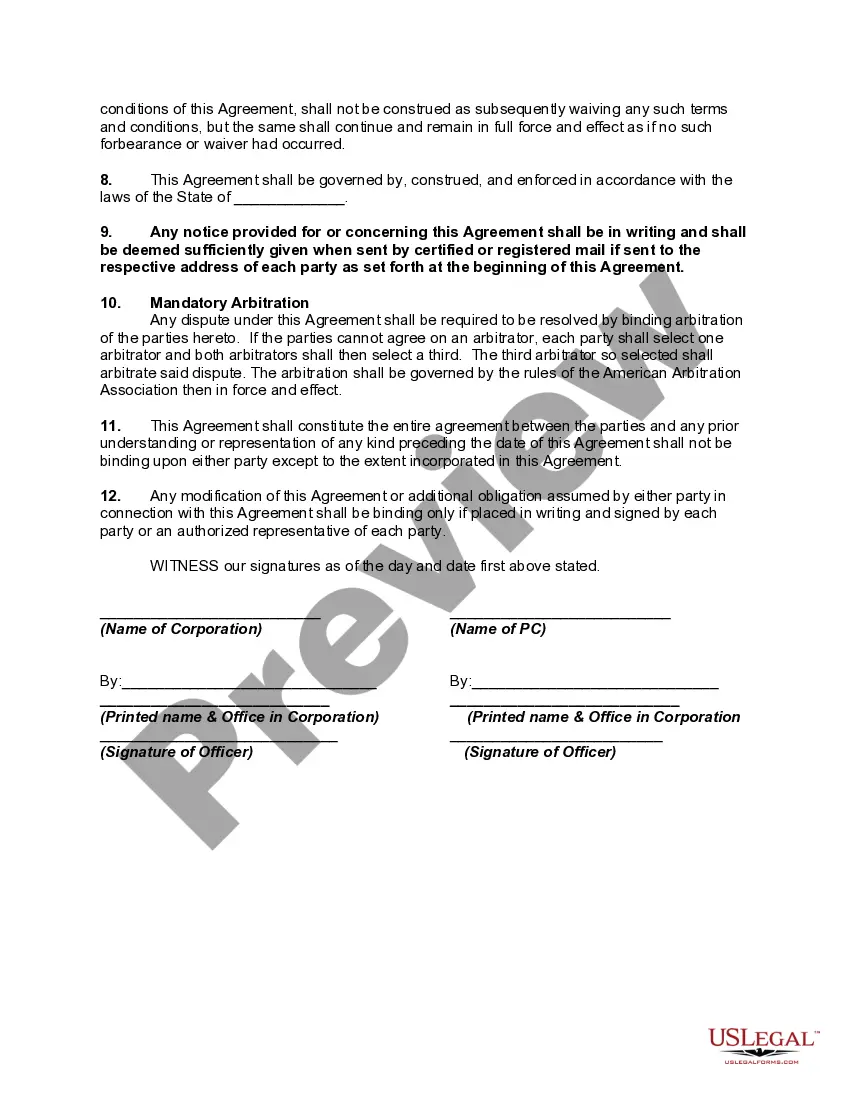
- Cancellation provisions for either party.
- Governing law and arbitration procedures in case of disputes.
When this form is needed
This agreement should be used when a professional corporation and a non-profit organization collaborate to provide healthcare services to patients who otherwise could not afford such services. It is particularly relevant for agreements that aim to enhance community health initiatives or charity programs focused on low-income individuals.
Who this form is for
- Non-profit organizations aiming to expand healthcare access for financially challenged individuals.
- Professional medical corporations looking to partner with non-profits for social responsibility initiatives.
- Healthcare administrators seeking to formalize an arrangement that ensures services are provided to underserved populations.
How to prepare this document
- Identify the parties involved by entering the names and addresses of the non-profit corporation and the professional corporation.
- Specify the date of the agreement.
- Outline the scope of services to be offered by the professional corporation.
- Detail the fee structure and payment terms that patients can manage.
- Include cancellation terms and the governing law that applies to the agreement.
- Ensure all necessary signatures are obtained from authorized representatives of both parties.
Notarization requirements for this form
This form usually doesn’t need to be notarized. However, local laws or specific transactions may require it. Our online notarization service, powered by Notarize, lets you complete it remotely through a secure video session, available 24/7.
Get your form ready online
Our built-in tools help you complete, sign, share, and store your documents in one place.
Make edits, fill in missing information, and update formatting in US Legal Forms—just like you would in MS Word.
Download a copy, print it, send it by email, or mail it via USPS—whatever works best for your next step.
Sign and collect signatures with our SignNow integration. Send to multiple recipients, set reminders, and more. Go Premium to unlock E-Sign.
If this form requires notarization, complete it online through a secure video call—no need to meet a notary in person or wait for an appointment.
We protect your documents and personal data by following strict security and privacy standards.

Make edits, fill in missing information, and update formatting in US Legal Forms—just like you would in MS Word.

Download a copy, print it, send it by email, or mail it via USPS—whatever works best for your next step.

Sign and collect signatures with our SignNow integration. Send to multiple recipients, set reminders, and more. Go Premium to unlock E-Sign.

If this form requires notarization, complete it online through a secure video call—no need to meet a notary in person or wait for an appointment.

We protect your documents and personal data by following strict security and privacy standards.
Common mistakes
- Failing to include complete addresses for both parties.
- Not specifying the exact nature of healthcare services to be provided.
- Overlooking the notice requirements for cancellation.
- Not ensuring that all necessary parties sign the document.
Benefits of using this form online
- Convenience of downloading the agreement at any time.
- Editability to tailor the terms specifically to your healthcare partnership needs.
- Reliable legal framework drafted by licensed attorneys for your peace of mind.
Legal use & context
- This agreement is legally binding and sets forth the obligations of both parties.
- It serves to protect the rights of both the healthcare providers and the patients.
- Parties involved should ensure that the terms comply with applicable healthcare regulations and charity laws.
Quick recap
- Establishes a formal partnership for healthcare delivery to financially challenged patients.
- Details the services and fees, ensuring clarity for both parties.
- Includes important legal stipulations for seamless cooperation and dispute resolution.
Looking for another form?

Form popularity
FAQ
Although not explicitly included in Section 501(c)(3) or in the accompanying regulations, the IRS has historically allowed physician professional corporations that have been formed in states that adhere to the corporate practice of medicine proscription to qualify as a tax-exempt organization under Section 501(c)(3).
For LLCs that document is your operating agreement. For Corporations, Social Purpose Corporations, Benefit Corporations, and Nonprofit Corporations, that document is your bylaws. The operating agreement of an LLC is the contract entered into between all of the members (aka owners) of the LLC.
The Rescue Plan further states that a nonprofit organization (defined in the original CARES Act as a 501(c)(3) organization and exempt from taxation under section 501(a) of the Internal Revenue Code) is eligible to receive a PPP if the organization employs not more than 500 employees per physical location of the
Exemption Requirements - 501(c)(3) Organizations To be tax-exempt under section 501(c)(3) of the Internal Revenue Code, an organization must be organized and operated exclusively for exempt purposes set forth in section 501(c)(3), and none of its earnings may inure to any private shareholder or individual.
The CARES Act establishes emergency loans for eligible businesses including nonprofit organizations. However, this provision is limited only to charitable organizations exempt from tax under Section 501(c)(3) of the Internal Revenue Code.
Private benefit. Nonprofits are not allowed to urge their members to support or oppose legislation. Political campaign activity. Unrelated business income. Annual reporting obligation. Operate in accord with stated nonprofit purposes.
Like the Constitution, your bylaws should deal with only the highest level of governing issues such as: Organizational purpose, board structure, officer position descriptions and responsibilities, terms of board service, officer/board member succession and removal, official meeting requirements, membership provisions,
Basic Rules for Non-Profit OrganizationsNon-profit entities must keep good records. They must record meetings of minutes and set up a separate bank account. All profits must be used in the organization's work and non-profit organizations are not allowed to distribute profits to members for any reason.
That can include private benefit, inurement, lobbying, political campaign activity, excessive unrelated business income, not filing an annual 990 tax information form, and failing to achieve its original purpose.