Boundary Line Agreement to Cure an Encroachment
Overview of this form
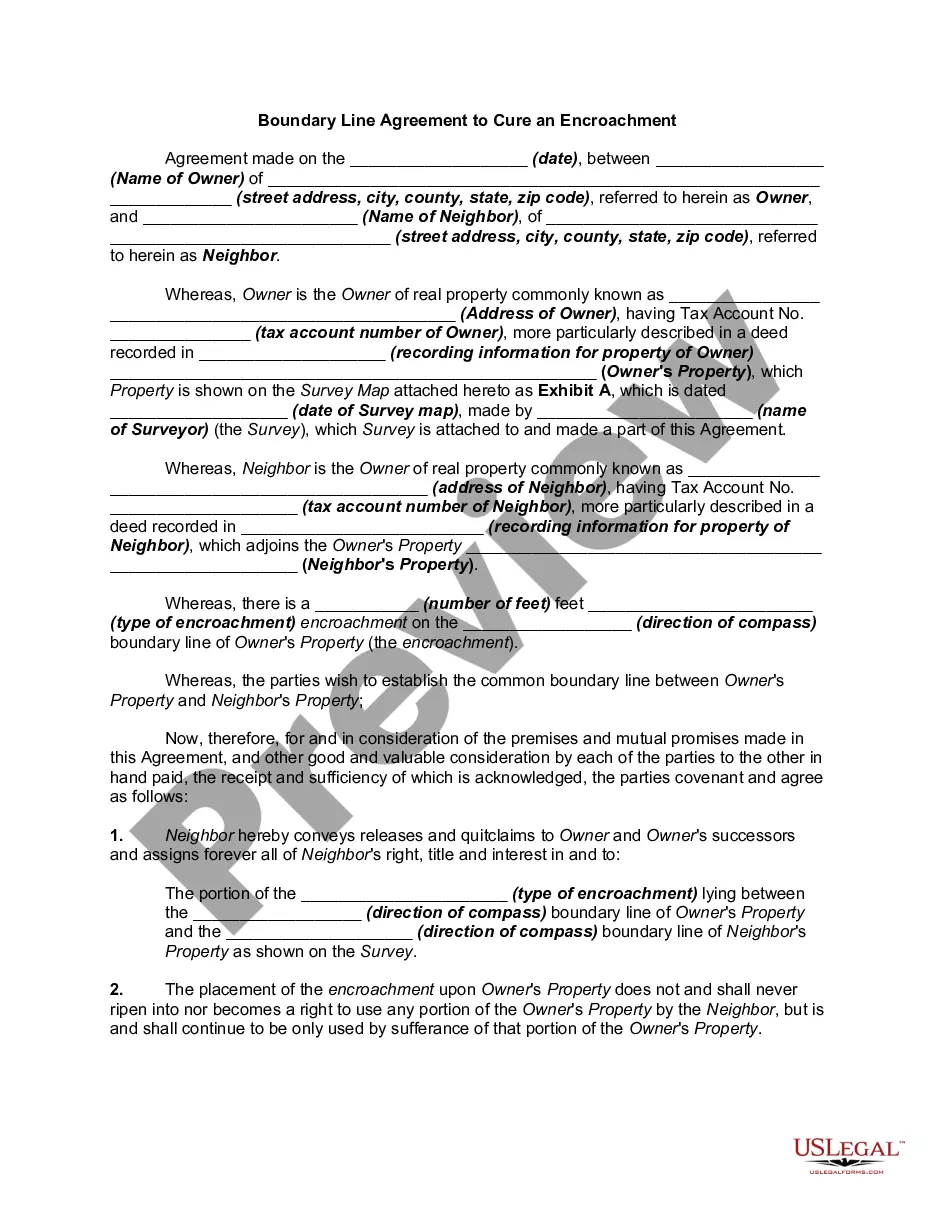
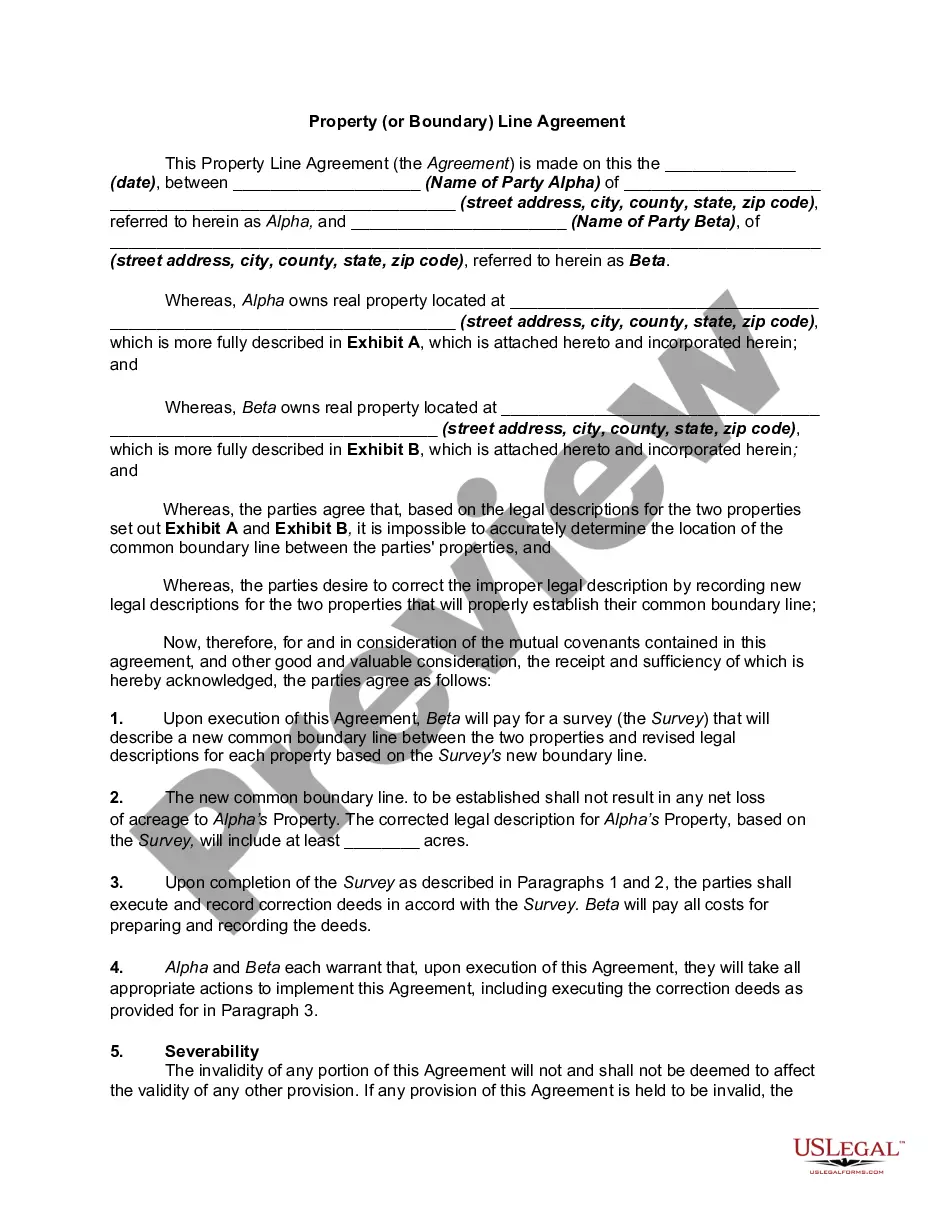
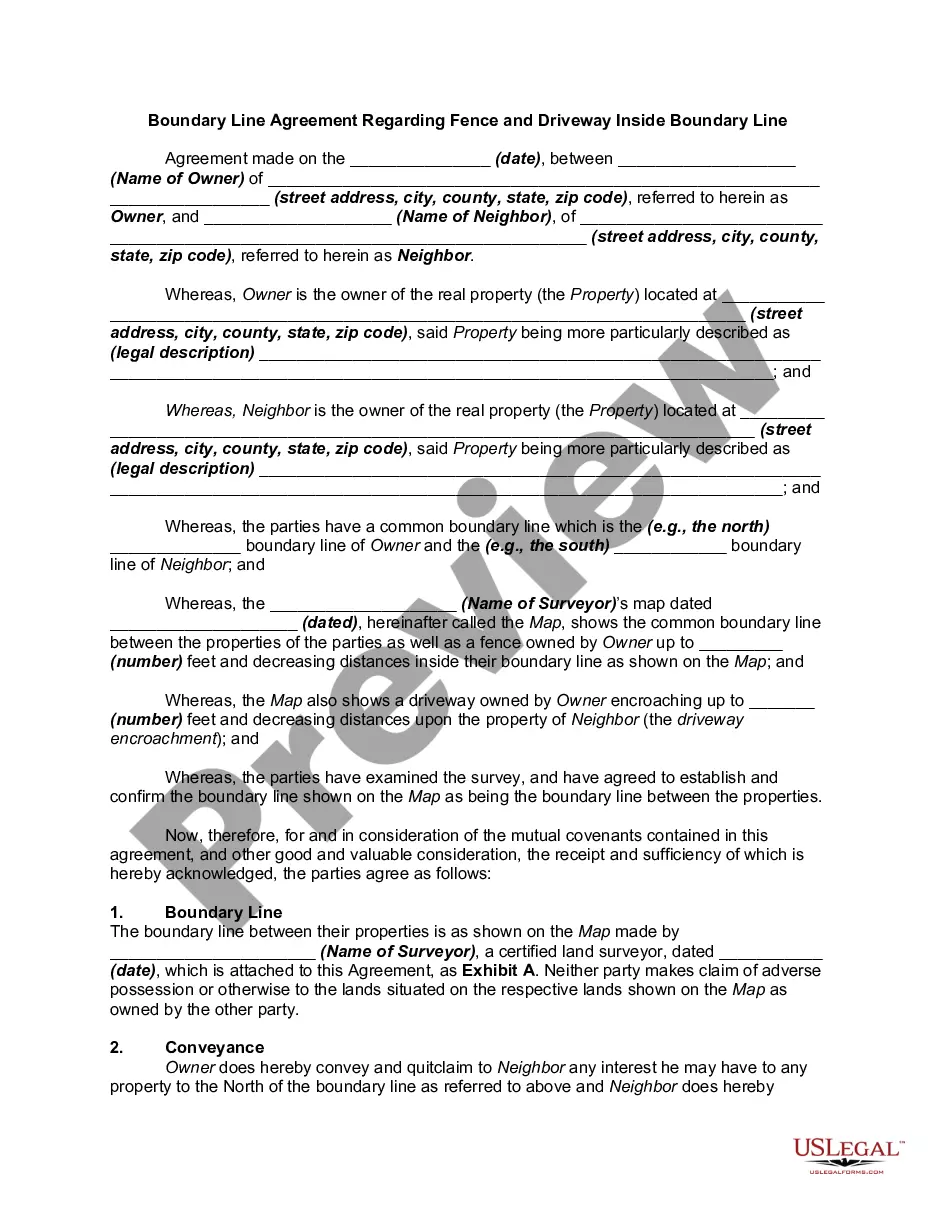
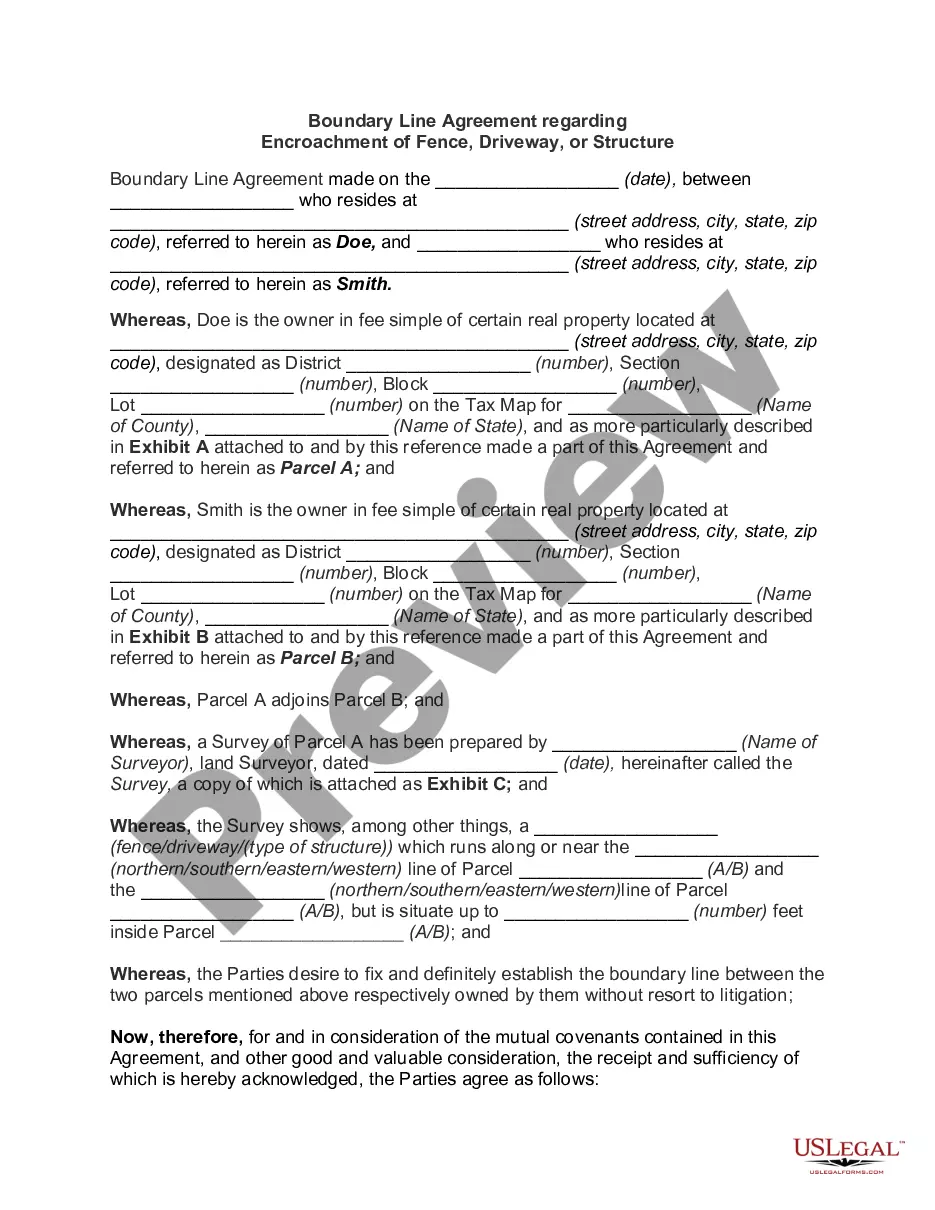
The Boundary Line Agreement to Cure an Encroachment is a legal document used to define the boundaries between two adjacent properties when one property has an encroachment on the other. This agreement clarifies ownership rights, allowing the encroaching party to maintain their structure while also protecting the rights of the property owner. It differs from other boundary agreements by specifically addressing the issue of encroachments and providing a path to resolve potential disputes amicably.
Main sections of this form
- Date of the agreement
- Name and address of the property owner
- Name and address of the neighbor
- Description of the encroachment, including its type and location
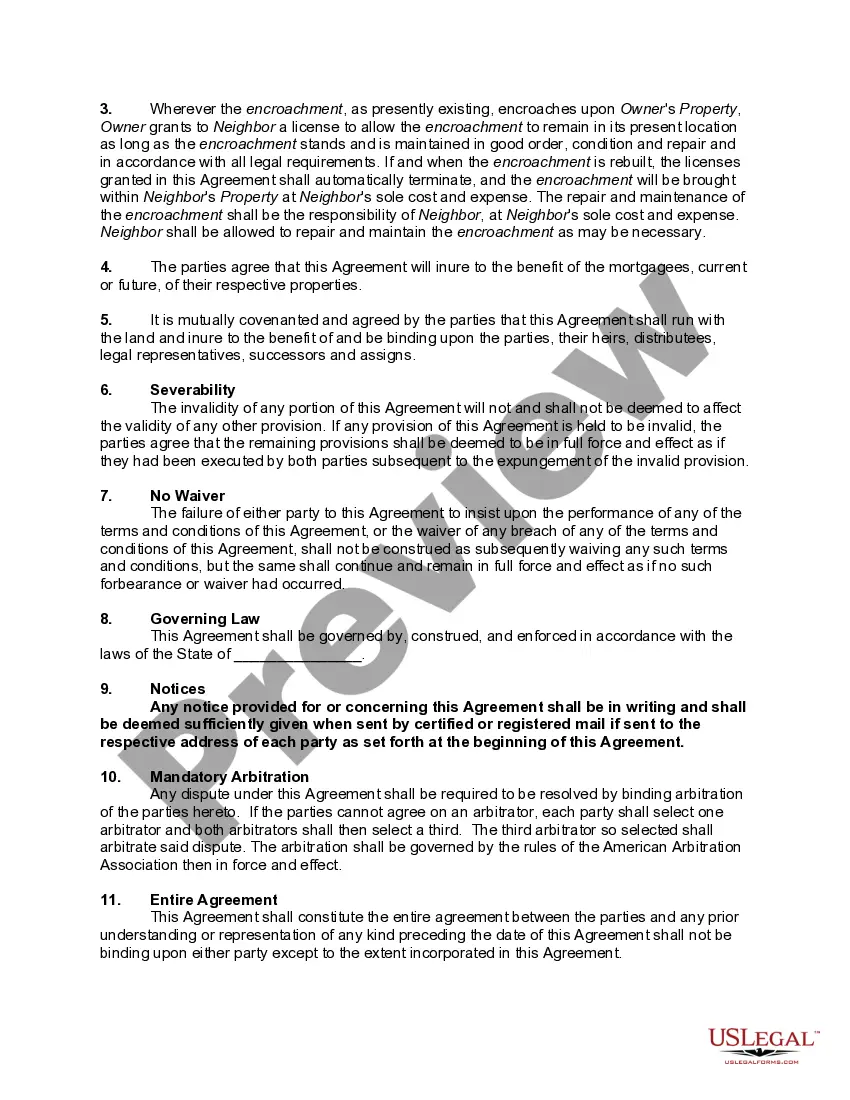
- Severability and waiver clauses
- Governing law and dispute resolution via arbitration
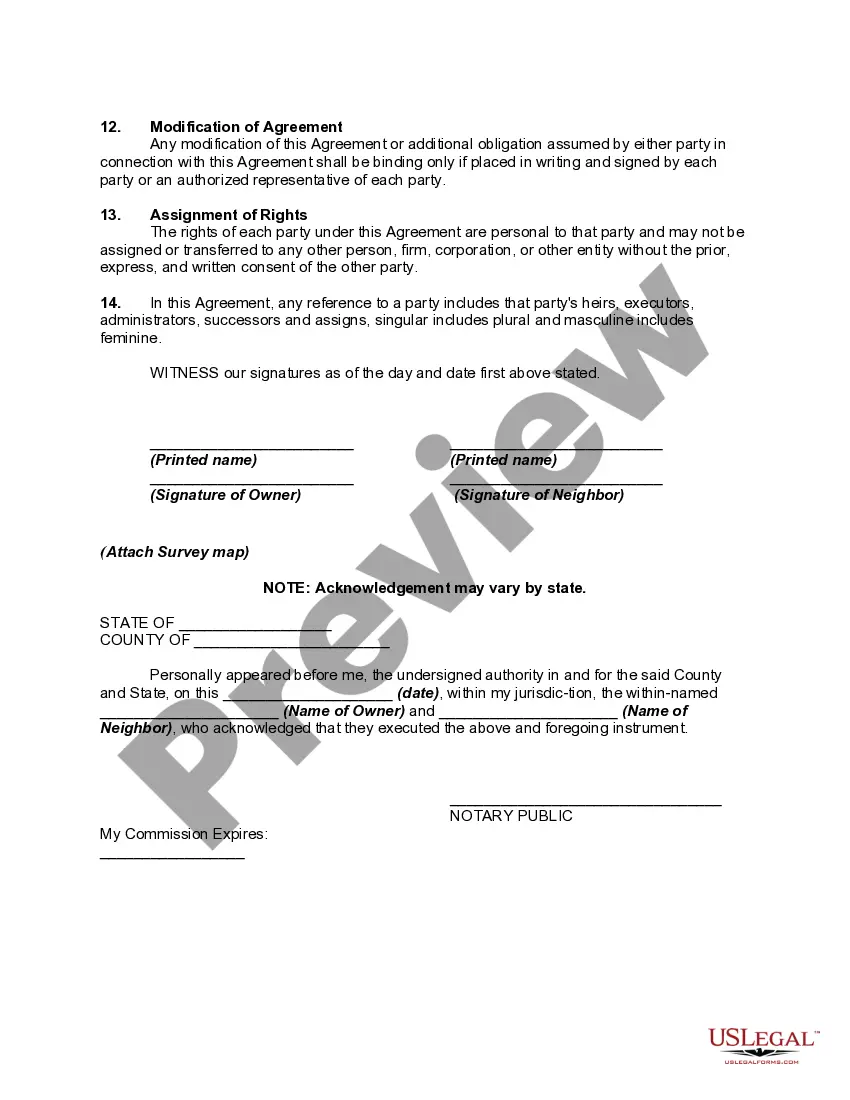
- Signature and notarization sections for both parties

Situations where this form applies
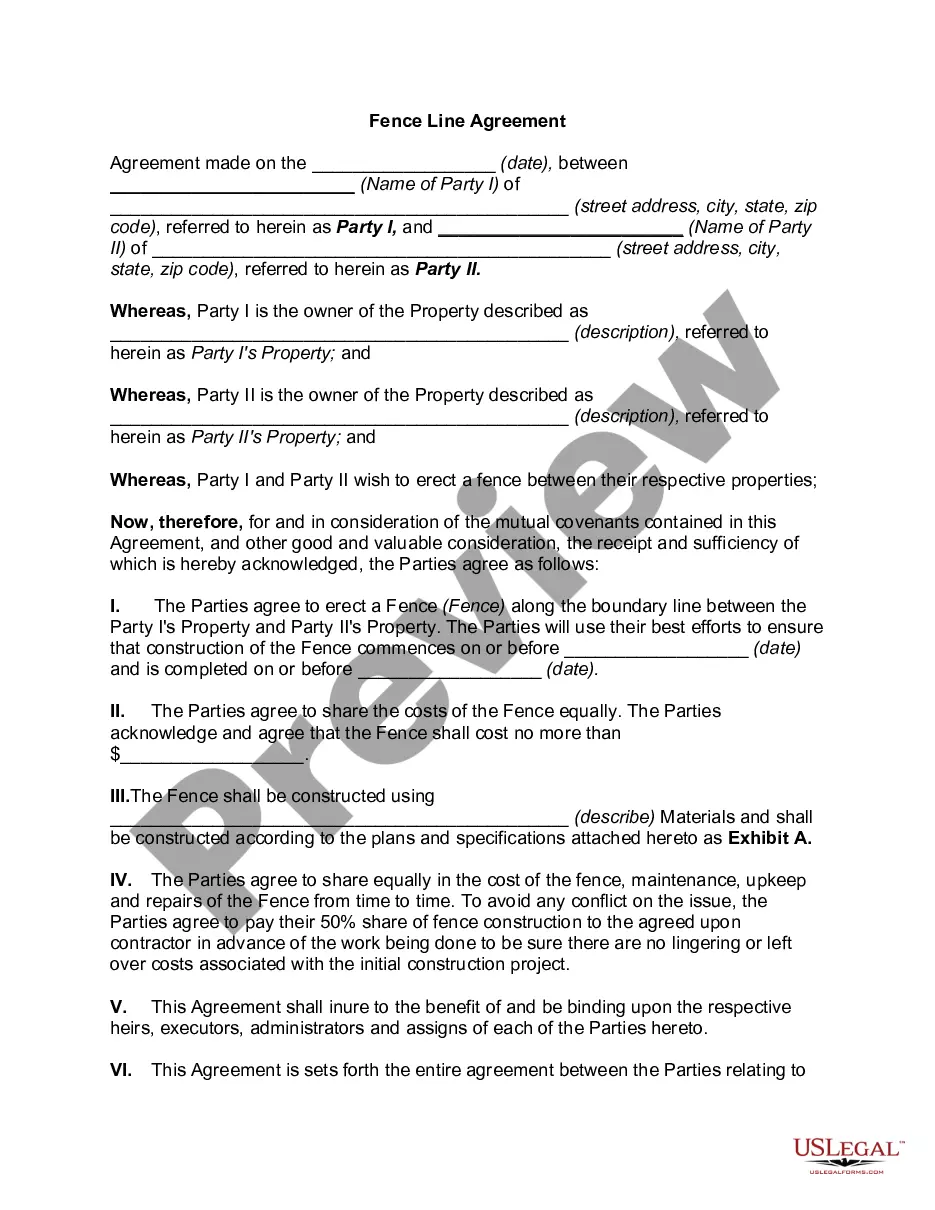
This form should be used when there is an encroachment from one property onto another, such as when a fence, tree, or building partially crosses property lines. It is essential in situations where neighbors wish to clarify property boundaries, protect property rights, and prevent future disputes regarding the use of the land.
Who should use this form
- Property owners with adjacent lands experiencing encroachments
- Neighbors seeking to formalize boundary agreements
- Real estate professionals handling disputes over property lines
- Homeowners looking for a clear understanding of property rights
Steps to complete this form
- Identify and enter the date of the agreement.
- Specify the names and addresses of both the property owner and neighbor.
- Describe the property locations, including tax account numbers and any relevant deed information.
- Detail the nature of the encroachment including its type, dimensions, and direction.
- Ensure both parties sign and date the agreement in the designated spaces.
- Consider notarizing the agreement as per state requirements.
Notarization guidance
This document requires notarization to meet legal standards. US Legal Forms provides secure online notarization powered by Notarize, allowing you to complete the process through a verified video call, available 24/7.
Get your form ready online
Our built-in tools help you complete, sign, share, and store your documents in one place.
Make edits, fill in missing information, and update formatting in US Legal Forms—just like you would in MS Word.
Download a copy, print it, send it by email, or mail it via USPS—whatever works best for your next step.
Sign and collect signatures with our SignNow integration. Send to multiple recipients, set reminders, and more. Go Premium to unlock E-Sign.
If this form requires notarization, complete it online through a secure video call—no need to meet a notary in person or wait for an appointment.
We protect your documents and personal data by following strict security and privacy standards.

Make edits, fill in missing information, and update formatting in US Legal Forms—just like you would in MS Word.

Download a copy, print it, send it by email, or mail it via USPS—whatever works best for your next step.

Sign and collect signatures with our SignNow integration. Send to multiple recipients, set reminders, and more. Go Premium to unlock E-Sign.

If this form requires notarization, complete it online through a secure video call—no need to meet a notary in person or wait for an appointment.

We protect your documents and personal data by following strict security and privacy standards.
Common mistakes to avoid
- Failing to accurately describe the encroachment type and location.
- Not including tax account numbers or property deed details.
- Forgetting to have both parties sign and date the agreement.
- Neglecting to address future maintenance and repair responsibilities.
Why use this form online
- Convenient access from anywhere at any time, saving time and travel.
- Editable templates allow for customization to meet specific needs.
- Reliability from professionally drafted documents by licensed attorneys.
Summary of main points
- The Boundary Line Agreement clarifies property boundaries and addresses encroachments.
- It is essential for property owners facing boundary disputes to formalize their agreement.
- Properly complete and sign the form to ensure its validity.
- Consider state-specific requirements and future property changes related to encroachments.
Looking for another form?

Form popularity
FAQ
A Land Survey Works Wonders for Boundary Disputes. If you feel like your neighbor has or is developing on top of your land, you may want to get a professional land survey. Talk it Over and Offer Concessions. Bring on a Neutral Third Party. Hire a Qualified Estate Attorney.
A Land Survey Works Wonders for Boundary Disputes. If you feel like your neighbor has or is developing on top of your land, you may want to get a professional land survey. Talk it Over and Offer Concessions. Bring on a Neutral Third Party. Hire a Qualified Estate Attorney.
Have a Professional Land Survey Done. Talk Things Out and Offer Concessions. Seek Mediation or a Neutral Third Party. If all else fails, hire a qualified real estate attorney.
Describe the violation. Explain that you are giving the neighbor notice that she needs to remove the encroaching structure. If relevant, mention other solutions such as selling the land or giving the neighbor permission to use the encroached-upon area.
There is a term for this battle of land: encroachment. An encroachment happens when a fence or another piece of your neighbor's property crosses the property lines. Other examples of encroachments could involve trees, parts of a building, fencing or any other fixtures located on both pieces of property.
1Have a Professional Land Survey Done.2Talk Things Out and Offer Concessions.3Seek Mediation or a Neutral Third Party.4If all else fails, hire a qualified real estate attorney.
1Negotiate directly with the neighbour to achieve a settlement of the dispute that has arisen; or.2Agree with the neighbour to enter into a form of Alternative Dispute Resolution (ADR), and in the present conundrum I would recommend Mediation; or.Resolving Boundary Disputes - Boundary Problems\nwww.boundary-problems.co.uk > boundary-problems > resolution
If you know where the boundary is and you don't need to follow the process for party walls, the best approach is to talk to your neighbour. Talk to them face to face if you can - make a note of what you agreed. If you don't feel comfortable speaking to them, write to them or ask someone to contact them for you.
As a last resort, if you feel confident that your property is being encroached upon, you can file a claim in court and ask a judge to decide the boundariesbut the more you involve the legal system, the more cost you will incur.