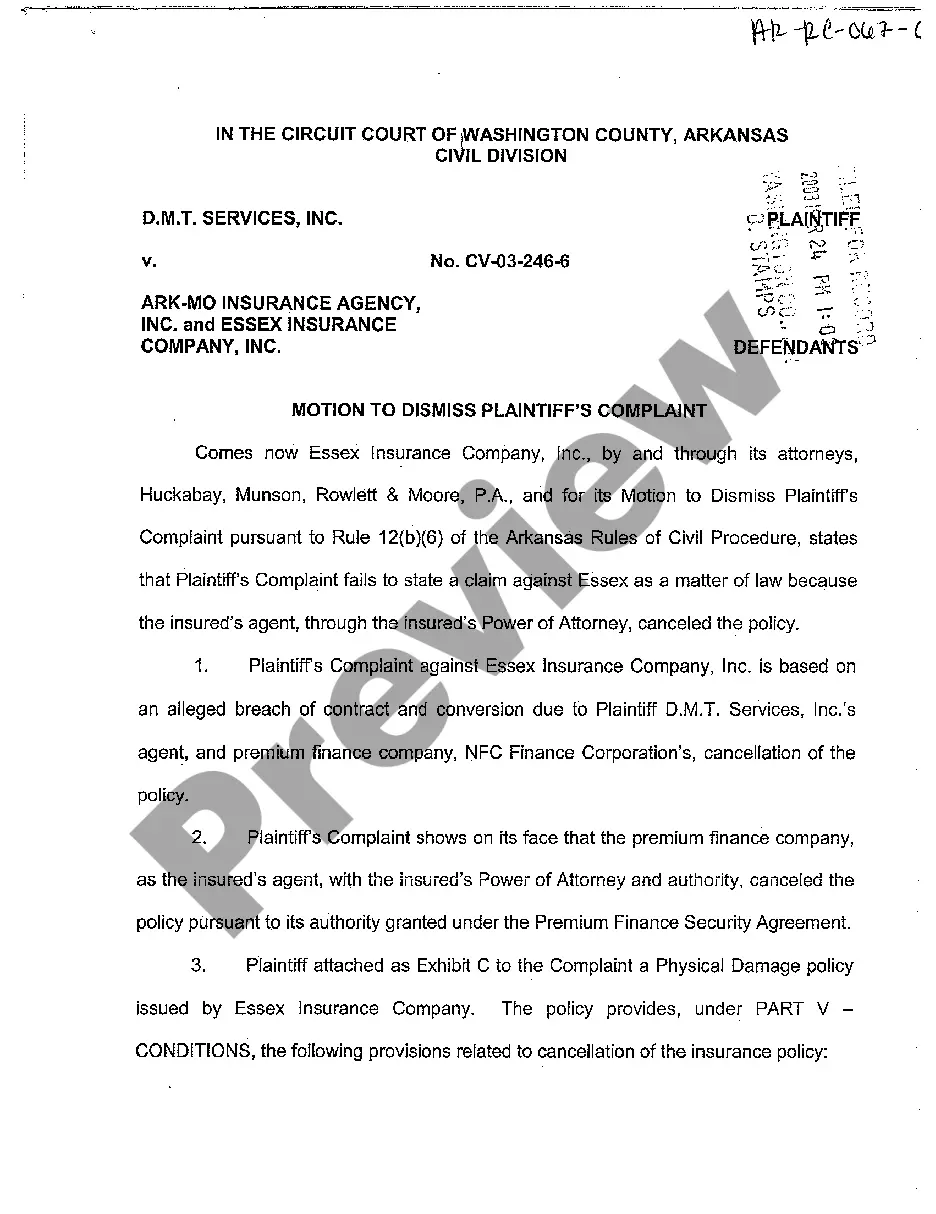
Agreement to Provide Financial Planning Advisory Services
Understanding this form
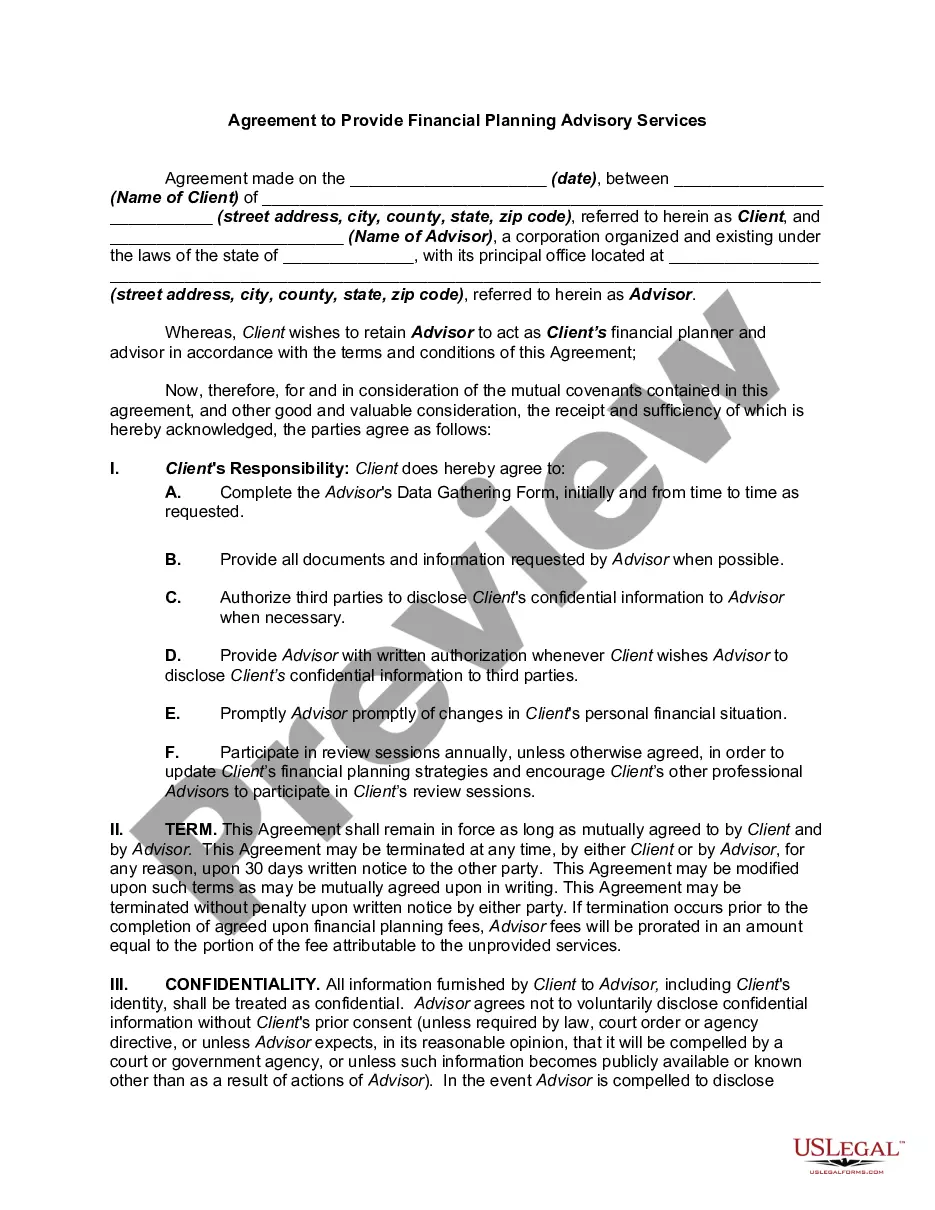
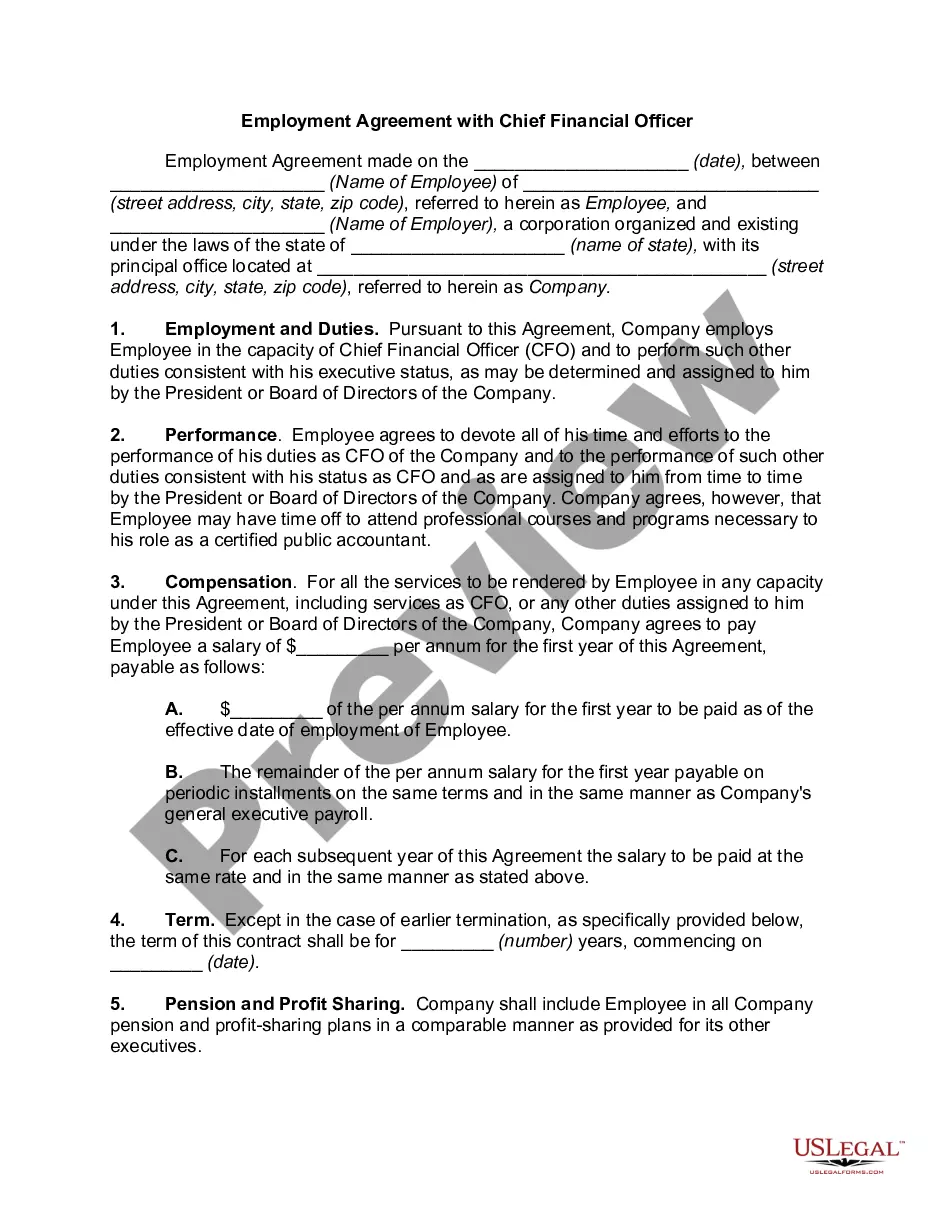
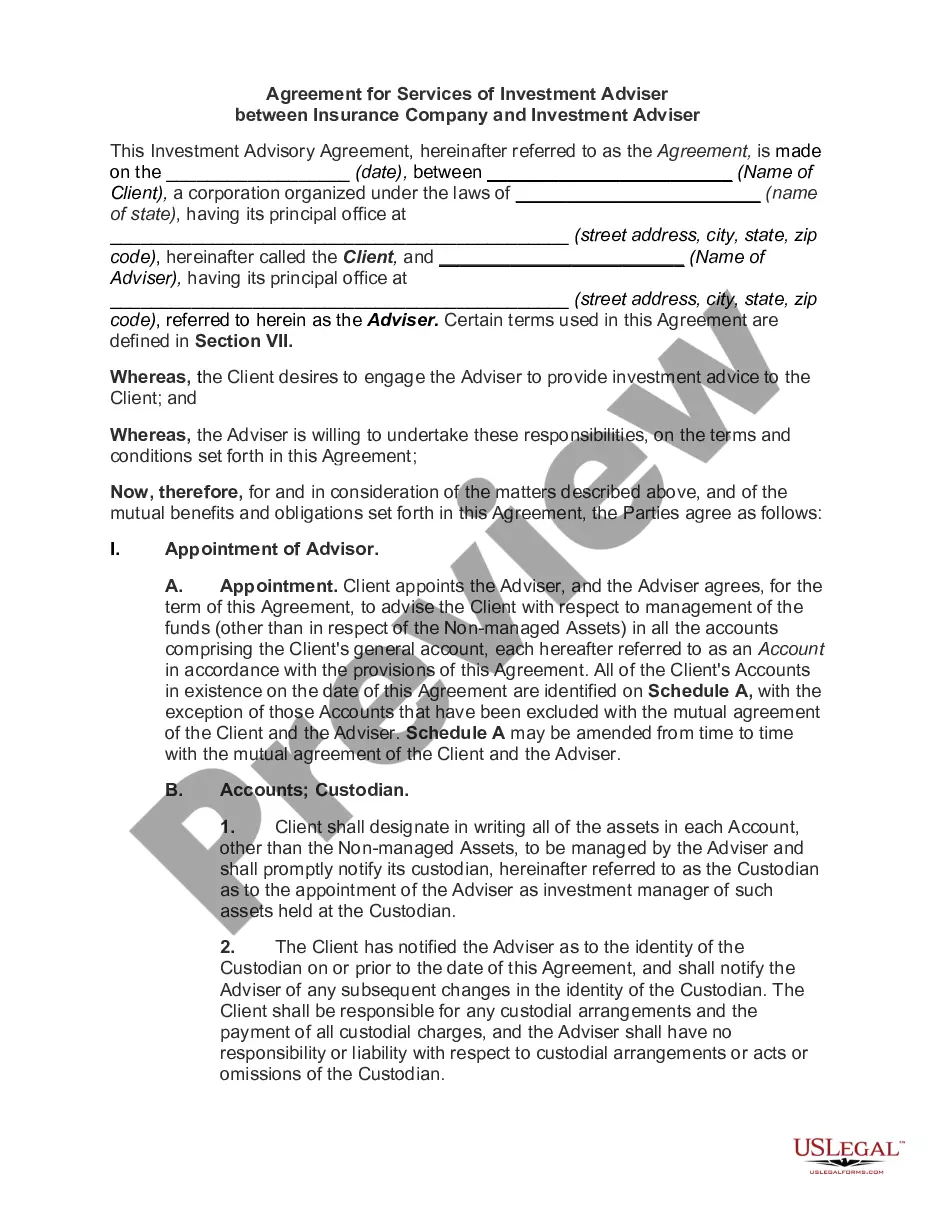
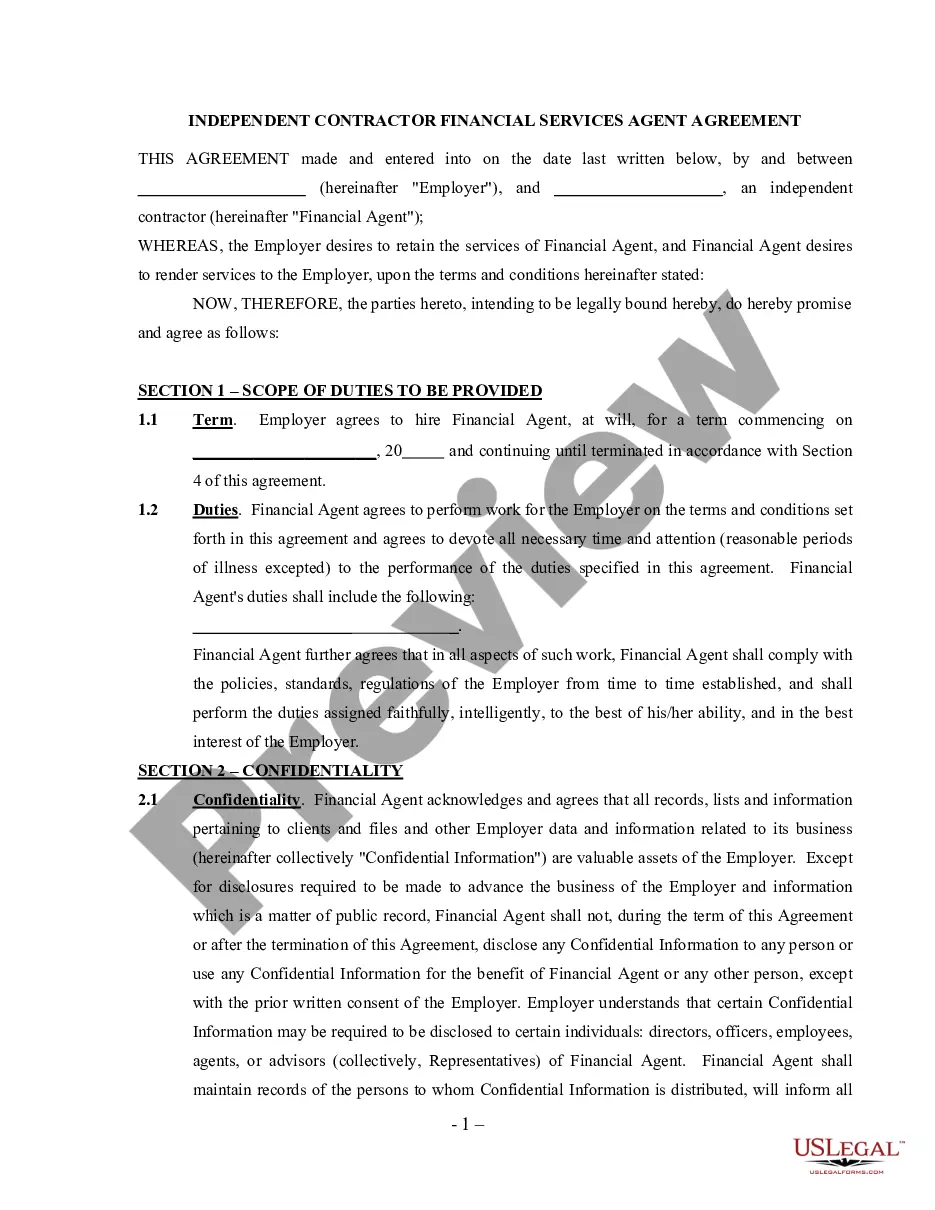
The Agreement to Provide Financial Planning Advisory Services establishes a formal relationship between a client and a financial advisor. It outlines the responsibilities, fees, and services provided by the advisor. This agreement differentiates itself from other financial documents by specifically detailing the advisory role and fiduciary duty of the advisor, ensuring the client's best interests are prioritized.
Main sections of this form
- Identification of the client and advisor.
- Client responsibilities, including data provision and participation in review sessions.
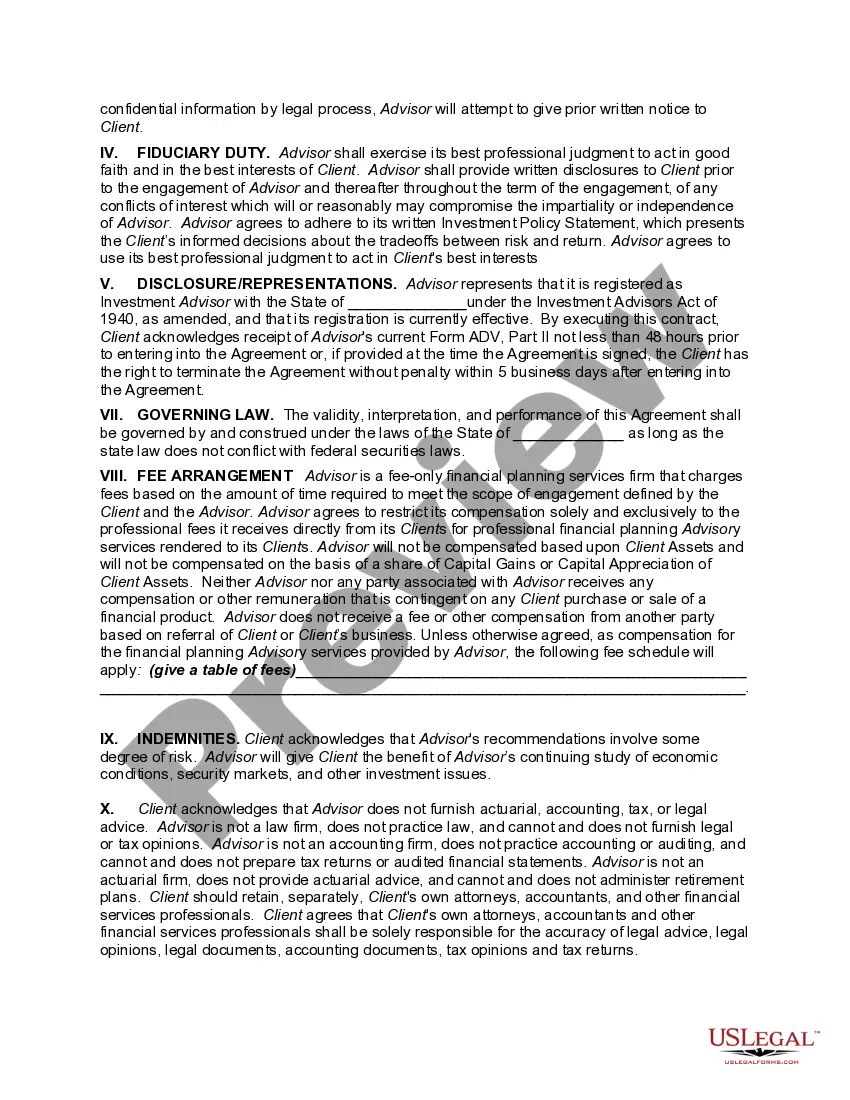
- Confidentiality provisions regarding client information.
- Fiduciary duty emphasis, ensuring advisors act in the best interests of the client.
- Fee arrangement detailing the compensation structure for advisory services.
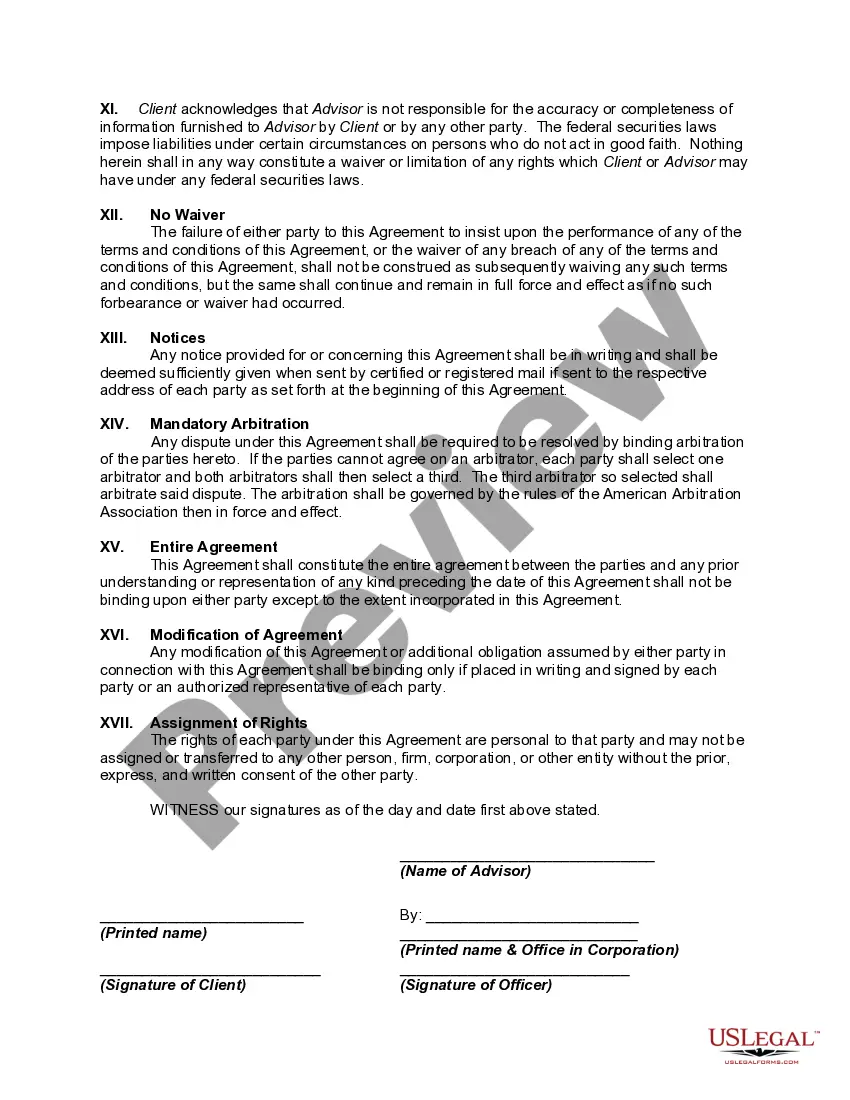
- Termination conditions and modification clauses.

When to use this document
This agreement should be used when a client seeks to formalize a relationship with a financial advisor for planning and investment advice. It is particularly relevant for individuals or businesses looking to manage their finances effectively, requiring detailed guidance on investment strategies and financial planning.
Who needs this form
- Clients who want to hire a financial advisor for professional advice.
- Individuals or businesses seeking a structured agreement outlining services and fees.
- Financial advisors wishing to clearly define their responsibilities and obligations.
Completing this form step by step
- Identify the parties involved by entering the client's and advisor's names and addresses.
- Specify the date the agreement is being made.
- Detail the responsibilities of the client regarding information sharing and active participation.
- Outline the fee structure, ensuring clarity on any payment terms.
- Include any necessary clauses for confidentiality and termination of the agreement.
Notarization requirements for this form
This form does not typically require notarization unless specified by local law. This means it can often be signed and executed without the need for a notary public, streamlining the process for both the client and the advisor.
Get your form ready online
Our built-in tools help you complete, sign, share, and store your documents in one place.
Make edits, fill in missing information, and update formatting in US Legal Forms—just like you would in MS Word.
Download a copy, print it, send it by email, or mail it via USPS—whatever works best for your next step.
Sign and collect signatures with our SignNow integration. Send to multiple recipients, set reminders, and more. Go Premium to unlock E-Sign.
If this form requires notarization, complete it online through a secure video call—no need to meet a notary in person or wait for an appointment.
We protect your documents and personal data by following strict security and privacy standards.

Make edits, fill in missing information, and update formatting in US Legal Forms—just like you would in MS Word.

Download a copy, print it, send it by email, or mail it via USPS—whatever works best for your next step.

Sign and collect signatures with our SignNow integration. Send to multiple recipients, set reminders, and more. Go Premium to unlock E-Sign.

If this form requires notarization, complete it online through a secure video call—no need to meet a notary in person or wait for an appointment.

We protect your documents and personal data by following strict security and privacy standards.
Common mistakes to avoid
- Failing to specify the scope of services offered by the advisor.
- Not including a clear fee arrangement, leading to misunderstandings.
- Omitting important client responsibilities, such as timely updates on financial situations.
Why complete this form online
- Convenience of downloading and completing the form at any time.
- Editability allows for customization to fit specific client-advisor circumstances.
- Reliability of templates drafted by licensed attorneys, ensuring legal compliance.
Legal use & context
- This agreement outlines the duties and expectations between a financial advisor and client.
- The contents help to establish a binding contract, providing legal recourse should disputes arise.
- Both parties are encouraged to understand the terms fully to avoid confusion or potential legal issues.
Quick recap
- Formally defines the relationship between a client and financial advisor.
- Details mutual responsibilities to enhance accountability.
- Protects both parties by outlining confidentiality and fee arrangements.
Looking for another form?








Form popularity
FAQ
401(k) and other investment plan statements.Mortgage and other debt statements (Hint: You shouldn't start investing until you're debt-free, besides the house.)Pay stubs for you and/or your spouse.Your most recent tax return.Your monthly budget.
Don't Treat The Business Plan As A Static Document. Keep Displacement In Mind As You Create It. Include A Plan For Hiring People. Understand That It Doesn't Need To Be Fancy. Do Your Research First. Be Conservative With Your Finances And Projections. Review Your Competition.
Provide financial planning and investment advisory services.Research and present investment strategies.Develop and execute retirement planning.Implement risk management and tax planning strategies.Coordinate estate planning.Manage client relationships.Financial Planner Job Description Sample Monster.com\nhiring.monster.com > employer-resources > job-description-templates > fin...
Your advisor will also sign and date it. By signing off on the agreement, you're acknowledging that you receive, accept and agree to the terms outlined in the document.
With some firms, all you need to do is to put in writing that you want to leave and that the relationship is dissolved. With others, things like annual service fees or termination fees might need to be negotiated or flat-out paid.
An advisory agreement should be used between a company and its advisor. The agreement sets forth the expectation of the relationship like work to be performed on behalf of the advisor and compensation. The agreement should also set forth certain key terms like confidentiality and assignment of work product.
The average fee for a financial advisor's services is 1.02% of assets under management (AUM) annually for an account of $1 million. An actively-managed portfolio usually involves a team of investment professionals buying and selling holdingsleading to higher fees.
Risk management and insurance planning. Education saving planning. Tax planning. Legacy or charitable planning. Retirement planning. Portfolio management. Cash flow analysis. Debt management.
While securities laws and regulations require oversight of independent financial advisors by their affiliated broker-dealer, the independent financial services industry has a long history of appropriately classifying affiliated financial advisors as independent contractors, Brown stated.