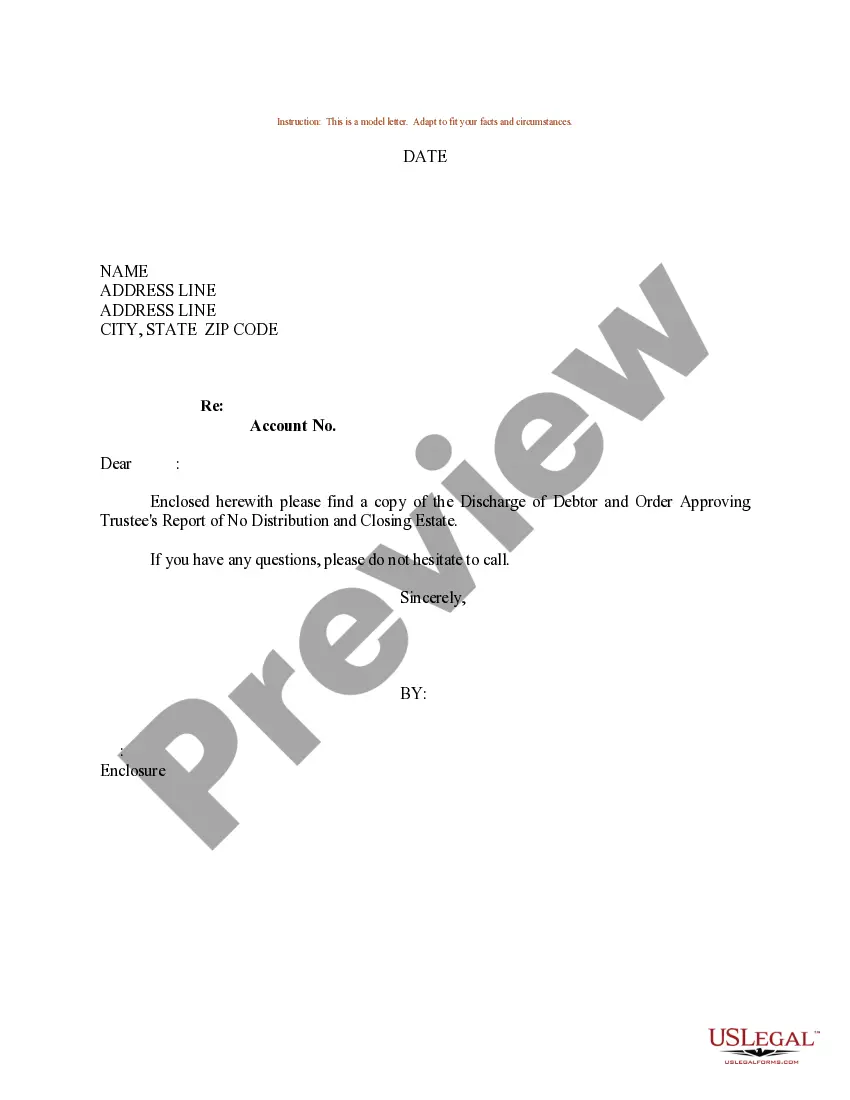
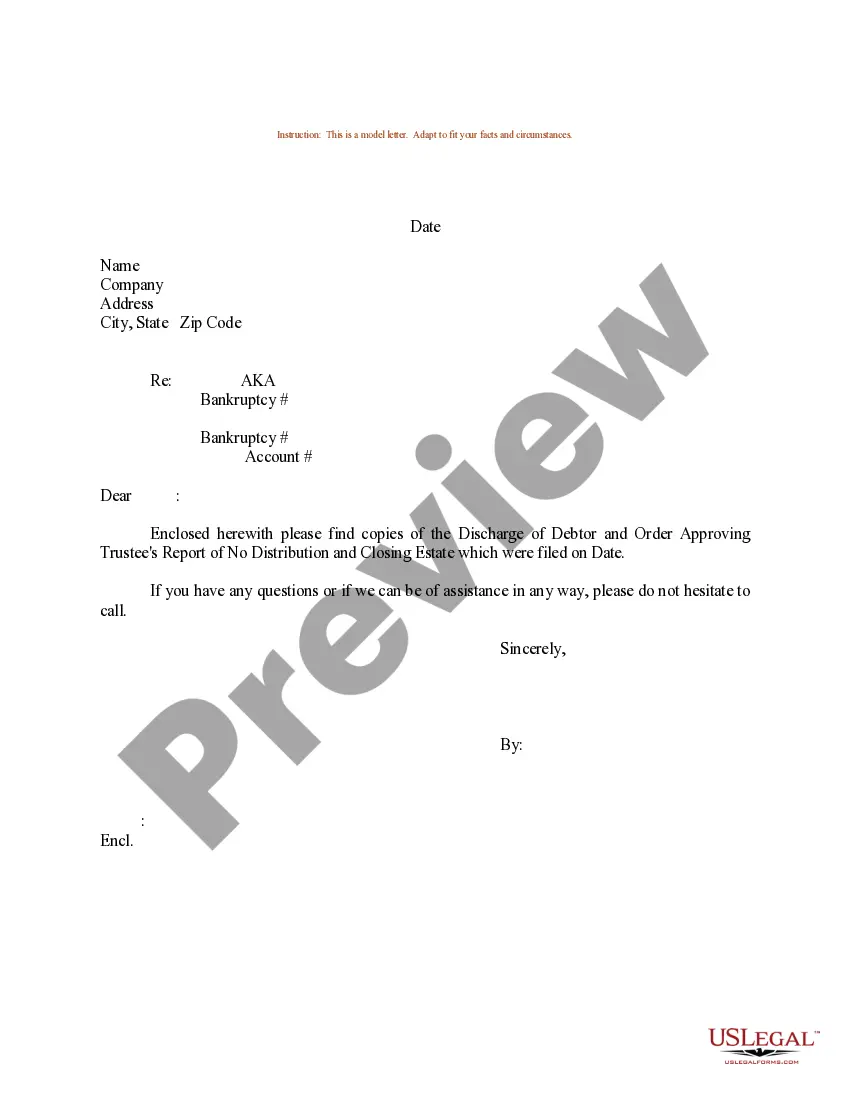
Sample Letter regarding Discharge of Debtor and Order Approving Trustee's Report of No Distribution and Closing Estate
Understanding this form
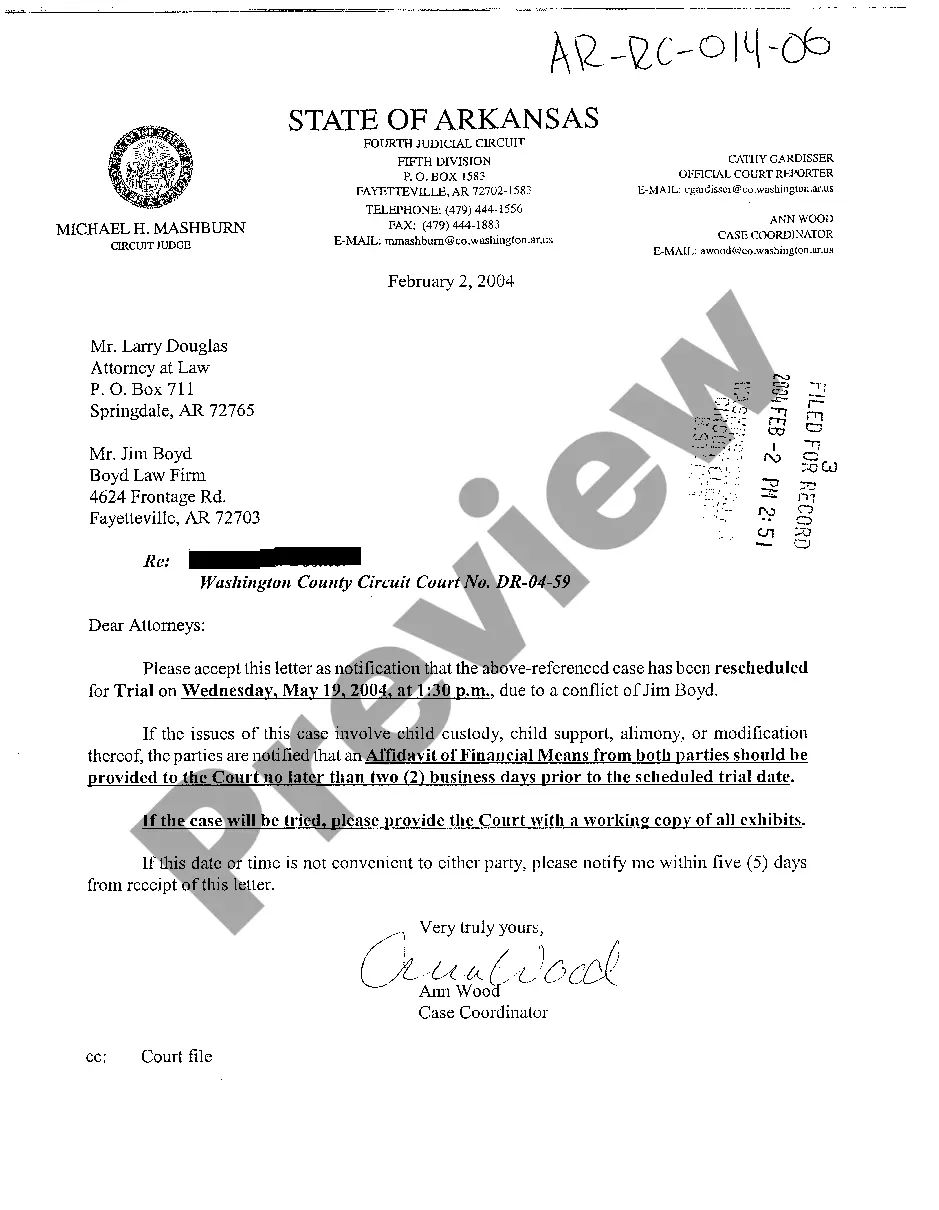
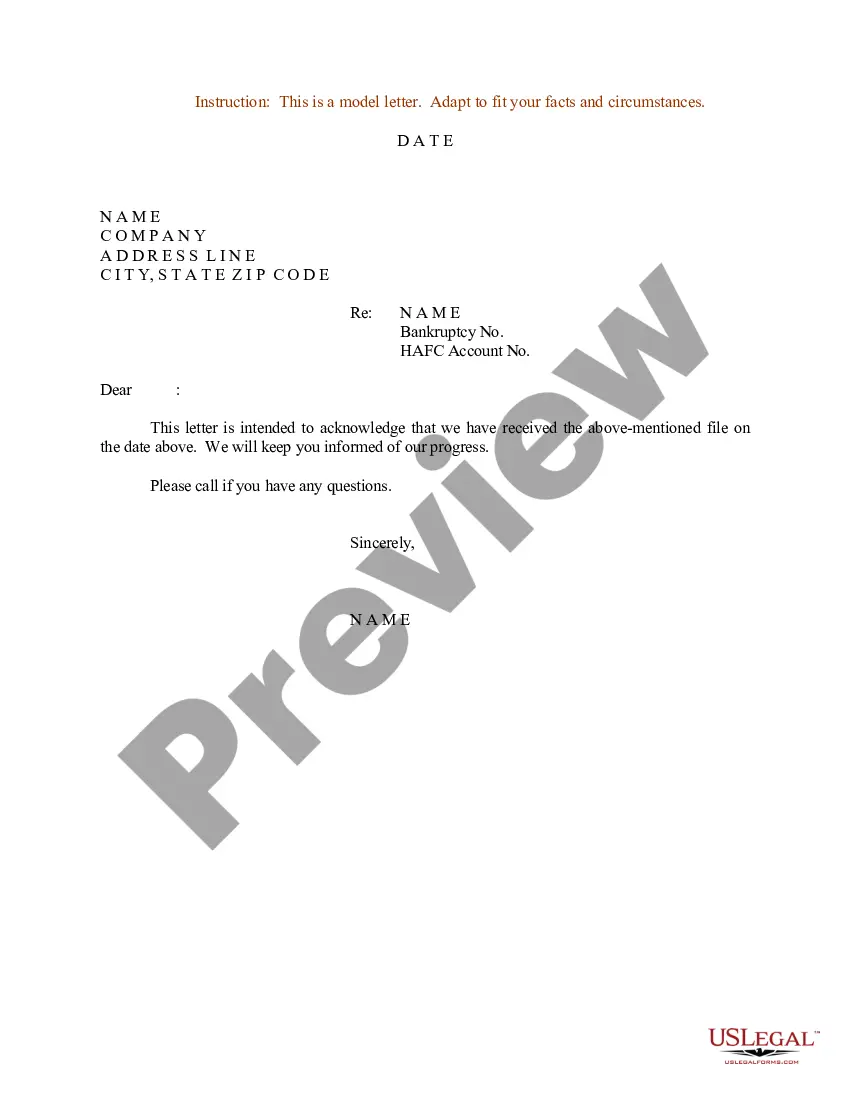
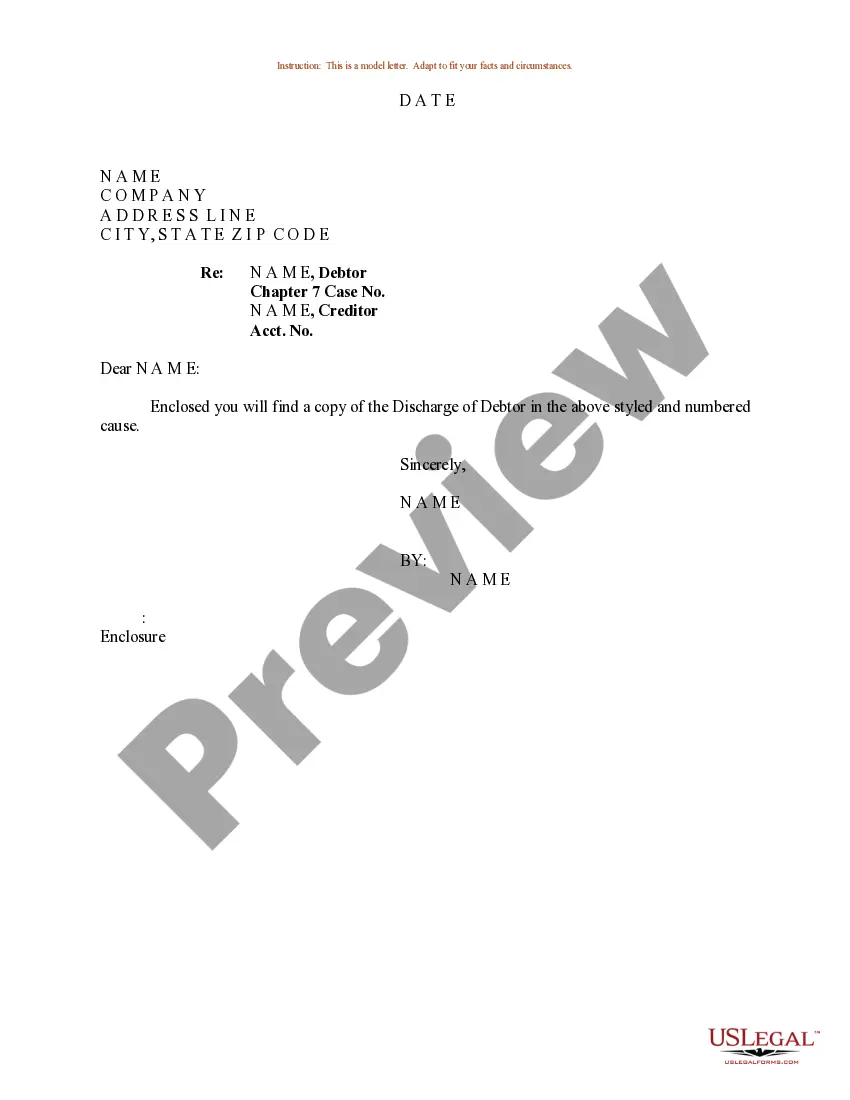
This form is a sample letter regarding the discharge of a debtor and the approval of a trustee's report of no distribution. It serves the purpose of officially notifying interested parties about the closing of an estate and the debtor's discharge. Unlike other financial forms, this sample letter provides a structured format for communicating the resolution of a bankruptcy case or similar proceedings, ensuring clarity and compliance with legal standards.
Main sections of this form
- Date: The date the letter is created.
- Recipient Information: Name and address of the concerned parties.
- Subject Line: Clear statement indicating the nature of the letter.
- Body: Detailed explanation of the discharge and the trustee's report.
- Signature Line: Space for the sender's signature.
Situations where this form applies
This form should be used when an estate is being closed after a bankruptcy case or when a debtor has fulfilled all obligations and is legally discharged from debts. It is appropriate in situations where formal notification to creditors or involved parties is necessary to finalize the trustee's report and close the estate.
Who should use this form
- Trustees handling bankruptcy cases.
- Debtors who have been discharged of their debts.
- Legal representatives seeking to notify creditors or interested parties.
- Individuals involved in estate management or administration.
Steps to complete this form
- Fill in the date of the letter at the top.
- Add the recipient's name and complete address.
- Write a clear subject line indicating the discharge of the debtor.
- In the body of the letter, provide details about the debtor's discharge and the trustee's report.
- Leave space for your signature at the bottom of the letter.
Notarization requirements for this form
In most cases, this form does not require notarization. However, some jurisdictions or signing circumstances might. US Legal Forms offers online notarization powered by Notarize, accessible 24/7 for a quick, remote process.
Get your form ready online
Our built-in tools help you complete, sign, share, and store your documents in one place.
Make edits, fill in missing information, and update formatting in US Legal Forms—just like you would in MS Word.
Download a copy, print it, send it by email, or mail it via USPS—whatever works best for your next step.
Sign and collect signatures with our SignNow integration. Send to multiple recipients, set reminders, and more. Go Premium to unlock E-Sign.
If this form requires notarization, complete it online through a secure video call—no need to meet a notary in person or wait for an appointment.
We protect your documents and personal data by following strict security and privacy standards.

Make edits, fill in missing information, and update formatting in US Legal Forms—just like you would in MS Word.

Download a copy, print it, send it by email, or mail it via USPS—whatever works best for your next step.

Sign and collect signatures with our SignNow integration. Send to multiple recipients, set reminders, and more. Go Premium to unlock E-Sign.

If this form requires notarization, complete it online through a secure video call—no need to meet a notary in person or wait for an appointment.

We protect your documents and personal data by following strict security and privacy standards.
Common mistakes to avoid
- Failure to include the date of the letter.
- Not addressing the letter to the correct recipient.
- Omitting important details about the discharge or estate closure.
- Neglecting to sign the letter.
Benefits of completing this form online
- Convenient access to a properly formatted document at any time.
- Editability allows users to customize the letter to fit specific needs.
- Reliability of a form drafted by licensed attorneys ensures legal validity.
Legal use & context
- This letter serves as a formal record of the trustee's findings and the debtor's status.
- It may be used in legal proceedings or negotiations to show compliance with bankruptcy laws.
- Inaccuracies or omissions in this letter could lead to misunderstandings or legal repercussions.
Quick recap
- This form is essential for notifying parties about a debtor's discharge.
- Use the form to maintain formal communication with involved parties.
- Customize the letter as necessary for your specific legal context.
Looking for another form?

Form popularity
FAQ
A discharge is a type of sentence imposed by a court whereby no punishment is imposed.Once the stated period has elapsed and no further offence is committed then the conviction may be removed from the defendant's record.
Firstly, that debt can likely not be added to a Chapter 7 later for numerous reasons. The most obvious of these is that the debtor is barred from filing another bankruptcy for another 7 years. If you default on those payments then the creditor can repossess the property that secures the debt.
In most cases, you can add still the creditor although there could be an amendment fee associated because you will need to file for an amendment and complete a new schedule list to show all creditors including the creditor that was left out of the previous filing.
Well first, the trustee can apply to the court for his discharged. This means he is no longer administering your bankruptcy.Once the trustee is discharged, all of the original creditors are able to come back.
The Trustee's Report of No Distribution, or NDR, lets the court and all interested parties know that no money will be paid to creditors. If a NDR is filed, the court will close the bankruptcy case shortly after the discharge has been entered.I request that I be discharged from any further duties as trustee.
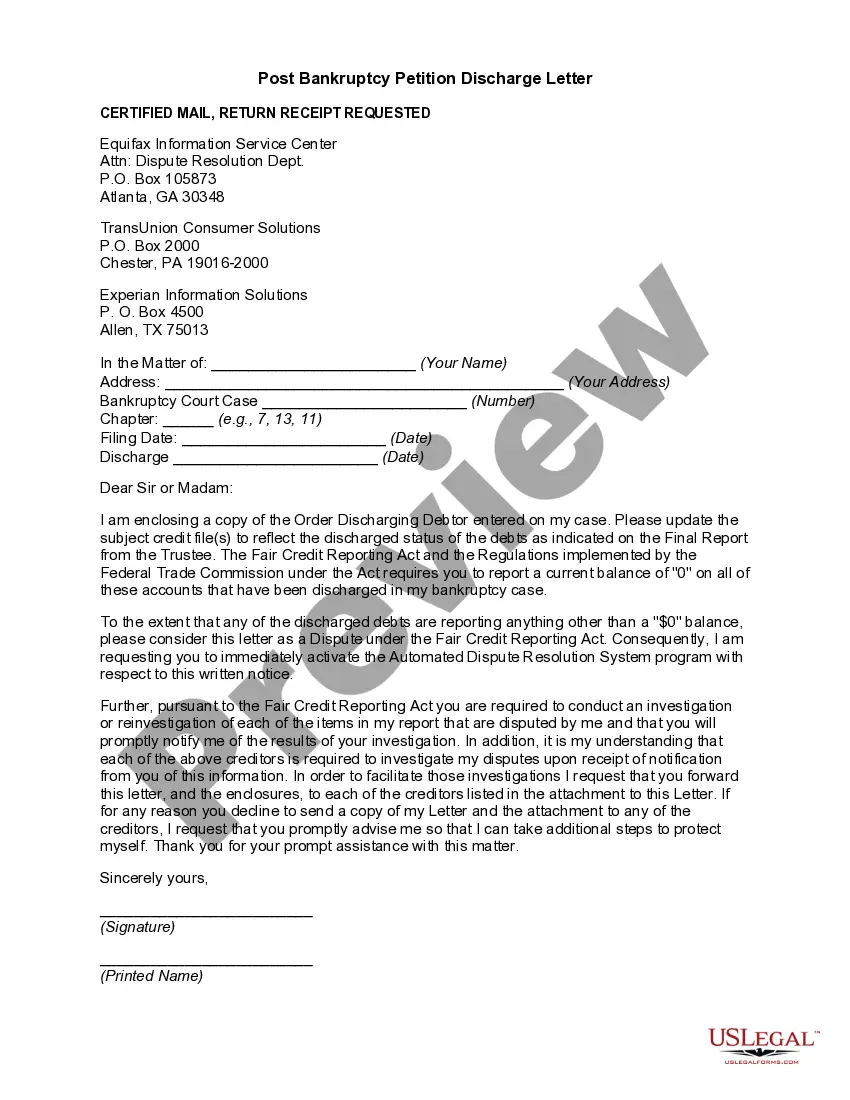
The bankruptcy is reported in the public records section of your credit report. Both the bankruptcy and the accounts included in the bankruptcy should indicate they are discharged once the bankruptcy has been completed. To verify this, the first step is to get a copy of your personal credit report.
The Chapter 7 Discharge. A discharge releases individual debtors from personal liability for most debts and prevents the creditors owed those debts from taking any collection actions against the debtor.
Assuming that everything goes according to schedule, you can expect to receive your bankruptcy discharge (the court order that wipes out your debts) about 60 days after your 341 meeting of creditors hearing, plus a few days for mailing.
Well first, the trustee can apply to the court for his discharged. This means he is no longer administering your bankruptcy.Once the trustee is discharged, all of the original creditors are able to come back.