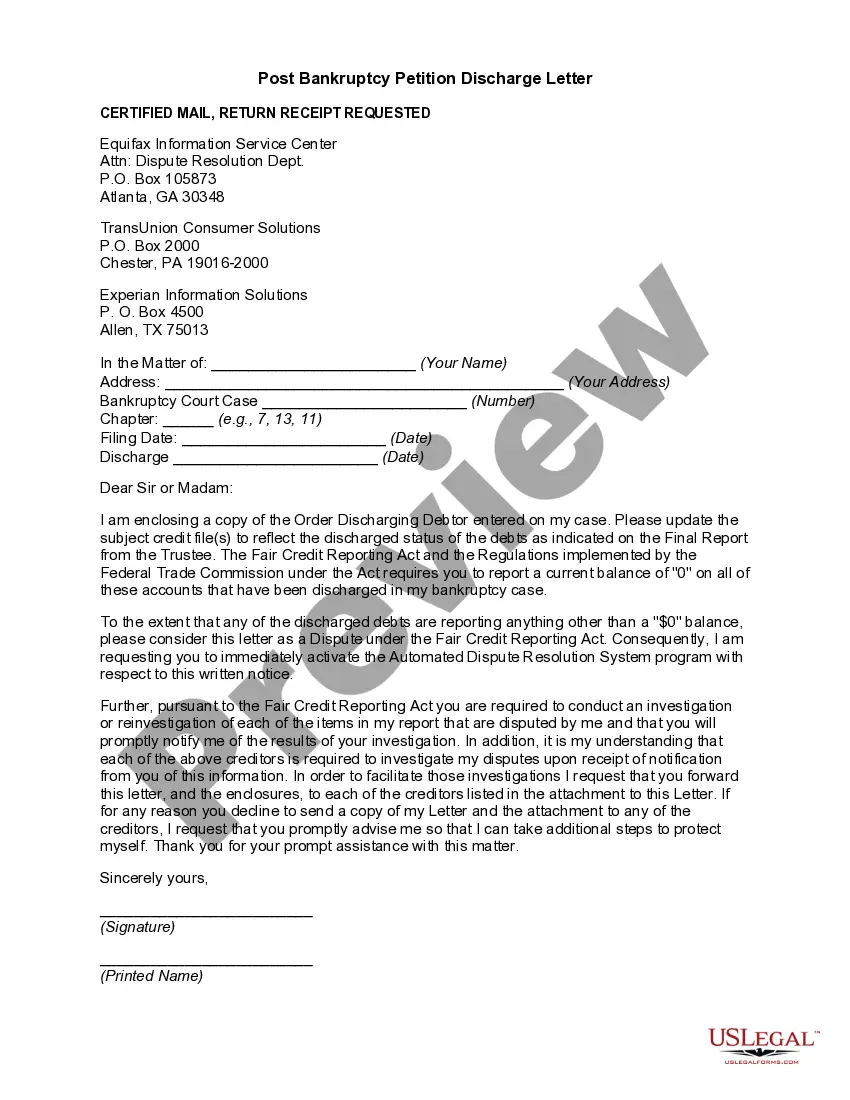
Post Bankruptcy Petition Discharge Letter
About this form
The Post Bankruptcy Petition Discharge Letter is a formal document that you send to credit reporting bureaus after your bankruptcy has been discharged. This letter notifies the bureaus of your bankruptcy discharge and requests that they update your credit record accordingly. Unlike a simple request for correction, this letter serves as both a notification and a dispute under the Fair Credit Reporting Act, ensuring that any discharged debts are reported as having a zero balance.
What’s included in this form
- Recipient details for credit reporting bureaus.
- Your identifying information, including name and address.
- Bankruptcy case details, including case number and discharge date.
- A request to update your credit file reflecting discharged debts.
- A dispute clause regarding incorrect reporting of discharged debts.
- Instructions for sending and following up on the letter.
When this form is needed
You should use the Post Bankruptcy Petition Discharge Letter once your bankruptcy case has been officially discharged by the court. This is typically important for individuals wanting to ensure their credit reports reflect accurate information following a bankruptcy, facilitating a smoother process in repairing their credit profile and potentially improving their opportunities for future credit approvals.
Who needs this form
- Individuals who have recently received a bankruptcy discharge.
- Those who want to update their credit reports accurately.
- Consumers seeking to dispute inaccurate reporting of debts post-bankruptcy.
- Anyone looking to ensure compliance with the Fair Credit Reporting Act regarding the reporting of discharged debts.
Completing this form step by step
- Fill in your name and address at the top of the letter to identify yourself.
- Include the bankruptcy court case number, chapter, filing date, and discharge date.
- Clearly state your request for the credit bureaus to update your account balances to zero.
- Attach a copy of your Order Discharging Debtor and proof of identity, such as a driver's license and Social Security card.
- Mail the letter via certified mail and keep a copy for your records.
- Retain the green Return Receipt once it is received by the bureau.
Does this document require notarization?
This form does not typically require notarization unless specified by local law. It is important to verify any state-specific requirements that may apply to your situation.
Get your form ready online
Our built-in tools help you complete, sign, share, and store your documents in one place.
Make edits, fill in missing information, and update formatting in US Legal Forms—just like you would in MS Word.
Download a copy, print it, send it by email, or mail it via USPS—whatever works best for your next step.
Sign and collect signatures with our SignNow integration. Send to multiple recipients, set reminders, and more. Go Premium to unlock E-Sign.
If this form requires notarization, complete it online through a secure video call—no need to meet a notary in person or wait for an appointment.
We protect your documents and personal data by following strict security and privacy standards.

Make edits, fill in missing information, and update formatting in US Legal Forms—just like you would in MS Word.

Download a copy, print it, send it by email, or mail it via USPS—whatever works best for your next step.

Sign and collect signatures with our SignNow integration. Send to multiple recipients, set reminders, and more. Go Premium to unlock E-Sign.

If this form requires notarization, complete it online through a secure video call—no need to meet a notary in person or wait for an appointment.

We protect your documents and personal data by following strict security and privacy standards.
Typical mistakes to avoid
- Failing to include all required attachments, such as proof of identity or the discharge order.
- Not using certified mail, which is crucial for proof of delivery.
- Omitting essential details like the bankruptcy case number and discharge date.
- Neglecting to keep copies of sent information and the Return Receipt for future reference.
Why use this form online
- Convenience of downloading and completing the form from home.
- Editable format allows for customization to fit individual circumstances.
- Access to attorney-drafted documents ensures legal validity and reliability.
Legal use & context
- This letter serves as formal notice to credit bureaus of your bankruptcy discharge.
- It invokes the protections of the Fair Credit Reporting Act, ensuring that reporting agencies must comply with updates to your credit file.
- Using this letter helps maintain your rights regarding the accuracy of your credit information.
Summary of main points
- The Post Bankruptcy Petition Discharge Letter is essential for correcting your credit report post-bankruptcy.
- Ensure all information is complete and sent via certified mail.
- Keep copies of all correspondence for your records as proof of your requests.
Looking for another form?
Form popularity
FAQ
Assuming that everything goes according to schedule, you can expect to receive your bankruptcy discharge (the court order that wipes out your debts) about 60 days after your 341 meeting of creditors hearing, plus a few days for mailing.
Request it from the Bankruptcy Clerk's Office. You can also request a bankruptcy discharge copy from the Clerk's office located in the district and division where the bankruptcy case was filed. The bankruptcy clerk will charge a small fee for this service.
Once filed, a Chapter 7 bankruptcy typically takes about 4 - 6 months to complete. The bankruptcy discharge is granted 3 - 4 months after filing in most cases. Written by Attorney Andrea Wimmer. Most Chapter 7 bankruptcy cases take between 4 - 6 months to complete after filing the case with the court.
Contact your attorney; she'll know if your case has been discharged yet or not. You can also ask her for a copy of your bankruptcy discharge notice. She should have the notice in her files and should be able to fax, email or regular mail the notice to you.
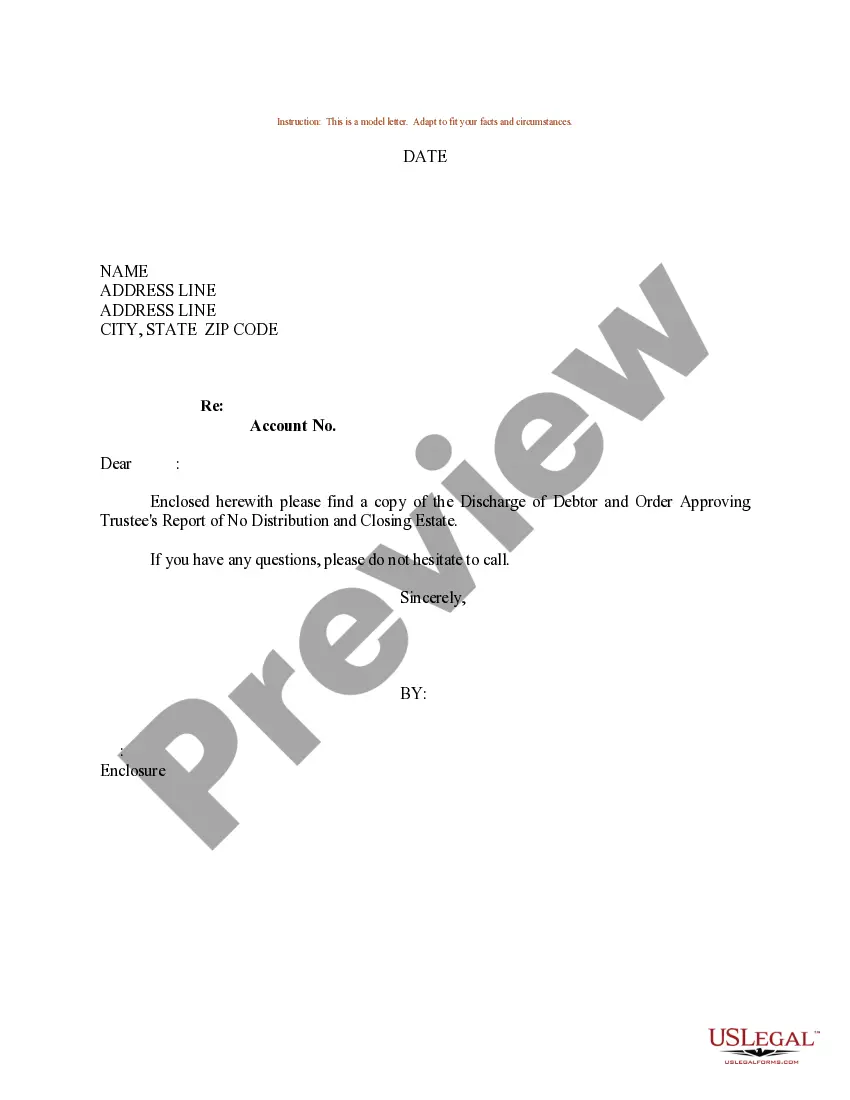
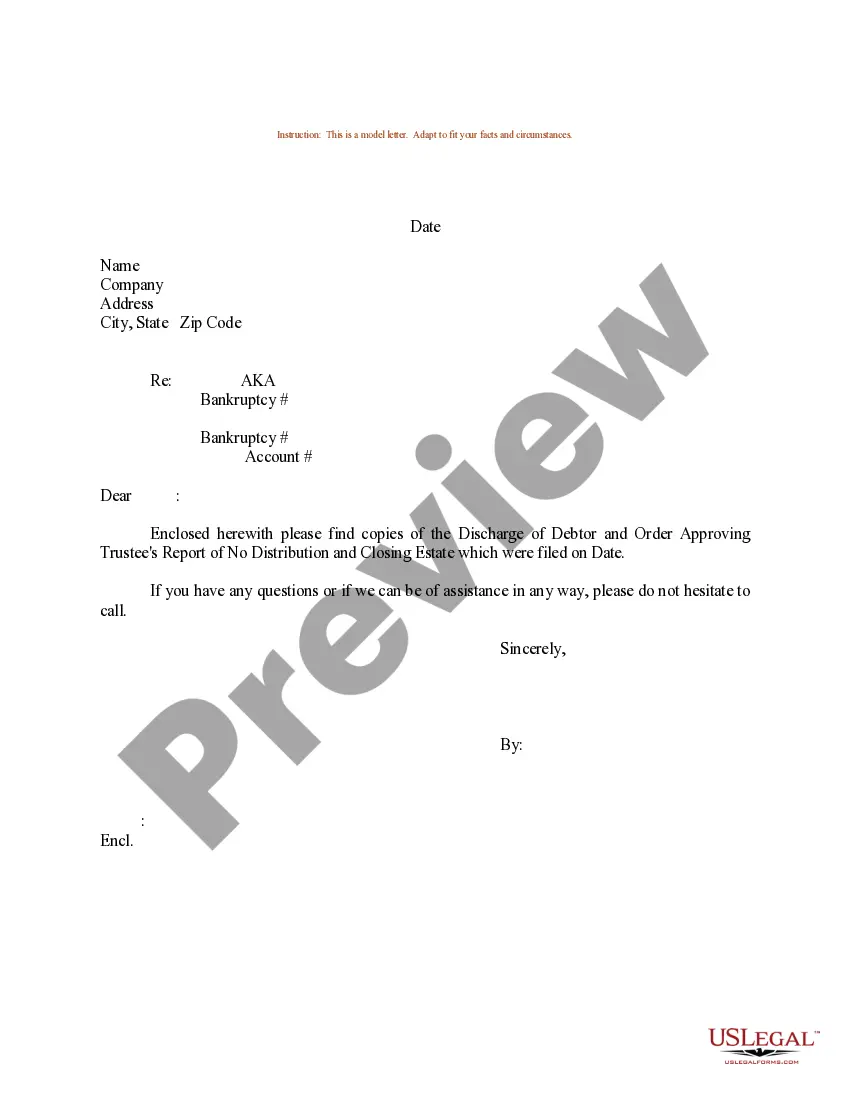
If the debtor loses or misplaces the discharge order, another copy can be obtained by contacting the clerk of the bankruptcy court that entered the order. The clerk will charge a fee for searching the court records and there will be additional fees for making and certifying copies.
The bankruptcy is reported in the public records section of your credit report. Both the bankruptcy and the accounts included in the bankruptcy should indicate they are discharged once the bankruptcy has been completed. To verify this, the first step is to get a copy of your personal credit report.
The bankruptcy discharge releases the debtor from liability for certain debts, so the debtor is no longer legally required to pay the balance.In some cases, the bankruptcy will continue for some time after the discharge order is issued.
The bankruptcy is reported in the public records section of your credit report. Both the bankruptcy and the accounts included in the bankruptcy should indicate they are discharged once the bankruptcy has been completed. To verify this, the first step is to get a copy of your personal credit report.
The bankruptcy is reported in the public records section of your credit report. Both the bankruptcy and the accounts included in the bankruptcy should indicate they are discharged once the bankruptcy has been completed. To verify this, the first step is to get a copy of your personal credit report.