Agreement to Recruit Pharmacists for Hospital
Understanding this form
The Agreement to Recruit Pharmacists for Hospital is a legally binding document establishing the terms between a hospital and a professional recruiter. It outlines the recruiter's responsibilities in finding and placing qualified pharmacists within the hospital's facilities. This agreement is essential for healthcare organizations facing talent shortages, as it formalizes the recruitment process and compensation structure, distinguishing it from less formal employment agreements.
Main sections of this form
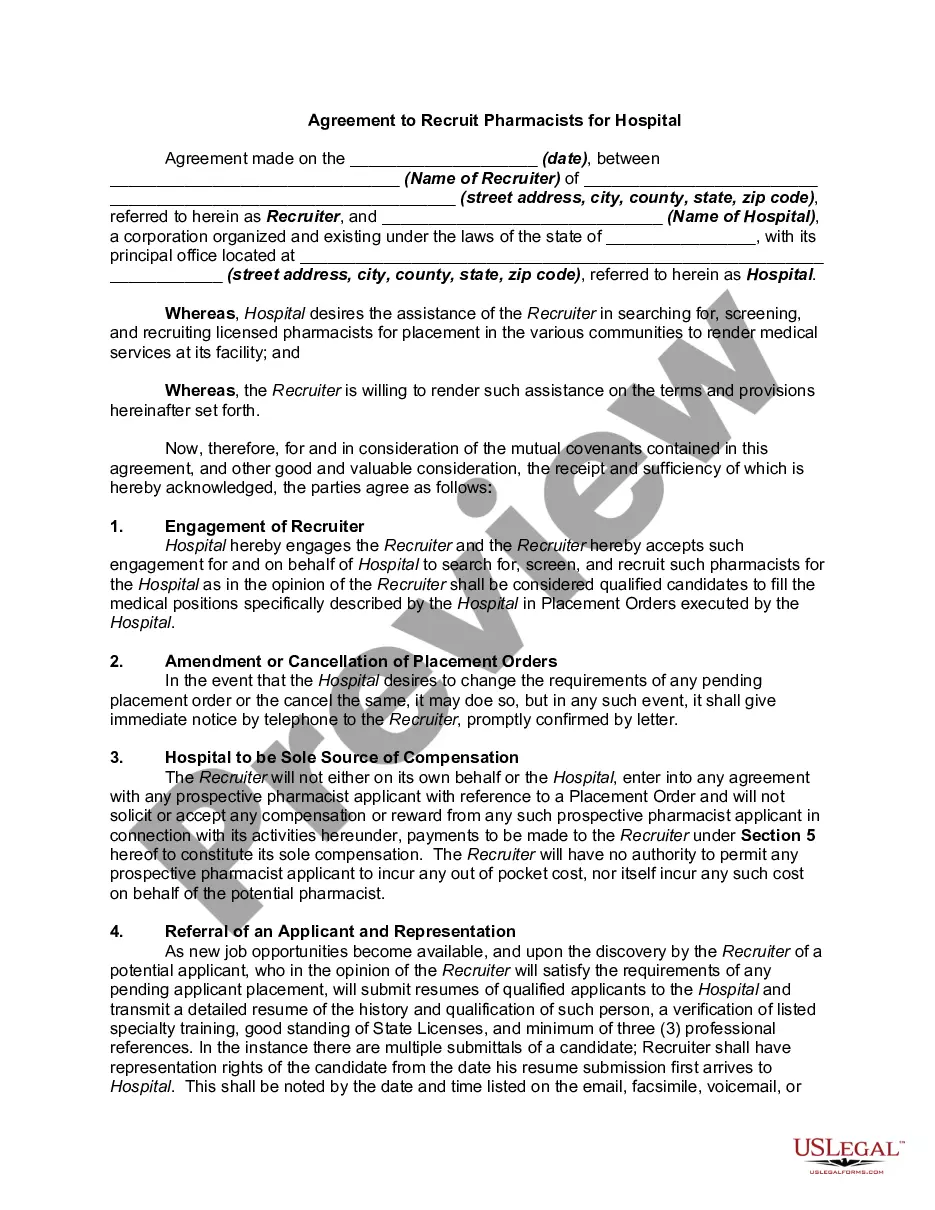
- Engagement of Recruiter: Defines the recruiter's role in finding and screening pharmacists.
- Amendment or Cancellation of Placement Orders: Describes how placement orders can be changed or canceled by the hospital.
- Referral of an Applicant: Outlines how the recruiter will submit candidate details and manage candidate representation.
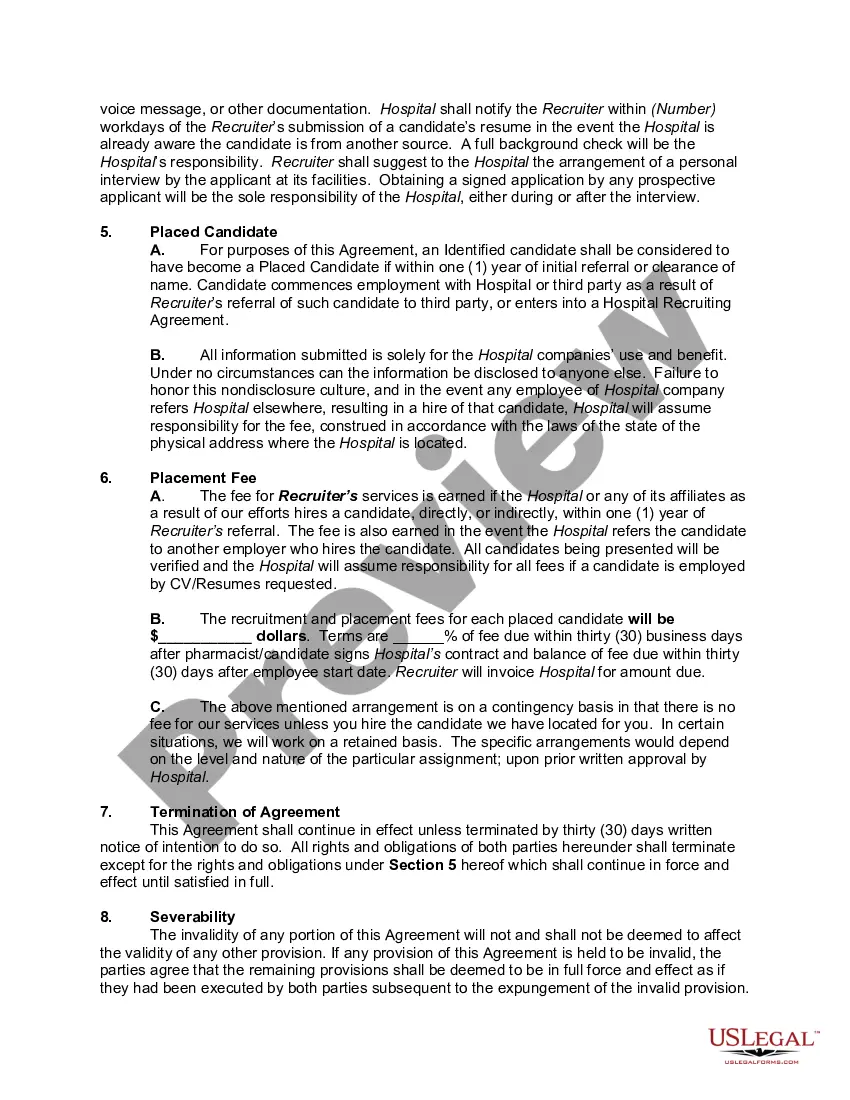
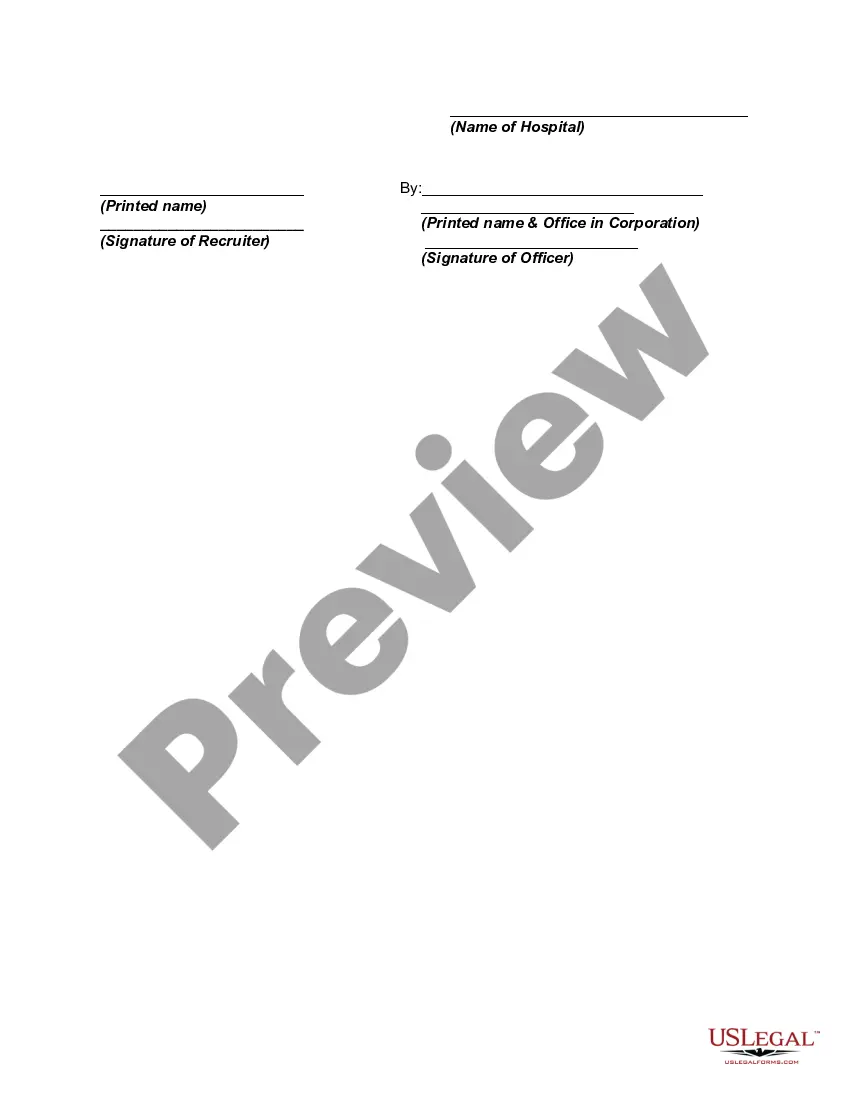
- Placement Fee: Specifies the conditions under which the recruiter earns their fee and the fee payment structure.
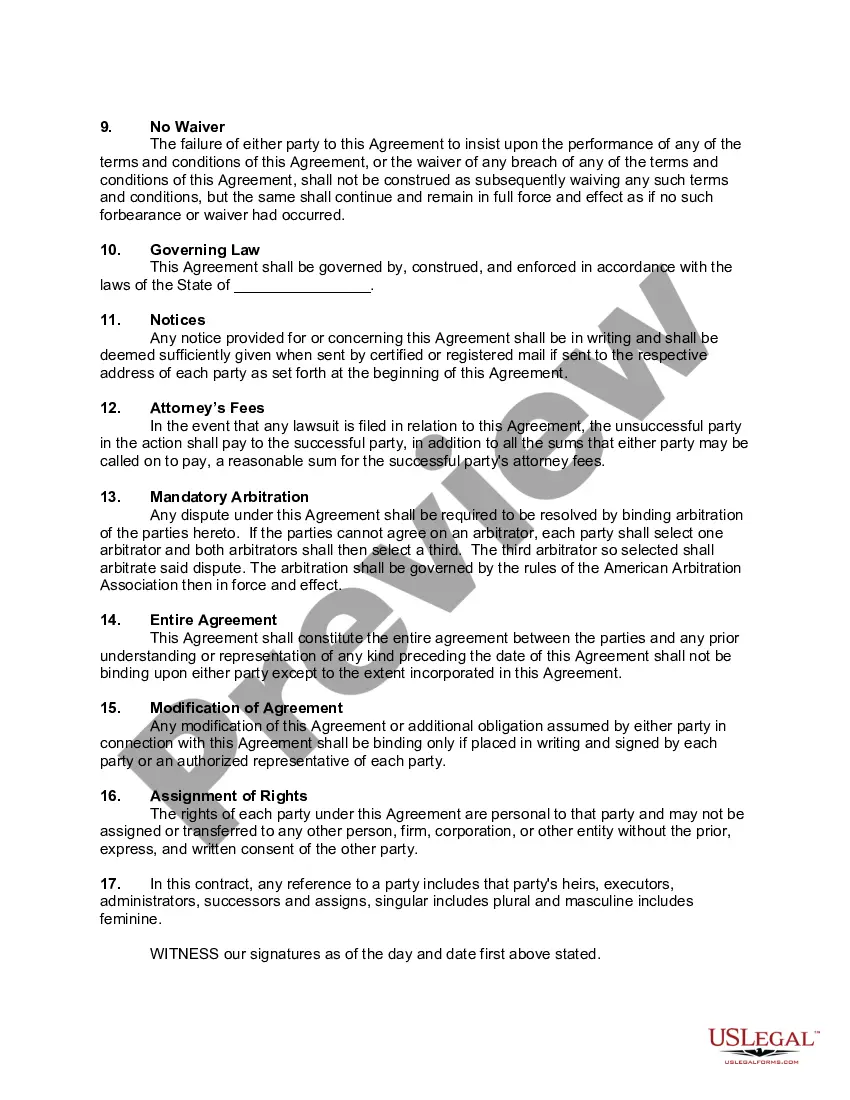
- Termination of Agreement: Details the conditions under which either party can end the agreement.
When to use this document
This form is needed when a hospital requires the assistance of a recruiter to effectively fill pharmacist positions due to a talent gap. It is beneficial for hospitals looking to streamline their hiring process while ensuring compliance with legal and contractual obligations concerning recruitment and placement.
Who this form is for
- Healthcare administrators seeking to hire pharmacists.
- Professional recruiters specializing in healthcare staffing.
- Legal teams involved in drafting or reviewing recruitment agreements.
- Human resources departments of hospitals and medical facilities.
Completing this form step by step
- Identify the parties: Fill in the names and addresses of the recruiter and the hospital.
- Specify the date of agreement: Enter the date on which the agreement is made.
- Detail the job responsibilities: Clearly define the roles the recruiter will undertake in recruiting pharmacists.
- Agree on the compensation structure: Specify the placement fee and payment terms.
- Include termination conditions: Outline how either party can terminate the agreement if necessary.
Does this form need to be notarized?
This form does not typically require notarization unless specified by local law. However, it's advisable to confirm any jurisdiction-specific requirements to ensure the agreement is enforceable.
Get your form ready online
Our built-in tools help you complete, sign, share, and store your documents in one place.
Make edits, fill in missing information, and update formatting in US Legal Forms—just like you would in MS Word.
Download a copy, print it, send it by email, or mail it via USPS—whatever works best for your next step.
Sign and collect signatures with our SignNow integration. Send to multiple recipients, set reminders, and more. Go Premium to unlock E-Sign.
If this form requires notarization, complete it online through a secure video call—no need to meet a notary in person or wait for an appointment.
We protect your documents and personal data by following strict security and privacy standards.

Make edits, fill in missing information, and update formatting in US Legal Forms—just like you would in MS Word.

Download a copy, print it, send it by email, or mail it via USPS—whatever works best for your next step.

Sign and collect signatures with our SignNow integration. Send to multiple recipients, set reminders, and more. Go Premium to unlock E-Sign.

If this form requires notarization, complete it online through a secure video call—no need to meet a notary in person or wait for an appointment.

We protect your documents and personal data by following strict security and privacy standards.
Common mistakes
- Failing to specify the correct placement fees or payment timelines.
- Neglecting to clearly define the recruiter's responsibilities.
- Not including provisions for amending or terminating the agreement.
- Omitting contact information for either party.
Why complete this form online
- Convenience of immediate access and download.
- Templates created by licensed attorneys ensure legal compliance.
- Editability allows customization to meet specific requirements.
- Streamlines the recruitment process with clear guidelines.
Legal use & context
- This agreement is legally enforceable in a court of law if completed properly and signed by both parties.
- By addressing candidate sourcing and placement fees, it limits disputes regarding payment and responsibilities.
- Includes provisions for termination and amendments to safeguard the interests of both parties throughout the recruitment process.
Quick recap
- The Agreement to Recruit Pharmacists is vital for hospitals seeking to efficiently hire qualified pharmacist candidates.
- Clearly outline each party's responsibilities and compensation arrangements to avoid misunderstandings.
- Stay informed about state-specific legal requirements to ensure compliance and enforceability of the agreement.
Looking for another form?






Form popularity
FAQ
Finding Healthcare Talent in 2020 and Beyond. Start early with campus recruiting. Improve your assessment and hiring process and go mobile-first. Know the best job boards for healthcare. Branch out to other professions. Offer better compensation and benefits than your peers. Hire from within.
Know your community need and convince candidates that there is a predictable long-term demand. Conduct a thorough initial telephone interview. Conduct a follow-up interview. Prepare for the site visit. Conduct the tour. Arrange for meetings with various members of the C-suite.
The basic functions of human resource management are divided into seven different categories. These are Planning, Recruiting, Selection, Socialization, Training and Development, Performance Appraisal, Compensation, Labor relation, and Motivation function.
Offer them a chance to grow. Reach out to local schools. Connect with new applicants on social media. Engage your current employees in the search. Conduct exit interviews. Widen your search.
Check prescriptions for errors, ensuring they're appropriate and safe for the individual patient. provide advice on the dosage of medicines and the most appropriate form of medication, which could be by tablet, injection, ointment or inhaler. participate in ward rounds to take patient drug histories.
Medical Equipment & Supplies. Hospitals. Recruitment is a vital task that involves professional perspective, expertise, and ability to find the best aspirant for the organization. The HR specialists of the recruitment department of the organization frequently face new tasks.
You might just hire your next best nurse from the same source. Ask for First-Day Referrals: During the first-day orientation for your new hires, ask them to write a list of the top five nurses from their previous facility. Ask them to help you recruit them and include incentives.
Hospital pharmacists' duties include administrative duties, clinical service patient care, drug distribution, drug control, ensuring medication safety, and activities for quality and performance improvement (Table 7).
The knowledge that the competent pharmacist is expected to have include knowledge about finances and responsible business operations, team work and personnel management, time management and service quality management.