Arkansas Property Possession Understanding
What this document covers
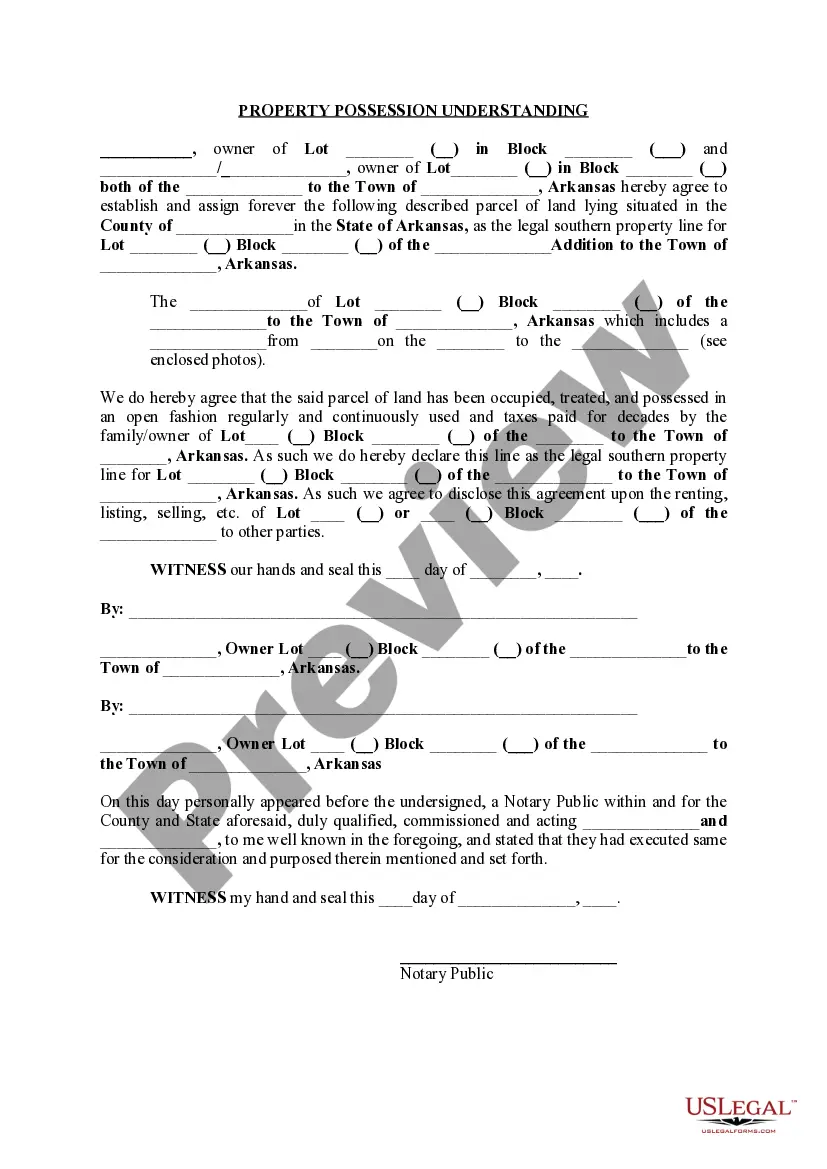
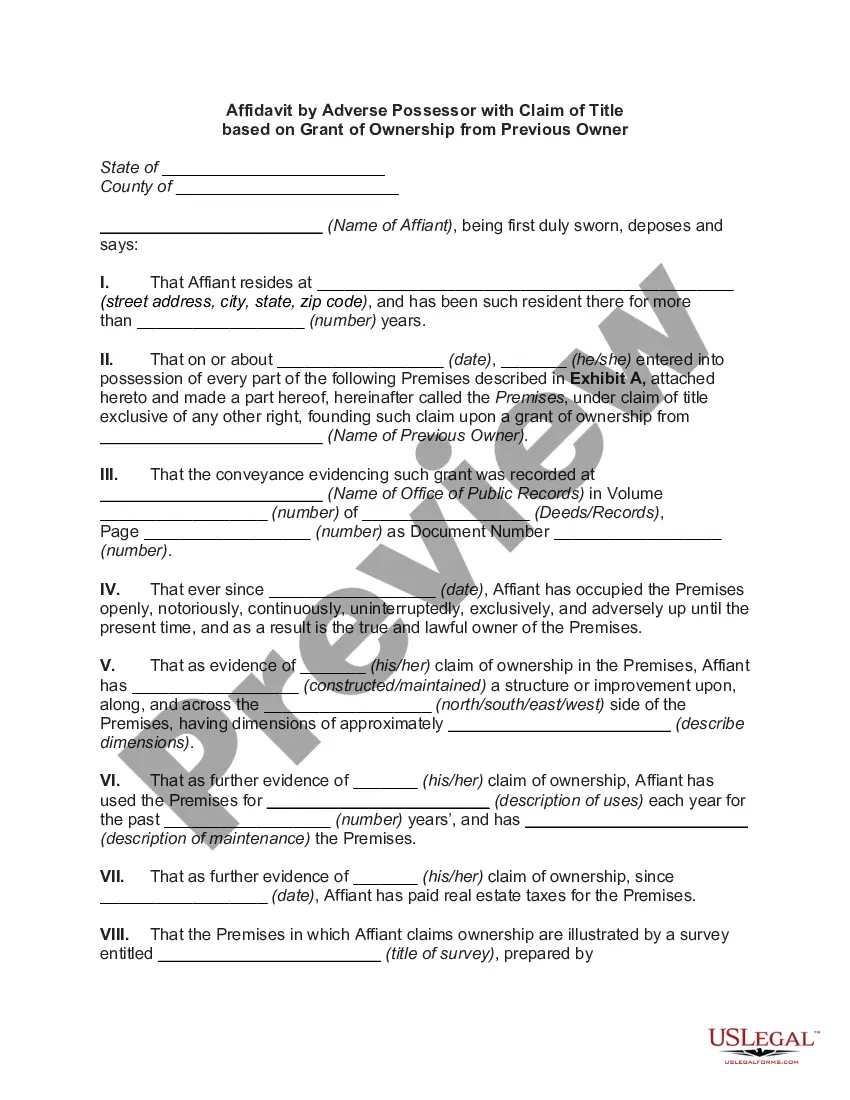
The Property Possession Understanding form is a legal document used to formalize the agreement between property owners regarding the boundaries and possession of their respective lots. Unlike similar documents, this form specifically addresses the southern property line, acknowledging that one party has openly and continuously possessed and treated the land for a significant period. This form helps prevent disputes and clarifies rights concerning property ownership and usage.
Main sections of this form
- Identification of property owners and their respective lots.
- Specification of the described parcel of land and its boundaries.
- Statement of long-term occupation and tax payment by one party.
- Agreement to disclose property line in transactions affecting the lots.
- Signature space for both property owners and a notary public.
When to use this form
This form is ideal for property owners who need to clarify possession rights over a specific boundary of land, particularly when it has been used or occupied without formal acknowledgment for many years. It is also recommended when planning to sell, rent, or otherwise transfer the property to ensure all parties are aware of the established property line and to mitigate potential disputes in the future.
Intended users of this form
- Property owners involved in boundary disputes.
- Individuals looking to formalize possession of a parcel of land.
- Homeowners planning to sell or lease their property.
- Real estate professionals assisting clients with property transactions.
Steps to complete this form
- Identify the property owners and clearly state their respective lot numbers and block information.
- Describe the parcel of land and specify its boundaries accurately.
- Include details about the occupation and usage of the property, including tax payment history.
- Both parties should sign the document, acknowledging their agreement.
- Have the form notarized to validate the signatures and the agreement.
Notarization requirements for this form
Yes, this form must be notarized to be legally valid. It's important to ensure that the signatures of all parties are witnessed by a notary public. US Legal Forms offers online notarization through secure video calls, available 24/7, allowing you to complete the process efficiently without needing to travel.
Get your form ready online
Our built-in tools help you complete, sign, share, and store your documents in one place.
Make edits, fill in missing information, and update formatting in US Legal Forms—just like you would in MS Word.
Download a copy, print it, send it by email, or mail it via USPS—whatever works best for your next step.
Sign and collect signatures with our SignNow integration. Send to multiple recipients, set reminders, and more. Go Premium to unlock E-Sign.
If this form requires notarization, complete it online through a secure video call—no need to meet a notary in person or wait for an appointment.
We protect your documents and personal data by following strict security and privacy standards.

Make edits, fill in missing information, and update formatting in US Legal Forms—just like you would in MS Word.

Download a copy, print it, send it by email, or mail it via USPS—whatever works best for your next step.

Sign and collect signatures with our SignNow integration. Send to multiple recipients, set reminders, and more. Go Premium to unlock E-Sign.

If this form requires notarization, complete it online through a secure video call—no need to meet a notary in person or wait for an appointment.

We protect your documents and personal data by following strict security and privacy standards.
Mistakes to watch out for
- Failing to accurately describe the parcel of land or its boundaries.
- Not including all necessary property ownersâ names and signatures.
- Overlooking the notarization requirement, which can lead to invalidation.
- Not considering local laws that may affect property lines and agreements.
Benefits of completing this form online
- Easy access to downloadable templates at your convenience.
- Quickly edit the form to fit your specific property details.
- Reliable legal language drafted by licensed attorneys ensures the document's validity.
- Saves time by avoiding long waits for in-person consultations.
Looking for another form?

Form popularity
FAQ
The so-called '7 year fence law' in Arkansas refers to a specific rule regarding property encroachments and adverse possession claims. If you build a fence that runs along a property line and maintain it for seven years, you may claim the land it encloses as your own. This law aims to clarify property boundaries and ownership disputes, making it an essential aspect of Arkansas property possession understanding. For further assistance with property laws, consider using resources from USLegalForms.
Paying property taxes can significantly strengthen your claim to ownership in Arkansas, although it does not guarantee it. If you possess a property under adverse possession, paying taxes may demonstrate your claim's validity. However, simply paying taxes does not automatically transfer ownership unless the adverse possession criteria are met. For a clearer pathway to understanding property ownership rights, explore the resources available on USLegalForms.
To claim adverse possession in Arkansas, you must demonstrate continuous and exclusive possession of the property for seven years. During this time, it is crucial that your use of the property is open and visible to others. Additionally, you may need to file a quiet title action to formally establish your ownership in court. Utilizing resources from platforms like USLegalForms can simplify this process and enhance your Arkansas property possession understanding.
In Arkansas, the shortest duration for adverse possession is seven years. This period is crucial, as it establishes your claim to the property. However, certain conditions like using the property openly and exclusively, as well as meeting the requirements discussed earlier, are necessary for your claim to be valid. When considering adverse possession, it's essential to have a solid grasp of Arkansas property possession understanding.
To claim adverse possession in Arkansas, you must meet five essential requirements. First, you must possess the property for a continuous period of at least seven years. Second, your possession must be actual, meaning you have to be physically present on the property. Third, your possession should be open and notorious, indicating that your presence is obvious to others. Fourth, it must be exclusive, meaning no one else holds possession. Finally, your possession must be hostile, asserting your claim against the true owner. Understanding these requirements can significantly aid your Arkansas property possession understanding.
When an owner dies in Arkansas, the property typically enters probate unless it is held in a trust. During probate, the estate is settled, and the property is transferred to the heirs according to the will or state law. Knowing the implications of Arkansas property possession can help heirs manage any associated challenges efficiently.
The order of heirship in Arkansas is determined by state law, which prioritizes spouses, children, and then more distant relatives. In the absence of a will, this legal structure dictates how property passes to heirs. Familiarizing oneself with Arkansas property possession understanding can simplify the complexities of inherited estates.
The property possession law in Arkansas embodies various statutes and case laws that govern how possession is established and defended. Key aspects include adverse possession, where a person can claim ownership if they possess it openly and continuously for a specific duration. For clarity in navigating these regulations, Arkansas property possession understanding is essential.
Arkansas recognizes several types of property ownership, including sole ownership, joint tenancy, and tenancy in common. Each type has distinct legal implications, especially regarding inheritance and transfer of property. Gaining a clear understanding of these structures can aid individuals in making informed decisions about their Arkansas property possession.
Heir property in Arkansas refers to property inherited without formal probate. This type of ownership can lead to challenges, such as ownership disputes among heirs. Exploring Arkansas property possession understanding is crucial for anyone dealing with heir property and its implications.