Employment Agreement with Physical Therapist
About this form
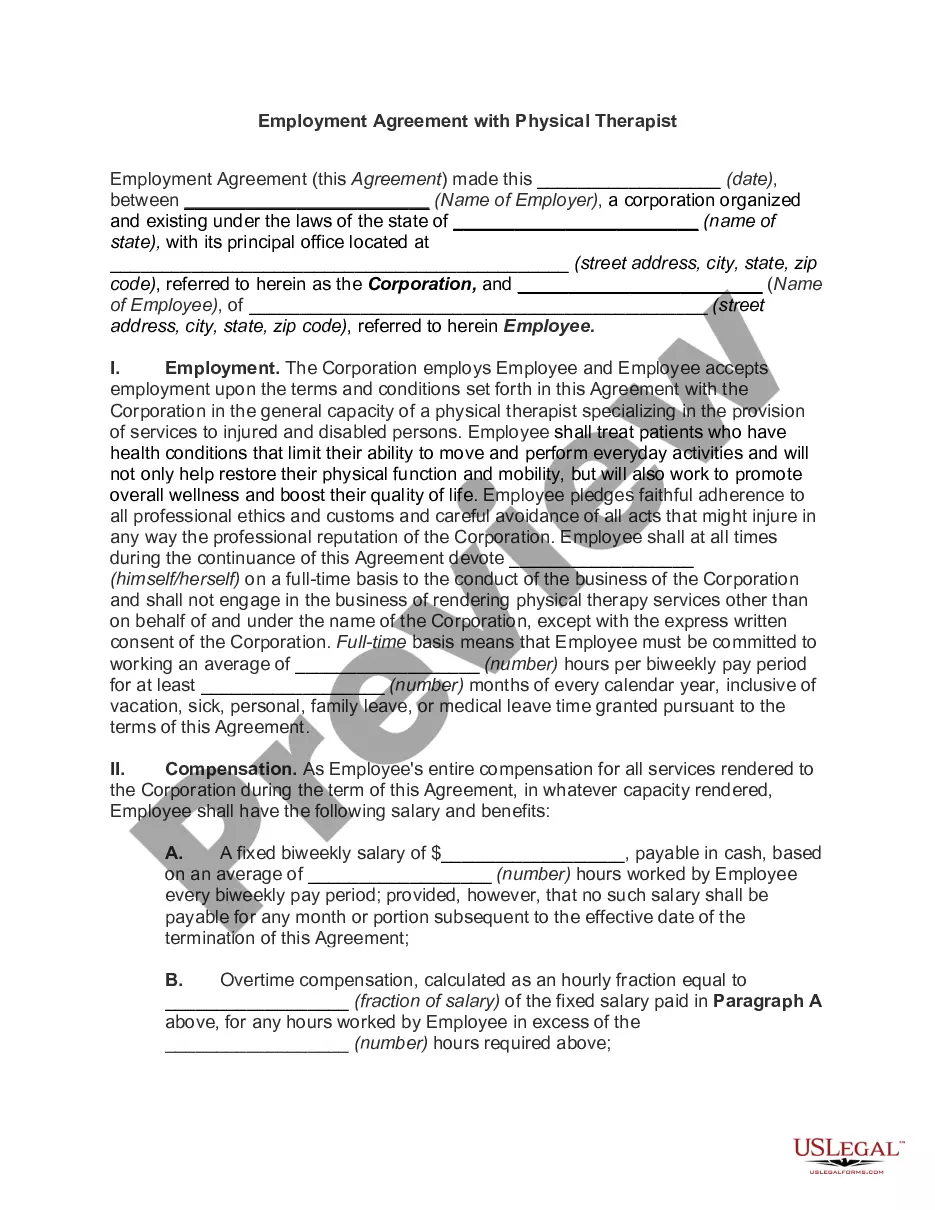
The Employment Agreement with Physical Therapist is a legal document that outlines the terms of employment for a physical therapist. This agreement specifies the roles, responsibilities, compensation, and other essential aspects of the employment relationship. This form is specifically tailored for hiring a physical therapist, distinguishing it from more generalized employment agreements by focusing on the unique skills and qualifications required in the field of physical therapy.
Form components explained
- Employment terms and conditions, including job responsibilities and ethical obligations.
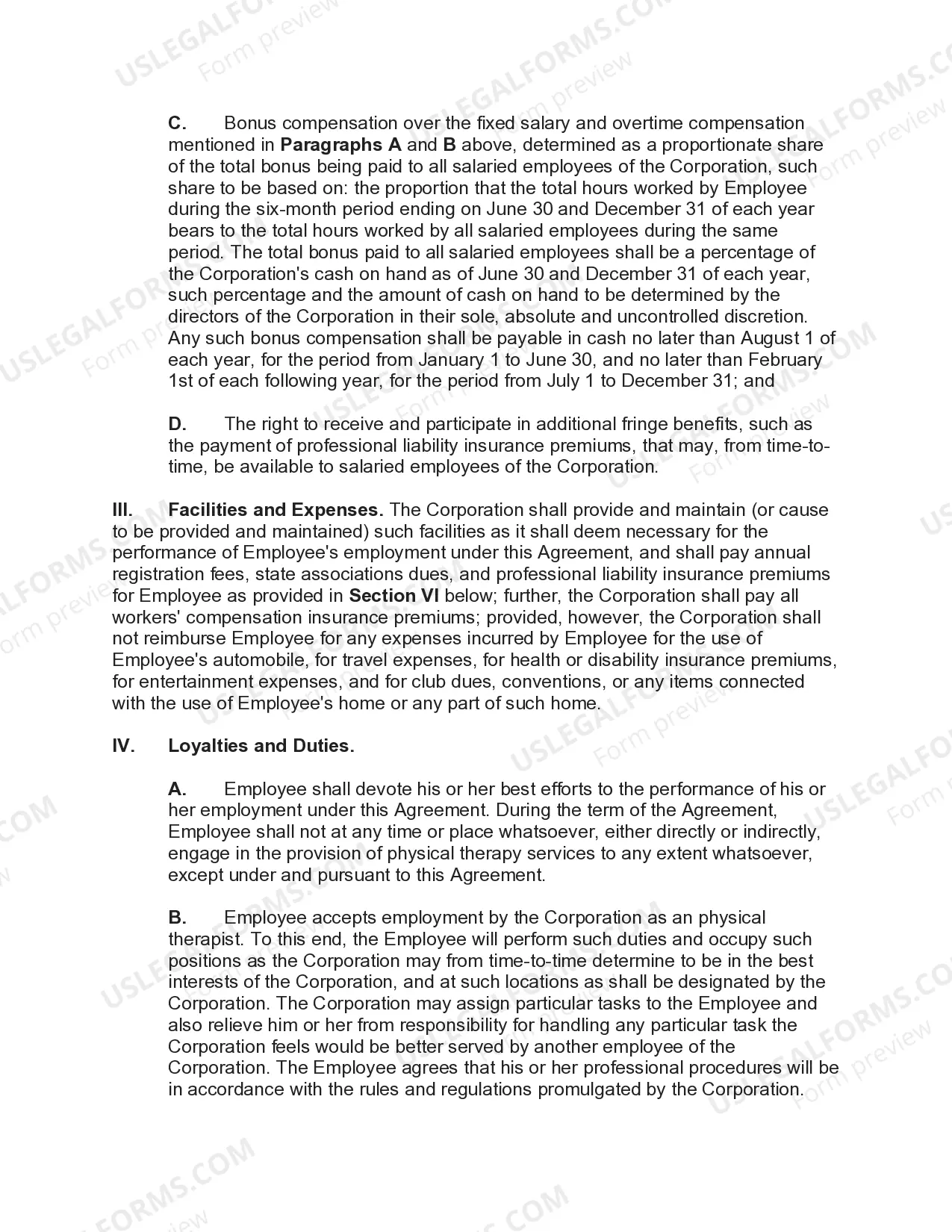
- Compensation details, including salary, bonuses, and benefits.
- Provisions related to facilities, expenses, and reimbursements.
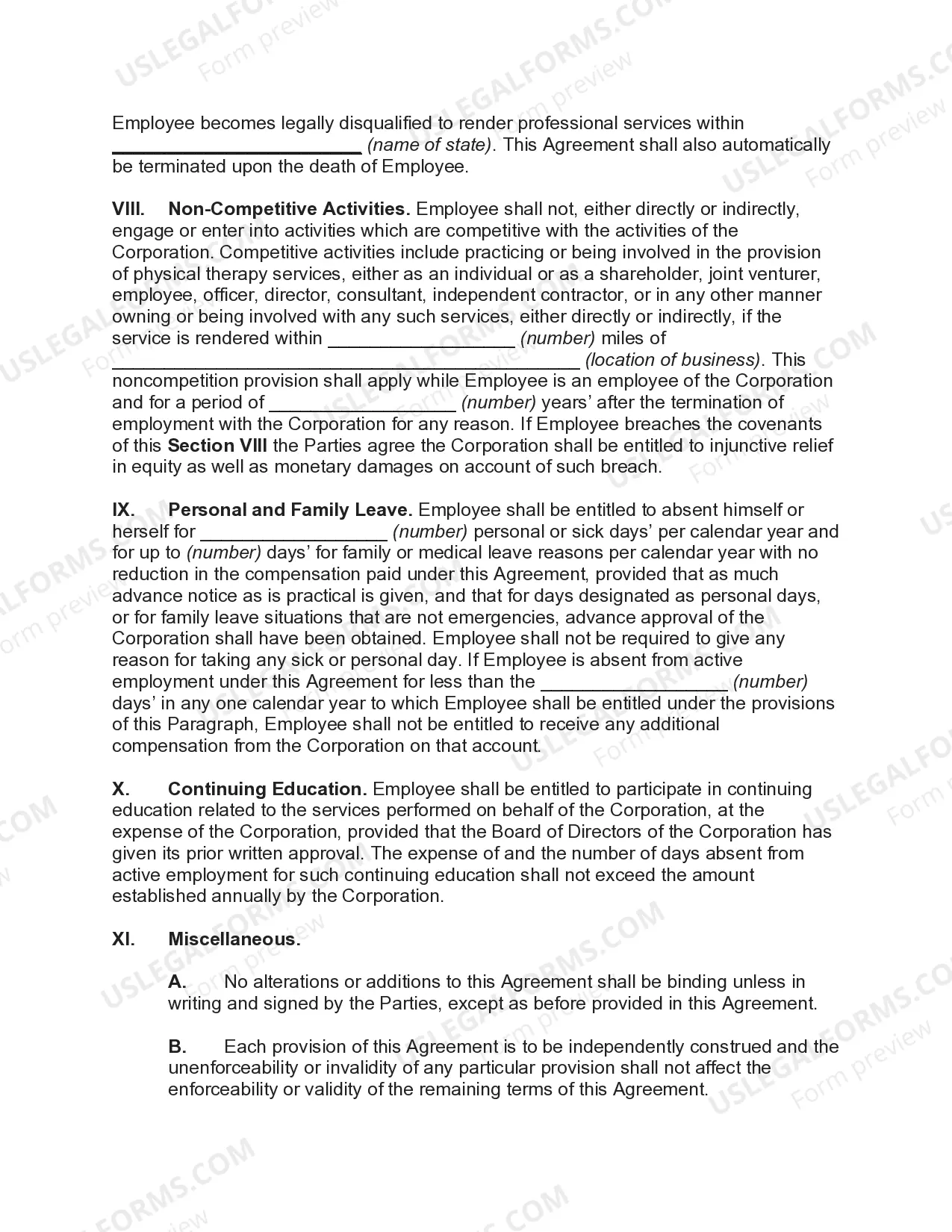
- Rules regarding non-competitive activities and confidentiality obligations.
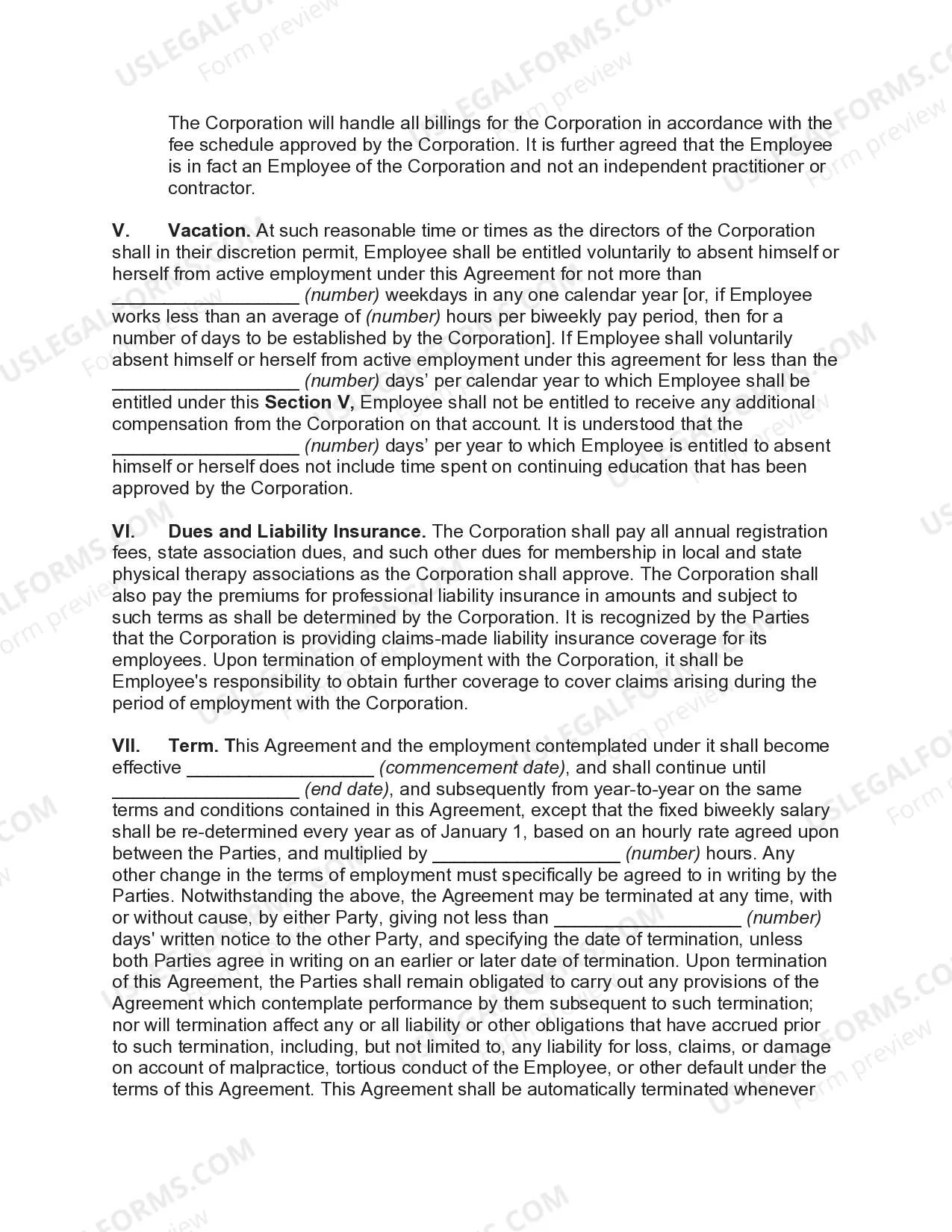
- Vacation and personal leave entitlements.
- Terms concerning continuing education and professional development.



Situations where this form applies
This Employment Agreement should be used when a medical facility or corporation is hiring a physical therapist to provide services. It is particularly relevant for establishing clear expectations regarding job duties, compensation, and professional standards so that both the employer and employee understand their rights and responsibilities from the start.
Who this form is for
- Employers seeking to hire a licensed physical therapist.
- Physical therapists entering into an employment relationship with healthcare providers.
- Managers and HR professionals responsible for drafting employment contracts.
How to prepare this document
- Identify the parties involved: the employer (corporation) and the physical therapist (employee).
- Specify employment details, including start date, job responsibilities, and working hours.
- Fill in salary, benefits, and any bonus structures applicable to the employee.
- Outline expectations regarding non-competitive activities and duties.
- Include provisions for vacation, leave entitlements, and continuing education opportunities.
Does this form need to be notarized?
This form does not typically require notarization unless specified by local law. However, it is advisable to check any state-specific regulations that may necessitate notarization for employment agreements.
Get your form ready online
Our built-in tools help you complete, sign, share, and store your documents in one place.
Make edits, fill in missing information, and update formatting in US Legal Forms—just like you would in MS Word.
Download a copy, print it, send it by email, or mail it via USPS—whatever works best for your next step.
Sign and collect signatures with our SignNow integration. Send to multiple recipients, set reminders, and more. Go Premium to unlock E-Sign.
If this form requires notarization, complete it online through a secure video call—no need to meet a notary in person or wait for an appointment.
We protect your documents and personal data by following strict security and privacy standards.

Make edits, fill in missing information, and update formatting in US Legal Forms—just like you would in MS Word.

Download a copy, print it, send it by email, or mail it via USPS—whatever works best for your next step.

Sign and collect signatures with our SignNow integration. Send to multiple recipients, set reminders, and more. Go Premium to unlock E-Sign.

If this form requires notarization, complete it online through a secure video call—no need to meet a notary in person or wait for an appointment.

We protect your documents and personal data by following strict security and privacy standards.
Common mistakes
- Failing to specify clear job responsibilities can lead to misunderstandings.
- Neglecting to outline compensation details, including bonuses and benefits.
- Not customizing the agreement for state-specific laws or requirements.
- Overlooking necessary provisions regarding termination and notice periods.
Benefits of completing this form online
- Convenience of downloading and customizing the form at any time.
- Easy access to templates drafted by licensed attorneys.
- Ability to edit and fill out the form digitally, ensuring accuracy.
Looking for another form?










Form popularity
FAQ
Because physical therapists and physical therapist assistants provide care directly to patients as contractors, under current law, they can no longer be independent contractors and must be employees unless they meet one of two criteria, recently passed into law under AB 2257.
An independent contractor (IC) is someone who is in an independent trade or profession offering services to the general public. An IC is considered to be able to control their own work, not the employer. 1fefffeff By contrast, an employee's work is controlled and directed by the employer.
Employment of physical therapists is projected to grow 18 percent from 2019 to 2029, much faster than the average for all occupations.
Licensure is required in order to practice as a PT or work as a PTA in the United States. You must pass the National Physical Therapy Exam, which is administered by the Federation of State Boards of Physical Therapy.
Job outlook: a statement that conveys the projected rate of growth or decline in employment in an occupation over the next 10 years; also compares the projected growth rate with that projected for all other occupations; see Growth rate.
Many PTs say they spend about 80 percent of their time each day in patient care, with the remaining 20 percent focused on administration (mostly paperwork: progress reports and insurance claims).
Accordingly, PTAs do not possess an independent scope of practice as do PTs. Each State's PT practice act defines the physical therapy scope of practice as belonging solely to the PT, who is legally responsible for all of the services, including the services of PTAs, provided under his or her supervision.
As a contract therapist, you don't get any paid time off, no 401(k) assistance, and you are (generally) on your own for healthcare. You might be offered a monthly stipend to go towards your healthcare premium, if you contract with a generous company.
First and foremost, California film and television producers have lost the option to hire most of their production crew as independent contractors under the new AB5 law. This is because California has tightened the guidelines of what classifies a worker as an employee instead of an independent contractor.