Broadcasting Agreement between Radio Station and High School Regarding Broadcasting Athletic Contest
What is this form?
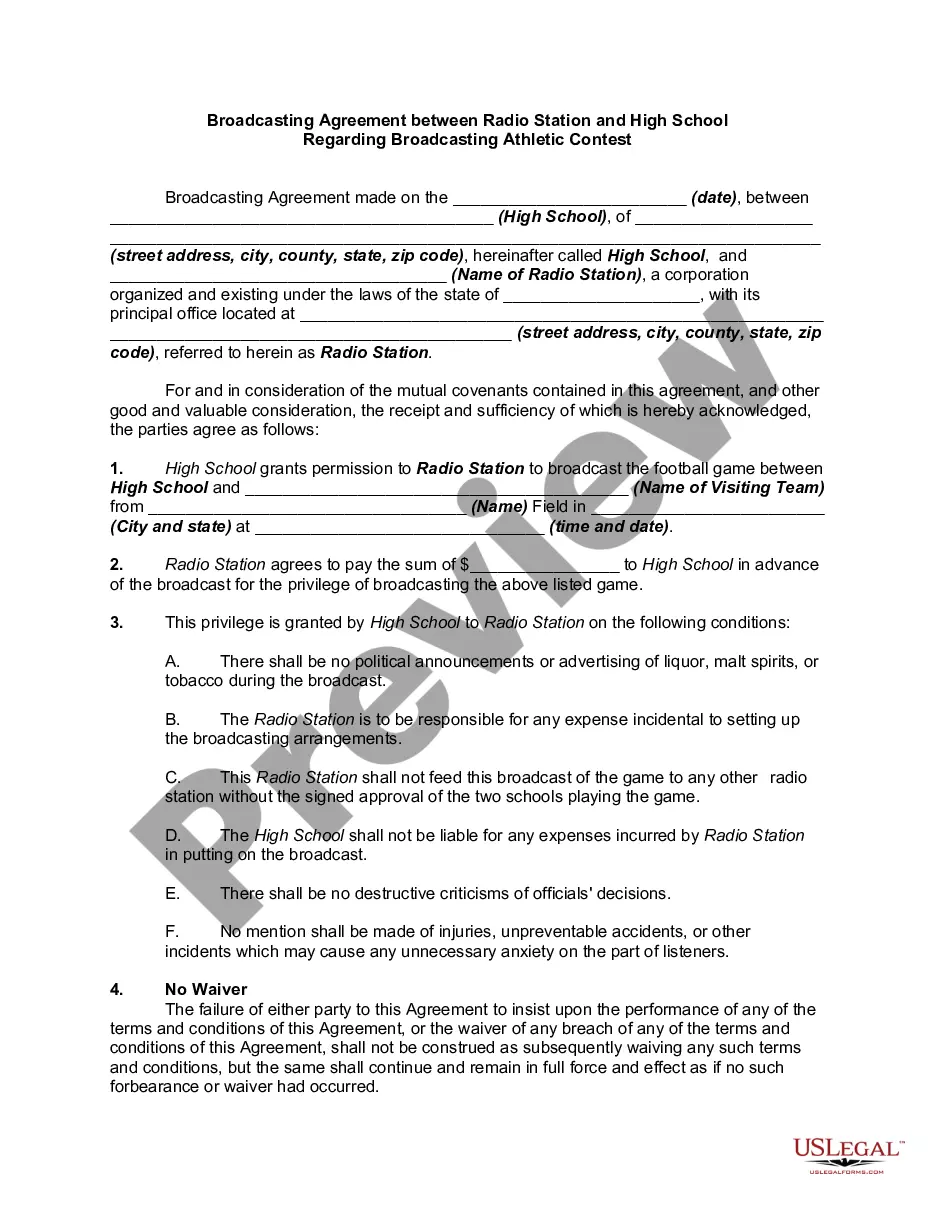
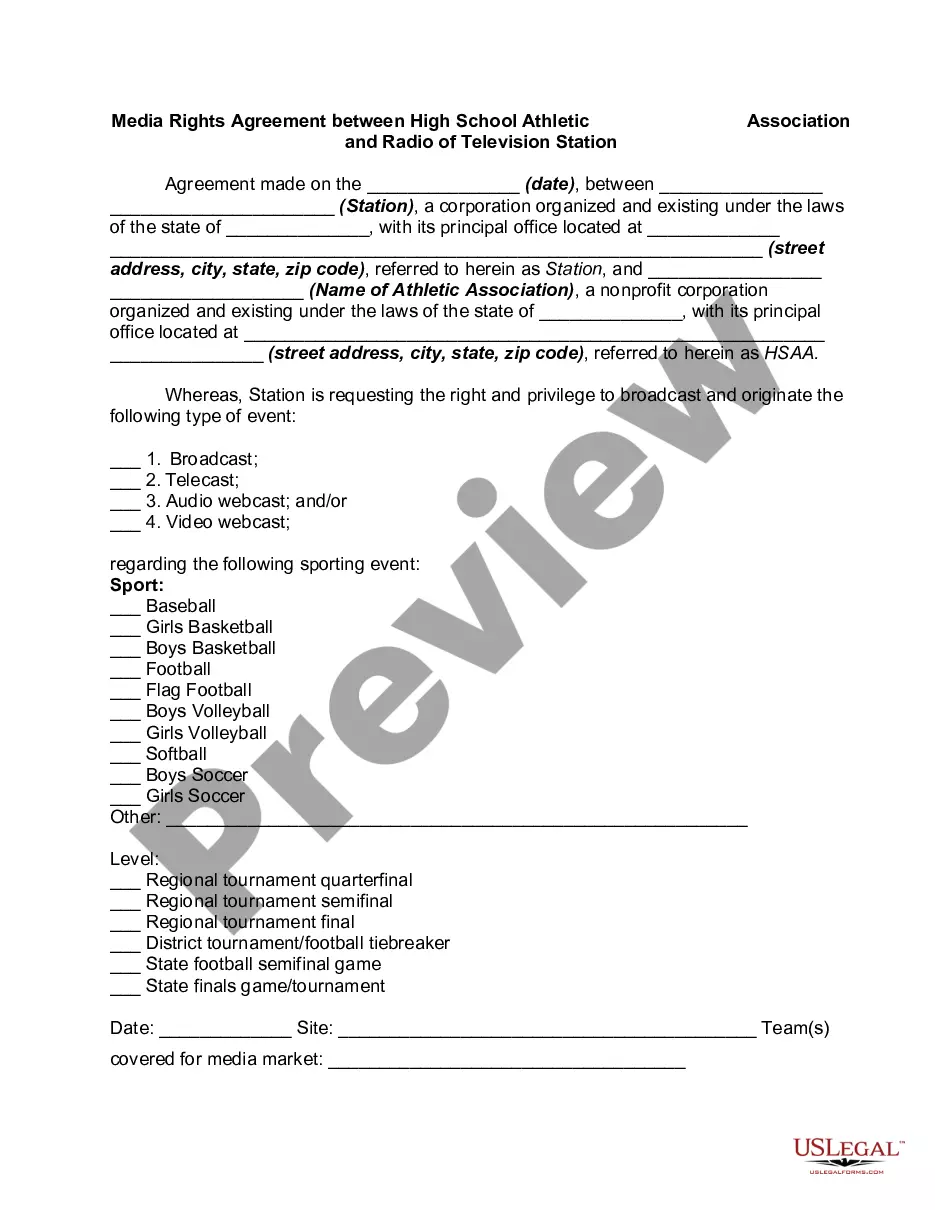
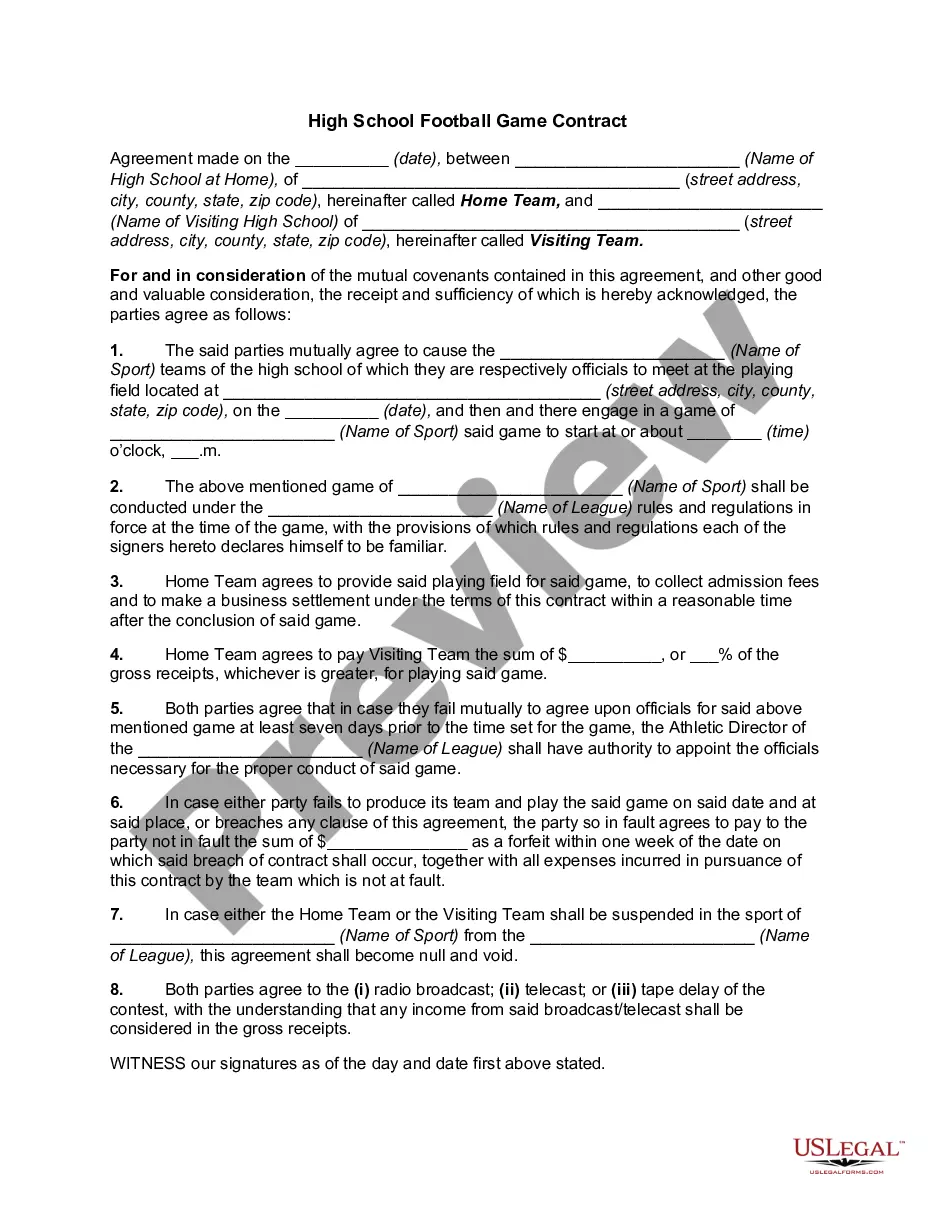
This Broadcasting Agreement serves as a legally binding contract between a radio station and a high school for the broadcasting of an athletic contest, such as a football game. It details the terms under which the radio station may broadcast the event, ensuring both parties are protected and aware of their responsibilities. This agreement is essential for any high school looking to manage their broadcasting rights effectively and maintain control over the content aired during the game.
Key parts of this document
- Date of the agreement.
- Identification of the high school and radio station involved.
- Details about the specific athletic contest being broadcast.
- Payment terms for the broadcasting rights.
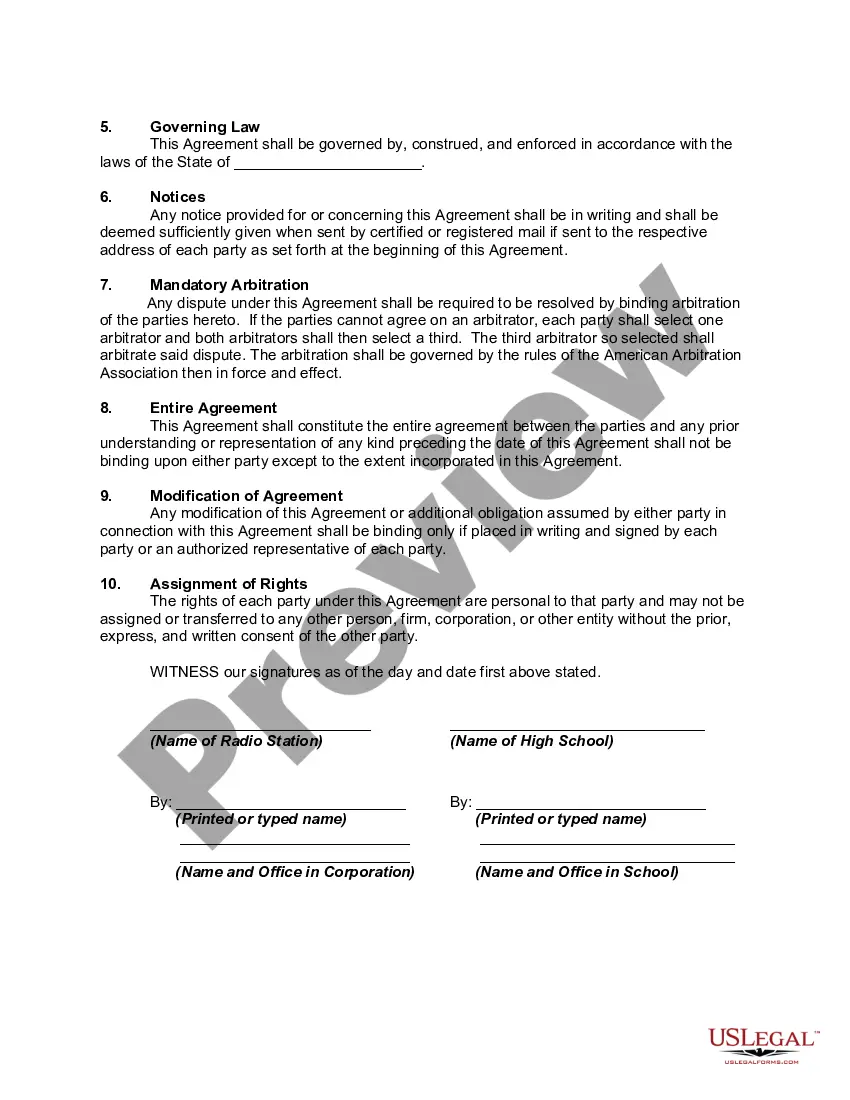
- Conditions regarding the broadcasting content and expenses incurred.
- Governing law and dispute resolution via arbitration.
When to use this form
This form should be used whenever a high school wants to authorize a radio station to broadcast an athletic event. It is particularly useful for events that are expected to attract significant local interest, such as championship games or rival matches, where proper legal arrangements can prevent misunderstandings about broadcasting rights and responsibilities.
Who should use this form
This form is intended for:
- High school administrators responsible for organizing athletic events.
- Radio station managers seeking broadcasting agreements with schools.
- Legal representatives of either party involved in the agreement.
Instructions for completing this form
- Fill in the date of the agreement.
- Provide the full names and addresses of the high school and radio station.
- Specify details of the athletic contest, including teams, location, and broadcast time.
- Indicate the payment amount agreed upon for broadcasting the event.
- Ensure all parties sign the agreement, including printed names and titles.
Does this form need to be notarized?
Notarization is not commonly needed for this form. However, certain documents or local rules may make it necessary. Our notarization service, powered by Notarize, allows you to finalize it securely online anytime, day or night.
Get your form ready online
Our built-in tools help you complete, sign, share, and store your documents in one place.
Make edits, fill in missing information, and update formatting in US Legal Forms—just like you would in MS Word.
Download a copy, print it, send it by email, or mail it via USPS—whatever works best for your next step.
Sign and collect signatures with our SignNow integration. Send to multiple recipients, set reminders, and more. Go Premium to unlock E-Sign.
If this form requires notarization, complete it online through a secure video call—no need to meet a notary in person or wait for an appointment.
We protect your documents and personal data by following strict security and privacy standards.

Make edits, fill in missing information, and update formatting in US Legal Forms—just like you would in MS Word.

Download a copy, print it, send it by email, or mail it via USPS—whatever works best for your next step.

Sign and collect signatures with our SignNow integration. Send to multiple recipients, set reminders, and more. Go Premium to unlock E-Sign.

If this form requires notarization, complete it online through a secure video call—no need to meet a notary in person or wait for an appointment.

We protect your documents and personal data by following strict security and privacy standards.
Common mistakes to avoid
- Failing to specify the date and time of the event being broadcast.
- Not including payment details, which can lead to disputes.
- Omitting necessary signatures or printed names from the agreement.
- Assuming verbal agreements are sufficient; all terms must be written.
Why use this form online
- Immediate access to downloadable and customizable templates.
- No need for legal consultations, saving time and money.
- Easily editable to meet specific requirements of the high school or radio station.
- Secure storage and retrieval of important legal documents.
Legal use & context
- The agreement must comply with local and state laws regarding broadcasting rights and educational institutions.
- It is a binding contract that can be enforced in court if necessary, provided it is properly completed and signed.
- Consideration of legal oversight is important to ensure compliance with advertising regulations during broadcasts.
Quick recap
- The Broadcasting Agreement is essential for formalizing the understanding between high schools and radio stations regarding athletic event broadcasts.
- It specifies payment, terms of the broadcast, and conditions to ensure a fair and responsible partnership.
- Using this form helps protect the interests of both parties and fosters community support for local athletic programs.
Looking for another form?
Form popularity
FAQ
Broadcasting rights also help boost other revenue streams, such as in stadia advertising, corporate sponsorship deals and naming rights, all of which acquire added value because of the visibility that broadcasting affords.
Transmitter. The transmitter is the key component to any radio broadcast. Receiver. The receiver picks up the encoded broadcast signal, decodes it, and allows for you to hear it. Antenna. Transmission Lines. Audio Processor. Mixer. Speakers. Cables.
To receive the content the listener must have a broadcast radio receiver (radio).Television broadcasting is a separate service which also uses radio frequencies to broadcast television (video) signals.
Overview. The Sports Broadcasting Act was passed in response to a court decision which ruled that the NFL's method of negotiating television broadcasting rights violated antitrust laws. The court ruled that the "pooling" of rights by all the teams to conclude an exclusive contract between the league and CBS was illegal
On 17 May 1939, the United States' first televised sporting event, a college baseball game between the Columbia Lions and Princeton Tigers, was broadcast by NBC from Columbia's Baker Field.
Get your bachelor's degree. A bachelor's degree is required to hold a position as a sports broadcaster. Get experience. Complete an internship. Review your work. Study other broadcasters. Learn the rules of various games. Create a demo tape. Apply at local news and radio stations.
The Licensing of TV and Radio Stations. Commercial and Noncommercial Educational Stations. The FCC licenses FM radio and full power TV stations as either commercial or noncommercial educational (NCE). (Most AM radio stations are licensed as commercial facilities.)
The term 'broadcast media' covers a wide range of different communication methods that include television, radio, podcasts, blogs, advertising, websites, online streaming and digital journalism.
The holder (or owner) of the copyright in telecasts of live sports programming is generally the sports leagues or individual sports clubs.