Jury Instruction - 2.2.1 First Amendment Claim Prisoner Alleging Denial Of Access To Courts
Overview of this form
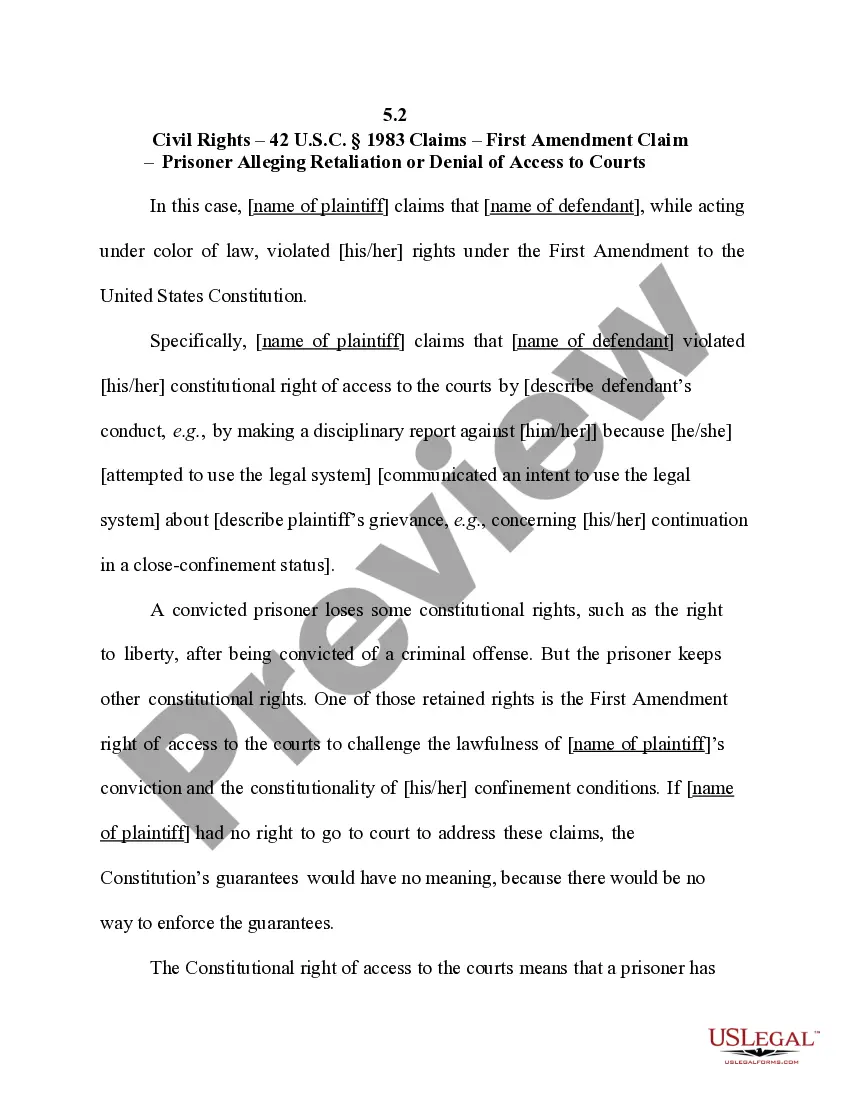
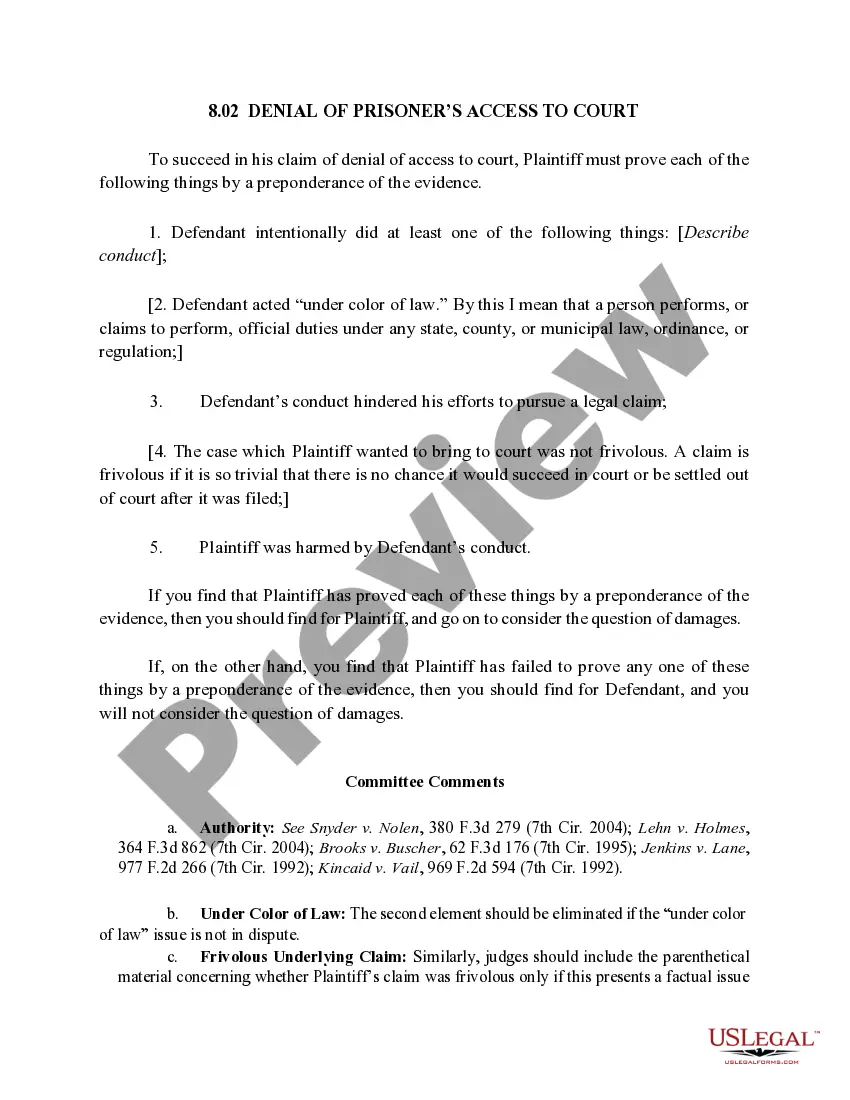
The Jury Instruction - 2.2.1 First Amendment Claim Prisoner Alleging Denial Of Access To Courts is a legal template that provides model language for juries to understand the rights of prisoners under the First Amendment. This form aids in conveying complex legal concepts surrounding a prisonerâs right to access the courts, particularly in the context of claims that their rights have been violated by state actions. Unlike standard jury instructions, this form includes specific elements related to civil rights claims under 42 USC 1983.
Main sections of this form
- Overview of the First Amendment rights related to access to the courts for prisoners.
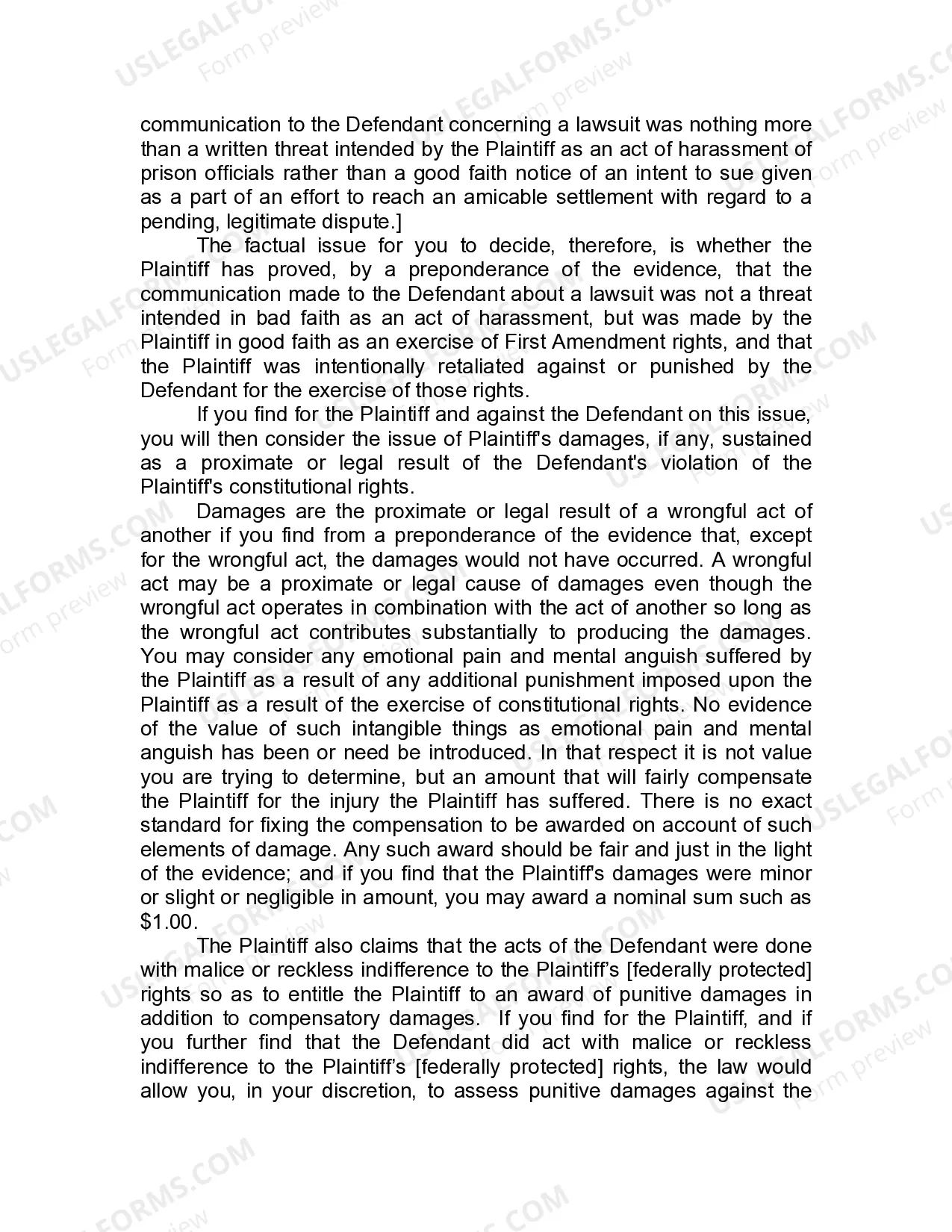
- Definition of what constitutes retaliation or punishment against a prisoner for exercising their rights.
- Guidance on assessing damages for emotional pain and mental anguish incurred by the prisoner.
- Instructions on determining whether punitive damages are appropriate based on the defendant's actions.
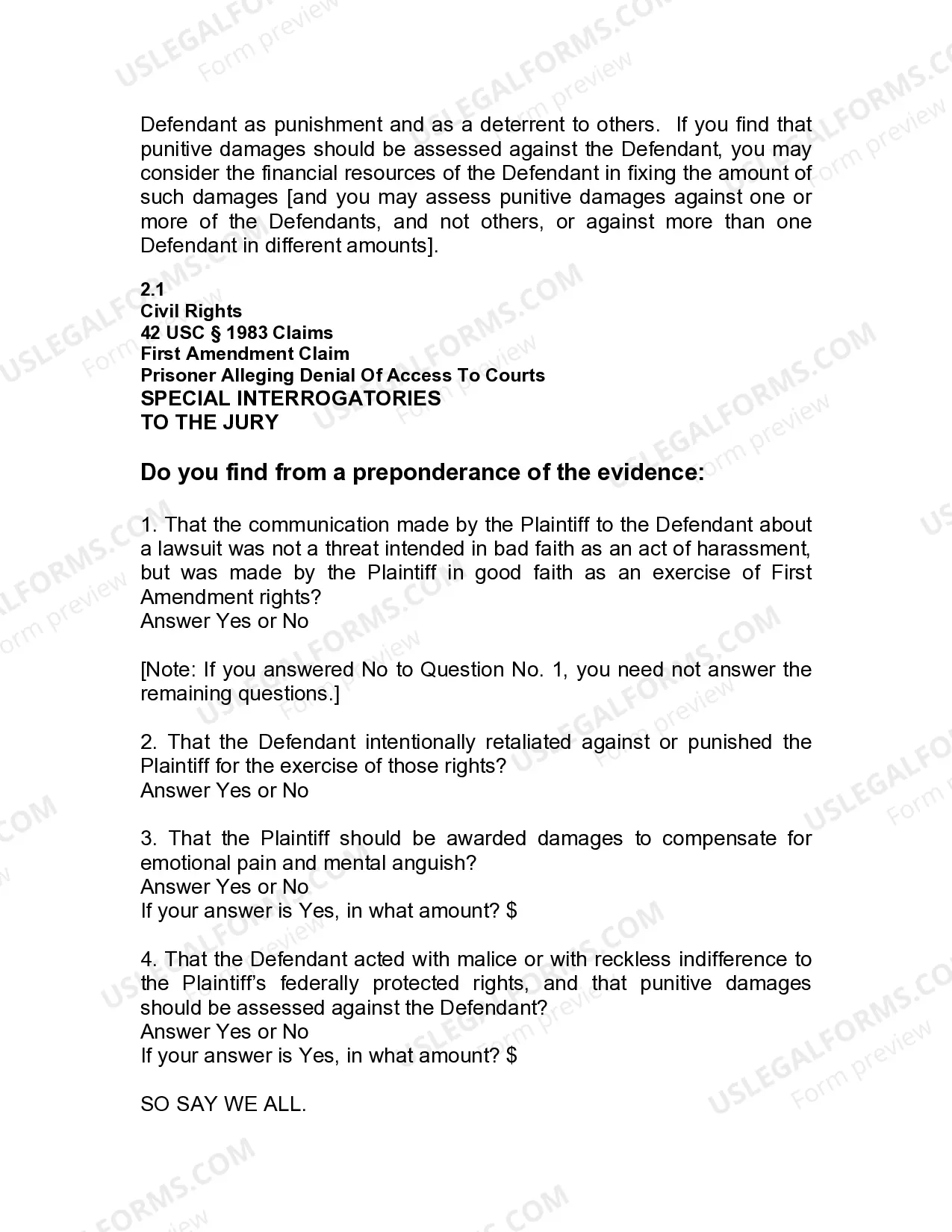
- Special interrogatories for the jury to establish findings of fact regarding the plaintiff and defendant actions.



When to use this document
This form should be used in cases where a convicted prisoner claims their First Amendment rights were infringed upon due to a denial of access to the courts. Situations may include instances where a prisoner is punished for filing lawsuits or expressing intent to sue regarding their treatment or conditions of confinement.
Who can use this document
This form is intended for:
- Attorneys representing prisoners in civil rights cases.
- Jury panels for civil rights lawsuits under 42 USC 1983.
- Legal professionals seeking to educate juries about First Amendment implications concerning prisoners.
Steps to complete this form
To complete this form, follow these steps:
- Identify the plaintiff (the prisoner) and the defendant (state official) in the case.
- Specify the nature of the communication made by the plaintiff regarding their intent to sue.
- Assess whether the plaintiff's communication was made in good faith and not intended as harassment.
- Determine the extent of any damages sustained by the plaintiff as a result of the defendant's actions.
- Evaluate if the defendant acted with malice or reckless indifference towards the plaintiff's rights.
Notarization requirements for this form
Notarization is not commonly needed for this form. However, certain documents or local rules may make it necessary. Our notarization service, powered by Notarize, allows you to finalize it securely online anytime, day or night.
Get your form ready online
Our built-in tools help you complete, sign, share, and store your documents in one place.
Make edits, fill in missing information, and update formatting in US Legal Forms—just like you would in MS Word.
Download a copy, print it, send it by email, or mail it via USPS—whatever works best for your next step.
Sign and collect signatures with our SignNow integration. Send to multiple recipients, set reminders, and more. Go Premium to unlock E-Sign.
If this form requires notarization, complete it online through a secure video call—no need to meet a notary in person or wait for an appointment.
We protect your documents and personal data by following strict security and privacy standards.

Make edits, fill in missing information, and update formatting in US Legal Forms—just like you would in MS Word.

Download a copy, print it, send it by email, or mail it via USPS—whatever works best for your next step.

Sign and collect signatures with our SignNow integration. Send to multiple recipients, set reminders, and more. Go Premium to unlock E-Sign.

If this form requires notarization, complete it online through a secure video call—no need to meet a notary in person or wait for an appointment.

We protect your documents and personal data by following strict security and privacy standards.
Typical mistakes to avoid
- Failing to adequately present evidence that distinguishes between good faith communication and threats.
- Not fully understanding the implications of punitive damages and under what circumstances they apply.
- Neglecting to consider the emotional impact and intangible damages suffered by the plaintiff.
Why use this form online
- Convenience of obtaining a legally vetted jury instruction template online.
- Accessibility for attorneys and users to tailor the instruction to fit specific cases.
- Time-saving as it eliminates the need for drafting from scratch.
- The form is legally sound and provides a clear framework for determining civil rights violations.
- It specifies the criteria under which prisoner rights are enforced in legal proceedings.
- This template is aligned with federal laws, enhancing its applicability in multiple jurisdictions.
What to keep in mind
- The Jury Instruction addresses essential First Amendment rights of prisoners.
- It assists juries in evaluating claims of retaliation in the context of prison law.
- Understanding both compensatory and punitive damages is crucial when using this form.
Looking for another form?


Form popularity
FAQ
Congress shall make no law respecting an establishment of religion, or prohibiting the free exercise thereof; or abridging the freedom of speech, or of the press; or the right of the people peaceably to assemble, and to petition the Government for a redress of grievances.
The Bill of Rights is the first 10 Amendments to the Constitution.
The Bill of Rights First Amendment: Freedom of religion, freedom of speech and the press, the right to assemble, the right to petition government. Second Amendment: The right to form a militia and to keep and bear arms. Third Amendment: The right not to have soldiers in one's home.
Between 1789 and December 2014, about 11,623 amendments were proposed in Congress.In total, in the past 227 years, Congress has sent only 33 amendments to the states for ratification just about one out of every 500 suggested amendments. Of these 33, the states have ratified 27.
The Bill of Rights First Amendment: Freedom of religion, freedom of speech and the press, the right to assemble, the right to petition government. Second Amendment: The right to form a militia and to keep and bear arms. Third Amendment: The right not to have soldiers in one's home.