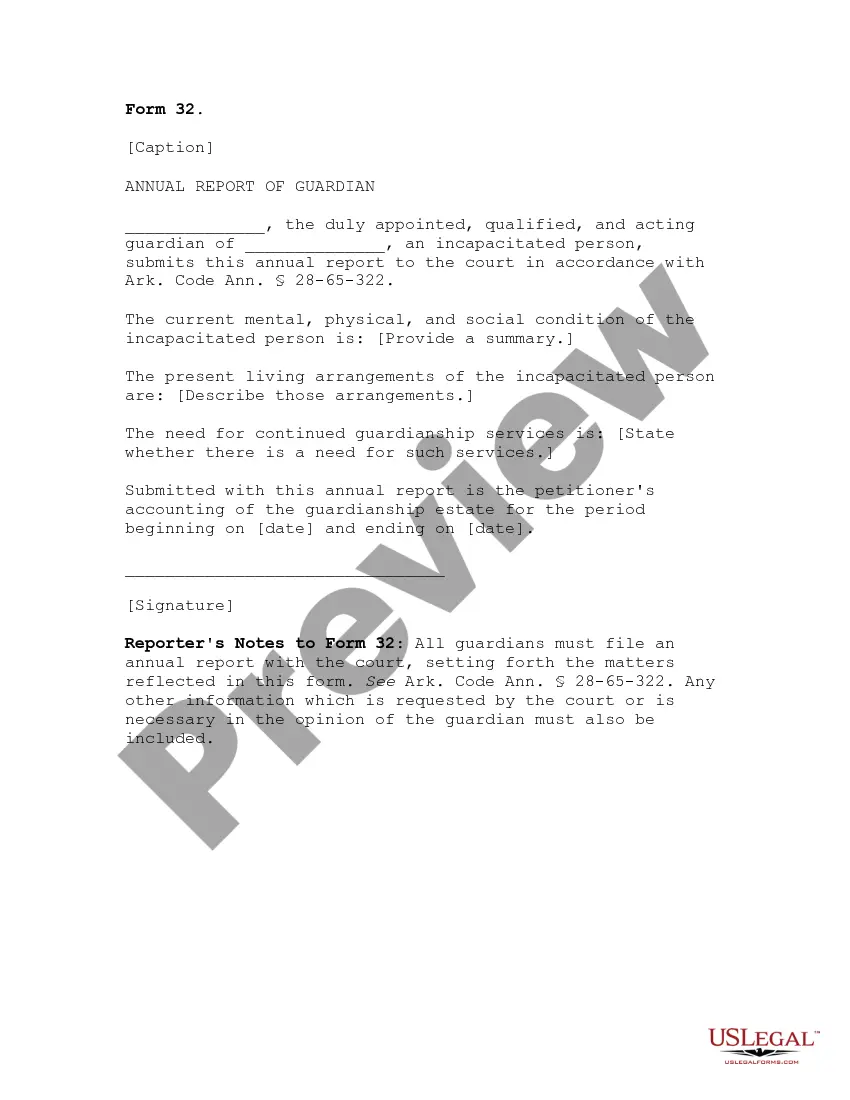
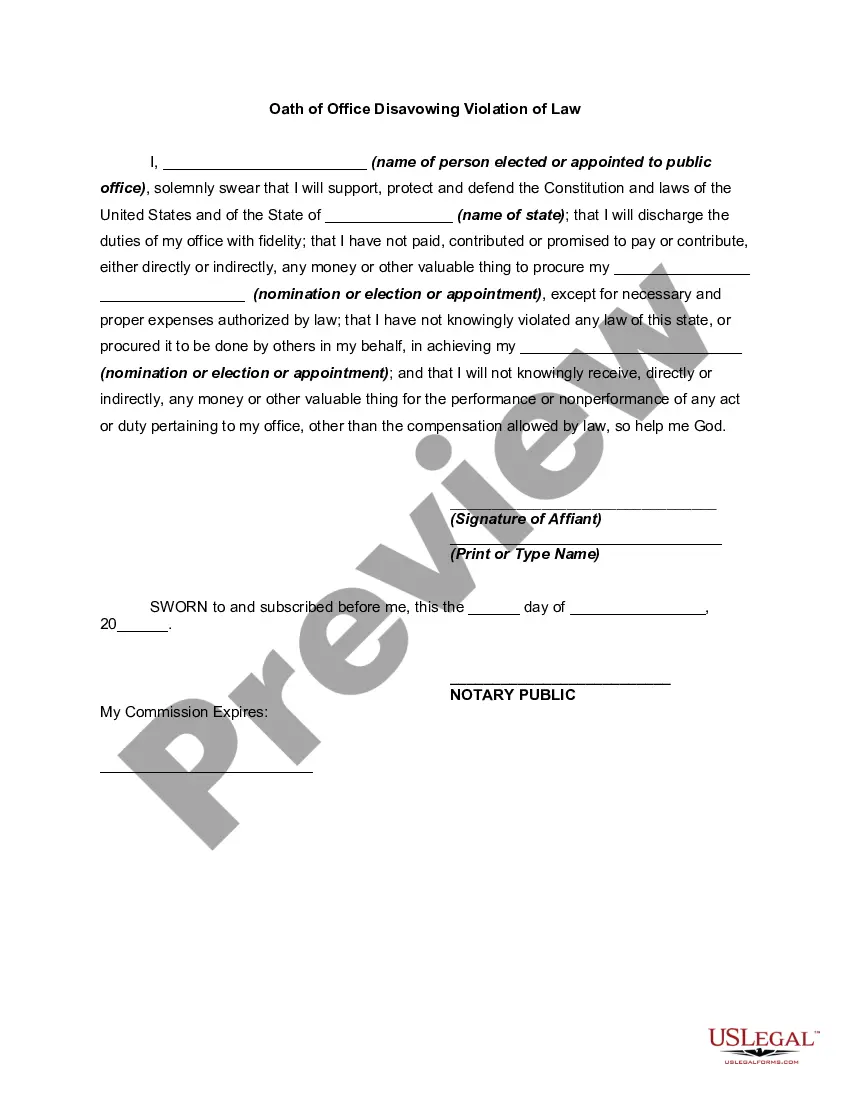
Oath of Office Disavowing Violation of Law
About this form
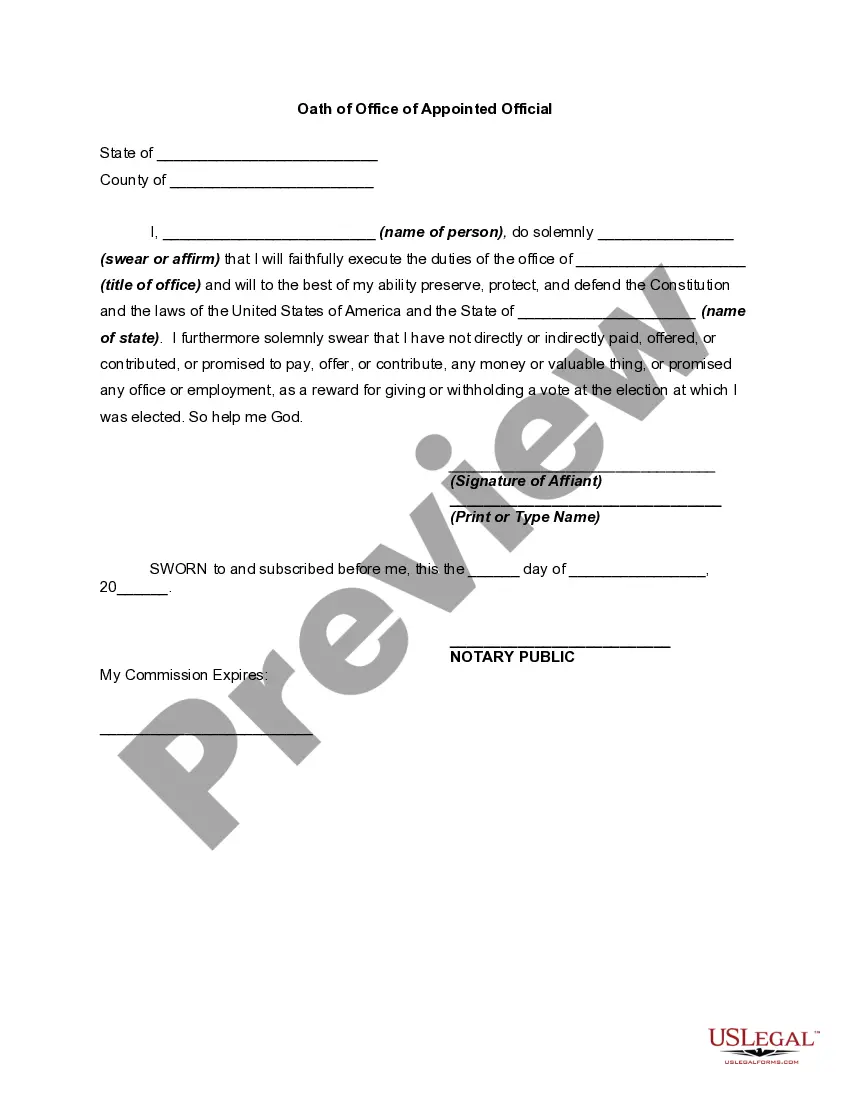
The Oath of Office Disavowing Violation of Law is a legal document that public officials use to affirm their commitment to uphold the laws and the constitution. This form is specifically designed to ensure that the individual has not engaged in any unlawful practices in relation to their nomination, election, or appointment. It is essential for establishing integrity among public officials and differs from similar forms by explicitly disavowing any prior law violations related to their office responsibilities.
Key components of this form
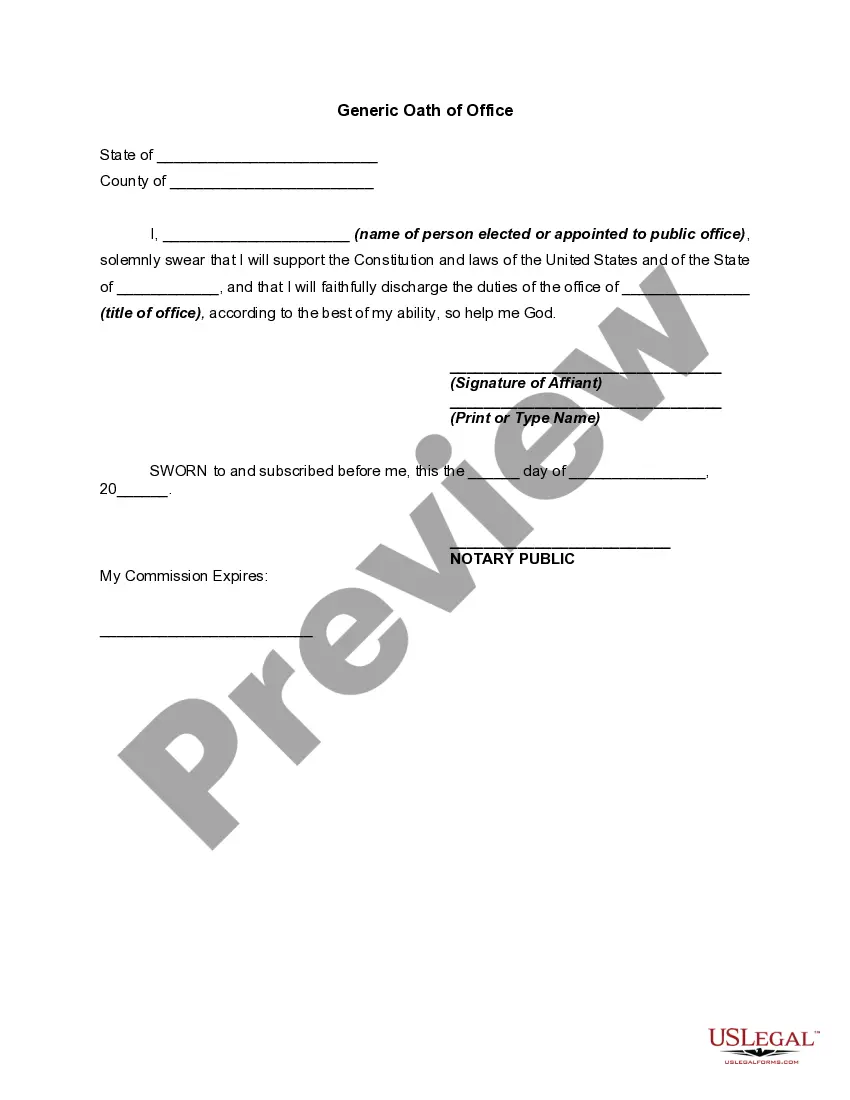
- Name of the elected or appointed person.
- Signature of the affiant (the person taking the oath).
- Name of the state for legal jurisdiction.
- Statement of allegiance to the U.S. Constitution and state laws.
- Declaration of no unlawful financial contributions related to the office.
- Notary acknowledgment section for verification.
When to use this document
This form should be used by individuals who have been nominated, elected, or appointed to a public office. It is crucial in instances where officials must formally declare their commitment to adhere to the law and serve their duties without any unlawful influences. Using this form can help maintain trust in public service and ensure compliance with legal and ethical standards.
Intended users of this form
- Individuals appointed to public office.
- Candidates running for public office.
- Elected officials looking to reaffirm their commitment to lawful conduct.
- Public servants required to submit an oath as a condition of office.
Completing this form step by step
- Enter the name of the individual being elected or appointed.
- Specify the state reflecting the jurisdiction of the office.
- Read the declaration carefully and affirm commitment to the law.
- Sign the form in the designated space for the affiant.
- Have the form notarized by a qualified notary public.
Does this form need to be notarized?
Notarization is required for this form to take effect. Our online notarization service, powered by Notarize, lets you verify and sign documents remotely through an encrypted video session, available 24/7.
Get your form ready online
Our built-in tools help you complete, sign, share, and store your documents in one place.
Make edits, fill in missing information, and update formatting in US Legal Forms—just like you would in MS Word.
Download a copy, print it, send it by email, or mail it via USPS—whatever works best for your next step.
Sign and collect signatures with our SignNow integration. Send to multiple recipients, set reminders, and more. Go Premium to unlock E-Sign.
If this form requires notarization, complete it online through a secure video call—no need to meet a notary in person or wait for an appointment.
We protect your documents and personal data by following strict security and privacy standards.

Make edits, fill in missing information, and update formatting in US Legal Forms—just like you would in MS Word.

Download a copy, print it, send it by email, or mail it via USPS—whatever works best for your next step.

Sign and collect signatures with our SignNow integration. Send to multiple recipients, set reminders, and more. Go Premium to unlock E-Sign.

If this form requires notarization, complete it online through a secure video call—no need to meet a notary in person or wait for an appointment.

We protect your documents and personal data by following strict security and privacy standards.
Mistakes to watch out for
- Failing to properly fill out the name of the state.
- Neglecting to sign the form before a notary.
- Forgetting to specify whether the individual is being nominated, elected, or appointed.
- Providing incomplete information in the declaration about prior lawful conduct.
Why use this form online
- Convenience of immediate access from any device.
- Easy editing features to customize the form as needed.
- Reliable templates drafted by licensed attorneys to ensure legal compliance.
- Eliminates the need for paper forms by providing a downloadable format.
Key takeaways
- The Oath of Office Disavowing Violation of Law is crucial for public officeholders.
- Completion of this form is necessary to pledge adherence to legal standards.
- Ensure accuracy and compliance with state-specific regulations.
Looking for another form?








Form popularity
FAQ
The Constitution defines treason as specific acts, namely "levying War against the United States, or in adhering to their Enemies, giving them Aid and Comfort." A contrast is therefore maintained with the English law, whereby crimes including conspiring to kill the King or "violating" the Queen, were punishable as
Lawyers are the foot soldiers of our Constitution. Every lawyer in the United States swears an oath.Each state's oath varies. However, there is a similarity in all oaths: every lawyer swears to support the Constitution of the United States.
Before he enter on the Execution of his Office, he shall take the following Oath or Affirmation: I do solemnly swear (or affirm) that I will faithfully execute the Office of President of the United States, and will to the best of my Ability, preserve, protect and defend the Constitution of the United States.
I do solemnly swear (or affirm) that I will support and defend the Constitution of the United States against all enemies, foreign and domestic; that I will bear true faith and allegiance to the same; that I take this obligation freely, without any mental reservation or purpose of evasion; and that I will well and
Text of Legal Provision The President of the Republic is not liable for his acts undertaken in the exercise of his functions except in the case of high treason. He cannot be charged except by a vote of the absolute majority of the two Assemblies and tried by the Supreme Court of Justice.
Under the laws of a state, it may be considered treason or a high crime to betray a sworn oath of office. The word "oath" and the phrase "I swear" refer to a solemn vow. For those who choose not to, the alternative terms "solemn promise" and "I promise" are sometimes used.
"I do solemnly swear (or affirm) that I will support and defend the Constitution of the United States against all enemies, foreign and domestic; that I will bear true faith and allegiance to the same; that I take this obligation freely, without any mental reservation or purpose of evasion; and that I will well and
The Oath, as stated in Article II, Section I, Clause 8 of the U.S. Constitution, is as follows: "I do solemnly swear (or affirm) that I will faithfully execute the office of President of the United States, and will to the best of my ability, preserve, protect and defend the Constitution of the United States."
Theodore Roosevelt did not use the Bible when taking the oath in 1901, nor did John Quincy Adams, who swore on a book of law, with the intention that he was swearing on the constitution. Lyndon B. Johnson was sworn in on a Roman Catholic missal on Air Force One.