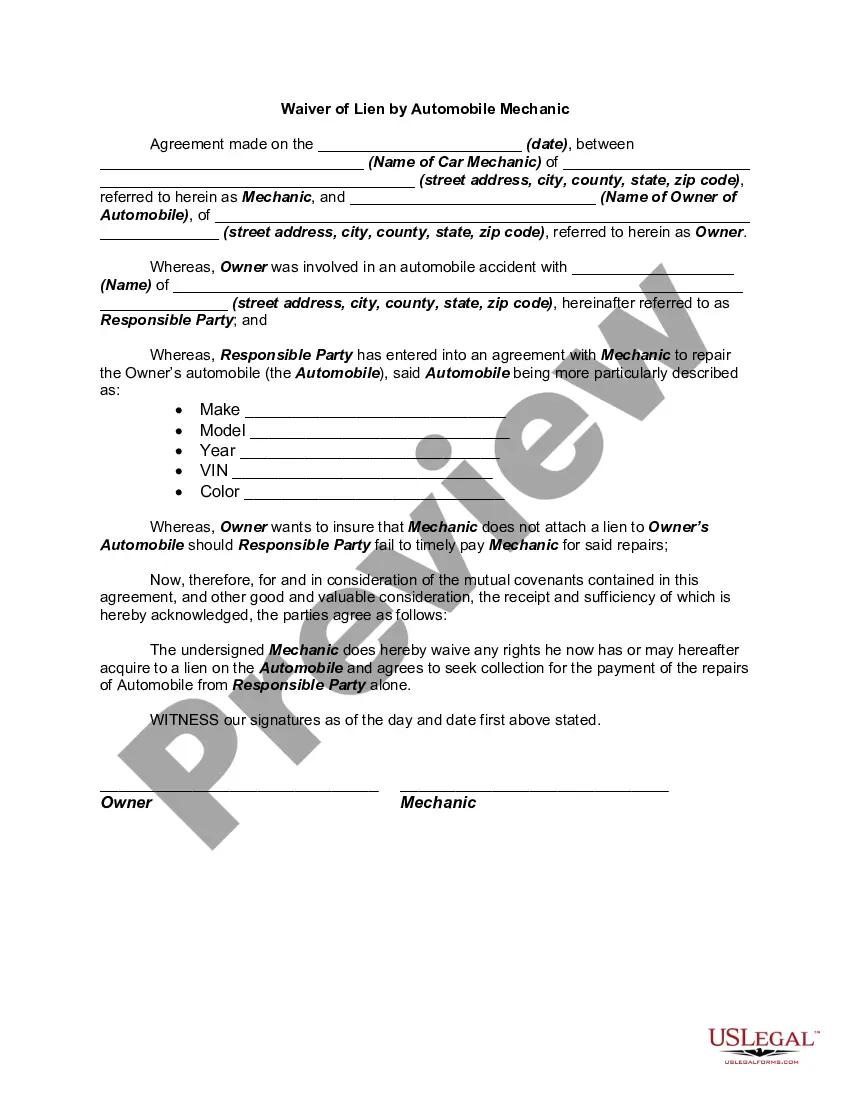
Waiver of Lien by Automobile or Car Mechanic
What is this form?
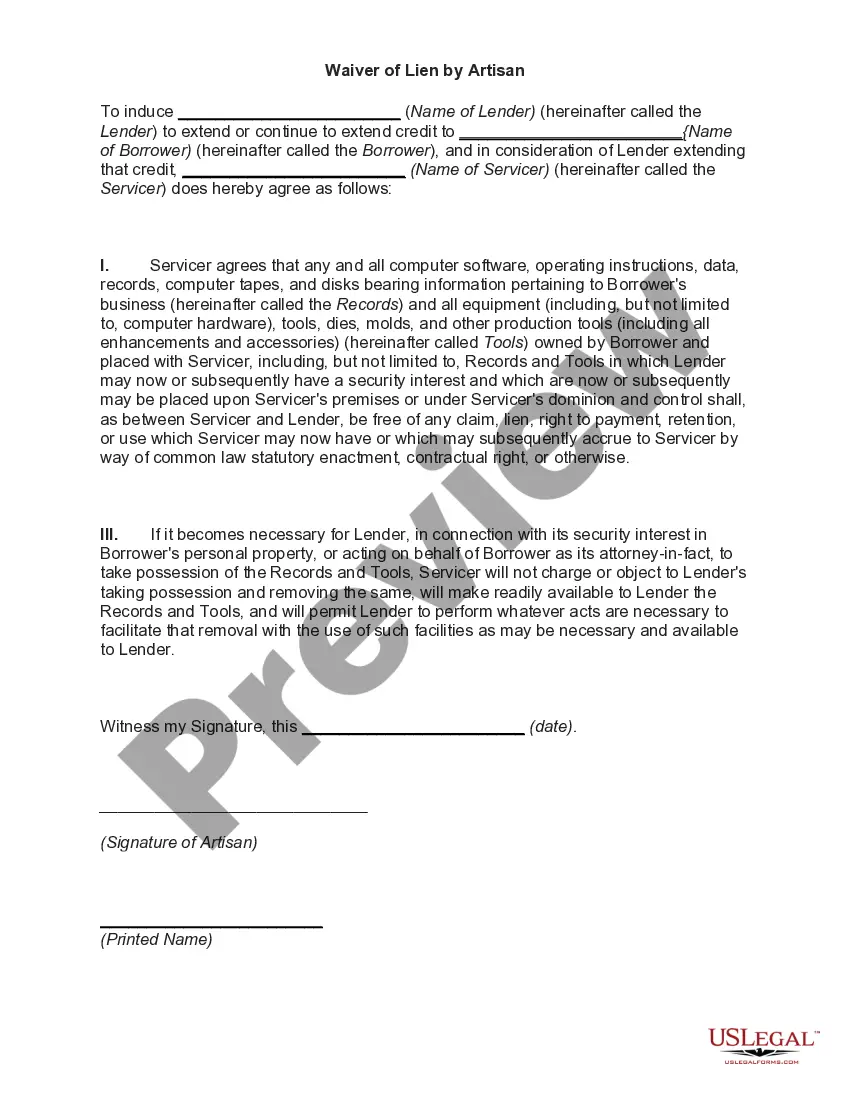
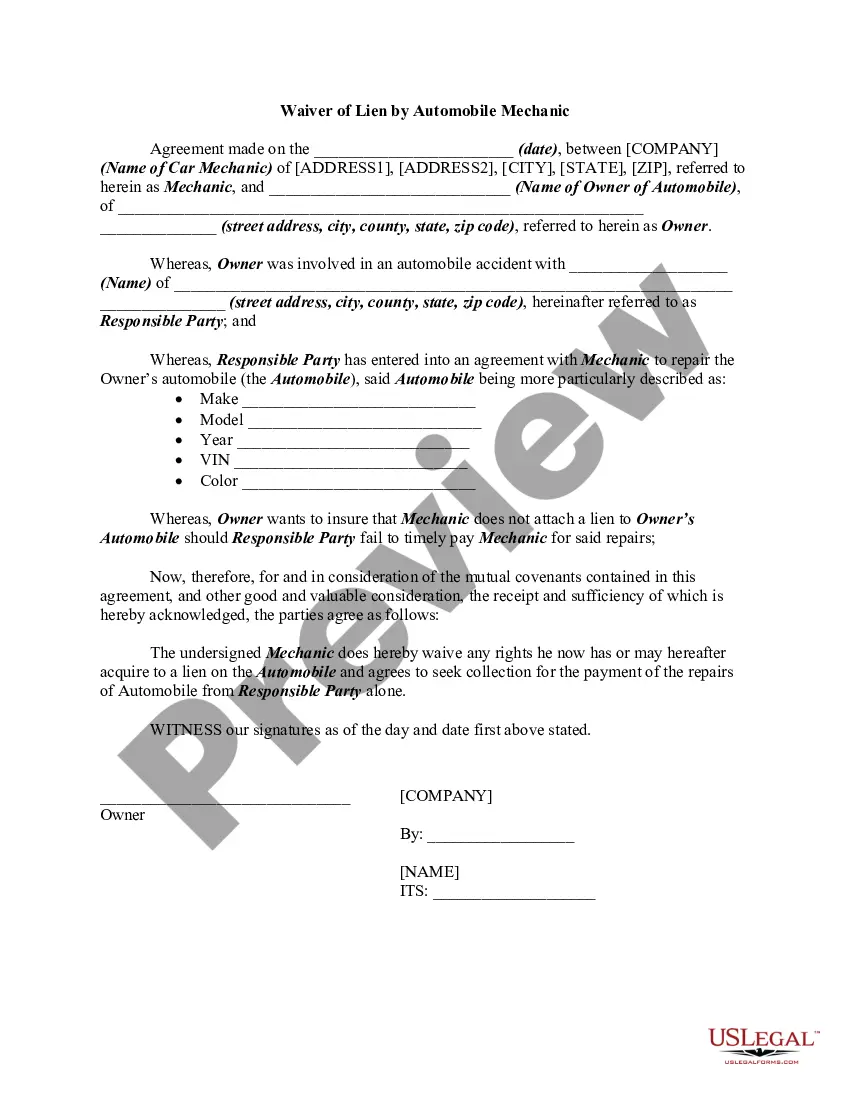
The Waiver of Lien by Automobile or Car Mechanic is a legal document that allows a mechanic to waive their right to attach a lien on a vehicle after completing repairs. Unlike a mechanic's lien, which secures a repairman's right to payment through property ownership, this waiver ensures that the mechanic will not pursue a lien against the owner's automobile should the responsible party fail to pay for the services rendered. This form is essential for car owners who wish to protect their vehicle from being subject to such liens while ensuring that the mechanic is compensated by the responsible party directly.
Main sections of this form
- Agreement date and parties involved (mechanic and vehicle owner).
- Description of the vehicle being repaired (make, model, year, VIN).
- Identification of the responsible party involved in the accident.
- Specific statement of the mechanic waiving lien rights on the vehicle.
- Signature lines for both the mechanic and the vehicle owner.
Common use cases
This form is used when an automobile owner has their vehicle repaired by a mechanic and wants to ensure that the mechanic cannot place a lien on their vehicle in case the party responsible for the damage does not pay for the repairs. It is particularly useful in situations where there is uncertainty regarding payment from the responsible party and offers peace of mind to the vehicle owner.
Intended users of this form
- Automobile owners who have had their vehicle repaired.
- Mechanics or auto repair shops seeking to clarify payment arrangements.
- Individuals or parties involved in accident claims where a third party is responsible for repairs.
Completing this form step by step
- Identify the date of the agreement.
- Fill in the names and addresses of both the mechanic and the automobile owner.
- Describe the vehicle, including its make, model, year, VIN, and color.
- Specify the name and address of the responsible party involved in the accident.
- Include a clear statement that the mechanic waives their right to a lien on the vehicle.
- Obtain signatures from both the mechanic and the vehicle owner.
Is notarization required?
This form does not typically require notarization unless specified by local law. It is advisable to check specific state regulations to confirm any notarization requirements.
Get your form ready online
Our built-in tools help you complete, sign, share, and store your documents in one place.
Make edits, fill in missing information, and update formatting in US Legal Forms—just like you would in MS Word.
Download a copy, print it, send it by email, or mail it via USPS—whatever works best for your next step.
Sign and collect signatures with our SignNow integration. Send to multiple recipients, set reminders, and more. Go Premium to unlock E-Sign.
If this form requires notarization, complete it online through a secure video call—no need to meet a notary in person or wait for an appointment.
We protect your documents and personal data by following strict security and privacy standards.

Make edits, fill in missing information, and update formatting in US Legal Forms—just like you would in MS Word.

Download a copy, print it, send it by email, or mail it via USPS—whatever works best for your next step.

Sign and collect signatures with our SignNow integration. Send to multiple recipients, set reminders, and more. Go Premium to unlock E-Sign.

If this form requires notarization, complete it online through a secure video call—no need to meet a notary in person or wait for an appointment.

We protect your documents and personal data by following strict security and privacy standards.
Mistakes to watch out for
- Failing to accurately describe the vehicle, which may lead to confusion or disputes.
- Not including the name and address of the responsible party.
- Forgetting to obtain signatures from all parties involved.
Advantages of online completion
- Convenience of downloading and printing the form from home.
- Customizable fields to tailor the form to your specific situation.
- Access to professionally drafted templates, ensuring legal compliance.
Legal use & context
- Validates the agreement between the mechanic and owner regarding lien rights.
- Provides a clear record of the waiver for future reference.
- Ensures compliance with state laws pertaining to mechanic's liens and repair services.
What to keep in mind
- The Waiver of Lien protects vehicle owners from having a lien placed on their automobile.
- It specifies the conditions under which the mechanic will seek payment from the responsible party.
- Proper completion and signing of the form can prevent future legal complications.
Looking for another form?
Form popularity
FAQ
Write your name and return address in the top three lines of the letter. Insert the complete date (month, day, year). Enter the recipient's name, title, company name and address on the next five lines. Greet the reader by writing "Dear (recipient's name):" Skip two lines. State the subject in a subject line.
Get lien waivers. You can have your contractor get lien waivers from every sub and supplier. Write checks to both parties. Pay subcontractors and suppliers yourself. Do your research.
The simplest way to prevent liens and ensure that subcontractors and suppliers are paid is to pay with joint checks. This is when both parties endorse the check. Compare the contractor's materials or labor bill to the schedule of payments in your contract and the Preliminary Notices.
Negotiate with the contractor who placed the lien (the "lienor" to remove it. Obtain a lien bond to discharge the lien, or. File a lawsuit to vacate the lien.
The process of bonding off a mechanics lien starts after a claimant has filed a mechanics lien. After the claim is made, a general contractor or a property owner can contact a surety bond company to purchase a surety bond that replaces the value of the lien that was filed against the property.
Who you are. The services or materials you provided. The last date you provided the services or materials. How much payment should be. The date on which you will file a lien if you do not receive payment. How the debtor should pay.
Posting a Bond Asselta says to expect to pay 110 percent of the lien amount. Submit the bond to the court. The lien will then transfer to the bond and clear the property's title. Wait for the contractor claimant to foreclose on the lien in the allotted period to dispute the lien in court.
When a contractor files a mechanics' (construction) lien on your home, the lien makes your home into what's called security for an outstanding debt, which the contractor claims is due and unpaid for services or materials.
Who you are. The services or materials you provided. The last date you provided the services or materials. How much payment should be. The date on which you will file a lien if you do not receive payment. How the debtor should pay.