Contract to Train Gun Dogs on Owner's Property
Understanding this form
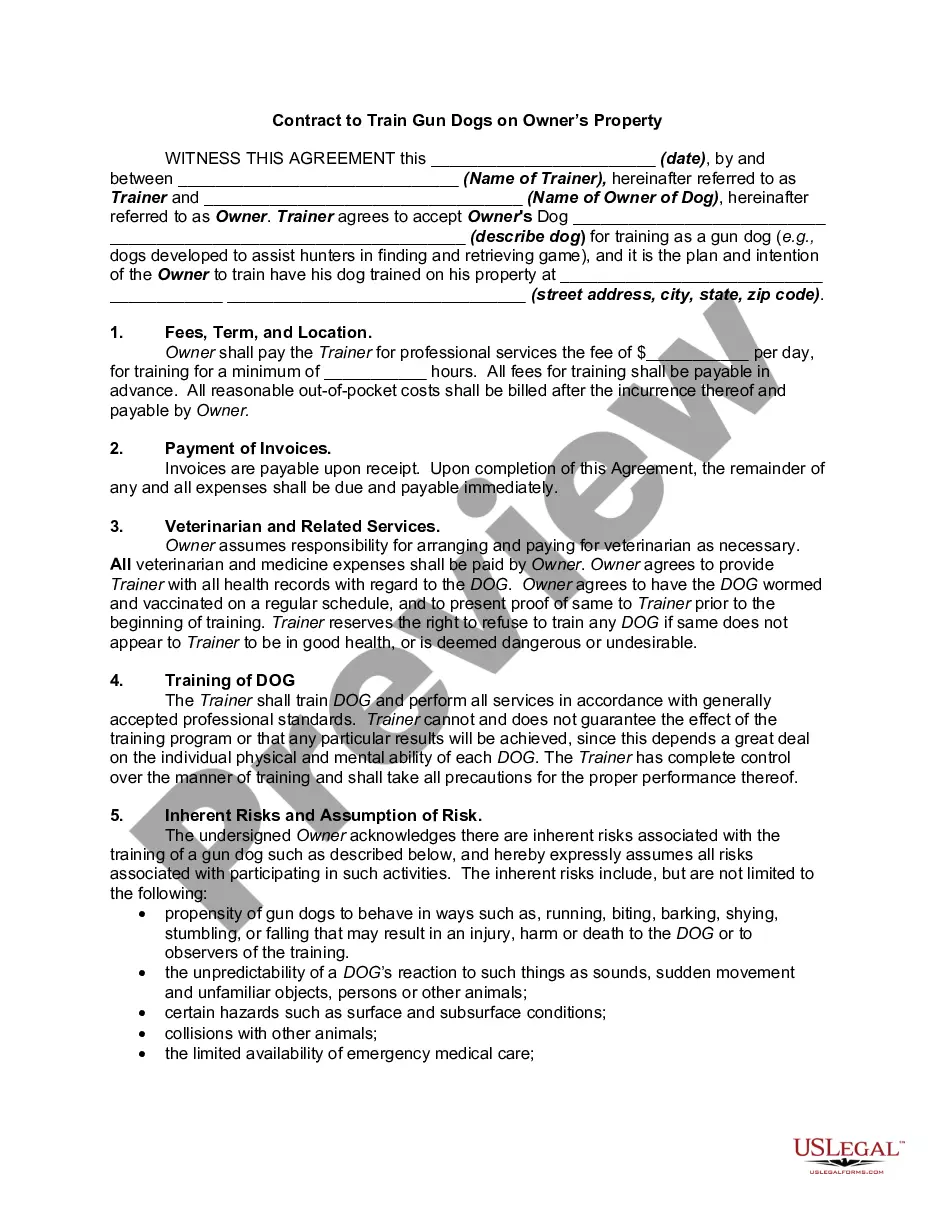
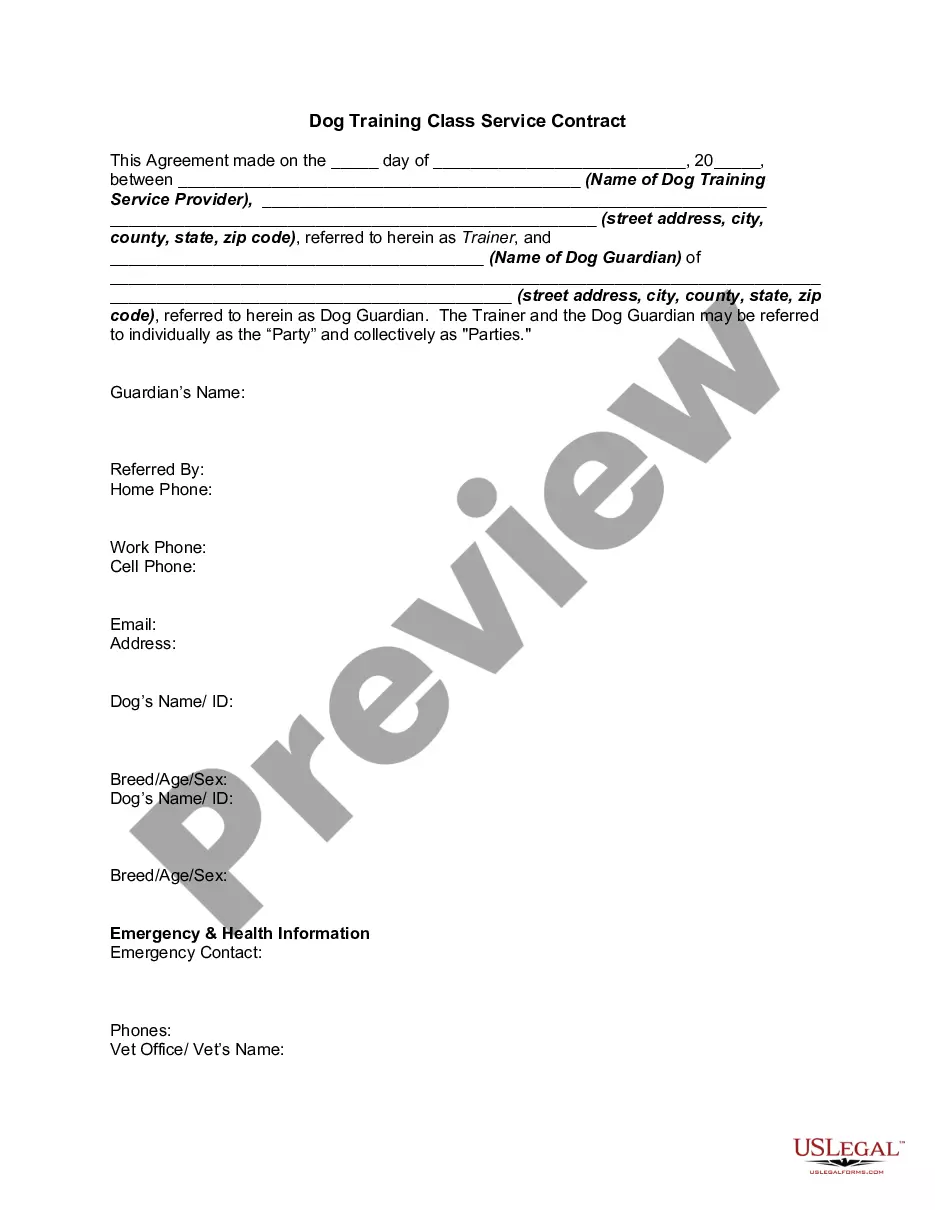
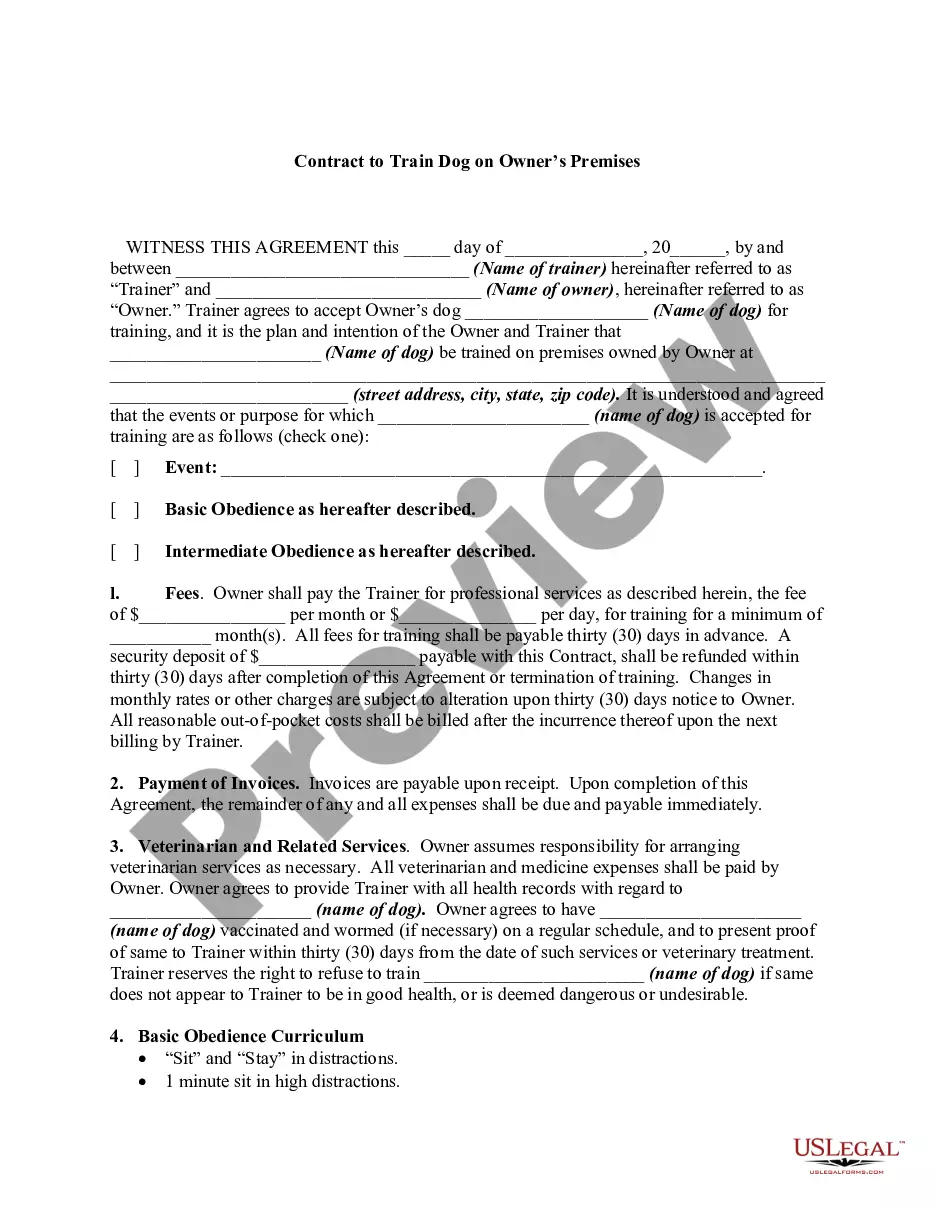
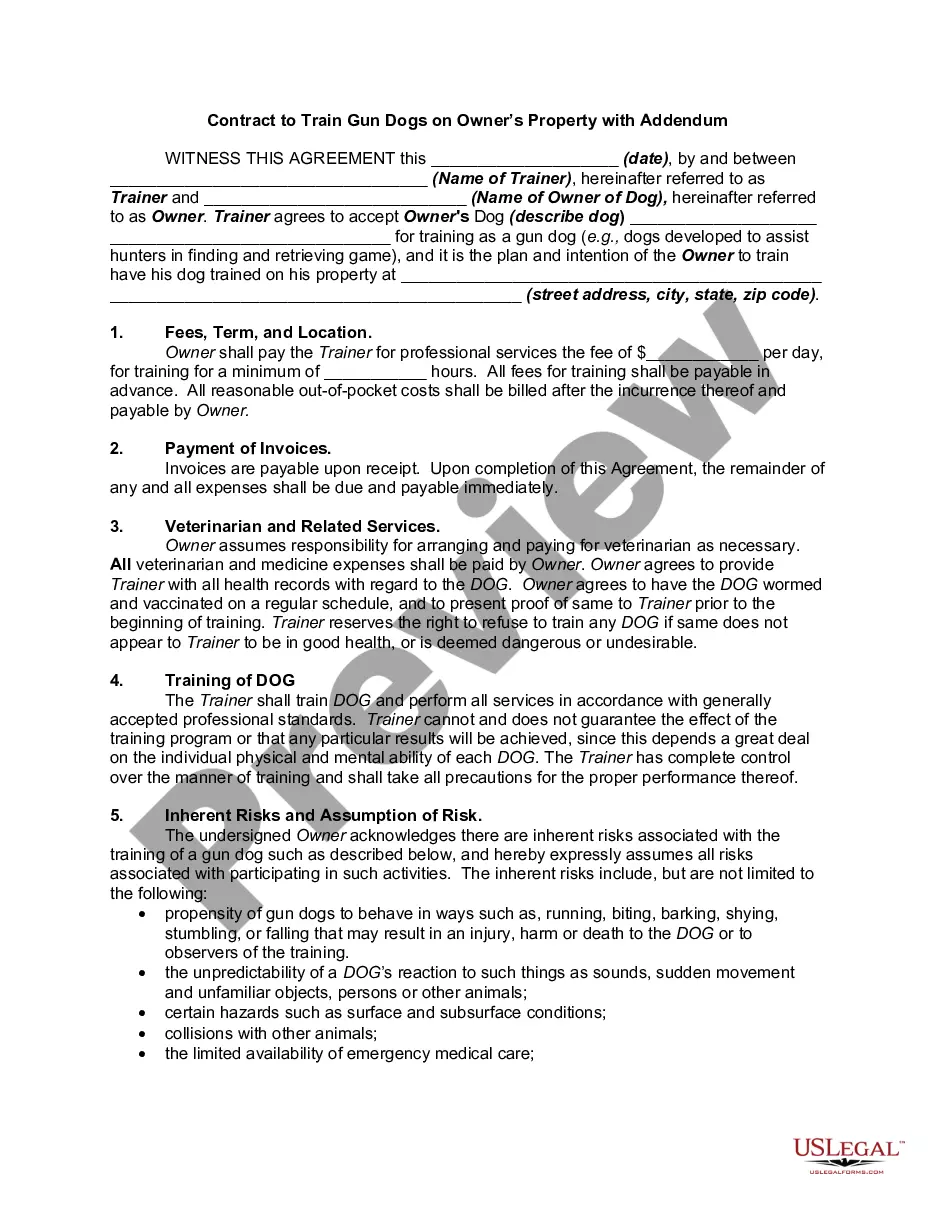
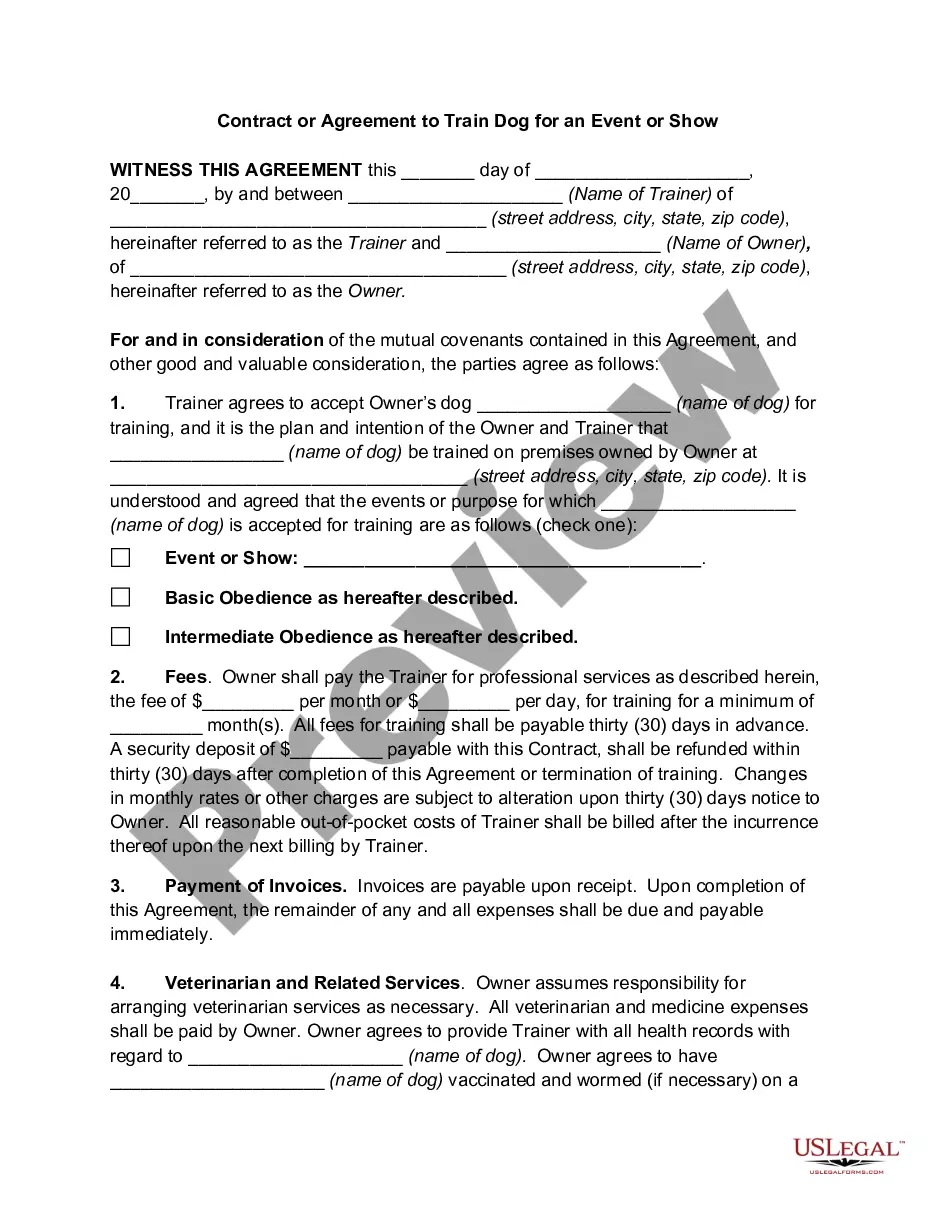
The Contract to Train Gun Dogs on Owner's Property is a legal agreement between a dog owner and a trainer specifically for the training of a gun dog on the owner's premises. This contract outlines the terms and conditions of training, including fees, responsibilities, and potential risks involved. It is distinct from other pet training agreements as it includes specific clauses related to gun dog training, which can involve unique challenges and liabilities.
What’s included in this form
- Date of agreement and identification of the trainer and owner.
- Fees for training services and payment terms.
- Responsibilities for veterinary care and health records.
- Inherent risks associated with training a gun dog.
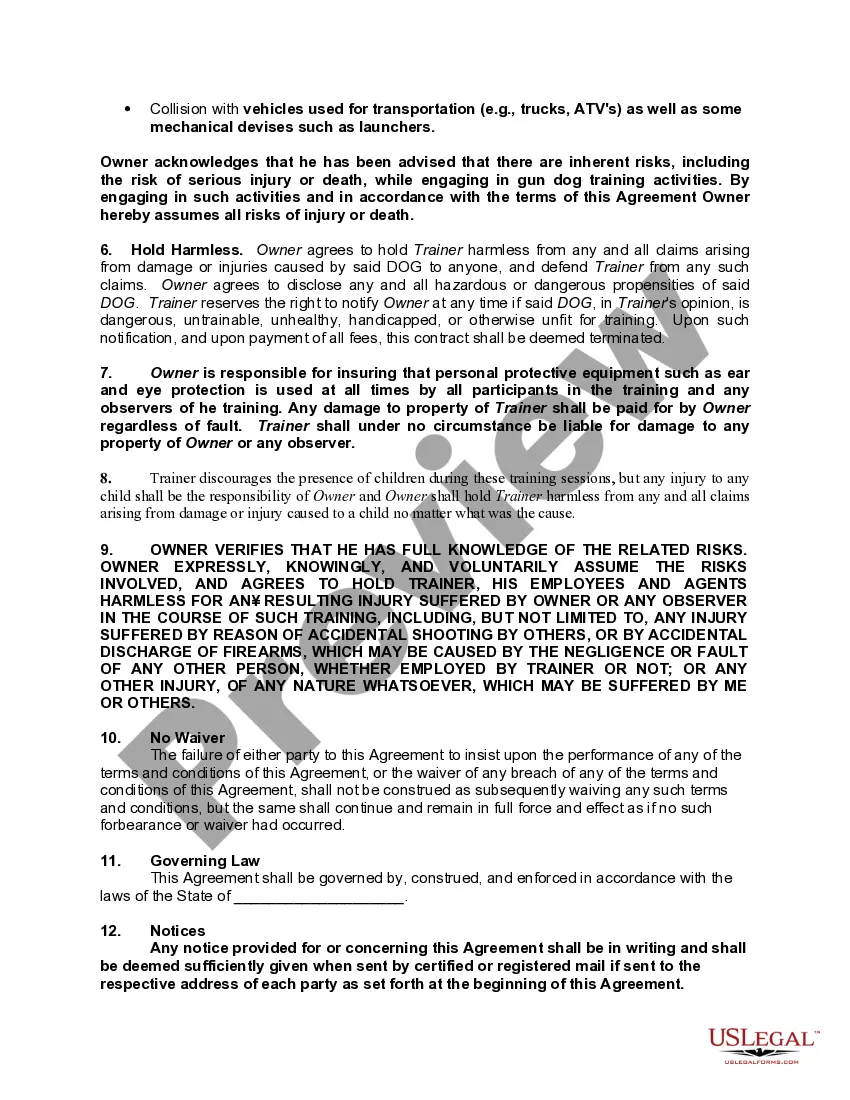
- Hold harmless clause to protect the trainer from liabilities.
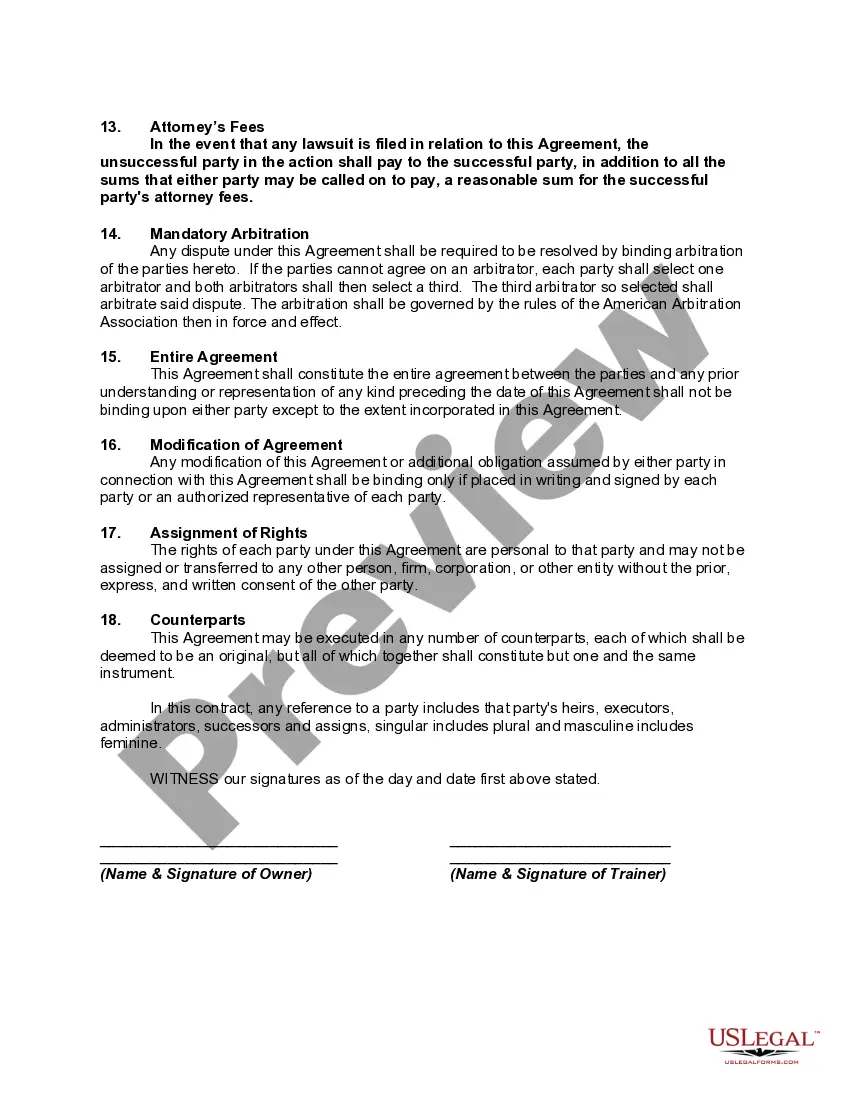
- Governing law and dispute resolution clauses.
When this form is needed
This form is useful when a dog owner intends to have their gun dog trained on their property. It is particularly relevant for hunters who need their dogs to assist in locating and retrieving game. Use this form to clarify expectations, financial commitments, and liability coverage between the trainer and the dog owner.
Who should use this form
- Dog owners looking to train their gun dogs on their property.
- Professional dog trainers offering services in gun dog training.
- Individuals seeking to protect their rights and limit liabilities in dog training agreements.
Instructions for completing this form
- Identify the trainer and the dog owner, including their signatures.
- Specify the dog's details, including breed and description.
- Clearly state the training fees, duration, and payment terms.
- Detail the owner's responsibilities regarding veterinary care and health records.
- Read and understand the inherent risks clause before signing.
Does this document require notarization?
This form does not typically require notarization unless specified by local law. Ensure you check local regulations for any notary requirements.
Get your form ready online
Our built-in tools help you complete, sign, share, and store your documents in one place.
Make edits, fill in missing information, and update formatting in US Legal Forms—just like you would in MS Word.
Download a copy, print it, send it by email, or mail it via USPS—whatever works best for your next step.
Sign and collect signatures with our SignNow integration. Send to multiple recipients, set reminders, and more. Go Premium to unlock E-Sign.
If this form requires notarization, complete it online through a secure video call—no need to meet a notary in person or wait for an appointment.
We protect your documents and personal data by following strict security and privacy standards.

Make edits, fill in missing information, and update formatting in US Legal Forms—just like you would in MS Word.

Download a copy, print it, send it by email, or mail it via USPS—whatever works best for your next step.

Sign and collect signatures with our SignNow integration. Send to multiple recipients, set reminders, and more. Go Premium to unlock E-Sign.

If this form requires notarization, complete it online through a secure video call—no need to meet a notary in person or wait for an appointment.

We protect your documents and personal data by following strict security and privacy standards.
Typical mistakes to avoid
- Failing to fully disclose any known issues or dangerous tendencies of the dog.
- Not specifying the training location, which can lead to disputes.
- Neglecting to understand the risks involved and assuming liability incorrectly.
Advantages of online completion
- Convenient access to legal forms without the need for in-person consultations.
- Editable templates that allow customization to fit specific training needs.
- Reliability from professionally drafted documents by licensed attorneys.
Legal use & context
- This form establishes a clear understanding of responsibilities and liabilities between the Trainer and Owner.
- It is enforceable in a court of law, provided all parties have signed and acknowledged it properly.
- By signing, the Owner agrees to hold the Trainer harmless for any accidents or injuries related to the training.
Key takeaways
- The form serves as a comprehensive agreement for training gun dogs on private property.
- Understanding and assuming the inherent risks is crucial for both parties.
- Proper completion and signatures are necessary for legal enforcement.
Looking for another form?

Form popularity
FAQ
Summary: Animals are property, not persons. And yet, at the same time, they are treated differently than other forms of property such as cars, toasters, and crops.
Critics shoot back at the animal activists and say these animals are not people. You can pretend as much as you want that a dog or cat is a child or a person, but basic biology tells us that these are not human beings.
If you're a dog owner, when is a dog legally yours?But even if it isn't, you can prove ownership by properly registering your pet with local authorities. Veterinary records. Keep your pet's veterinary and vaccination records up to date and make sure you keep updated copies at the ready.
Laws around dog ownership can be difficult to deal with. Dogs are classed as property under the law, despite the emotional attachment owners have towards their four-legged friends.
Animals are considered property under the law, which limits their protections.Animals deserve a legal status that reflects the kinds of beings they are individuals with their own desires and lives, who have the capacity for pain and pleasure, joy and sorrow, fear and contentment.
In determining proof of ownership, a judge will consider the following: Registration and license: The most likely document to be recognized by the court is the initial registration required for the majority of household pets.Veterinary records: The court may also consider veterinary medical records.
Animals are considered property under the law, which limits their protections.Yet, the property designation puts living, feeling beings in the same legal category as things, such as a chair.
Laws regarding animal rights continue to change as humans have begun to rethink what it means to own a pet.Despite the fact that animals, such as cats and dogs, are viewed by many as family members, the law in numerous states still treats them as personal property.