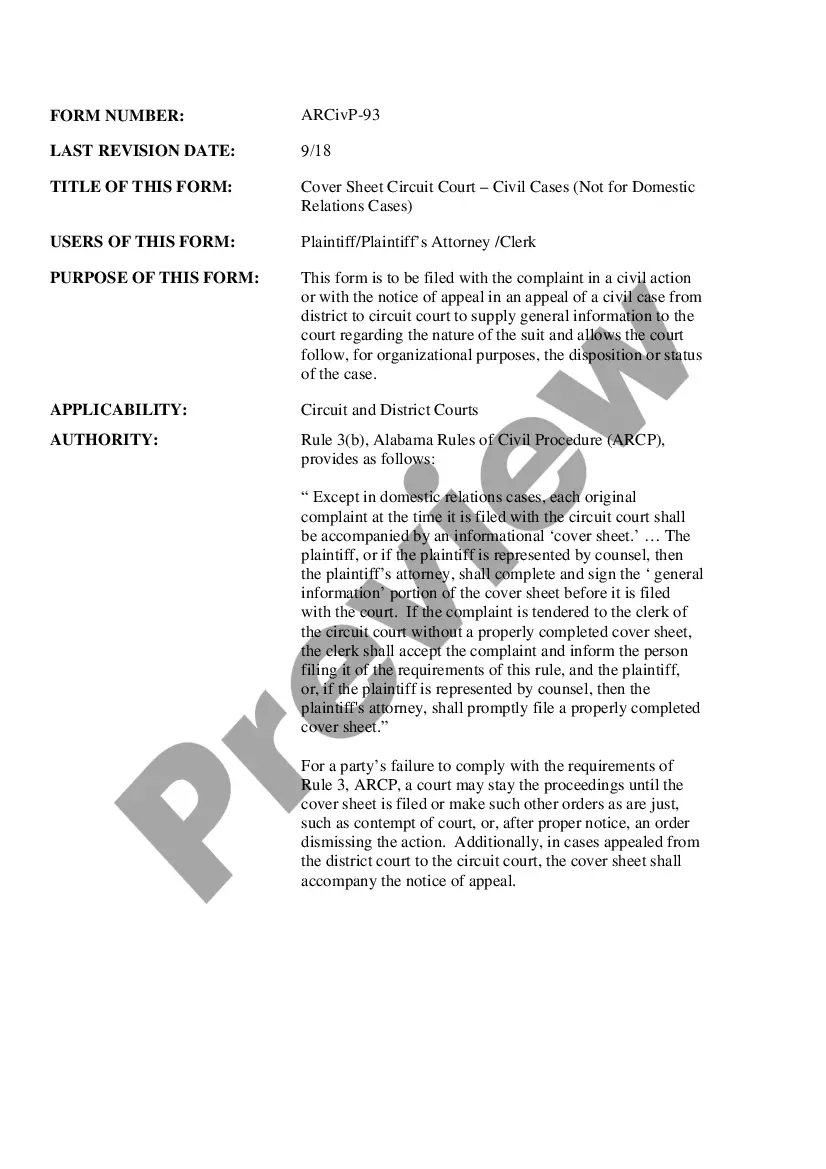
Non-Marital Cohabitation Living Together Agreement
What this document covers
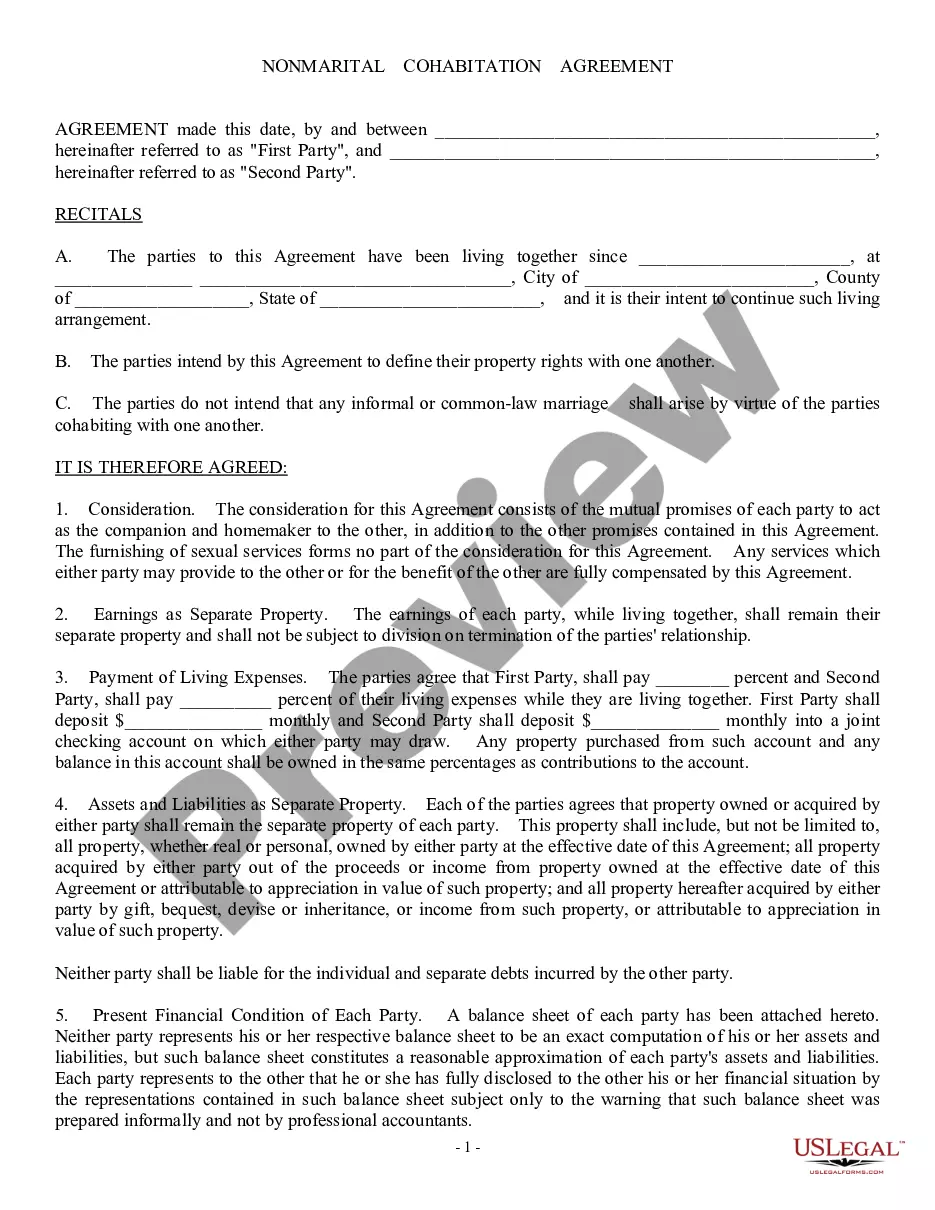
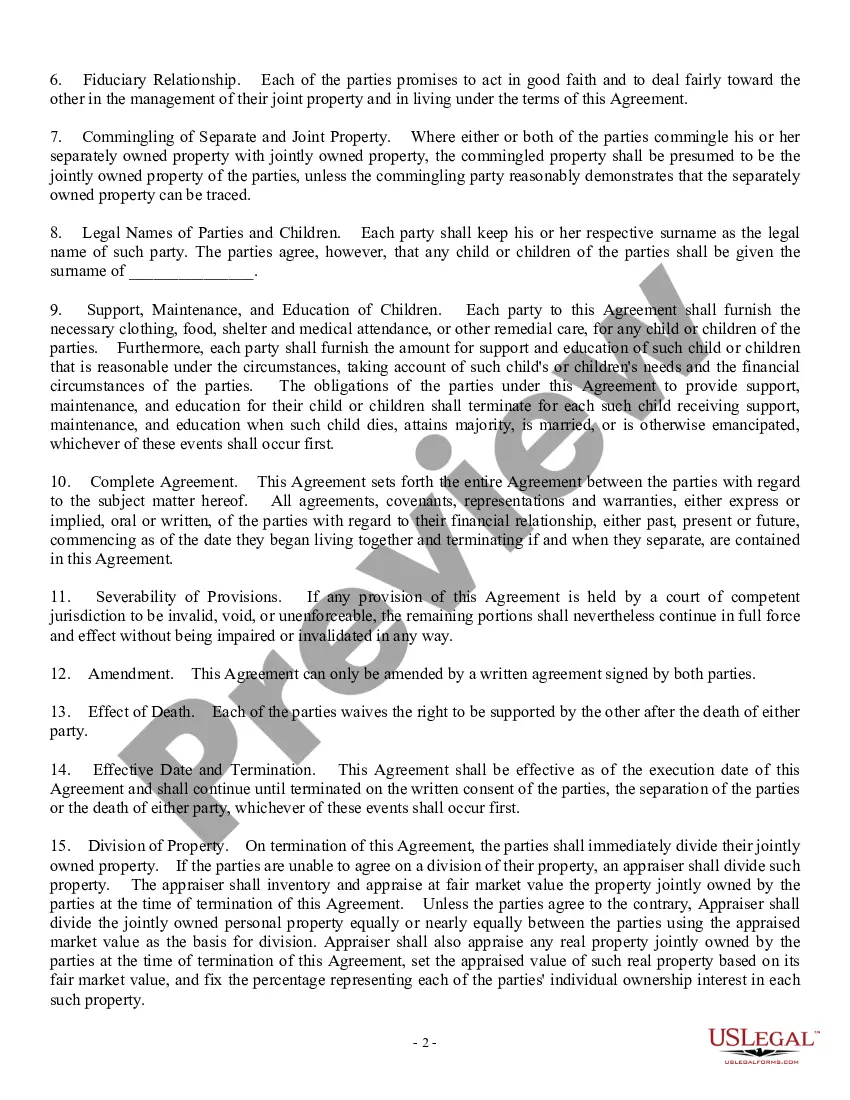
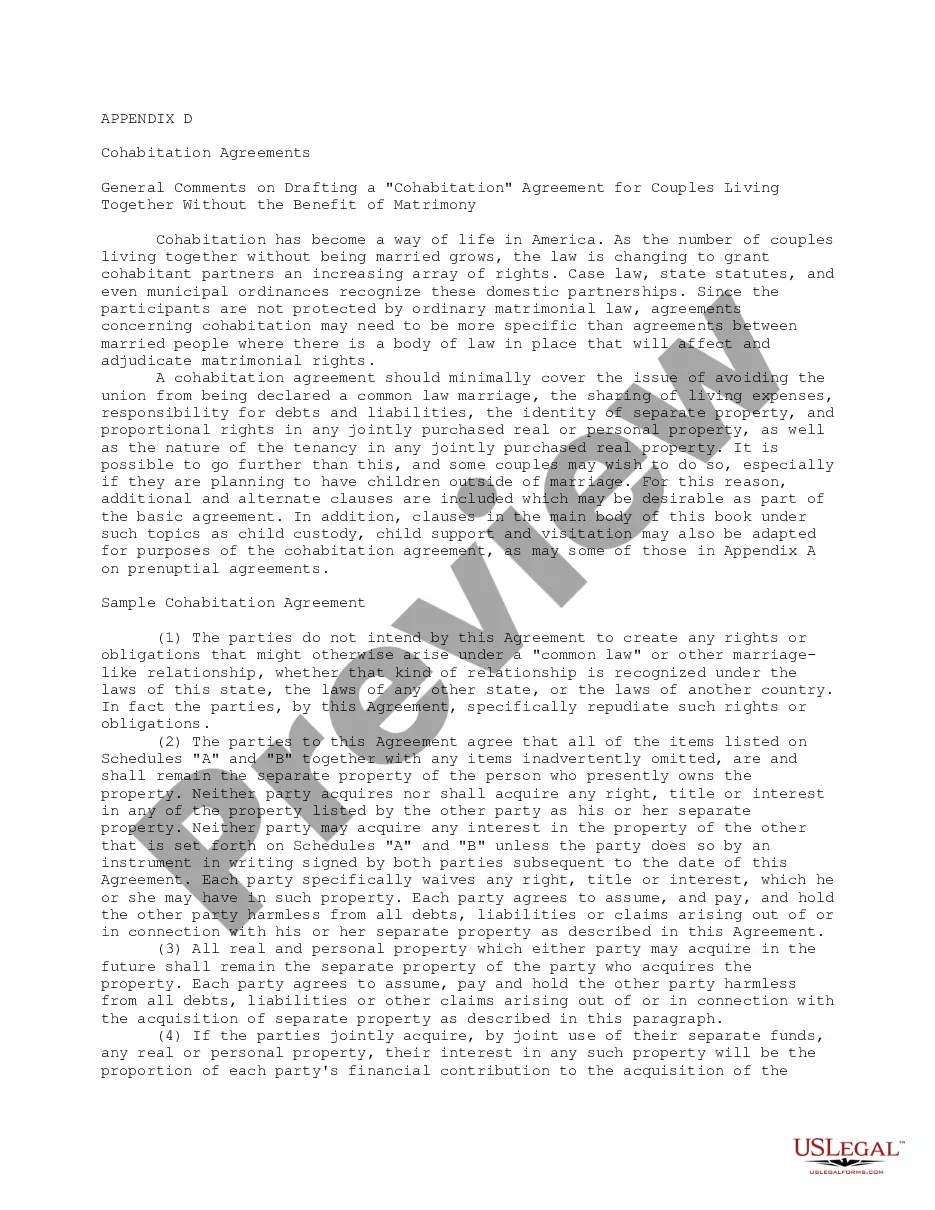
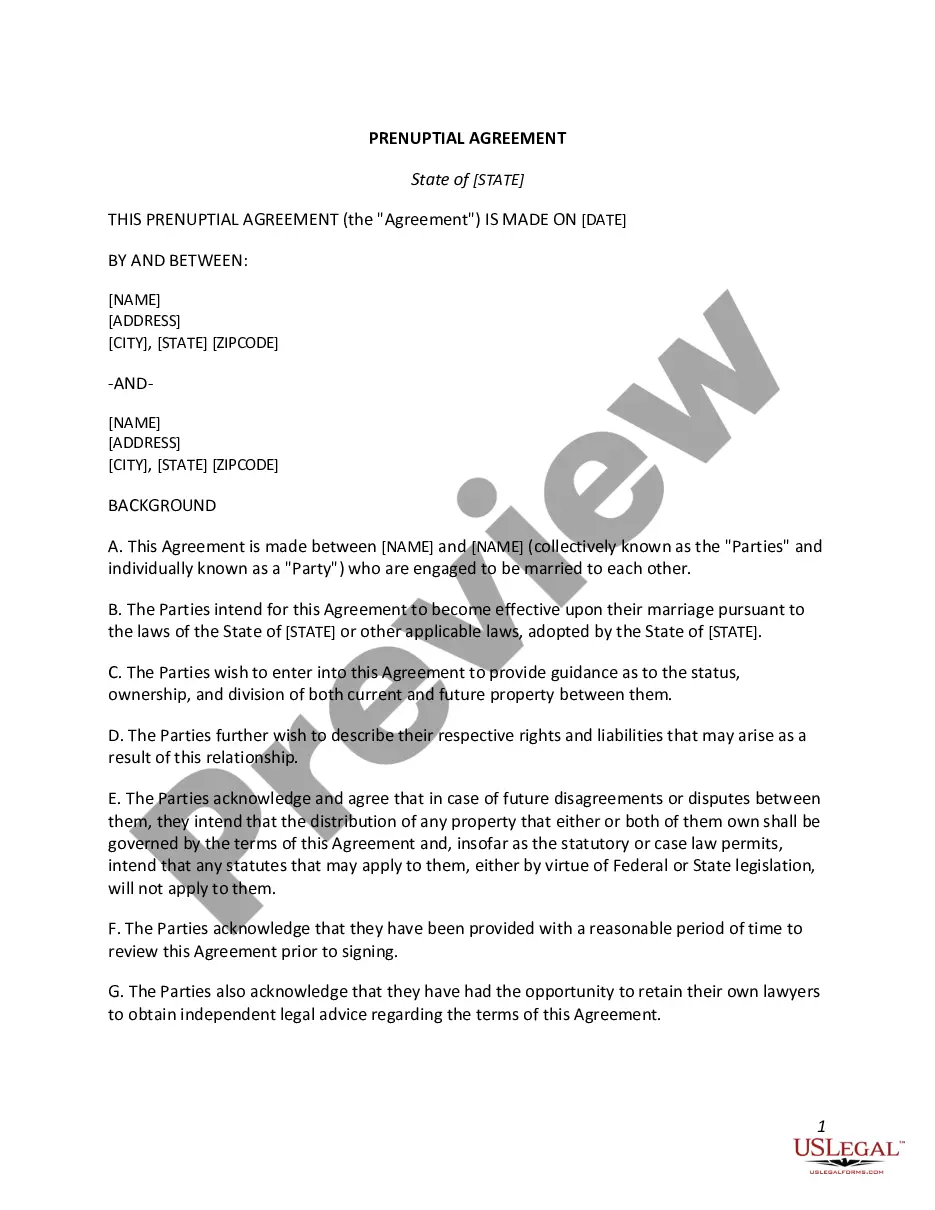
The Non-Marital Cohabitation Living Together Agreement is a legal document that outlines the property rights and responsibilities of parties living together without being married. It establishes that each party's earnings remain their separate property and will not be subject to division if the relationship ends. This form is distinct from marriage agreements as it specifically addresses the dynamics of cohabitating couples who wish to clarify their financial and personal obligations to each other.
Key components of this form
- Consideration: Describes mutual promises between partners.
- Earnings as separate property: Ensures each party's income remains individual property.
- Payment of living expenses: Outlines how living costs will be shared between parties.
- Assets and liabilities: Declares each party's property as separate, including gifts and inheritances.
- Division of property: Specifies how jointly owned property will be divided upon separation.
- Governing law: Identifies the state laws that will govern the agreement.

Common use cases
This agreement is ideal for couples who are cohabitating but do not wish to marry and want to clearly define their financial responsibilities and property rights. It can be particularly useful in situations where partners have different incomes, possess separate assets, or have children together, ensuring clarity and reducing potential conflicts in the event of a separation.
Who can use this document
- Couples living together without a marriage contract.
- Individuals looking to clarify property rights before moving in together.
- Partners who wish to document financial arrangements regarding shared living expenses.
- Couples with children, wanting to address parental responsibilities in a formal agreement.
How to prepare this document
- Identify the parties involved by entering the names of the first and second party.
- Specify the start date of cohabitation and the address of the shared residence.
- Detail the financial arrangement, including percentages for living expenses and the amounts to be deposited into a joint account.
- Make sure to include provisions related to children, including their surname and support obligations.
- Ensure both parties review and sign the agreement, along with a witness if required.
Notarization requirements for this form
This form does not typically require notarization unless specified by local law. However, having it notarized can provide an additional layer of assurance and validity in some jurisdictions.
Get your form ready online
Our built-in tools help you complete, sign, share, and store your documents in one place.
Make edits, fill in missing information, and update formatting in US Legal Forms—just like you would in MS Word.
Download a copy, print it, send it by email, or mail it via USPS—whatever works best for your next step.
Sign and collect signatures with our SignNow integration. Send to multiple recipients, set reminders, and more. Go Premium to unlock E-Sign.
If this form requires notarization, complete it online through a secure video call—no need to meet a notary in person or wait for an appointment.
We protect your documents and personal data by following strict security and privacy standards.

Make edits, fill in missing information, and update formatting in US Legal Forms—just like you would in MS Word.

Download a copy, print it, send it by email, or mail it via USPS—whatever works best for your next step.

Sign and collect signatures with our SignNow integration. Send to multiple recipients, set reminders, and more. Go Premium to unlock E-Sign.

If this form requires notarization, complete it online through a secure video call—no need to meet a notary in person or wait for an appointment.

We protect your documents and personal data by following strict security and privacy standards.
Typical mistakes to avoid
- Failing to include all relevant financial details, leading to misunderstandings.
- Not clearly specifying the separate properties and debts of each party.
- Overlooking the need for a witness signature if required by state law.
- Not updating the agreement if there are significant changes in circumstances or relationships.
Advantages of online completion
- Convenience: Access and fill out the form anytime from anywhere.
- Editability: Modify sections to fit personal circumstances easily.
- Time-saving: Quickly download and print your agreement.
- Trustworthiness: Forms are drafted by licensed attorneys, ensuring legal validity.
What to keep in mind
Key takeaways:
- This agreement protects individual financial interests for cohabiting partners.
- Clearly defines responsibilities regarding living expenses and assets.
- Modify the agreement as needed to reflect changing circumstances.
Looking for another form?








Form popularity
FAQ
Common-law marriage, also known as non-ceremonial marriage, sui iuris marriage, informal marriage, or marriage by habit and repute, is a legal framework where a couple may be considered married without having formally registered their relation as a civil or religious marriage.
Cohabitation agreements are legally binding contracts, provided that they are drafted and executed properly, and are signed as a deed. It is therefore essential to obtain legal advice before preparing an agreement.
Some couples choose not to enter into a marriage or legally recognized domestic partnership but choose to enter into a cohabitation agreement instead. Oftentimes, these agreements are made orally and difficult to enforce after the relationship has ended.
Cohabitation agreements are similar contracts for unmarried spouses. These contracts allow you to make legal decisions about your rights in a relationship and decide how you want to arrange your finances if your relationship ends.
Whether you've been living together for 1 year, 10 years or even 50 years, if you're not married, you have no automatic legal right over your partner's assets.Often someone will move into a property that their partner already owns, or it may be that one person can't afford to contribute to the purchase of a new house.
Cohabitation is an arrangement where two people are not married but live together.
Cohabitation is an arrangement where two people are not married but live together. They are often involved in a romantic or sexually intimate relationship on a long-term or permanent basis.More broadly, the term cohabitation can mean any number of people living together.
Example of Cohabitation Two single people meet at a university and live together to save on expenses and have a sexual relationship.
In both types of agreements, the disclosure requirements are onerous but necessary. Full disclosure includes things such as income tax returns, pay stubs, banks account and credit card statements, RRSP/investment statements and a statutory declaration of all income, assets and debts, among others.