Agreement for Exhibition of Unpatented Invention to Prospective Purchaser or Licensee
Overview of this form
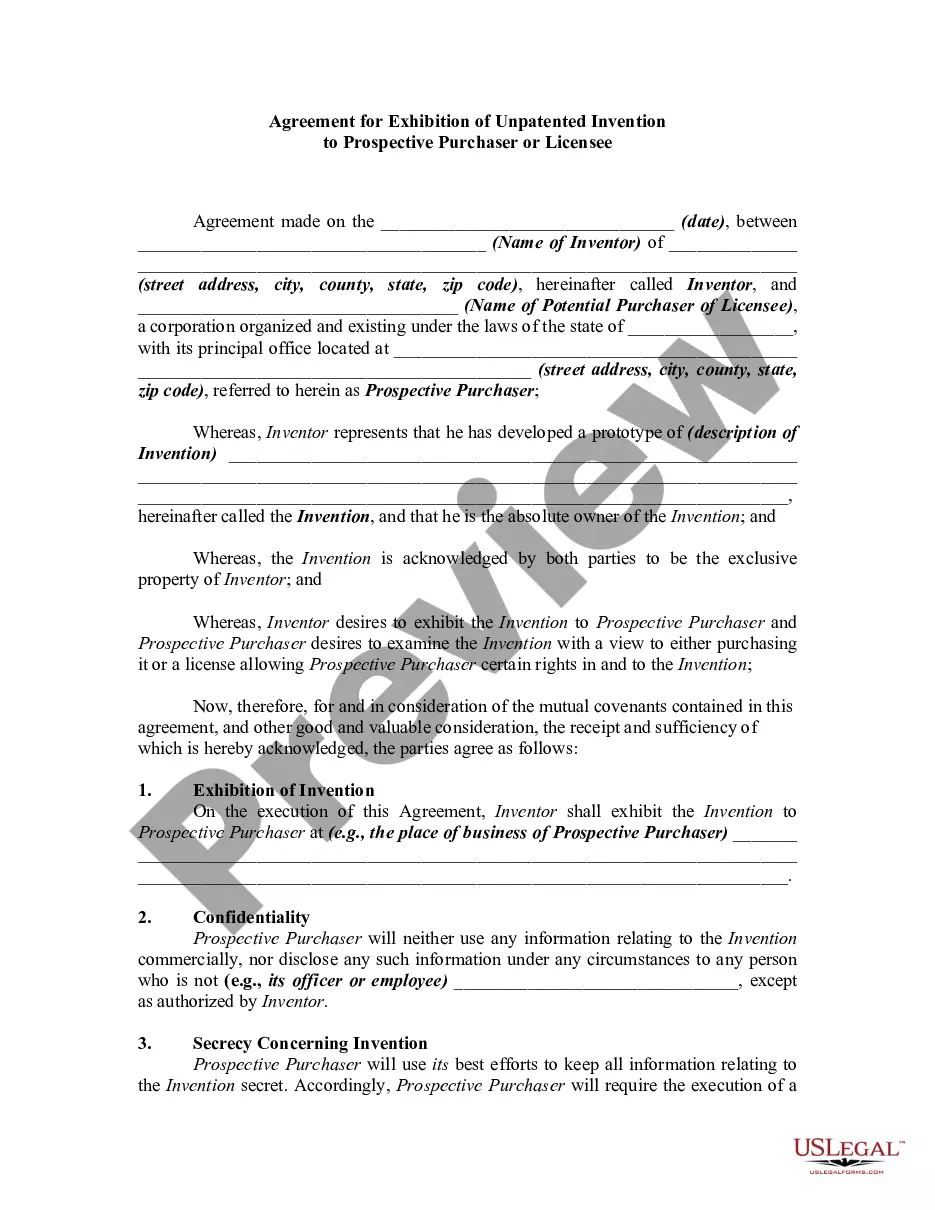
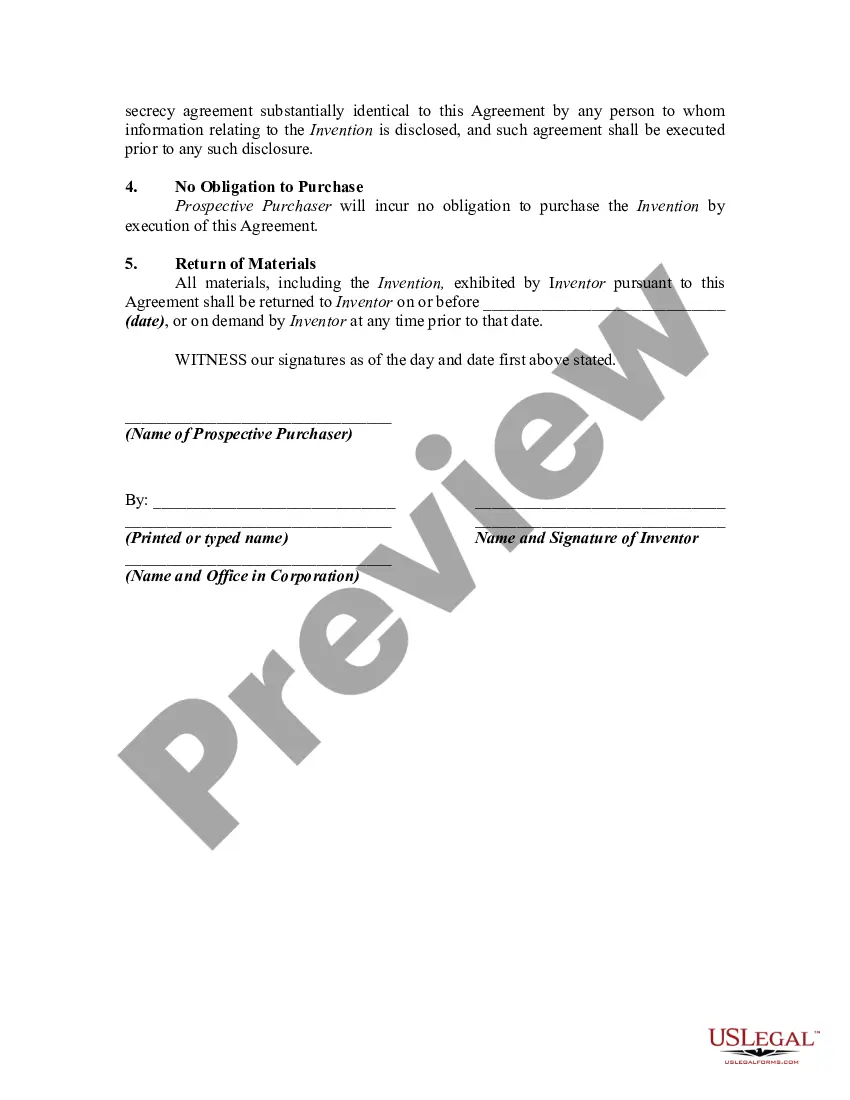
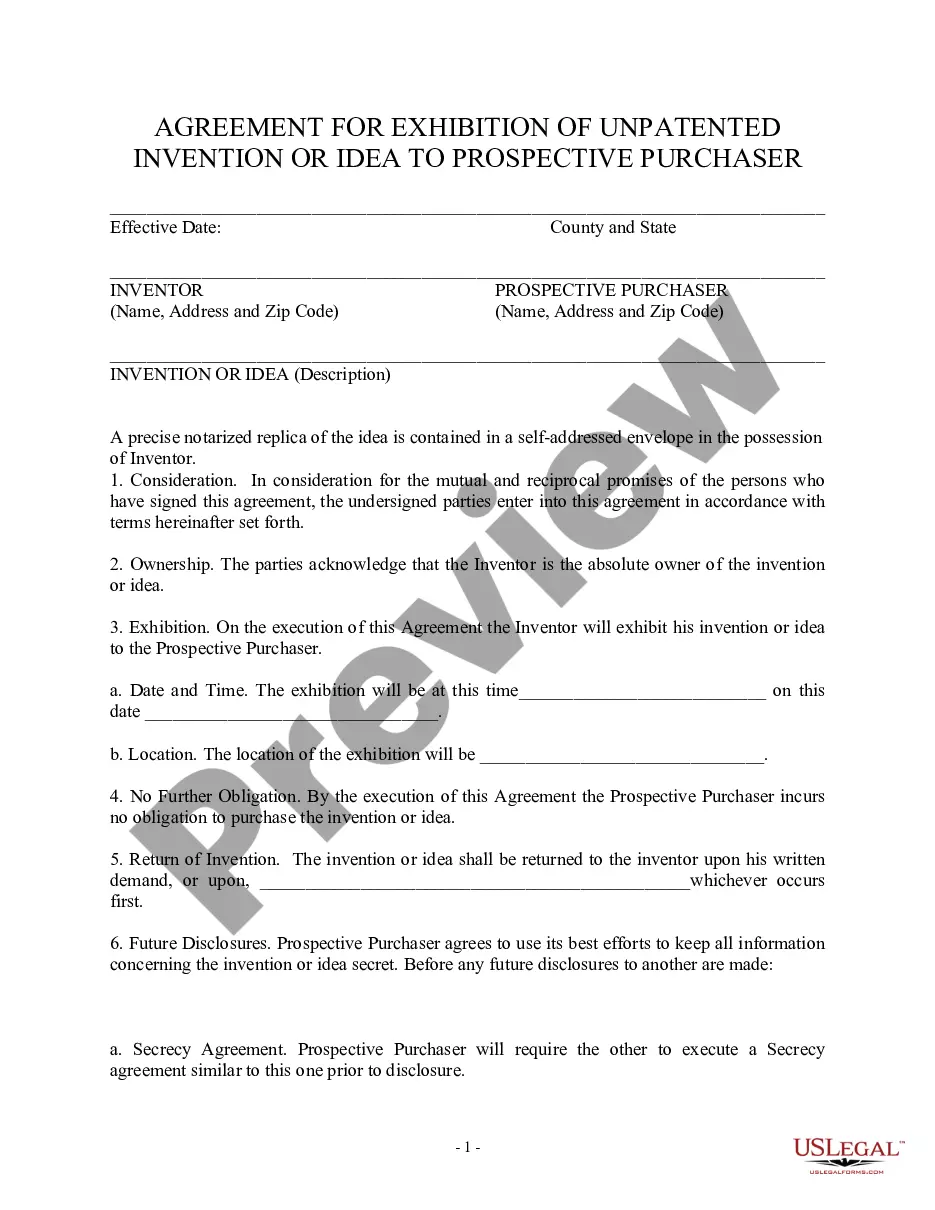
The Agreement for Exhibition of Unpatented Invention to Prospective Purchaser or Licensee is a legal document that facilitates the showcasing of an inventor's unpatented invention to a potential buyer or licensee. This agreement is distinct from patent-related documents as it emphasizes confidentiality and ownership rights without granting exclusive intellectual property rights until a formal patent is obtained. By using this form, inventors can protect their ideas while attracting potential investment or licensing opportunities.
What’s included in this form
- Date of the agreement
- Name and contact information of the inventor
- Name and details of the prospective purchaser or licensee
- Description of the invention to be exhibited
- Clauses addressing confidentiality and secrecy obligations
- Return of materials clause outlining responsibilities for returning exhibited items
When to use this document
This form should be used when an inventor wishes to present their unpatented invention to a potential buyer or licensee, ensuring that their intellectual property is protected during the discussion and evaluation process. It is particularly useful when the inventor wants to safeguard sensitive information while seeking commercial interest.
Who needs this form
Ideal users:
- Inventors seeking to showcase their unpatented inventions
- Businesses looking to evaluate new products for licensing or purchase
- Individuals or corporations involved in innovation and product development
- Entrepreneurs wanting to secure potential agreements before applying for a patent
How to prepare this document
Steps to complete this form:
- Enter the date of the agreement at the top of the document.
- Provide the full name and address of the inventor.
- Include the name and address of the prospective purchaser or licensee.
- Clearly describe the invention that will be exhibited.
- Fill in details for confidentiality and secrecy obligations, specifying who has access to the information.
- Ensure all parties sign and date the agreement to validate it.
Does this document require notarization?
This form does not typically require notarization unless specified by local law. However, it is advisable to consult with a legal professional to confirm specific requirements based on your jurisdiction.
Get your form ready online
Our built-in tools help you complete, sign, share, and store your documents in one place.
Make edits, fill in missing information, and update formatting in US Legal Forms—just like you would in MS Word.
Download a copy, print it, send it by email, or mail it via USPS—whatever works best for your next step.
Sign and collect signatures with our SignNow integration. Send to multiple recipients, set reminders, and more. Go Premium to unlock E-Sign.
If this form requires notarization, complete it online through a secure video call—no need to meet a notary in person or wait for an appointment.
We protect your documents and personal data by following strict security and privacy standards.

Make edits, fill in missing information, and update formatting in US Legal Forms—just like you would in MS Word.

Download a copy, print it, send it by email, or mail it via USPS—whatever works best for your next step.

Sign and collect signatures with our SignNow integration. Send to multiple recipients, set reminders, and more. Go Premium to unlock E-Sign.

If this form requires notarization, complete it online through a secure video call—no need to meet a notary in person or wait for an appointment.

We protect your documents and personal data by following strict security and privacy standards.
Mistakes to watch out for
- Failing to adequately describe the invention, which can lead to misunderstandings.
- Not including all necessary parties in the agreement.
- Omitting the return date for materials after the exhibition.
- Neglecting to specify confidentiality measures clearly.
- Assuming the agreement grants rights to the invention without a formal patent.
Why use this form online
- Convenient online access to ready-to-use legal templates.
- Editability to customize the form for specific inventions or situations.
- Reliability, as the forms are drafted by licensed attorneys.
Summary of main points
The agreement protects an inventor's unpatented invention from unauthorized use.
It ensures confidentiality during discussions with potential buyers or licensees.
Having a clear, written agreement minimizes risks associated with idea theft.
Looking for another form?
Form popularity
FAQ
The title of the invention. The inventor's name, address, and phone number. When and how you thought of the invention. Date of the actual reduction to practice (this may be the same as the date of invention) Date of public disclosure of the invention.
An exclusive license agreement covers a license that is limited to a specific field or subject, such as a market, territory, length of time, or context.The licensor can issue an unlimited number of licenses that have different rights within the same field, or licenses with the same rights in a different field.
If you determine that the invention is probably not patentable, the most effective way to protect yourself is to have prospective licensees sign a nondisclosure agreement before you reveal your invention. This document is sometimes called an "NDA" or a "confidentiality agreement," but the terms are similar.
You can sell your invention idea, or you can outright sell the invention itself for one large lump sum as compensation for your idea. The second option is to enter a licensing agreement. You would collect royalties each time your product is sold.
How do I protect my idea? Copyright does not protect ideas, concepts, systems, or methods of doing something. You may express your ideas in writing or drawings and claim copyright in your description, but be aware that copyright will not protect the idea itself as revealed in your written or artistic work.
Copyright is automatic. Copyright does not last forever and can expire after a certain time.
Keep in mind that you are explaining the invention to the corporation for the first time. Be clear and use a step-by-step approach when pointing out how the product works. Emphasize how your invention will appeal to the company's customers. Explain why customers will be motivated to buy the product.
Keep a Written Record of Your Invention. Record every step of the invention process in a notebook. Make Sure Your Invention Qualifies for Patent Protection. Assess the Commercial Potential of Your Invention. Conduct a Thorough Patent Search. Prepare and File an Application With the USPTO.
Compose a description of your invention. Apply for a patent. Take photographs of your invention. Sign and date the proposal and ask two witnesses to co-sign the document.