Instruction to Jury Regarding Damages for Wrongful Foreclosure
About this form
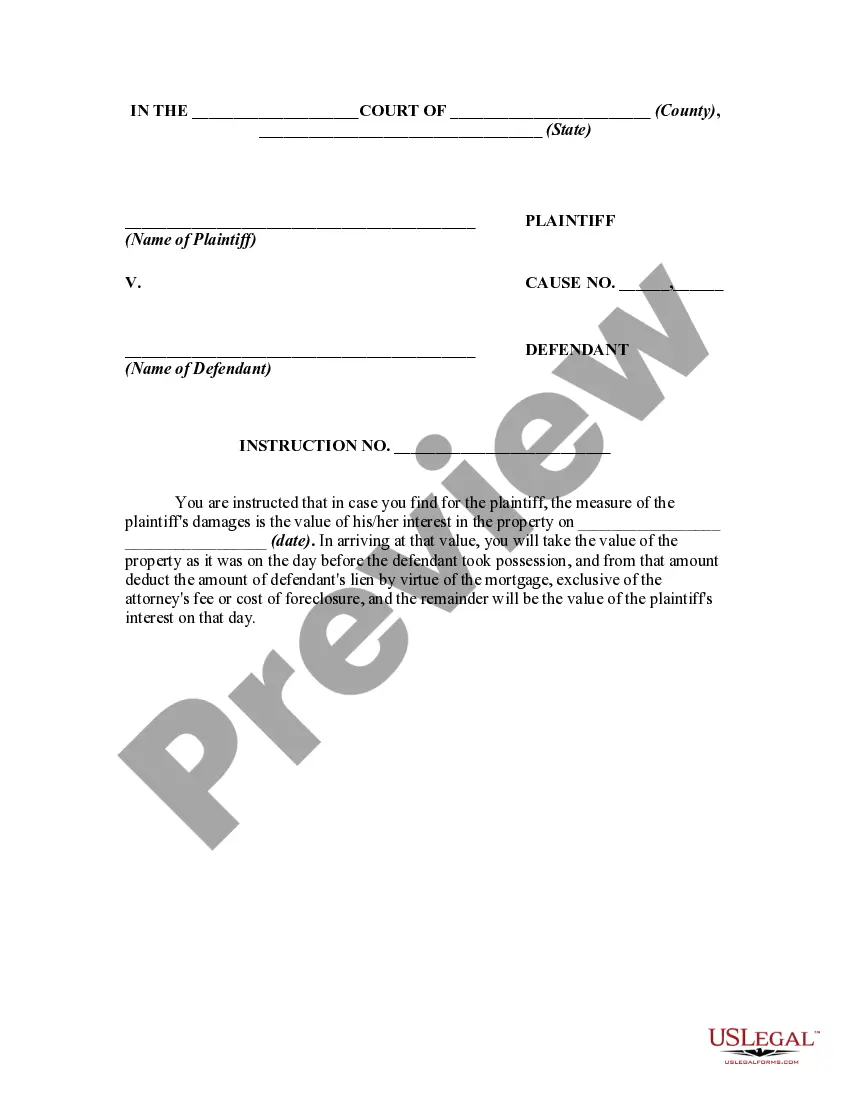
The Instruction to Jury Regarding Damages for Wrongful Foreclosure is a legal document used in court cases where a plaintiff seeks damages due to a wrongful foreclosure. This form instructs juries on how to evaluate the damages owed to the plaintiff if they find in favor of the plaintiff. It differs from other forms related to foreclosure by focusing specifically on the assessment of damages for wrongful actions taken during the foreclosure process rather than the initiation of foreclosure itself.
Key parts of this document
- Title of the case, including plaintiff and defendant names.
- Instruction number specifying the particular instruction for the jury.
- A clear definition of how to determine the value of the plaintiff's interest in the property.
- Relevance of the property's value on the day before possession by the defendant.
- Guidance on deducting the amount of the defendant's lien from the property value.
When to use this form
This form is used when a plaintiff has filed a wrongful foreclosure lawsuit and needs to present instructions to the jury regarding how to assess damages. It is relevant in cases where there is a dispute over the correctness of the foreclosure process, such as disputes over payments or adherence to agreements between the borrower and lender.
Who needs this form
- Plaintiffs involved in wrongful foreclosure lawsuits.
- Attorneys representing clients in property disputes related to foreclosure.
- Court officials and juries requiring clarity on the assessment of damages in such cases.
Steps to complete this form
- Identify the parties involved in the case, listing the plaintiff and defendant names.
- Enter the cause number of the case to reference it properly.
- Specify the instruction number for clarity on which instruction is being presented to the jury.
- Determine the value of the property as it was before the defendant's possession and record that value.
- Calculate and deduct the defendant's lien from the property value, excluding attorney fees and costs.
Notarization guidance
This form does not typically require notarization unless specified by local law. It is advisable to verify local requirements to ensure compliance in your jurisdiction.
Get your form ready online
Our built-in tools help you complete, sign, share, and store your documents in one place.
Make edits, fill in missing information, and update formatting in US Legal Forms—just like you would in MS Word.
Download a copy, print it, send it by email, or mail it via USPS—whatever works best for your next step.
Sign and collect signatures with our SignNow integration. Send to multiple recipients, set reminders, and more. Go Premium to unlock E-Sign.
If this form requires notarization, complete it online through a secure video call—no need to meet a notary in person or wait for an appointment.
We protect your documents and personal data by following strict security and privacy standards.

Make edits, fill in missing information, and update formatting in US Legal Forms—just like you would in MS Word.

Download a copy, print it, send it by email, or mail it via USPS—whatever works best for your next step.

Sign and collect signatures with our SignNow integration. Send to multiple recipients, set reminders, and more. Go Premium to unlock E-Sign.

If this form requires notarization, complete it online through a secure video call—no need to meet a notary in person or wait for an appointment.

We protect your documents and personal data by following strict security and privacy standards.
Avoid these common issues
- Providing incorrect property values or failing to specify the correct date.
- Neglecting to include all necessary parties' names in the title.
- Omitting the instruction number, which can lead to confusion in jury deliberations.
Benefits of using this form online
- Convenient access to legal templates that can be easily downloaded and completed.
- Editable forms allow for personalized details to be added as needed.
- Reliable templates drafted by licensed attorneys increase confidence in legal compliance.
Looking for another form?

Form popularity
FAQ
California jury instructions tell every juror considering punitive damages to consider: The reprehensibility of the conduct of the defendant. The amount of punitive damages which will have a deterrent effect on the defendant in the light of defendant's financial condition.
According to this theory, the jurors use the amount of compensation that the plaintiff is seeking as a starting point during deliberations. For example, if a plaintiff is seeking $500,000 in damages, the jury may begin deliberations by discussing whether they should award the full $500,000.
The damages to which you are entitled are typically calculated based on the severity of your injuries, the underlying circumstances of the incident in question, and whether the case settles or proceeds to a trial. The following factors are typically considered: Medical treatment expenses.
General compensatory damages, meanwhile, include estimates of loss not involving actual monetary expenditure. Some courts use the "multiplier method," which calculates general damages by multiplying the sum total of one's actual damages by a number that signifies the seriousness of the injury.
How does a jury come up with its award when a personal injury lawsuit goes to trial?In order to make its decision, the jurors have to review the evidence that was presented in the trial, and consider the law that applies to the case.
Proving Wrongful Foreclosure If you wish to sue the bank for wrongful foreclosure, you must prove the following: The lender owed you, the borrower, a legal duty. The lender breached that duty. The breach of duty caused your injury or loss (damages)