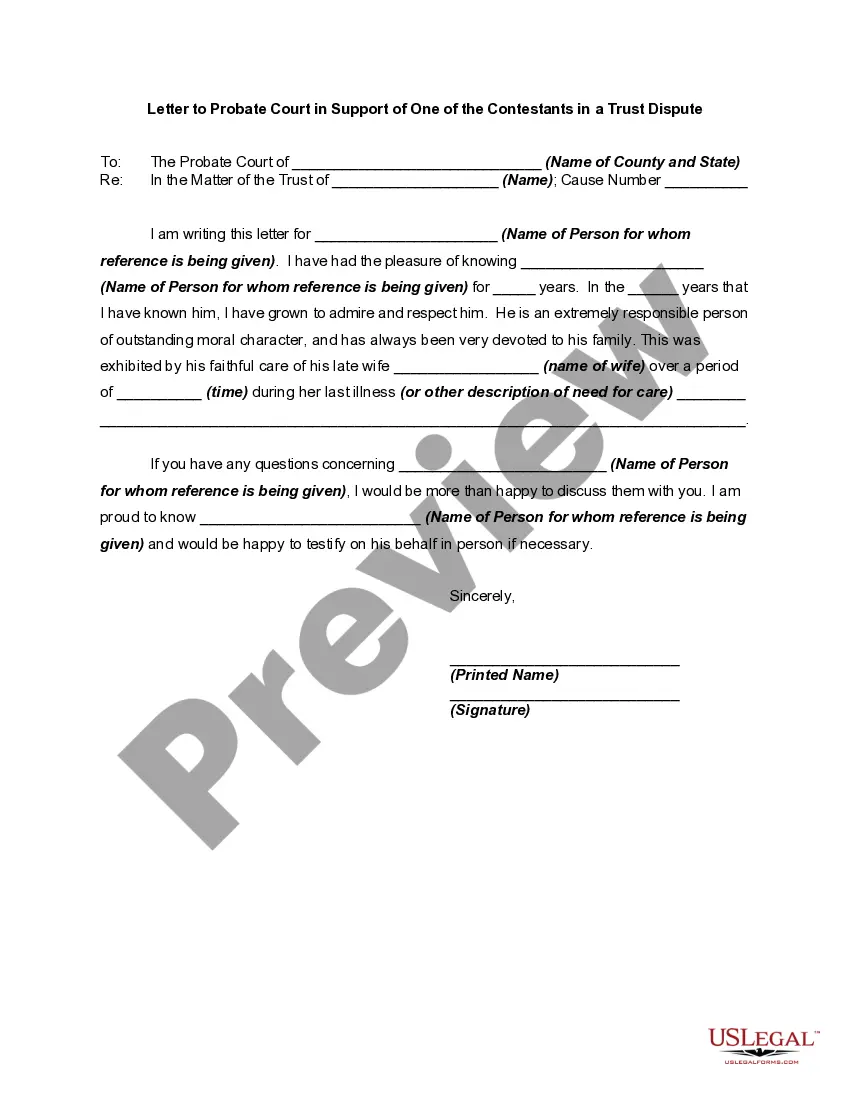
Letter to Probate Court in Support of One of the Contestants in a Trust Dispute
What this document covers
This Letter to Probate Court in Support of One of the Contestants in a Trust Dispute serves as a formal endorsement of an individual involved in a trust dispute. It allows a party to present their character and moral standing to the probate court, illustrating their reliability and dedication, particularly in regard to their role in a trust. This is different from standard letters of recommendation, as it specifically addresses a legal matter involving trust disputes and probate issues.
Form components explained
- Recipient details: Specifies the probate court's name and jurisdiction.
- Subject matter: Refers to the trust in question and its specific details.
- Personal reference: Includes the name of the person being supported and the relationship of the writer to them.
- Personal attributes: Describes the moral character and reliability of the person being endorsed.
- Offer for further contact: Invites the court to reach out if they have additional questions.
- Signatures: Requires the printed name and signature of the endorsing party.
When to use this document
This form is used when an individual is involved in a trust dispute and needs to provide support for one of the contestants. It is particularly useful in situations where character references are needed to establish credibility and moral integrity, such as when a court is determining the validity of a trust or addressing claims of misconduct among trustees or beneficiaries.
Who this form is for
- Individuals contesting a trust who want to present character references.
- Friends or family members of a contestant who wish to support their reputation in court.
- Legal representatives preparing evidence for a probate dispute.
- Any person who meets the ethical standards of the court and has relevant insights into the character of the contestant.
Completing this form step by step
- Identify the probate court where the letter will be submitted.
- Fill in the case details, including the name of the trust and cause number.
- Provide the name of the individual you are supporting, along with your relationship to them.
- Describe your positive experiences and observations of their character and reliability.
- Include your contact information and offer to provide additional insights if necessary.
- Sign and date the letter before submission to the court.
Is notarization required?
In most cases, this form does not require notarization. However, some jurisdictions or signing circumstances might. US Legal Forms offers online notarization powered by Notarize, accessible 24/7 for a quick, remote process.
Get your form ready online
Our built-in tools help you complete, sign, share, and store your documents in one place.
Make edits, fill in missing information, and update formatting in US Legal Forms—just like you would in MS Word.
Download a copy, print it, send it by email, or mail it via USPS—whatever works best for your next step.
Sign and collect signatures with our SignNow integration. Send to multiple recipients, set reminders, and more. Go Premium to unlock E-Sign.
If this form requires notarization, complete it online through a secure video call—no need to meet a notary in person or wait for an appointment.
We protect your documents and personal data by following strict security and privacy standards.

Make edits, fill in missing information, and update formatting in US Legal Forms—just like you would in MS Word.

Download a copy, print it, send it by email, or mail it via USPS—whatever works best for your next step.

Sign and collect signatures with our SignNow integration. Send to multiple recipients, set reminders, and more. Go Premium to unlock E-Sign.

If this form requires notarization, complete it online through a secure video call—no need to meet a notary in person or wait for an appointment.

We protect your documents and personal data by following strict security and privacy standards.
Avoid these common issues
- Failing to personalize the letter for the specific case.
- Not including all relevant case details, such as the cause number.
- Using vague or generic statements instead of specific examples of character.
- Omitting your contact information for follow-up questions.
- Not signing the letter, which would invalidate it.
Why complete this form online
- Convenience: Easily fill out and download the form from anywhere.
- Editability: Quickly customize the form to fit individual needs.
- Time-saving: Instant access means no waiting for a physical copy.
- Reliable: Access forms vetted by licensed attorneys, ensuring legal accuracy.
Looking for another form?








Form popularity
FAQ
The first thing you need to do is file an application with the probate court. The application must include information such as the date of death, the name and address of the deceased, and identities of the heirs. After filing, submit a copy of the Will to the court.
Step 1: Filing the Petition. Step 2: Handling of Notices. Step 3: Proving the Will. Step 4: Asset Collection. Step 5: Payments to Creditors. Step 6: Estate Tax Payments. Step 7: Conclusion of the Estate.
Before distributing assets to beneficiaries, the executor must pay valid debts and expenses, subject to any exclusions provided under state probate laws.The executor must maintain receipts and related documents and provide a detailed accounting to estate beneficiaries.
Beneficiaries often must sign off on the inheritance they receive to acknowledge receipt of the distribution. For example, if you inherit a portion of real estate from the decedent, you must sign a deed accepting that real estate.
Beneficiaries are entitled to receive a financial accounting of the trust, including bank statements, regularly. When statements are not received as requested, a beneficiary must submit a written demand to the trustee.The court will review the trust account for any discrepancies or irregular activity.
All taxes and liabilities paid from the estate, including medical expenses, attorney fees, burial or cremation expenses, estate sale costs, appraisal expenses, and more. The executor should keep all receipts for any services or transactions needed to liquidate the assets of the deceased.
Q: How Long Does an Executor Have to Distribute Assets From a Will? A: Dear Waiting: In most states, a will must be executed within three years of a person's death.
To do this, you must file a Petition for Probate (form DE-111. NOTE: If there is no will and a court case is needed, the court will appoint an administrator to manage the estate during the probate process.
Probate is initiated by filing a petition with the California Superior Court in the county in which the deceased individual lived at the time of their death. This is done, in part, to request a court hearing to appoint an estate representative. An original of the will, if there is one, must be filed with the petition.