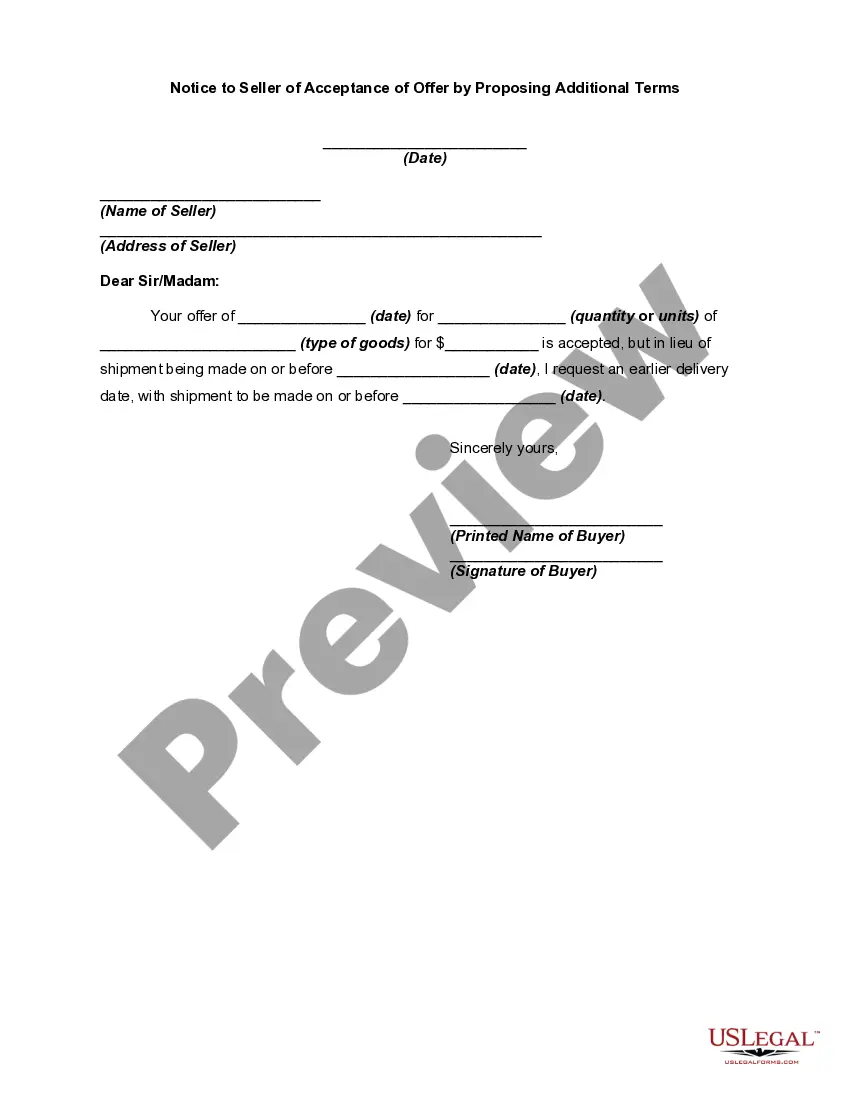
Letter and Notice to Seller Accepting Offer But Proposing Additional Terms - Earlier Delivery Date
What is this form?
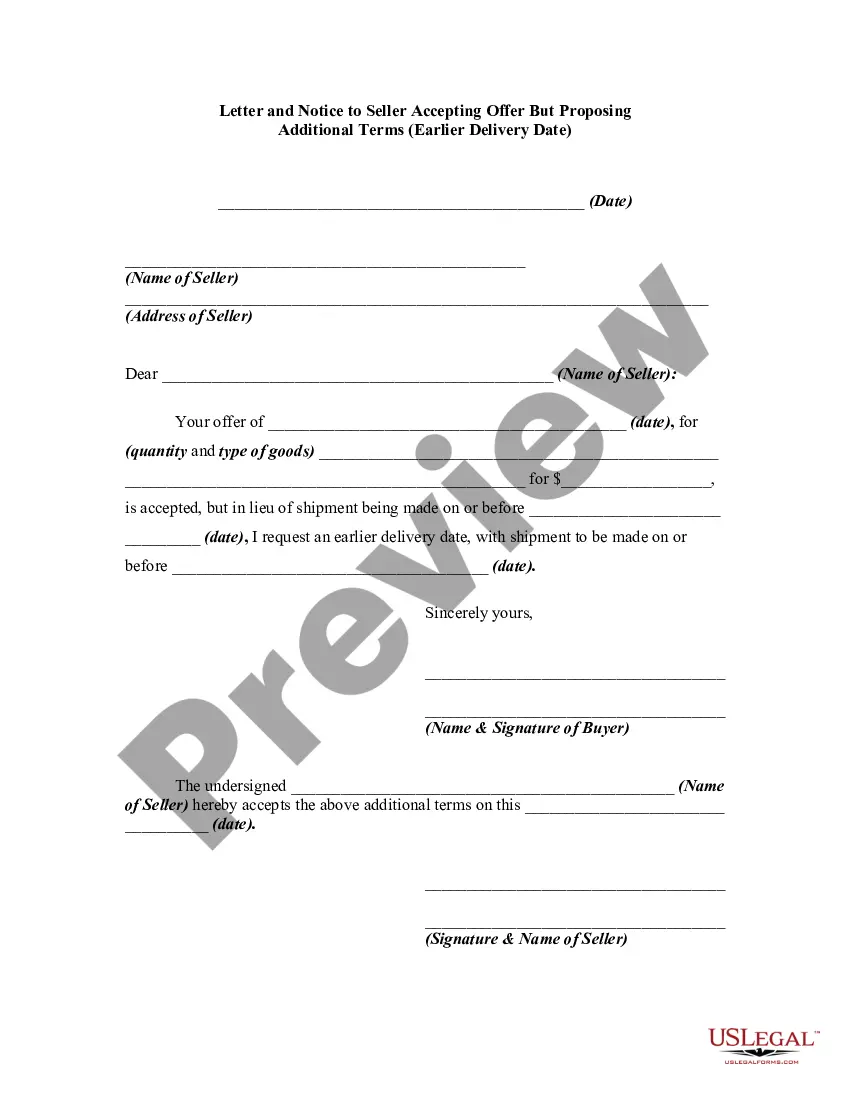
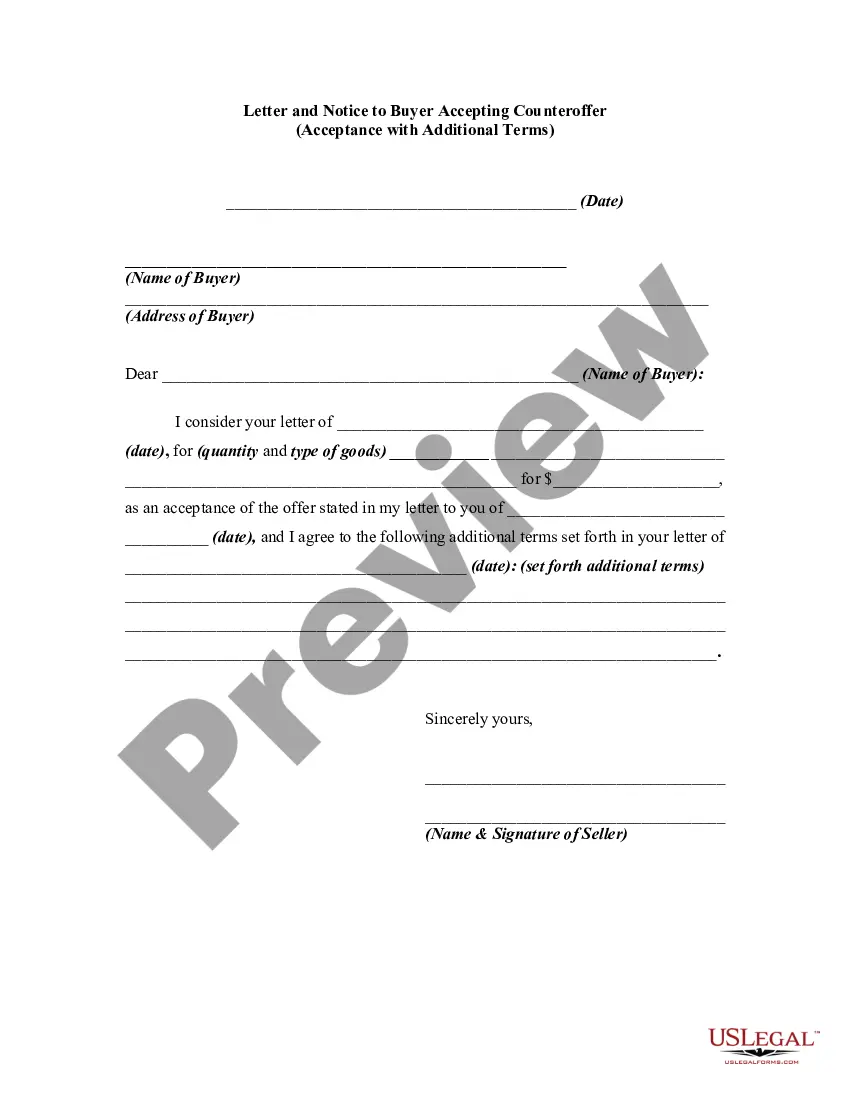
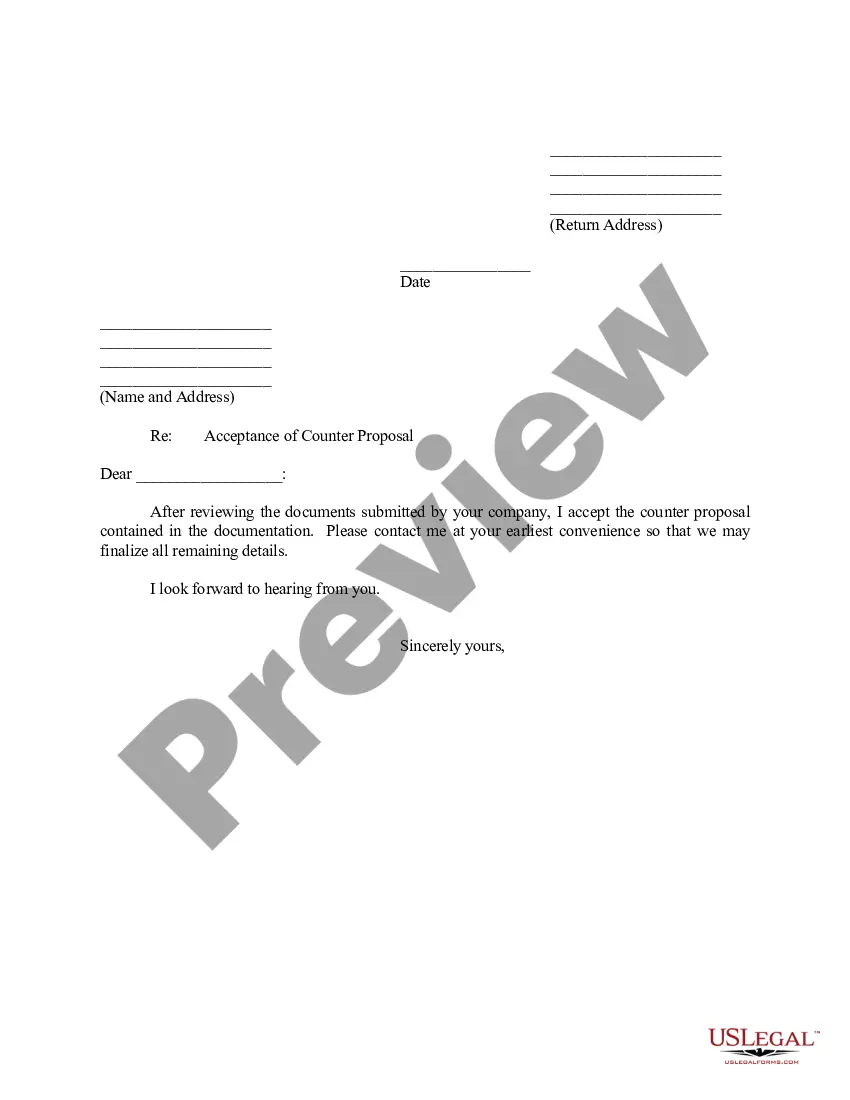
The Letter and Notice to Seller Accepting Offer But Proposing Additional Terms - Earlier Delivery Date is a formal document used in commercial transactions. It enables a buyer to accept a seller's offer while simultaneously proposing changes to the terms, specifically requesting an earlier delivery date for goods. This form serves as a counteroffer, allowing negotiations to continue without fully rejecting the original offer, distinguishing itself from standard acceptance forms by adding additional terms for consideration.
Key parts of this document
- Date of the letter
- Name and address of the seller
- Description of the accepted offer (goods and terms)
- Request for an earlier delivery date
- Signature of the buyer
- Acceptance of the additional terms by the seller with date and signature
When to use this form
This form is useful when a buyer wishes to accept a seller's offer but needs to alter specific terms, such as the delivery date. It is typically used in situations where the product availability schedule is critical, and timely delivery could affect the buyer's operations or selling strategy. For instance, if a buyer anticipates needing goods sooner than proposed, this form allows them to negotiate their operational deadlines effectively.
Who needs this form
- Buyers who want to accept a seller's offer while proposing new terms
- Business professionals involved in sales transactions
- Individuals negotiating purchase agreements for goods
- Legal representatives managing contract negotiations
How to complete this form
- Enter the date of the letter at the top of the form.
- Fill in the name and address of the seller.
- Describe the goods being offered, including the relevant details like quantity and type.
- Specify your request for an earlier delivery date and mention the new proposed date.
- Sign the letter, including your printed name.
- Ensure the seller signs below to accept the additional terms.
Does this form need to be notarized?
This form does not typically require notarization unless specified by local law. It is advisable to check specific state regulations to confirm any notarization requirements.
Get your form ready online
Our built-in tools help you complete, sign, share, and store your documents in one place.
Make edits, fill in missing information, and update formatting in US Legal Forms—just like you would in MS Word.
Download a copy, print it, send it by email, or mail it via USPS—whatever works best for your next step.
Sign and collect signatures with our SignNow integration. Send to multiple recipients, set reminders, and more. Go Premium to unlock E-Sign.
If this form requires notarization, complete it online through a secure video call—no need to meet a notary in person or wait for an appointment.
We protect your documents and personal data by following strict security and privacy standards.

Make edits, fill in missing information, and update formatting in US Legal Forms—just like you would in MS Word.

Download a copy, print it, send it by email, or mail it via USPS—whatever works best for your next step.

Sign and collect signatures with our SignNow integration. Send to multiple recipients, set reminders, and more. Go Premium to unlock E-Sign.

If this form requires notarization, complete it online through a secure video call—no need to meet a notary in person or wait for an appointment.

We protect your documents and personal data by following strict security and privacy standards.
Common mistakes to avoid
- Failing to include all required details about the goods and proposed terms.
- Not signing the form or having the seller neglect to sign it after agreement.
- Omitting the date, which could lead to confusion about the timelines.
Benefits of completing this form online
- Convenient access to a professionally drafted legal document.
- Editability to customize terms to fit your specific needs.
- Reliability from documents created by licensed attorneys.
Legal use & context
- The form serves as a legal document of acceptance with proposed amendments.
- It can be used in disputes to prove the buyerâs intention regarding delivery terms.
- Should reflect good faith negotiations in commercial transactions.
Quick recap
- This form is essential for buyers wanting to modify delivery terms upon acceptance of an offer.
- Clear documentation helps prevent misunderstandings between parties.
- Enter accurate details to make the counter offer effective.
Looking for another form?
Form popularity
FAQ
The general rule under contract law is that silence on the part of the offeree does not communicate to acceptance of the offer made by the offeror.Where the offeree gives the offeror the impression that silence is acceptance of the offer.
In order for an offer to be valid, it must be clearly communicated, giving the offeree a chance to accept or reject it. Clear communication can include actions, oral communication, or in writing. A valid offer can be made to a group, a single person, or the public at large. Valid offers are definite in their substance.
There are three types of acceptance including express acceptance, implied acceptance, and conditional acceptance. In the world of merchant agreements, formal contracts are sometimes too tedious for a busy schedule. Instead, merchants, contractors, and buyers have developed these types of acceptance of a contract.
Generally, a simple price quote is not an offer.If a person rejects an offer, it is considered terminated. Likewise, if the recipient of an offer changes its terms, the original offer is terminated and a new offer is created. This new offer is called a counteroffer, and the original offerer may accept it.
The three requirements for a valid offer are: present intent to contract, definiteness and communication to the offeree.
If the offeree accepts the offeror's terms while complaining about them, it is called a grumbling acceptance.The intention to accept an offer must be a present intent to contract.
Offers at common law required three elements: communication, commitment and definite terms.
Revocation means "cancellation". Revocation of an offer means its withdrawal by the offeror.Section 5 lays down "a proposal may be revoked at any time before the communication of its acceptance as against the proposer". An offer is made irrevocable by acceptance. Revocation may be express or implied.
In the law of contracts, the mirror image rule, also referred to as an unequivocal and absolute acceptance requirement, states that an offer must be accepted exactly with no modifications. The offeror is the master of their own offer.