Authorization of Motor Vehicle or Car Owner for Garage to Make Repairs and Acknowledgment of Lien
What this document covers
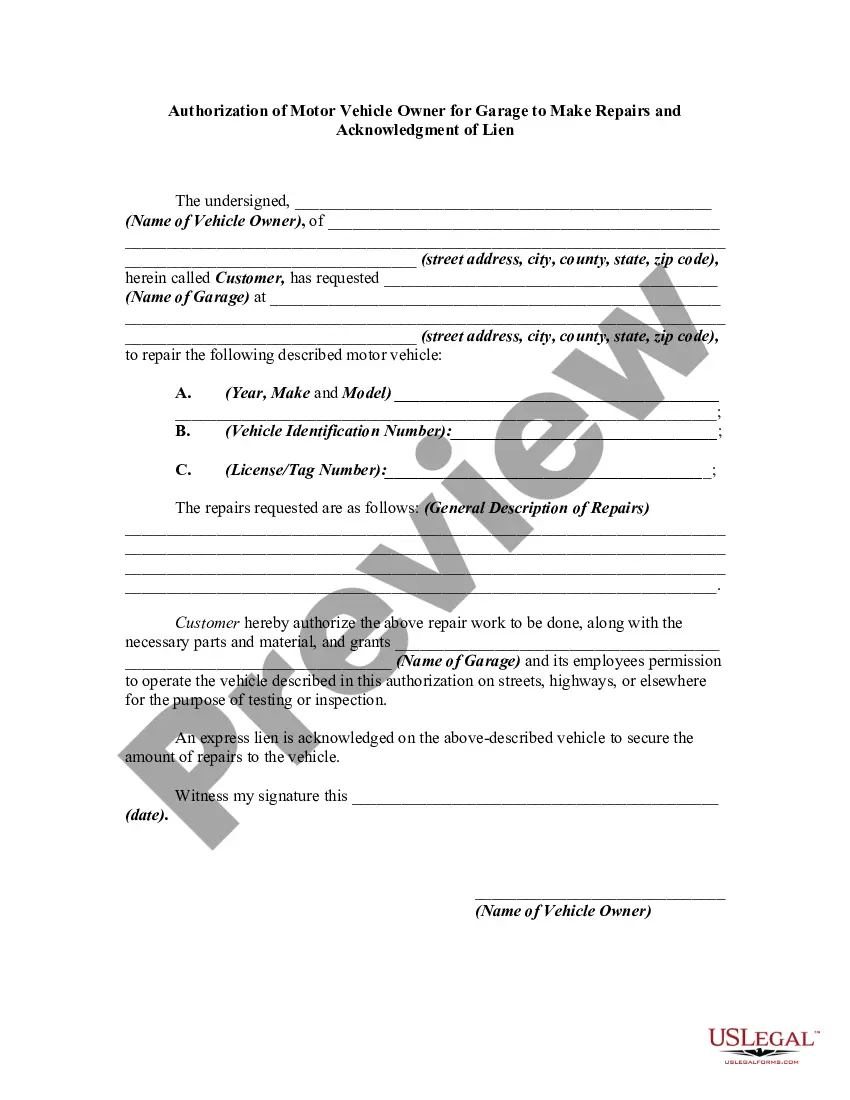
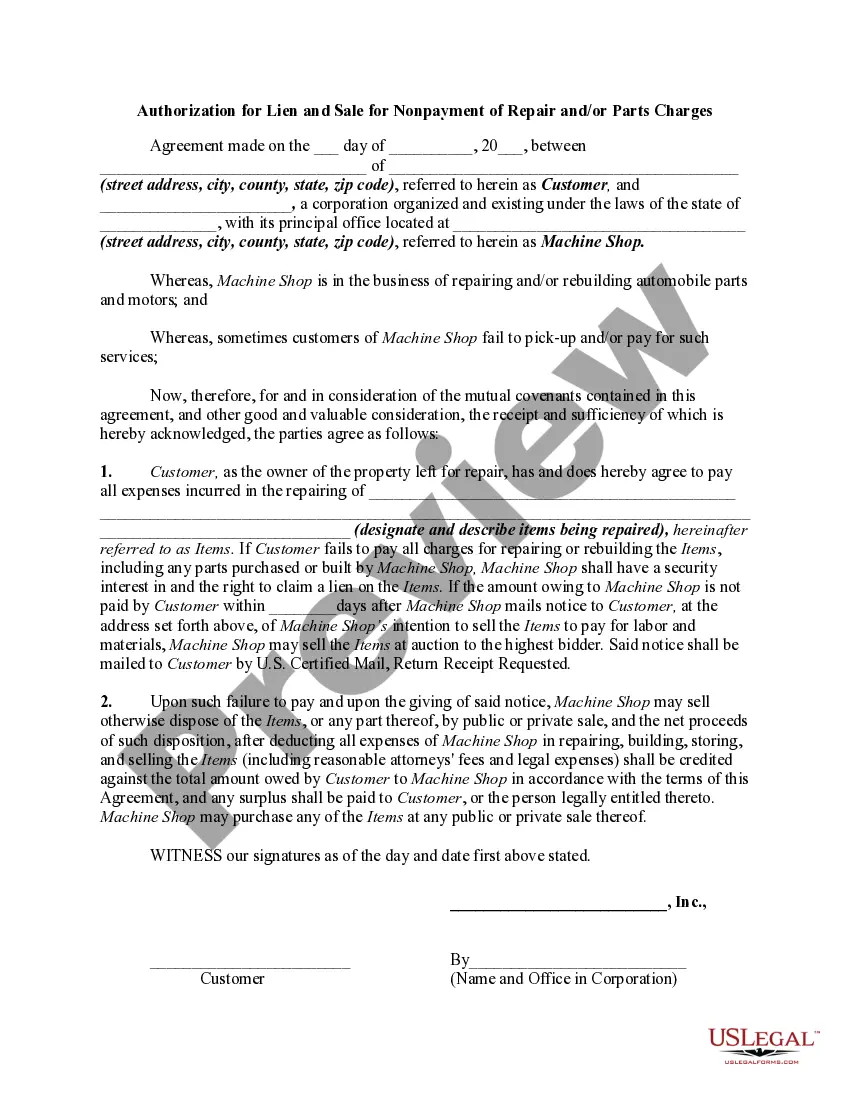
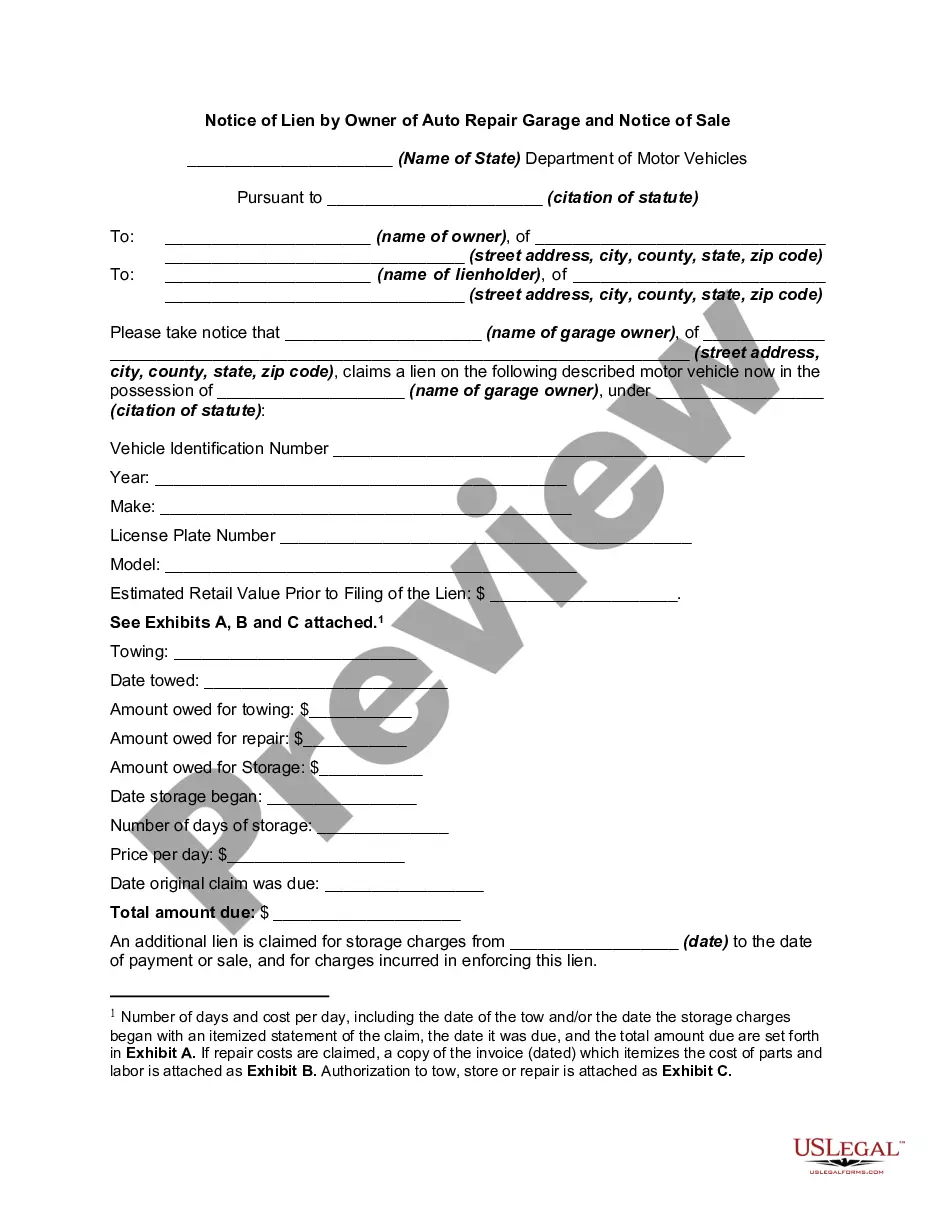
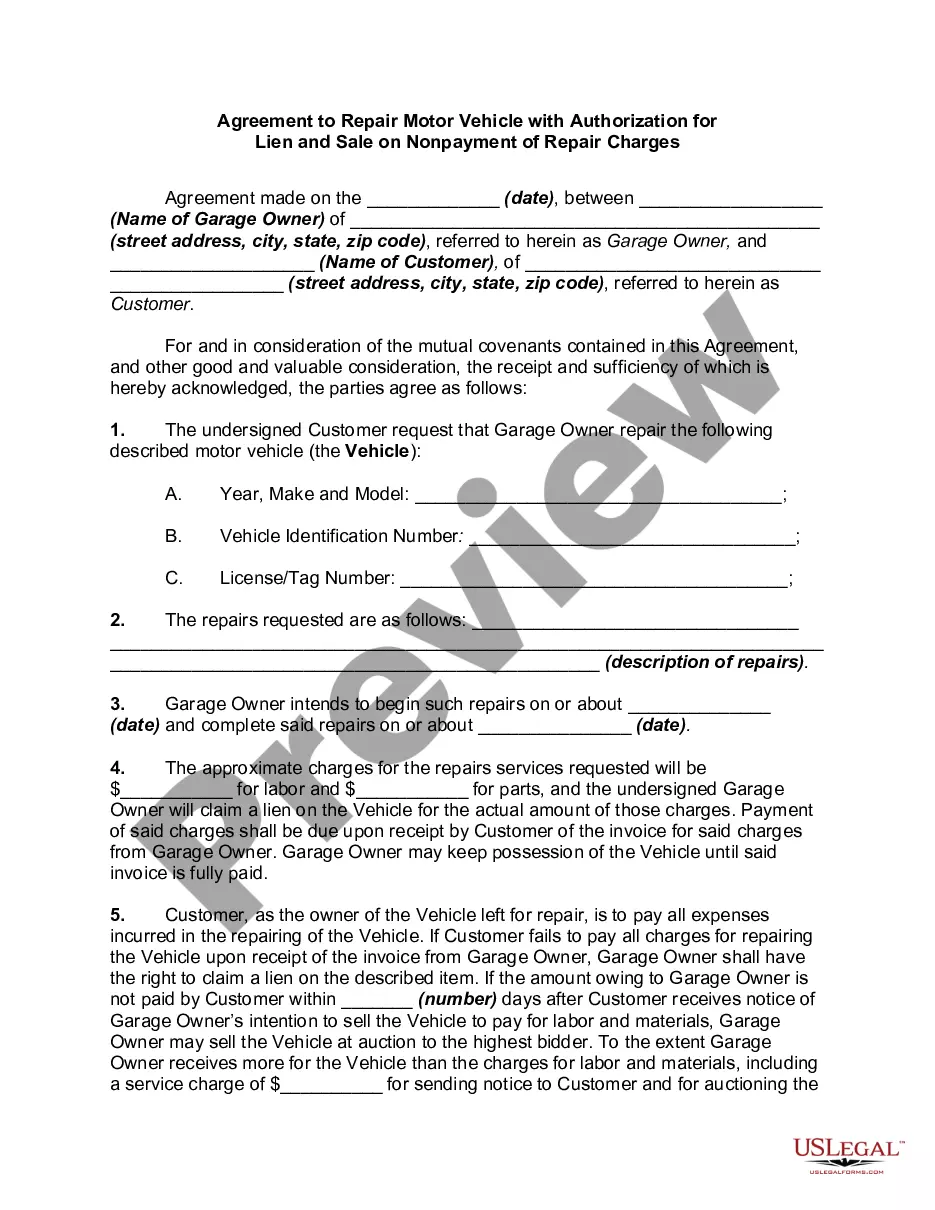
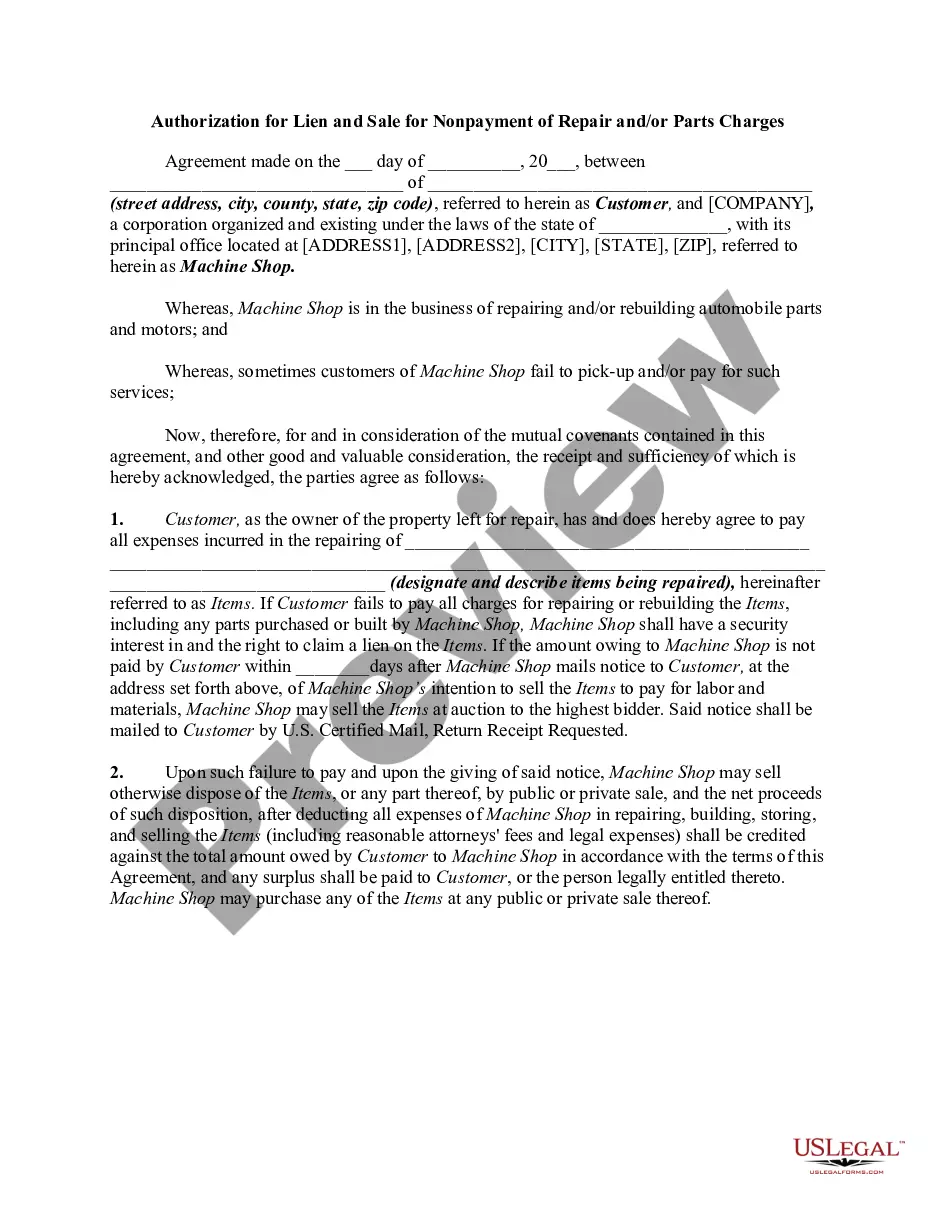
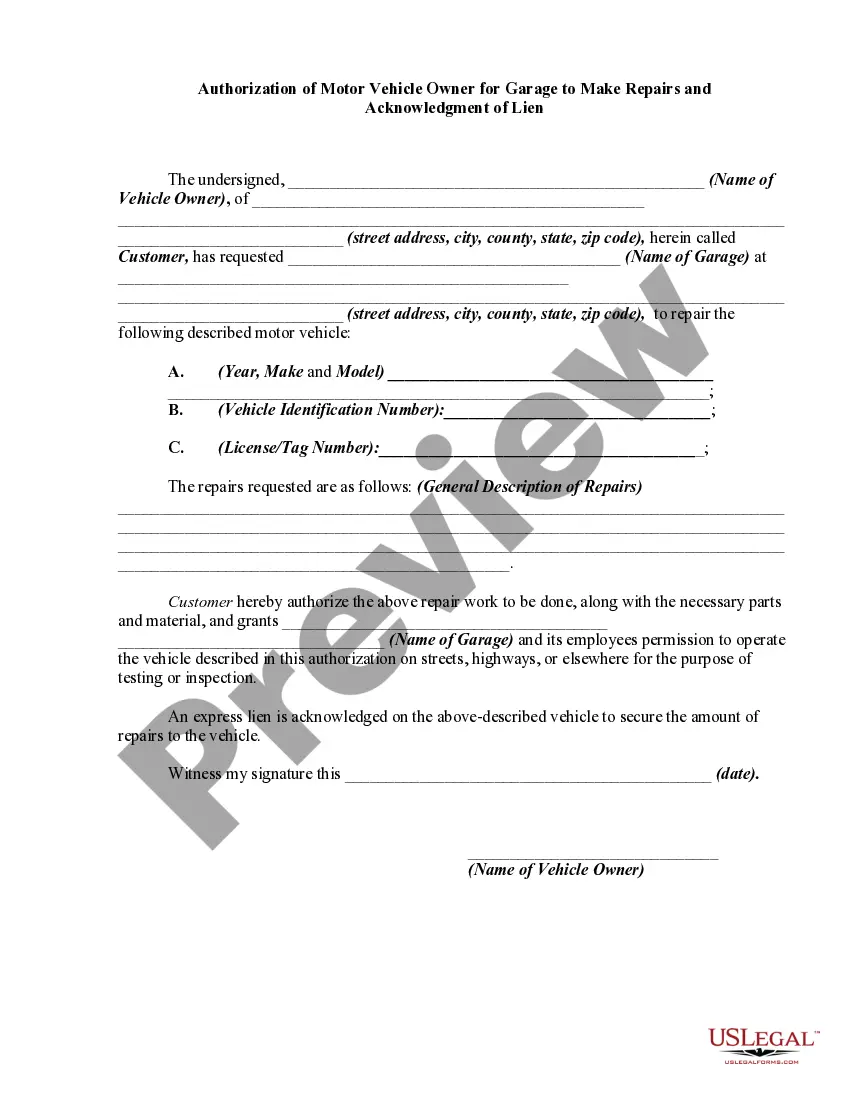
The Authorization of Motor Vehicle or Car Owner for Garage to Make Repairs and Acknowledgment of Lien form is a legal document that allows a vehicle owner to authorize a garage to perform repairs on their motor vehicle. This form is important as it establishes the owner's consent for the work and acknowledges the garage's right to place a lien on the vehicle for the costs incurred. This form differs from other repair authorization forms by explicitly providing an acknowledgment of lien, which secures the garage's payment for services rendered.
Form components explained
- Identification of the vehicle owner, including name and address.
- Details of the garage involved in the repair.
- Description of the motor vehicle, including year, make, model, and VIN.
- A section for the specific repairs requested by the vehicle owner.
- Authorization for the garage to operate the vehicle for testing or inspection.
- A declaration of an express lien on the vehicle for securing payment.
- Signature of the vehicle owner with date for validation.
When to use this document
This form should be utilized when a vehicle owner wants to authorize a garage to perform repairs on their automobile. It is particularly necessary when the repairs may be costly, allowing the garage to secure a lien against the vehicle, which assures payment. This situation typically arises when the vehicle is taken to a mechanic, and the garage requires formal permission to proceed with the work and protect their financial interests.
Who needs this form
- Vehicle owners who need to authorize repairs on their automobiles.
- Garage owners and mechanics who require a formal agreement with the vehicle owner before performing work.
- Any individual or entity involved in automotive repairs who needs to establish consent and a lien on the vehicle.
How to complete this form
- Identify and enter the name and address of the vehicle owner in the designated fields.
- Provide the name and address of the garage that will perform the repairs.
- Fill in the vehicle details, including year, make, model, and vehicle identification number (VIN).
- Specify the repairs requested in the provided section to clearly outline the work to be done.
- Sign and date the form to authorize the repairs and acknowledge the lien.
Notarization requirements for this form
This form does not typically require notarization unless specified by local law. It is advisable to check the specific requirements in your jurisdiction regarding notarization for added legal assurance.
Get your form ready online
Our built-in tools help you complete, sign, share, and store your documents in one place.
Make edits, fill in missing information, and update formatting in US Legal Forms—just like you would in MS Word.
Download a copy, print it, send it by email, or mail it via USPS—whatever works best for your next step.
Sign and collect signatures with our SignNow integration. Send to multiple recipients, set reminders, and more. Go Premium to unlock E-Sign.
If this form requires notarization, complete it online through a secure video call—no need to meet a notary in person or wait for an appointment.
We protect your documents and personal data by following strict security and privacy standards.

Make edits, fill in missing information, and update formatting in US Legal Forms—just like you would in MS Word.

Download a copy, print it, send it by email, or mail it via USPS—whatever works best for your next step.

Sign and collect signatures with our SignNow integration. Send to multiple recipients, set reminders, and more. Go Premium to unlock E-Sign.

If this form requires notarization, complete it online through a secure video call—no need to meet a notary in person or wait for an appointment.

We protect your documents and personal data by following strict security and privacy standards.
Common mistakes to avoid
- Failing to include complete information about the vehicle or garage.
- Not specifying the repairs clearly, leading to ambiguity.
- Omitting the signature or date, which is essential for validity.
- Ignoring local laws that may require additional disclosures or formats.
Why use this form online
- Convenient and immediate access to legal document templates.
- Editability allows customization to fit specific needs and circumstances.
- Reliability of forms drafted by licensed attorneys, ensuring compliance and legal validity.
Looking for another form?

Form popularity
FAQ
You can use the title certificate with the new owner's name, the bill of sale or the sales tax form as proof you sold your car. You can download a bill of sale from your state's DMV website for both parties to sign. If you need additional documentation, contact the buyer for additional proof.
Step 1: Visit the official website of the RTO (Regional Transport Office) at https://parivahan.gov.in. Step 2: Enter the registration number of the vehicle for which you wish to check the ownership details. Step 3: You will have to enter the verification code given on the page. Step 4: Then click on Check Status
In most jurisdictions you can perform a personal property registry search, that will tell you what vehicles or property a person owns, and who has lines on them, if any. Most government agencies will facilitate this, to coincide with filing judgments In civil litigation or facilitate collecting overdue debts.
Registration date. Chassis number (not mentioned in full) Engine number (not mentioned in full) Owner's name. Vehicle class. Fuel type. Model and manufacturer details. Vehicular fitness duration.
Look at the previous and existing owners names and addresses as printed on the V5C logbook. Look through the service records and see if there are any old receipts or invoices for maintenance work. Complete a V888 form via the DVLA to request information about a vehicle.
Registered keeper details will be on the V5c registration document and you should never buy a used car without seeing the V5c. You can check vehicle details online using DVLA's vehicle enquiry service if you know the make and registration number, but keeper details are much harder to verify if you don't have the V5c.
Can you find out who owns it? Not really. The only people who have access to that sort of information are the police and the DVLA and neither of them will divulge it as it is covered by the Data Protection Act. The only hope you have of finding the owner is if you spot the car on the road.