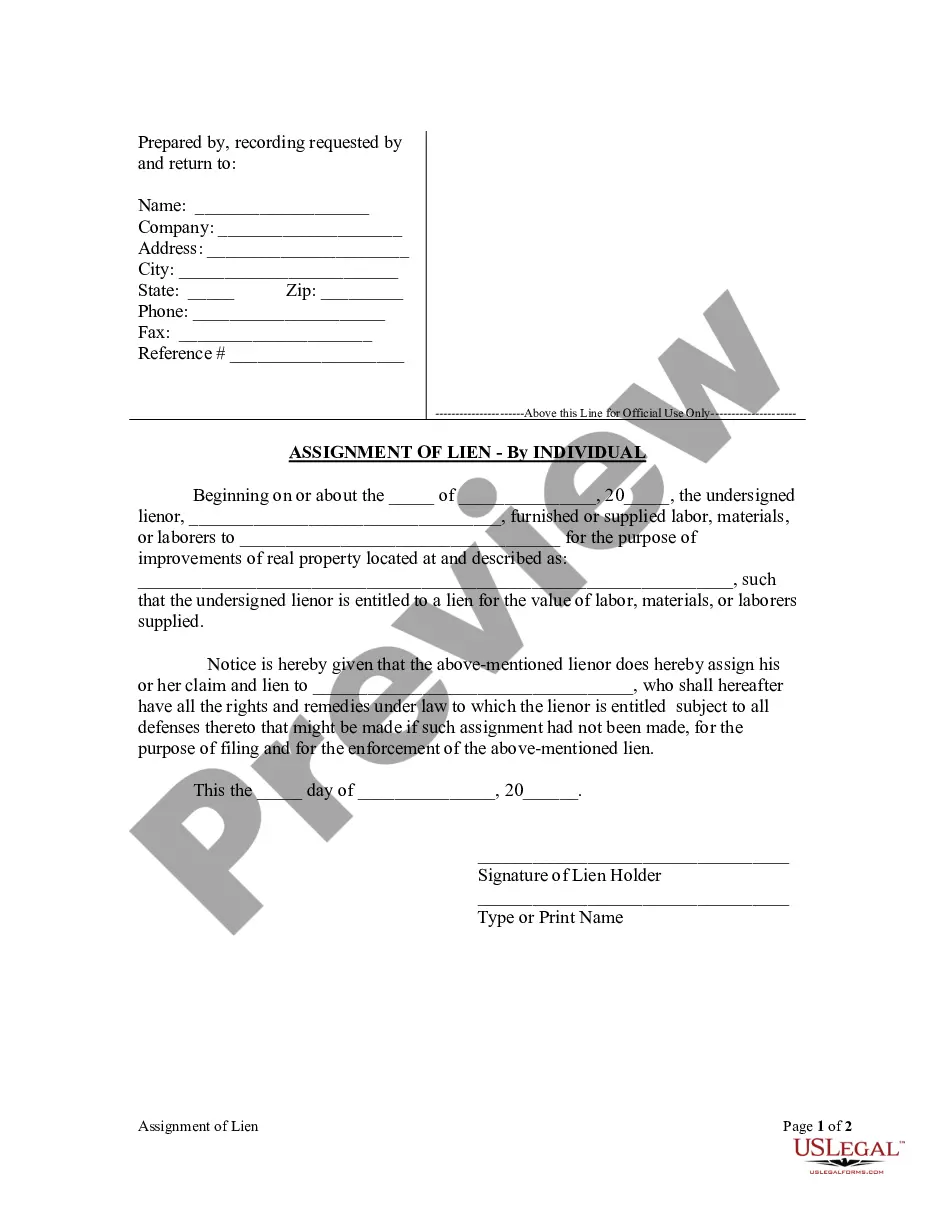
Assignment of Lien - Individual
Note: This summary is not intended to be an all
inclusive summary of the law of construction liens in Washington, but does
contain basic and other information.
Definitions.
Unless the context requires otherwise, the definitions in this section
apply throughout this chapter.
(1) "Construction agent" means any registered or licensed contractor,
registered or licensed subcontractor, architect, engineer, or other person
having charge of any improvement to real property, who shall be deemed
the agent of the owner for the limited purpose of establishing the lien
created by this chapter.
(2) "Contract price" means the amount agreed upon by the contracting
parties, or if no amount is agreed upon, then the customary and reasonable
charge therefor.
(3) "Draws" means periodic disbursements of interim or construction
financing by a lender.
(4) "Furnishing labor, professional services, materials, or equipment"
means the performance of any labor or professional services, the contribution
owed to any employee benefit plan on account of any labor, the provision
of any supplies or materials, and the renting, leasing, or otherwise supplying
of equipment for the improvement of real property.
(5) "Improvement" means: (a) Constructing, altering, repairing, remodeling,
demolishing, clearing, grading, or filling in, of, to, or upon any real
property or street or road in front of or adjoining the same; (b) planting
of trees, vines, shrubs, plants, hedges, or lawns, or providing other landscaping
materials on any real property; and (c) providing professional services
upon real property or in preparation for or in conjunction with the intended
activities in (a) or (b) of this subsection.
(6) "Interim or construction financing" means that portion of money
secured by a mortgage, deed of trust, or other encumbrance to finance improvement
of, or to real property, but does not include:
(b) Funds to pay interest, insurance premiums, lease deposits, taxes,
assessments, or prior encumbrances;
(c) Funds to pay loan, commitment, title, legal, closing, recording,
or appraisal fees;
(d) Funds to pay other customary fees, which pursuant to agreement
with the owner or borrower are to be paid by the lender from time to time;
(e) Funds to acquire personal property for which the potential lien
claimant may not claim a lien pursuant to this chapter.
(7) "Labor" means exertion of the powers of body or mind performed
at the site for compensation. "Labor" includes amounts due and owed
to any employee benefit plan on account of such labor performed.
(8) "Mortgagee" means a person who has a valid mortgage of record or
deed of trust of record securing a loan.
(9) "Owner-occupied" means a single-family residence occupied by the
owner as his or her principal residence.
(10) "Payment bond" means a surety bond issued by a surety licensed
to issue surety bonds in the state of Washington that confers upon potential
claimants the rights of third party beneficiaries.
(11) "Potential lien claimant" means any person or entity entitled
to assert lien rights under this chapter who has otherwise complied with
the provisions of this chapter and is registered or licensed if required
to be licensed or registered by the provisions of the laws of the state
of Washington.
(12) "Prime contractor" includes all contractors, general contractors,
and specialty contractors, as defined by chapter 18.27 or 19.28 RCW, or
who are otherwise required to be registered or licensed by law, who contract
directly with a property owner or their common law agent to assume primary
responsibility for the creation of an improvement to real property, and
includes property owners or their common law agents who are contractors,
general contractors, or specialty contractors as defined in chapter 18.27
or 19.28 RCW, or who are otherwise required to be registered or licensed
by law, who offer to sell their property without occupying or using the
structures, projects, developments, or improvements for more than one year.
(13) "Professional services" means surveying, establishing or marking
the boundaries of, preparing maps, plans, or specifications for, or inspecting,
testing, or otherwise performing any other architectural or engineering
services for the improvement of real property.
(14) "Real property lender" means a bank, savings bank, savings and
loan association, credit union, mortgage company, or other corporation,
association, partnership, trust, or individual that makes loans secured
by real property located in the state of Washington.
(15) "Site" means the real property which is or is to be improved.
(16) "Subcontractor" means a general contractor or specialty contractor
as defined by chapter 18.27 or 19.28 RCW, or who is otherwise required
to be registered or licensed by law, who contracts for the improvement
of real property with someone other than the owner of the property or their
common law agent. RCW 60.04.011
Lien authorized.
Except as provided in RCW 60.04.031, any person furnishing labor, professional
services, materials, or equipment for the improvement of real property
shall have a lien upon the improvement for the contract price of labor,
professional services, materials, or equipment furnished at the instance
of the owner, or the agent or construction agent of the owner. RCW 60.04.021
Notices -- Exceptions.
(1) Except as otherwise provided in this section, every person furnishing
professional services, materials, or equipment for the improvement of real
property shall give the owner or reputed owner notice in writing of the
right to claim a lien. If the prime contractor is in compliance with
the requirements of RCW 19.27.095, 60.04.230, and 60.04.261, this notice
shall also be given to the prime contractor as described in this subsection
unless the potential lien claimant has contracted directly with the prime
contractor. The notice may be given at any time but only protects
the right to claim a lien for professional services, materials, or equipment
supplied after the date which is sixty days before:
(b) Delivering or serving the notice personally upon the owner or reputed
owner and obtaining evidence of delivery in the form of a receipt or other
acknowledgement signed by the owner or reputed owner or an affidavit of
service.
In the case of new construction of a single-family residence, the notice
of a right to claim a lien may be given at any time but only protects the
right to claim a lien for professional services, materials, or equipment
supplied after a date which is ten days before the notice is given as described
in this subsection.
(2) Notices of a right to claim a lien shall not be required of:
(b) Laborers whose claim of lien is based solely on performing labor;
or,
(c) Subcontractors who contract for the improvement of real property
directly with the prime contractor, except as provided in subsection (3)(b)
of this section.
(3) Persons who furnish professional services, materials, or equipment
in connection with the repair, alteration, or remodel of an existing owner-occupied
single-family residence or appurtenant garage:
(a) Who contract directly with the owner-occupier or their common law
agent shall not be required to send a written notice of the right to claim
a lien and shall have a lien for the full amount due under their contract,
as provided in RCW 60.04.021; or
(b) Who do not contract directly with the owner-occupier or their common
law agent shall give notice of the right to claim a lien to the owner-occupier.
Liens of persons furnishing professional services, materials, or equipment
who do not contract directly with the owner-occupier or their common law
agent may only be satisfied from amounts not yet paid to the prime contractor
by the owner at the time the notice described in this section is received,
regardless of whether amounts not yet paid to the prime contractor are
due. For the purposes of this subsection "received" means actual receipt of notice by personal service, or registered
or certified mail, or three days after mailing by registered or certified
mail, excluding Saturdays, Sundays, or legal holidays.
(4) The notice of right to claim a lien described in subsection (1)
of this section, shall include but not be limited to the following information
and shall substantially be in the following form, using lower-case and
upper-case ten-point type where appropriate. See Form WA-01-09 or WA-01A-09.
(5) Every potential lien claimant providing professional services where
no improvement as defined in RCW 60.04.011(5) (a) or (b) has been commenced,
and the professional services provided are not visible from an inspection
of the real property may record in the real property records of the county
where the property is located a notice which shall contain the professional
service provider's name, address, telephone number, legal description of
the property, the owner or reputed owner's name, and the general nature
of the professional services provided. If such notice is not recorded,
the lien claimed shall be subordinate to the interest of any subsequent
mortgagee and invalid as to the interest of any subsequent purchaser if
the mortgagee or purchaser acts in good faith and for a valuable consideration
acquires an interest in the property prior to the commencement of an improvement
as defined in RCW 60.04.011(5) (a) or (b) without notice of the professional
services being provided. The notice described in this subsection
shall be substantially in the following form: See Form WA-02-09 or WA-02A-09.
(6) A lien authorized by this chapter shall not be enforced unless the
lien claimant has complied with the applicable provisions of this section.
Acts of coercion -- Application of chapter 19.86 RCW.
The legislature finds that acts of coercion or attempted coercion, including
threats to withhold future contracts, made by a contractor or developer
to discourage a contractor, subcontractor, or material or equipment supplier
from giving an owner the notice of right to claim a lien required by RCW
60.04.031, or from filing a claim of lien under this chapter are matters
vitally affecting the public interest for the purpose of applying the consumer
protection act, chapter 19.86 RCW. These acts of coercion are not
reasonable in relation to the development and preservation of business.
These acts of coercion shall constitute an unfair or deceptive act or practice
in trade or commerce for the purpose of applying the consumer protection
act, chapter 19.86 RCW. RCW 60.04.035
Contractor registration.
A contractor or subcontractor required to be registered under chapter
18.27 RCW or licensed under chapter 19.28 RCW, or otherwise required to
be registered or licensed by law, shall be deemed the construction agent
of the owner for the purposes of establishing the lien created by this
chapter only if so registered or licensed. Persons dealing with contractors
or subcontractors may rely, for the purposes of this section, upon a certificate
of registration issued pursuant to chapter 18.27 RCW or license issued
pursuant to chapter 19.28 RCW, or other certificate or license issued pursuant
to law, covering the period when the labor, professional services, material,
or equipment shall be furnished, and the lien rights shall not be lost
by suspension or revocation of registration or license without their knowledge.
No lien rights described in this chapter shall be lost or denied by virtue
of the absence, suspension, or revocation of such registration or license
with respect to any contractor or subcontractor not in immediate contractual
privity with the lien claimant. RCW 60.04.041
Property subject to lien.
The lot, tract, or parcel of land which is improved is subject to a
lien to the extent of the interest of the owner at whose instance, directly
or through a common law or construction agent the labor, professional services,
equipment, or materials were furnished, as the court deems appropriate
for satisfaction of the lien. If, for any reason, the title or interest
in the land upon which the improvement is situated cannot be subjected
to the lien, the court in order to satisfy the lien may order the sale
and removal of the improvement from the land which is subject to the lien.
RCW 60.04.051
Priority of lien.
The claim of lien created by this chapter upon any lot or parcel of
land shall be prior to any lien, mortgage, deed of trust, or other encumbrance
which attached to the land after or was unrecorded at the time of commencement
of labor or professional services or first delivery of materials or equipment
by the lien claimant. RCW 60.04.061
Release of lien rights.
Upon payment and acceptance of the amount due to the lien claimant and
upon demand of the owner or the person making payment, the lien claimant
shall immediately prepare and execute a release of all lien rights for
which payment has been made, and deliver the release to the person making
payment. In any suit to compel deliverance of the release thereafter
in which the court determines the delay was unjustified, the court shall,
in addition to ordering the deliverance of the release, award the costs
of the action including reasonable attorneys' fees and any damages. RCW
60.04.071
Frivolous claim -- Procedure.
(1) Any owner of real property subject to a recorded claim of lien under
this chapter, or contractor, subcontractor, lender, or lien claimant who
believes the claim of lien to be frivolous and made without reasonable
cause, or clearly excessive may apply by motion to the superior court for
the county where the property, or some part thereof is located, for an
order directing the lien claimant to appear before the court at a time
no earlier than six nor later than fifteen days following the date of service
of the application and order on the lien claimant, and show cause, if any
he or she has, why the relief requested should not be granted. The
motion shall state the grounds upon which relief is asked, and shall be
supported by the affidavit of the applicant or his or her attorney setting
forth a concise statement of the facts upon which the motion is based.
(2) The order shall clearly state that if the lien claimant fails to
appear at the time and place noted, the lien shall be released, with prejudice,
and that the lien claimant shall be ordered to pay the costs requested
by the applicant including reasonable attorneys' fees.
(3) If no action to foreclose the lien claim has been filed, the clerk
of the court shall assign a cause number to the application and obtain
from the applicant a filing fee of thirty-five dollars. If an action has been filed to foreclose the lien claim, the application
shall be made a part of that action.
(4) If, following a hearing on the matter, the court determines that
the lien is frivolous and made without reasonable cause, or clearly excessive,
the court shall issue an order releasing the lien if frivolous and made
without reasonable cause, or reducing the lien if clearly excessive, and
awarding costs and reasonable attorneys' fees to the applicant to be paid
by the lien claimant. If the court determines that the lien is not frivolous and was made with reasonable cause, and
is not clearly excessive, the court shall issue an order so stating and
awarding costs and reasonable attorneys' fees to the lien claimant to be
paid by the applicant.
(5) Proceedings under this section shall not affect other rights and
remedies available to the parties under this chapter or otherwise. RCW
60.04.081
Recording--Time--Contents of lien.
Every person claiming a lien under RCW 60.04.021 shall file for recording,
in the county where the subject property is located, a notice of claim
of lien not later than ninety days after the person has ceased to furnish
labor, professional services, materials, or equipment or the last date
on which employee benefit contributions were due. The notice of claim of
lien:
(b) The first and last date on which the labor, professional services,
materials, or equipment was furnished or employee benefit contributions
were due;
(d) The street address, legal description, or other description reasonably
calculated to identify, for a person familiar with the area, the location
of the real property to be charged with the lien;
(e) The name of the owner or reputed owner of the property, if known,
and, if not known, that fact shall be stated; and
(2) Shall be signed by the claimant or some person authorized to act
on his or her behalf who shall affirmatively state they have read the notice
of claim of lien and believe the notice of claim of lien to be true and
correct under penalty of perjury, and shall be acknowledged pursuant to
chapter 64.08 RCW. If the lien has been assigned, the name of the assignee
shall be stated. Where an action to foreclose the lien has been commenced
such notice of claim of lien may be amended as pleadings may be by order
of the court insofar as the interests of third parties are not adversely
affected by such amendment. A claim of lien substantially in the following
form shall be sufficient: See form WA-05-09 or WA-05A-09.
The period provided for recording the claim of lien is a period of
limitation and no action to foreclose a lien shall be maintained unless
the claim of lien is filed for recording within the ninety-day period stated.
The lien claimant shall give a copy of the claim of lien to the owner or
reputed owner by mailing it by certified or registered mail or by personal
service within fourteen days of the time the claim of lien is filed for
recording. Failure to do so results in a forfeiture of any right the claimant
may have to attorneys' fees and costs against the owner under RCW 60.04.181.
Separate residential units -- Time for filing.
When furnishing labor, professional services, materials, or equipment
for the construction of two or more separate residential units, the time
for filing claims of lien against each separate residential unit shall
commence to run upon the cessation of the furnishing of labor, professional
services, materials, or equipment on each residential unit, as provided
in this chapter. For the purposes of this section a separate residential
unit is defined as consisting of one residential structure together with
any garages or other outbuildings appurtenant thereto. RCW 60.04.101
Recording -- Fees.
The county auditor shall record the notice of claim of lien in the same
manner as deeds and other instruments of title are recorded under chapter
65.08 RCW. Notices of claim of lien for registered land need not
be recorded in the Torrens register. The county auditor shall charge
no higher fee for recording notices of claim of lien than other documents.
RCW
60.04.111
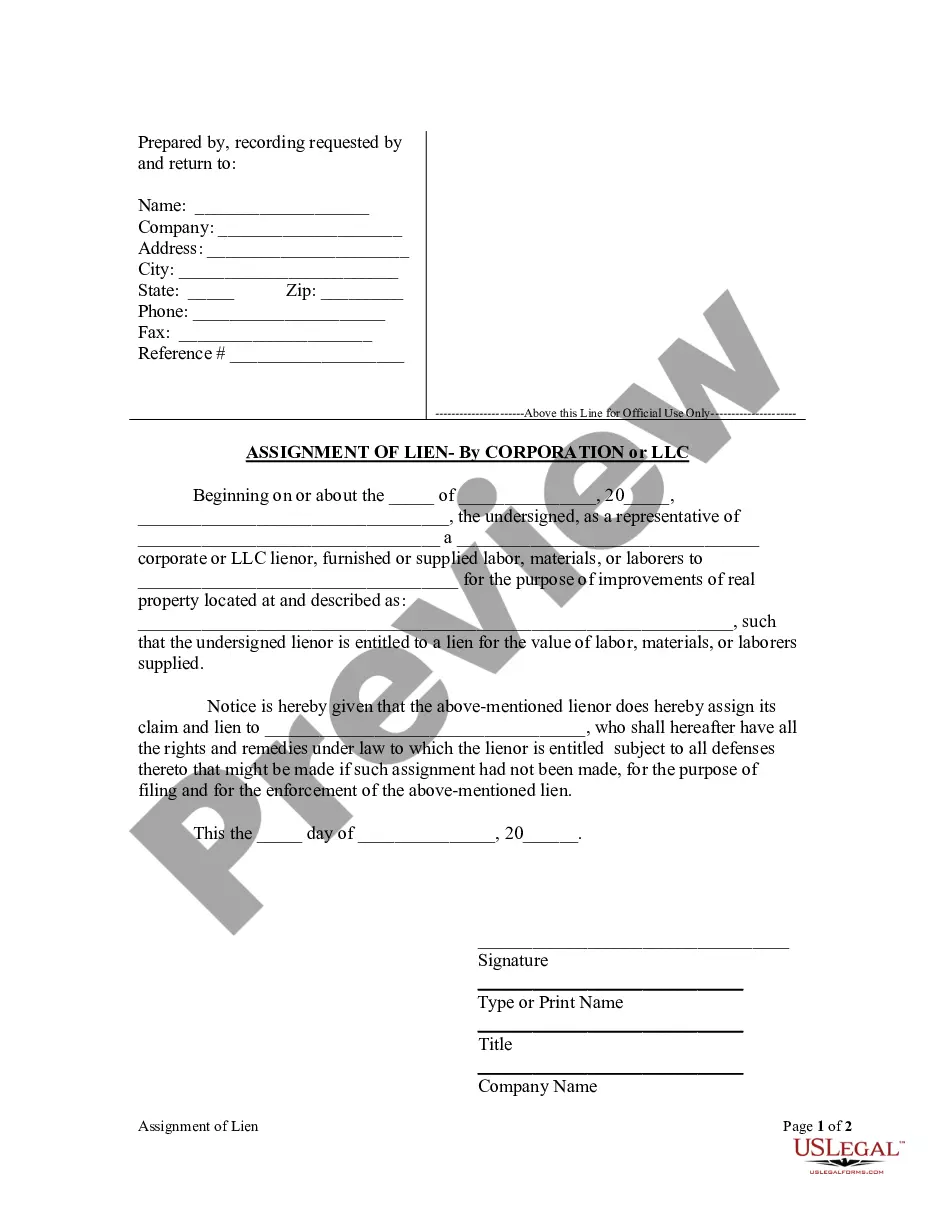
Lien -- Assignment.
Any lien or right of lien created by this chapter and the right of action
to recover therefor, shall be assignable so as to vest in the assignee
all rights and remedies of the assignor, subject to all defenses thereto
that might be made. RCW 60.04.121
Claims -- Designation of amount due.
In every case in which the notice of claim of lien is recorded against
two or more separate pieces of property owned by the same person or owned
by two or more persons jointly or otherwise, who contracted for the labor,
professional services, material, or equipment for which the notice of claim
of lien is recorded, the person recording the notice of claim of lien shall
designate in the notice of claim of lien the amount due on each piece of
property. Otherwise, the lien is subordinated to other liens that may be
established under this chapter. The lien of such claim does not extend
beyond the amount designated as against other creditors having liens upon
any of such pieces of property. RCW 60.04.131
Lien -- Duration -- Procedural limitations.
No lien created by this chapter binds the property subject to the lien
for a longer period than eight calendar months after the claim of lien
has been recorded unless an action is filed by the lien claimant within
that time in the superior court in the county where the subject property
is located to enforce the lien, and service is made upon the owner of the
subject property within ninety days of the date of filing the action; or,
if credit is given and the terms thereof are stated in the claim of lien,
then eight calendar months after the expiration of such credit; and in
case the action is not prosecuted to judgment within two years after the
commencement thereof, the court, in its discretion, may dismiss the action
for want of prosecution, and the dismissal of the action or a judgment
rendered thereon that no lien exists shall constitute a cancellation of
the lien. This is a period of limitation, which shall be tolled by
the filing of any petition seeking protection under Title Eleven, United
States Code by an owner of any property subject to the lien established
by this chapter. RCW 60.04.141
Rights of owner -- Recovery options.
The lien claimant shall be entitled to recover upon the claim recorded
the contract price after deducting all claims of other lien claimants to
whom the claimant is liable, for furnishing labor, professional services,
materials, or equipment; and in all cases where a claim of lien shall be
recorded under this chapter for labor, professional services, materials,
or equipment supplied to any lien claimant, he or she shall defend any
action brought thereupon at his or her own expense.
During the pendency of the action, the owner may withhold from the prime
contractor the amount of money for which a claim is recorded by any subcontractor,
supplier, or laborer. In case of judgment against the owner or the
owner's property, upon the lien, the owner shall be entitled to deduct
from sums due to the prime contractor the principal amount of the judgment
from any amount due or to become due from the owner to the prime contractor
plus such costs, including interest and attorneys' fees, as the court deems
just and equitable, and the owner shall be entitled to recover back from
the prime contractor the amount for which a lien or liens are established
in excess of any sum that may remain due from the owner to the prime contractor. RCW
60.04.151
Bond in lieu of claim.
Any owner of real property subject to a recorded claim of lien under
this chapter, or contractor, subcontractor, lender, or lien claimant who
disputes the correctness or validity of the claim of lien may record, either
before or after the commencement of an action to enforce the lien, in the
office of the county recorder or auditor in the county where the claim
of lien was recorded, a bond issued by a surety company authorized to issue
surety bonds in the state. The surety shall be listed in the latest
federal department of the treasury list of surety companies acceptable
on federal bonds, published in the Federal Register, as authorized to issue
bonds on United States government projects with an underwriting limitation,
including applicable reinsurance, equal to or greater than the amount of
the bond to be recorded. The bond shall contain a description of
the claim of lien and real property involved, and be in an amount equal
to the greater of five thousand dollars or two times the amount of the
lien claimed if it is ten thousand dollars or less, and in an amount equal
to or greater than one and one-half times the amount of the lien if it
is in excess of ten thousand dollars. If the claim of lien affects more than one parcel of real property and is
segregated to each parcel, the bond may be segregated the same as in the
claim of lien. A separate bond shall be required for each claim of
lien made by separate claimants. However, a single bond may be used
to guarantee payment of amounts claimed by more than one claim of lien
by a single claimant so long as the amount of the bond meets the requirements
of this section as applied to the aggregate sum of all claims by such claimant.
The condition of the bond shall be to guarantee payment of any judgment
upon the lien in favor of the lien claimant entered in any action to recover
the amount claimed in a claim of lien, or on the claim asserted in the
claim of lien. The effect of recording a bond shall be to release
the real property described in the notice of claim of lien from the lien
and any action brought to recover the amount claimed. Unless otherwise
prohibited by law, if no action is commenced to recover on a lien within
the time specified in RCW 60.04.141, the surety shall be discharged from
liability under the bond. If an action is timely commenced, then
on payment of any judgment entered in the action or on payment of the full
amount of the bond to the holder of the judgment, whichever is less, the
surety shall be discharged from liability under the bond.
Nothing in this section shall in any way prohibit or limit the use of
other methods, devised by the affected parties to secure the obligation
underlying a claim of lien and to obtain a release of real property from
a claim of lien. RCW 60.04.161
Foreclosure -- Parties.
The lien provided by this chapter, for which claims of lien have been
recorded, may be foreclosed and enforced by a civil action in the court
having jurisdiction in the manner prescribed for the judicial foreclosure
of a mortgage. The court shall have the power to order the sale of
the property. In any action brought to foreclose a lien, the owner
shall be joined as a party. The interest in the real property of
any person who, prior to the commencement of the action, has a recorded
interest in the property, or any part thereof, shall not be foreclosed
or affected unless they are joined as a party.
A person shall not begin an action to foreclose a lien upon any property
while a prior action begun to foreclose another lien on the same property
is pending, but if not made a party plaintiff or defendant to the prior
action, he or she may apply to the court to be joined as a party thereto,
and his or her lien may be foreclosed in the same action. The filing
of such application shall toll the running of the period of limitation
established by RCW 60.04.141 until disposition of the application or other
time set by the court. The court shall grant the application for
joinder unless to do so would create an undue delay or cause hardship which
cannot be cured by the imposition of costs or other conditions as the court
deems just. If a lien foreclosure action is filed during the pendency
of another such action, the court may, on its own motion or the motion
of any party, consolidate actions upon such terms and conditions as the
court deems just, unless to do so would create an undue delay or cause
hardship which cannot be cured by the imposition of costs or other conditions.
If consolidation of actions is not permissible under this section, the
lien foreclosure action filed during the pendency of another such action
shall not be dismissed if the filing was the result of mistake, inadvertence,
surprise, excusable neglect, or irregularity. An action to foreclose
a lien shall not be dismissed at the instance of a plaintiff therein to
the prejudice of another party to the suit who claims a lien. RCW 60.04.171
Rank of lien -- Application of proceeds -- Attorneys' fees.
(1) In every case in which different construction liens are claimed
against the same property, the court shall declare the rank of such lien
or class of liens, which liens shall be in the following order:
(2) The proceeds of the sale of property must be applied to each lien
or class of liens in order of its rank and, in an action brought to foreclose
a lien, pro rata among each claimant in each separate priority class.
A personal judgment may be rendered against any party personally liable
for any debt for which the lien is claimed. If the lien is established,
the judgment shall provide for the enforcement thereof upon the property
liable as in the case of foreclosure of judgment liens. The amount
realized by such enforcement of the lien shall be credited upon the proper
personal judgment. The deficiency, if any, remaining unsatisfied,
shall stand as a personal judgment, and may be collected by execution against
any party liable therefor.
(3) The court may allow the prevailing party in the action, whether
plaintiff or defendant, as part of the costs of the action, the moneys
paid for recording the claim of lien, costs of title report, bond costs,
and attorneys' fees and necessary expenses incurred by the attorney in
the superior court, court of appeals, supreme court, or arbitration, as
the court or arbitrator deems reasonable. Such costs shall have the
priority of the class of lien to which they are related, as established
by subsection (1) of this section.
(4) Real property against which a lien under this chapter is enforced
may be ordered sold by the court and the proceeds deposited into the registry
of the clerk of the court, pending further determination respecting distribution
of the proceeds of the sale. RCW 60.04.181
Lien -- Effect on community interest.
The claim of lien, when filed as required by this chapter, shall be
notice to the husband or wife of the person who appears of record to be
the owner of the property sought to be charged with the lien, and shall
subject all the community interest of both husband and wife to the lien. RCW
60.04.211
Liberal construction -- 1991 c 281.
RCW 19.27.095, 60.04.230, and 60.04.011 through 60.04.226 and 60.04.261
are to be liberally construed to provide security for all parties intended
to be protected by their provisions. RCW 60.04.900