Notice to Landowner of Damaged Tree that Poses Threat to Property of Adjoining Landowner
Overview of this form
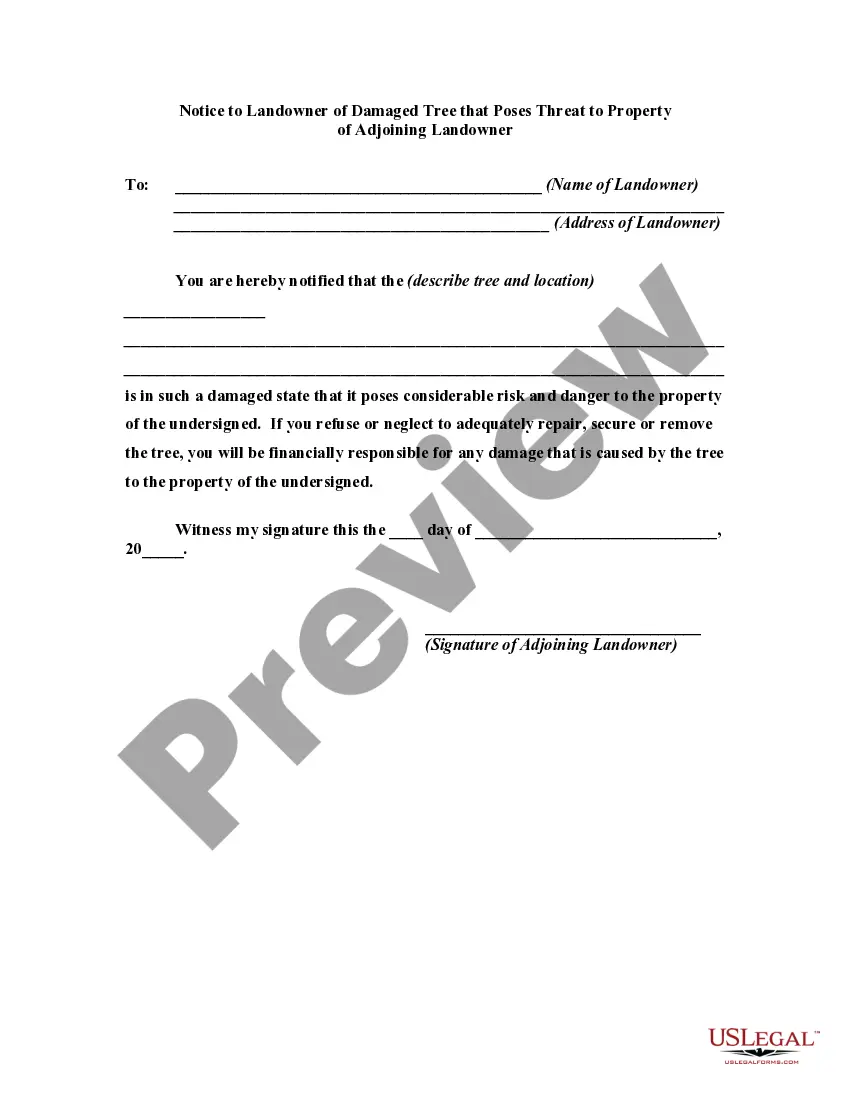
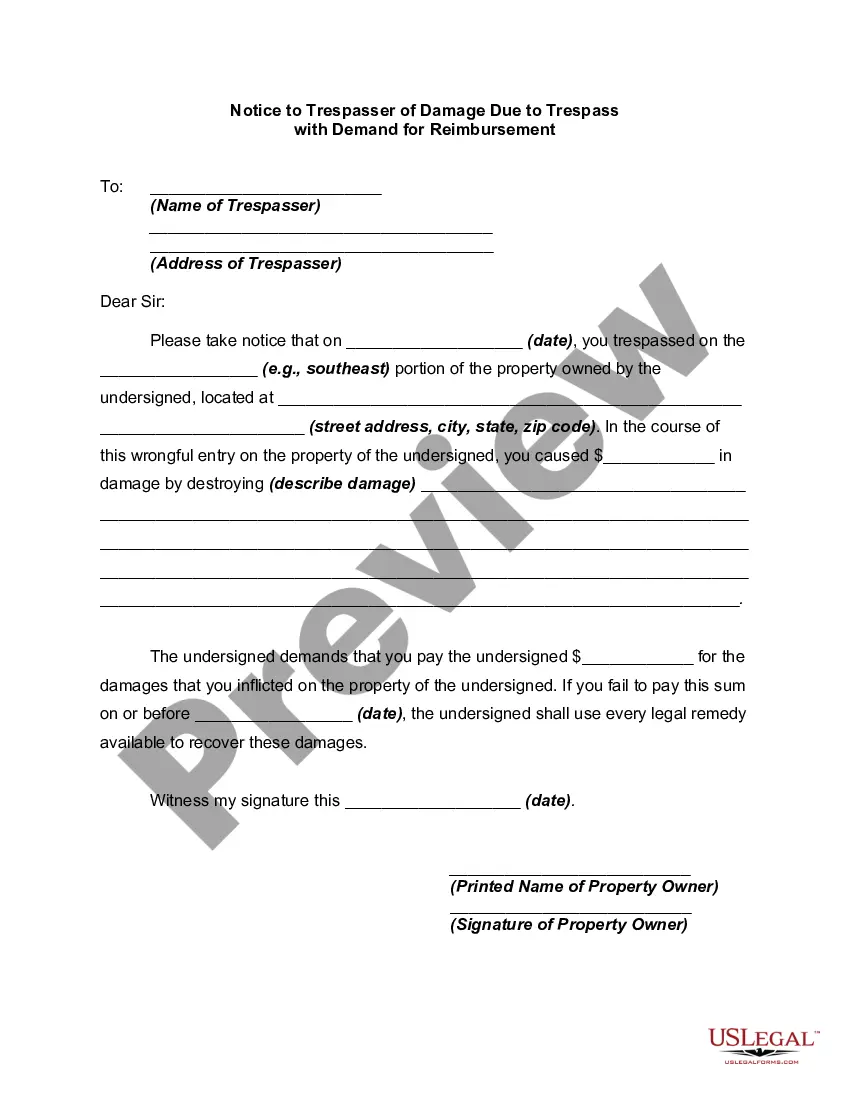
The Notice to Landowner of Damaged Tree that Poses Threat to Property of Adjoining Landowner is a legal document used to formally alert a landowner about a tree on their property that is damaged and poses a risk to adjacent properties. This notice serves as a warning and establishes potential financial responsibility for any damages that might occur due to negligence in addressing the issue. By using this form, adjoining landowners can take proactive steps to protect their property and ensure that any hazards are addressed in a timely manner.
Key components of this form
- Identification of the landowner receiving the notice.
- Description of the damaged tree and its location.
- Statement of risk indicating the potential for damage to adjoining property.
- Warning regarding financial responsibility for damages if the tree is not adequately managed.
- Signature line for the adjoining landowner to document the complaint.
When this form is needed
This form is necessary when an adjoining landowner observes that a tree on a neighbor's property is damaged and poses a threat to their own property. Situations may include instances where a tree is leaning dangerously, has significant decay, or shows signs of potential falling. Utilizing this notice allows the landowner to legally inform the neighbor, urging them to take necessary action to prevent property damage.
Who needs this form
- Adjoining landowners concerned about the safety of their property due to nearby damaged trees.
- Property owners seeking to hold a neighbor accountable for maintenance to prevent potential hazards.
- Individuals with limited legal knowledge looking for a straightforward way to address property disputes.
Completing this form step by step
- Identify the recipient, entering the name and address of the landowner being notified.
- Describe the specific tree in question, including its location and condition.
- Clearly state the risk posed by the tree and potential damages to your property.
- Indicate that the landowner will be held financially responsible for any damages if no action is taken.
- Date the notice and provide your signature as the adjoining landowner.
Does this form need to be notarized?
In most cases, this form does not require notarization. However, some jurisdictions or signing circumstances might. US Legal Forms offers online notarization powered by Notarize, accessible 24/7 for a quick, remote process.
Get your form ready online
Our built-in tools help you complete, sign, share, and store your documents in one place.
Make edits, fill in missing information, and update formatting in US Legal Forms—just like you would in MS Word.
Download a copy, print it, send it by email, or mail it via USPS—whatever works best for your next step.
Sign and collect signatures with our SignNow integration. Send to multiple recipients, set reminders, and more. Go Premium to unlock E-Sign.
If this form requires notarization, complete it online through a secure video call—no need to meet a notary in person or wait for an appointment.
We protect your documents and personal data by following strict security and privacy standards.

Make edits, fill in missing information, and update formatting in US Legal Forms—just like you would in MS Word.

Download a copy, print it, send it by email, or mail it via USPS—whatever works best for your next step.

Sign and collect signatures with our SignNow integration. Send to multiple recipients, set reminders, and more. Go Premium to unlock E-Sign.

If this form requires notarization, complete it online through a secure video call—no need to meet a notary in person or wait for an appointment.

We protect your documents and personal data by following strict security and privacy standards.
Mistakes to watch out for
- Failing to provide a clear description of the tree and its location.
- Not specifying the exact risks posed by the damaged tree.
- Omitting the date or signature, making the notice invalid.
- Using ambiguous language that might lead to misunderstandings about responsibilities.
Benefits of using this form online
- Convenient access to legal templates that can be downloaded and completed at your own pace.
- Editable format allowing customization according to personal details and situations.
- Reliable, professionally drafted forms ensure compliance with legal standards.
Legal use & context
This form serves as a legal notification and may be used as evidence in property disputes. It establishes a clear communication channel and document trail, which can be beneficial in case of further legal issues regarding property maintenance and responsibilities.
Summary of main points
- Use this form to notify a landowner about a damaged tree that could threaten your property.
- Clearly document the risks and potential liabilities involved.
- Ensure to complete all sections accurately for effectiveness.
Looking for another form?

Form popularity
FAQ
Yes, they can. Your tree was most likely encroaching over your neighbor's property so they cut it back. They don't have to haul the branches away, because it's your tree. Also, should a windstorm blow your tree down on your neighbor's property then you're liable for damages.
You can ask the court to order the owner to prune or remove the tree. You'll probably have to sue in regular court (not small claims court) and have proof that the tree really does pose a danger to you.
In most states, if your tree or any part of it falls on your neighbors' property and causes damage to their property through no fault of your own (due to a snow storm, winds, hurricane, or another so-called act of God), you are not responsible.
If you think your neighbour's tree is dangerous, you can report it to the council - for example if you think it might fall over. They might ask the owner to make it safe or deal with it themselves. Search for 'trees' on your council's website to find which department to contact.
Yes. By law, you have the right to trim branches and limbs that extend past the property line. However, the law only allows tree trimming and tree cutting up to the property line. You may not go onto the neighbor's property or destroy the tree.
Trees can be tricky, but for the most part homeowners are responsible for what falls into their own yard. So if a storm causes your neighbor's tree to fall in your yard, your homeowners insurance could help cover the cost of removing the tree and remedying the damage it caused on your property, after your deductible.
Even if the tree trunk is on your neighbor's property, you have the responsibility for cutting any branches that extend onto your property line. You are responsible for the cost of cutting any branches you choose to trim. You can cut back anything up to your property line.
And, since this case isn't about a tree that's posing harm or impeding on their property at all, the neighbor cannot force Phyllis to cut it down.Homeowners must inspect trees and ensure their trees are safe. Homeowners can be held liable if they fail to remove a dangerous tree and it causes damages.
You could file a nuisance claim, and if the court finds that the true is a nuisance, the court may order the tree removed. Most cities have ordinances prohibiting property owners from keeping dangerous conditions on their property.