Motion For Stay Pending Appeal and Notice of Motion
About this form
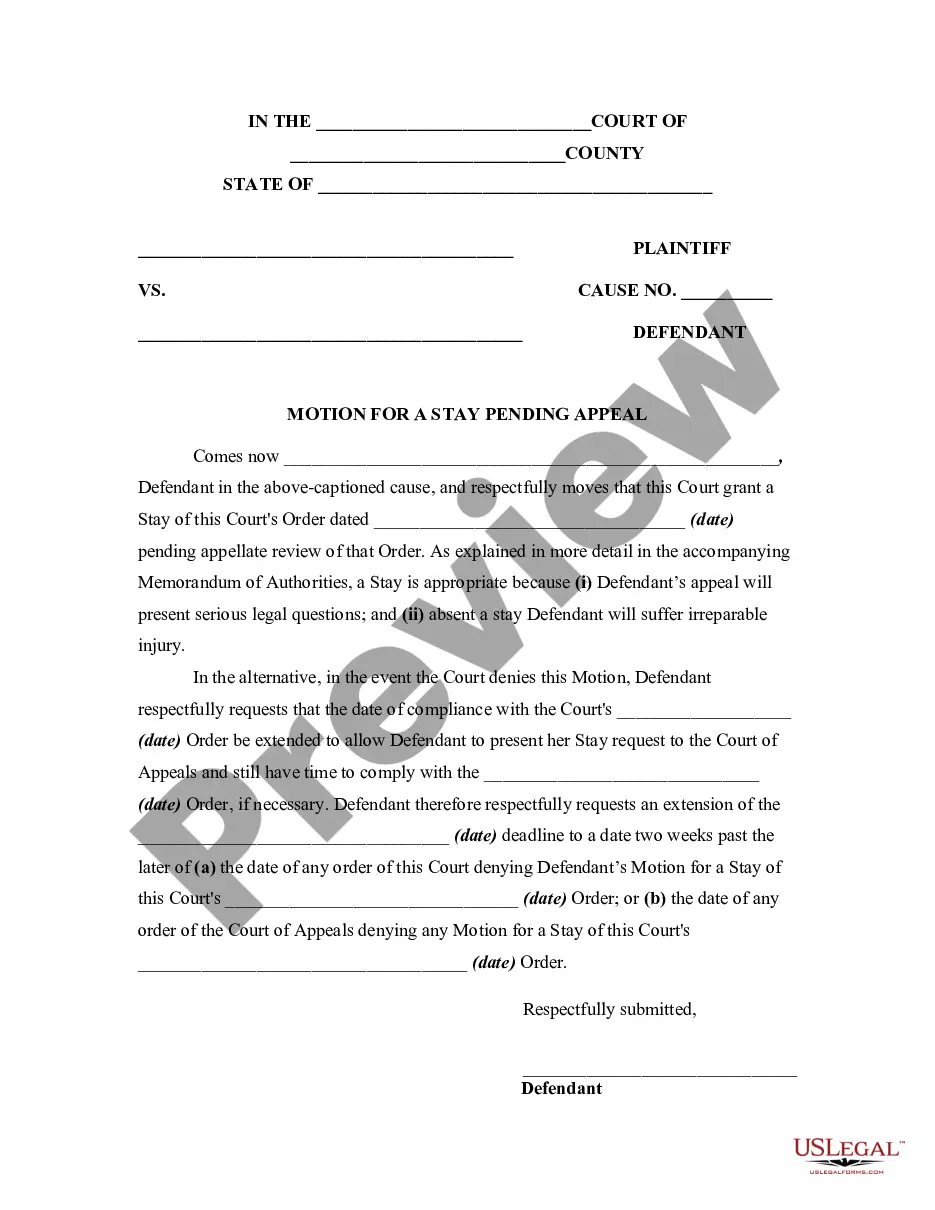
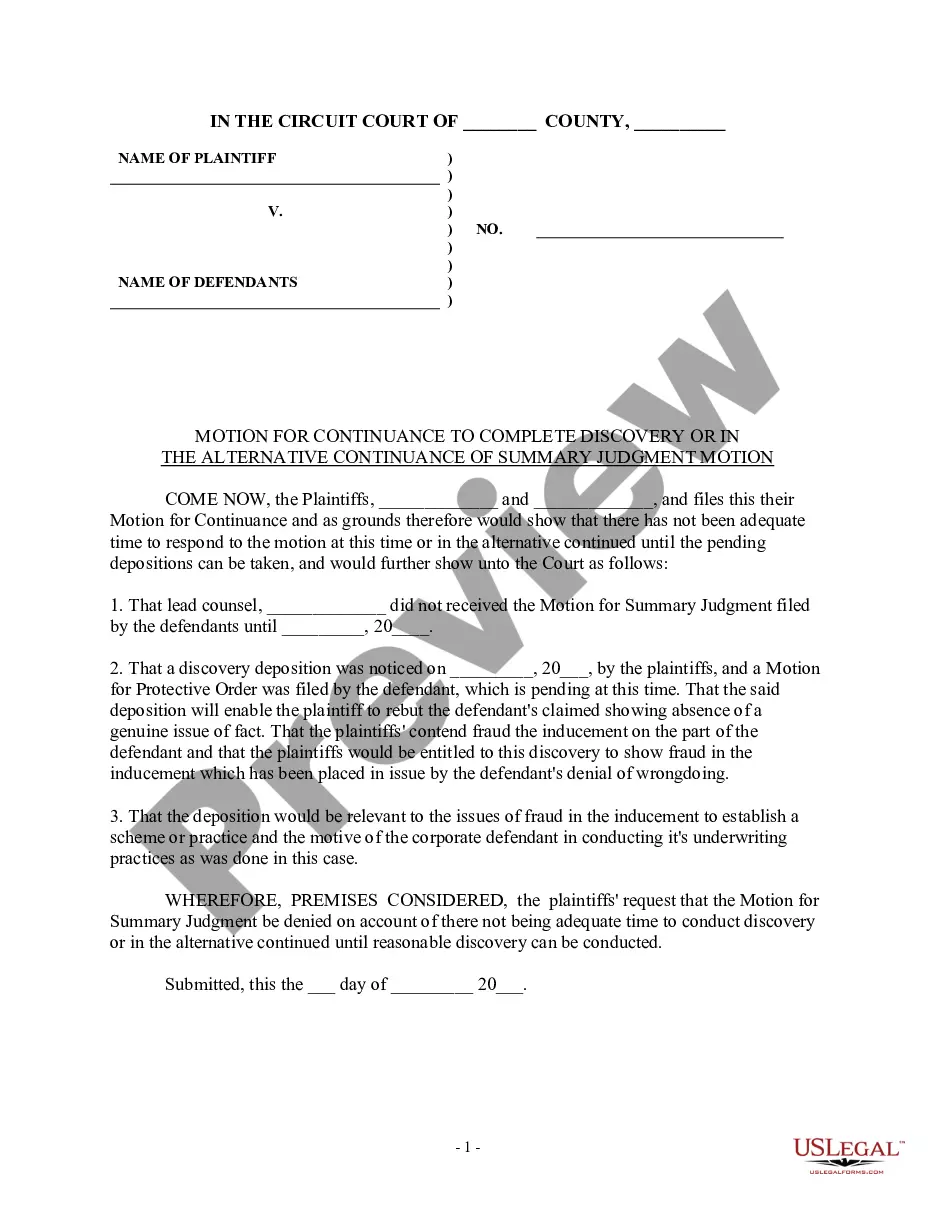
The Motion for Stay Pending Appeal is a legal document that requests a court to pause the enforcement of a judgment while an appeal is being considered. This form is particularly useful for a losing party who wishes to delay the execution of the judgment until a higher court reviews the case, ensuring they do not face immediate consequences while seeking relief through the appeal process.
What’s included in this form
- Party names: Identifies the plaintiff and defendant involved in the case.
- Motion request: Clearly states the request for a stay and references the date of the original court order.
- Legal rationale: Provides arguments supporting the request, including potential irreparable harm and serious legal questions.
- Alternative requests: Includes a request for an extension if the motion for stay is denied.
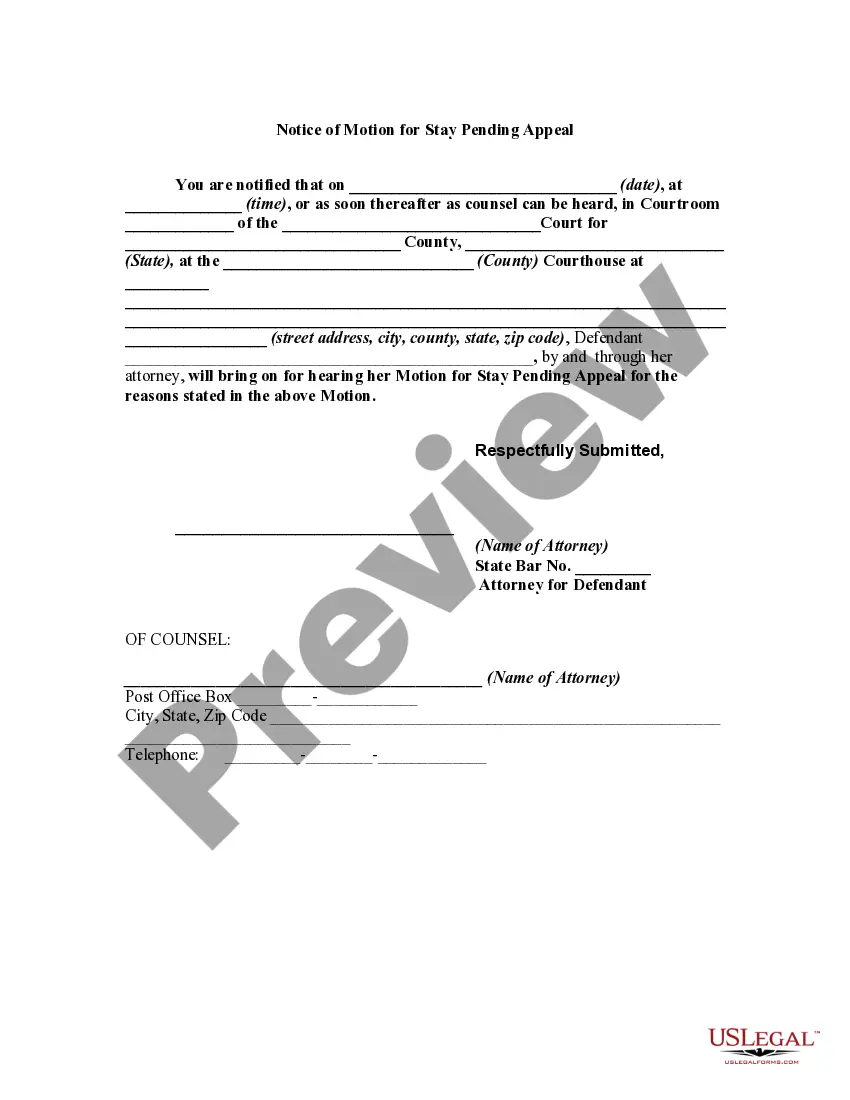
- Hearing notification: Details when and where the motion will be heard by the court.
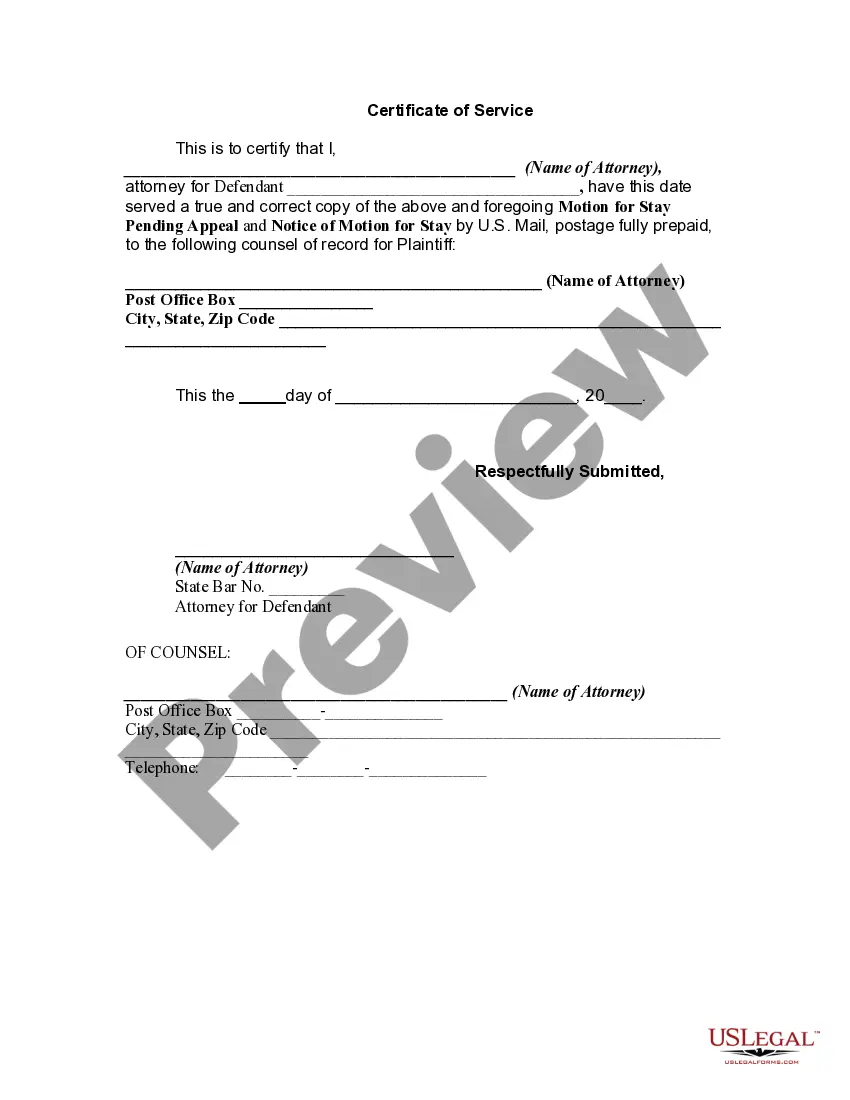
- Certificate of service: Confirms that other parties have been notified of the motion.
When this form is needed
This form is useful when a party loses a court case and intends to appeal the judgment. It is especially critical in situations where the execution of the judgment could lead to significant and irreversible consequences for the defendant before the appeal process is concluded. If your appeal raises serious legal questions that warrant a stay, this form is essential.
Who needs this form
- Defendants in civil lawsuits who have received an unfavorable judgment.
- Individuals or entities seeking to delay the enforcement of a court order while pursuing an appeal.
- Attorneys representing clients in civil matters who require a formal mechanism to request a stay.
How to prepare this document
- Identify the parties involved: Clearly state the names of the plaintiff and defendant at the top of the form.
- Enter the cause number: Fill in the specific case number assigned by the court.
- Specify the details of the motion: State the date of the court order you wish to stay and detail the reasons for the motion.
- List the alternative requests: If needed, include any requests for extensions of deadlines related to compliance.
- Fill in the hearing details: Provide the date, time, and location for the hearing of the motion.
- Complete the certificate of service: Ensure proper notification to the opposing counsel by filling in their contact details.
Notarization guidance
This form usually doesn’t need to be notarized. However, local laws or specific transactions may require it. Our online notarization service, powered by Notarize, lets you complete it remotely through a secure video session, available 24/7.
Get your form ready online
Our built-in tools help you complete, sign, share, and store your documents in one place.
Make edits, fill in missing information, and update formatting in US Legal Forms—just like you would in MS Word.
Download a copy, print it, send it by email, or mail it via USPS—whatever works best for your next step.
Sign and collect signatures with our SignNow integration. Send to multiple recipients, set reminders, and more. Go Premium to unlock E-Sign.
If this form requires notarization, complete it online through a secure video call—no need to meet a notary in person or wait for an appointment.
We protect your documents and personal data by following strict security and privacy standards.

Make edits, fill in missing information, and update formatting in US Legal Forms—just like you would in MS Word.

Download a copy, print it, send it by email, or mail it via USPS—whatever works best for your next step.

Sign and collect signatures with our SignNow integration. Send to multiple recipients, set reminders, and more. Go Premium to unlock E-Sign.

If this form requires notarization, complete it online through a secure video call—no need to meet a notary in person or wait for an appointment.

We protect your documents and personal data by following strict security and privacy standards.
Avoid these common issues
- Failing to include all necessary party names and cause number.
- Not providing clear legal justifications for the stay.
- Overlooking the requirement to notify the opposing party of the motion.
- Submitting the motion after the deadline for filing an appeal.
Why use this form online
- Convenience: Easily download and fill out the form from anywhere at any time.
- Editability: Customize the form to fit your specific situation before printing.
- Reliability: Access forms created by licensed attorneys to ensure legal accuracy.
Key takeaways
- The Motion for Stay Pending Appeal is essential for delaying the enforcement of a judgment during an appeal.
- Appropriate justifications must be provided to support the stay request.
- Understanding local rules can significantly impact how the form is filled out and submitted.
Looking for another form?



Form popularity
FAQ
A ruling by a court to stop or suspend a proceeding or trial temporarily or indefinitely. A court may later lift the stay and continue the proceeding.
The act of temporarily stopping a judicial proceeding through the order of a court. A stay is a suspension of a case or a suspension of a particular proceeding within a case. A judge may grant a stay on the motion of a party to the case or issue a stay sua sponte, without the request of a party.
An appeal means that the whole case is heard again. It is a new trial. If you won your claim but lost the other person's claim, you cannot just appeal the part of the case you lost. If you appeal, the court will hear all the claims again.
The motion must include a separate "Notice of Motion" which includes a brief summary of the nature of the motion, the deadline for filing a response, and if there is a hearing, the date, time, and location of the hearing.
General format - each motion generally consists of a case caption, a title that briefly identifies the relief sought, a series of numbered paragraphs that explains -- in a logical way -- why you are entitled to that relief, a prayer for relief, a signature block, a certification that a copy of the motion was sent to
List all known pending related cases; State whether the stay order should extend to any such related case; and. Be supported by a memorandum and by declarations establishing the facts relied on to show that a stay order is necessary and appropriate to effectuate the purposes of coordination.
How to Ask to Lift the Automatic Stay. The creditor must file a written motion with the court explaining the need to lift the stay. The burden is on the creditor to prove that good cause exists to lift the automatic stay. The creditor must also provide the debtor with notice of the motion and the hearing on the matter.
If you lose your motion to alter the judgment, or if you decide not to make one, you can appeal to the U.S. Court of Appeals for your district. You begin your appeal by filing a Notice of Appeal with the clerk of the U.S. District Court whose decision you want to appeal.
In a civil case, an appeal doesn't ordinarily prevent the enforcement of the trial court's judgment.The filing of this bond will prevent, or stay, further action on the judgment until the appeal is over by guaranteeing that the appealing party will pay or perform the judgment if it is not reversed on appeal.