Notice of Lien and of Sale of Personal Property Pursuant to Non-Statutory Lien
Understanding this form
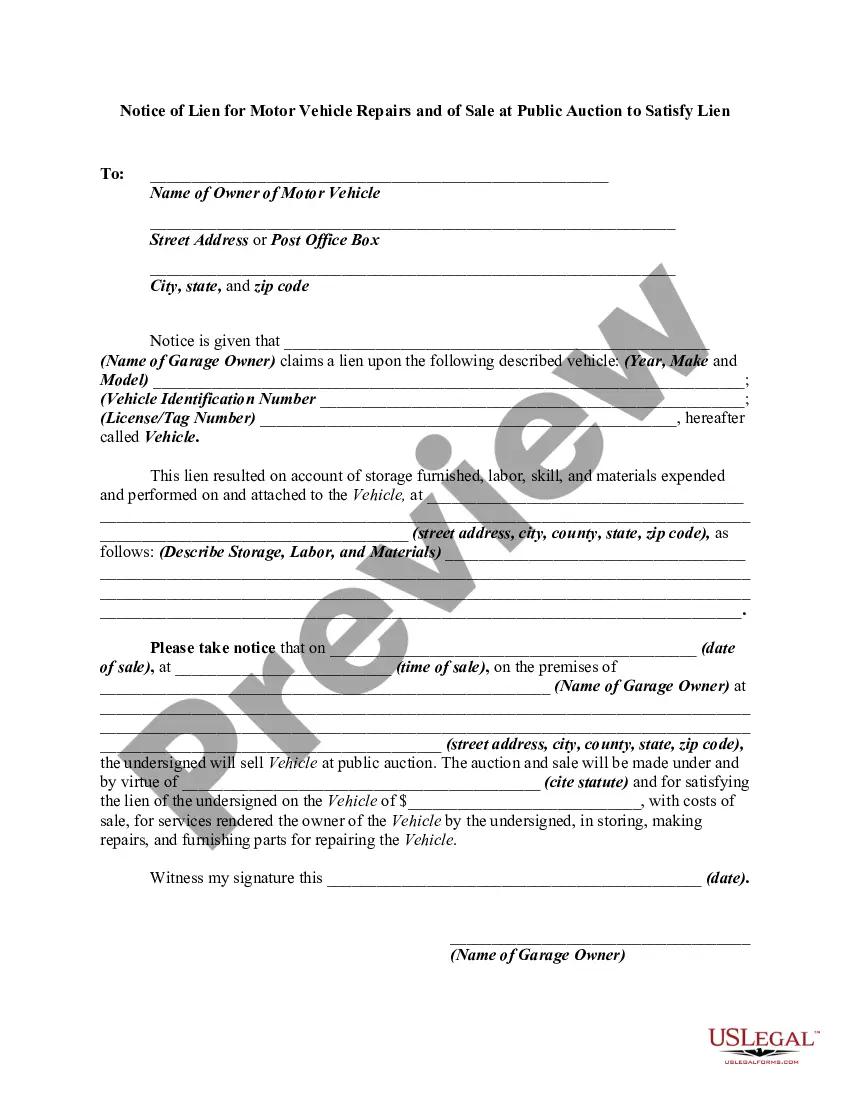
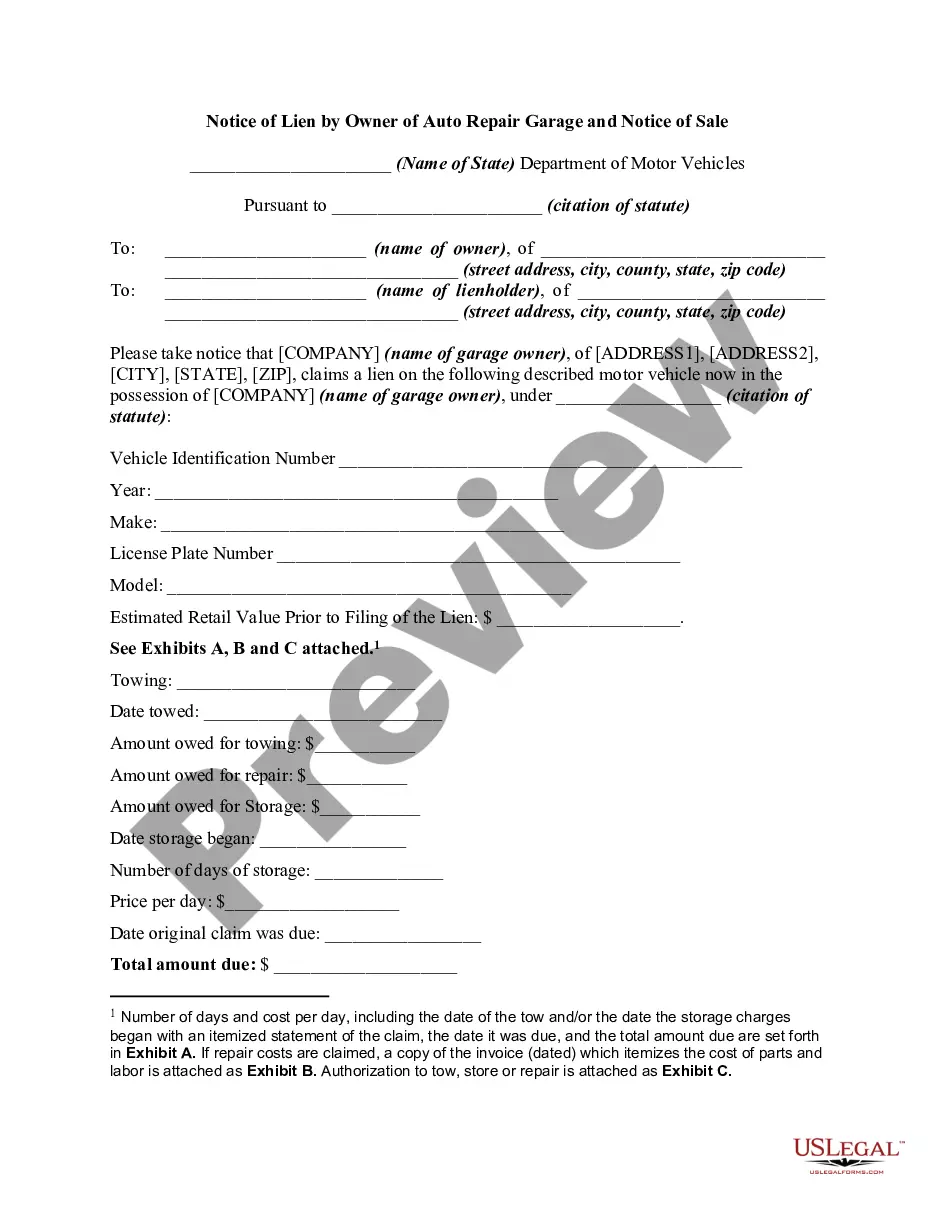
The Notice of Lien and of Sale of Personal Property Pursuant to Non-Statutory Lien is a legal document that allows a lienholder to formally declare their right to retain personal property until a debt is satisfied. This form serves as a notice to the property owner regarding the lien and intended sale of the property if the debt remains unpaid, distinguishing it from other types of liens and notices often governed by specific statutes.
Main sections of this form
- The lienholder's information, including name and address.
- Description of the personal property under lien.
- Details of services rendered that created the lien.
- Amount of charges due and duration of non-payment.
- Notice of intent to sell the property if payment is not made.
- Signature of the lienholder to validate the notice.
Common use cases
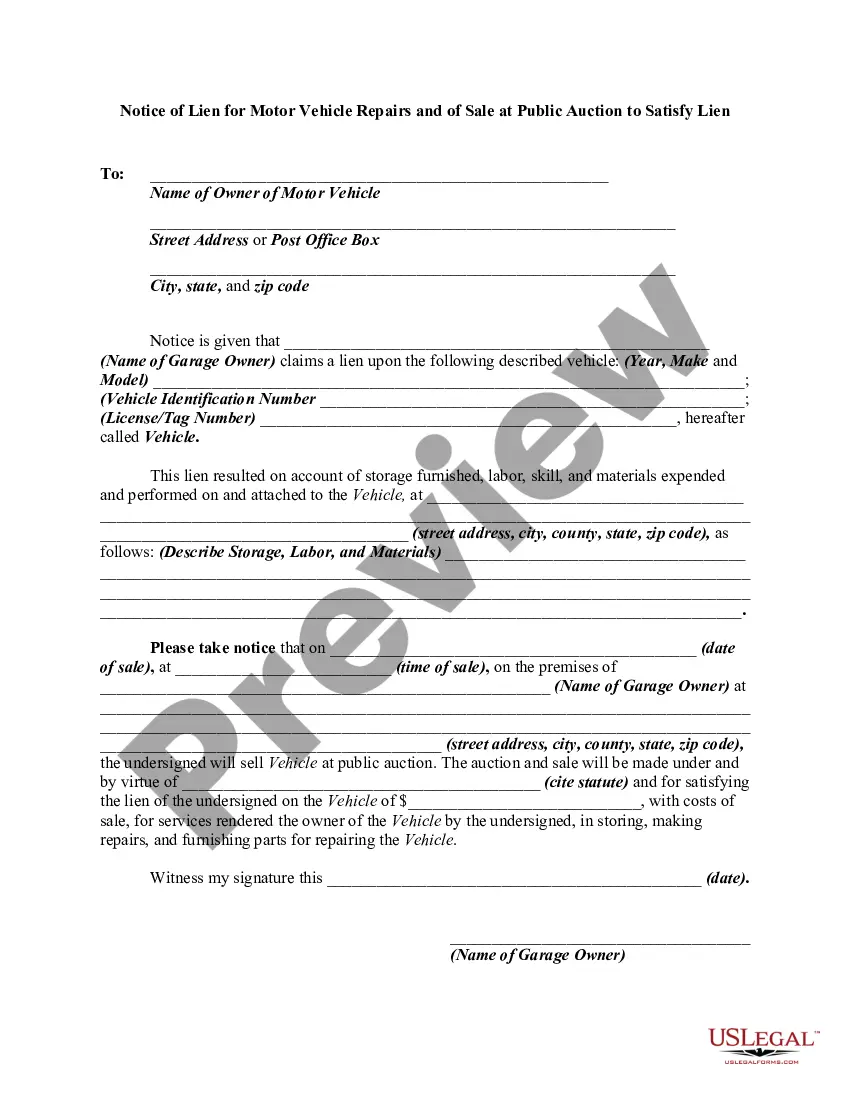
This form is used when a creditor has retained possession of personal property due to an unpaid debt. It is particularly applicable in situations involving repair shops, storage facilities, or any instance where goods or personal items are held until payment is received for services rendered. This notice serves as a legal formalization of the lien and informs the debtor of the consequences of non-payment.
Intended users of this form
This form is intended for:
- Creditors who have a common-law lien on personal property.
- Businesses providing services that involve holding personal property as security for payment.
- Individuals who need to notify a debtor of a lien and the intent to sell the property.
How to prepare this document
- Identify the lienholder and enter their name and address.
- Provide a detailed description of the personal property subject to the lien.
- Specify the services rendered that justify the lien.
- Indicate the total amount due and the number of days the amount has been unpaid.
- State the time frame for payment before the property will be sold.
- Sign and date the notice to finalize the document.
Notarization requirements for this form
Notarization is generally not required for this form. However, certain states or situations might demand it. You can complete notarization online through US Legal Forms, powered by Notarize, using a verified video call available anytime.
Get your form ready online
Our built-in tools help you complete, sign, share, and store your documents in one place.
Make edits, fill in missing information, and update formatting in US Legal Forms—just like you would in MS Word.
Download a copy, print it, send it by email, or mail it via USPS—whatever works best for your next step.
Sign and collect signatures with our SignNow integration. Send to multiple recipients, set reminders, and more. Go Premium to unlock E-Sign.
If this form requires notarization, complete it online through a secure video call—no need to meet a notary in person or wait for an appointment.
We protect your documents and personal data by following strict security and privacy standards.

Make edits, fill in missing information, and update formatting in US Legal Forms—just like you would in MS Word.

Download a copy, print it, send it by email, or mail it via USPS—whatever works best for your next step.

Sign and collect signatures with our SignNow integration. Send to multiple recipients, set reminders, and more. Go Premium to unlock E-Sign.

If this form requires notarization, complete it online through a secure video call—no need to meet a notary in person or wait for an appointment.

We protect your documents and personal data by following strict security and privacy standards.
Common mistakes to avoid
- Failing to clearly describe the personal property and services rendered.
- Not including the correct lienholder contact information.
- Missing the signature or date on the notice.
- Not specifying the duration the charges remain unpaid.
Advantages of online completion
- Convenient access to the form, allowing for quick and easy completion.
- Editability to customize the form according to specific needs.
- Reliability, as the form is drafted by licensed attorneys to meet legal standards.
Legal use & context
- This form serves as an official notice and is a crucial step before a lienholder can legally sell the property to recover debts.
- Understanding the context of common-law liens can help enforce rights regarding the retention of personal property.
Quick recap
- The Notice of Lien and of Sale of Personal Property provides a formal means to notify debtors of unpaid services related to personal property.
- Utilizing this form can protect a service provider's rights to secure payment through the sale of retained property.
- Carefully completing the form and consulting local laws ensures compliance and clarity in the process.
Looking for another form?










Form popularity
FAQ
So, the purpose of a subordination agreement is to adjust the new loan's priority so that in the event of a foreclosure, that lien gets paid off first. In a subordination agreement, a prior lienholder agrees that its lien will be subordinate (junior) to a subsequently recorded lien.
A lien is a legal claim against your property to secure payment of your tax debt, while a levy actually takes the property to satisfy the tax debt.When filed, the Notice of Federal Tax Lien is a public document that alerts other creditors that the IRS is asserting a secured claim against your assets.
A general rule in property law says that whichever lien is recorded first in the land records has higher priority over later-recorded liens.
However, if the IRS has placed a lien on a person's assets and resources, it can take a personal injury settlement to resolve the back taxes that are behind that lien when the settlement amount is deposited into an injured party's bank account.
Can a lien be placed on your property without you knowing? Yes, it happens. Sometimes a court decision or settlement results in a lien being placed on a property, and for some reason the owner doesn't know about it initially.
The Indian Contract Act, 1872 classifies the Right of Lien into two types: Particular Lien and General Lien. Section 170 of the aforesaid Act gives the exact definition of Particular Lien which states that the Bailee is free to hold control of a precise property with position to the charge which is due.
Mortgage liens usually take priority over any other lien except tax liens.
What Is a First Mortgage? A first mortgage is a primary lien on a property. As a primary loan that pays for the property, the loan has priority over all other liens or claims on a property in the event of default.
Someone who is owed money is generally not able to just put a lien on property without first securing a judgment. Securing a judgment requires the creditor to sue the debtor. This may be through circuit court in many jurisdictions. If under a certain dollar amount, this suit may be through the small claims court.