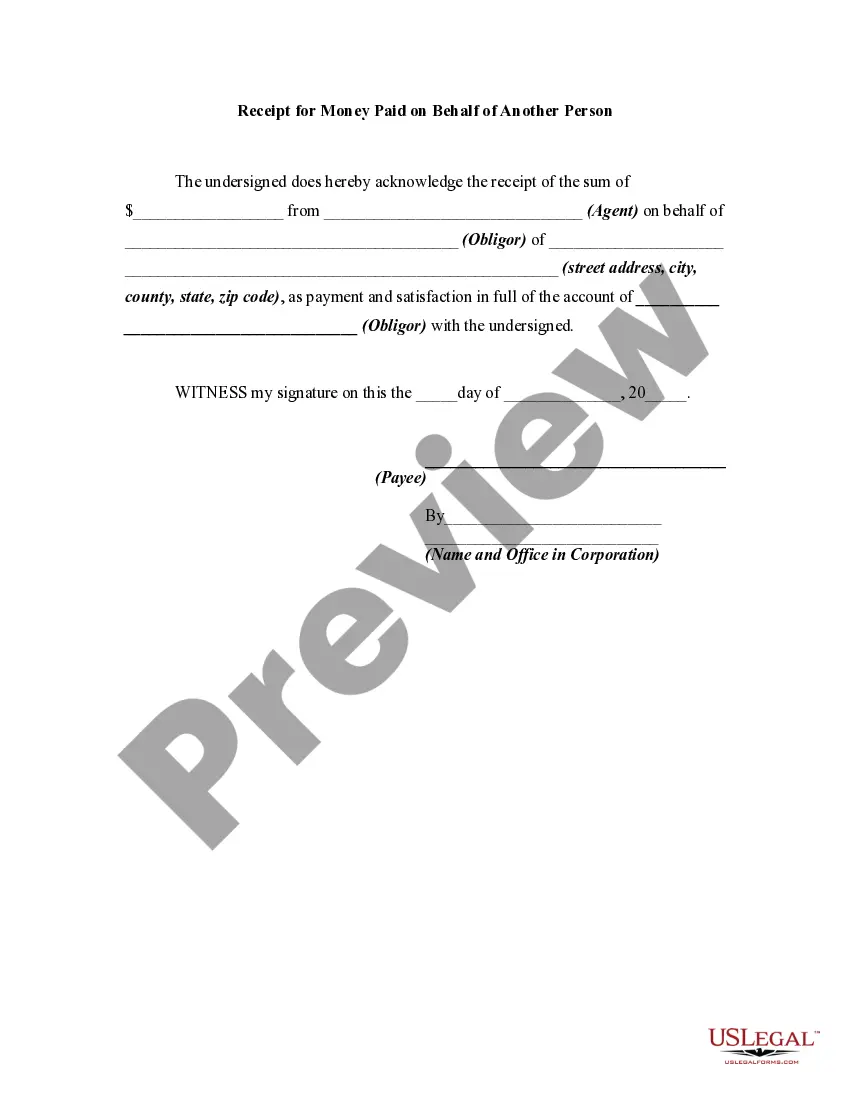
Receipt for Money Paid on Behalf of Another Person
About this form
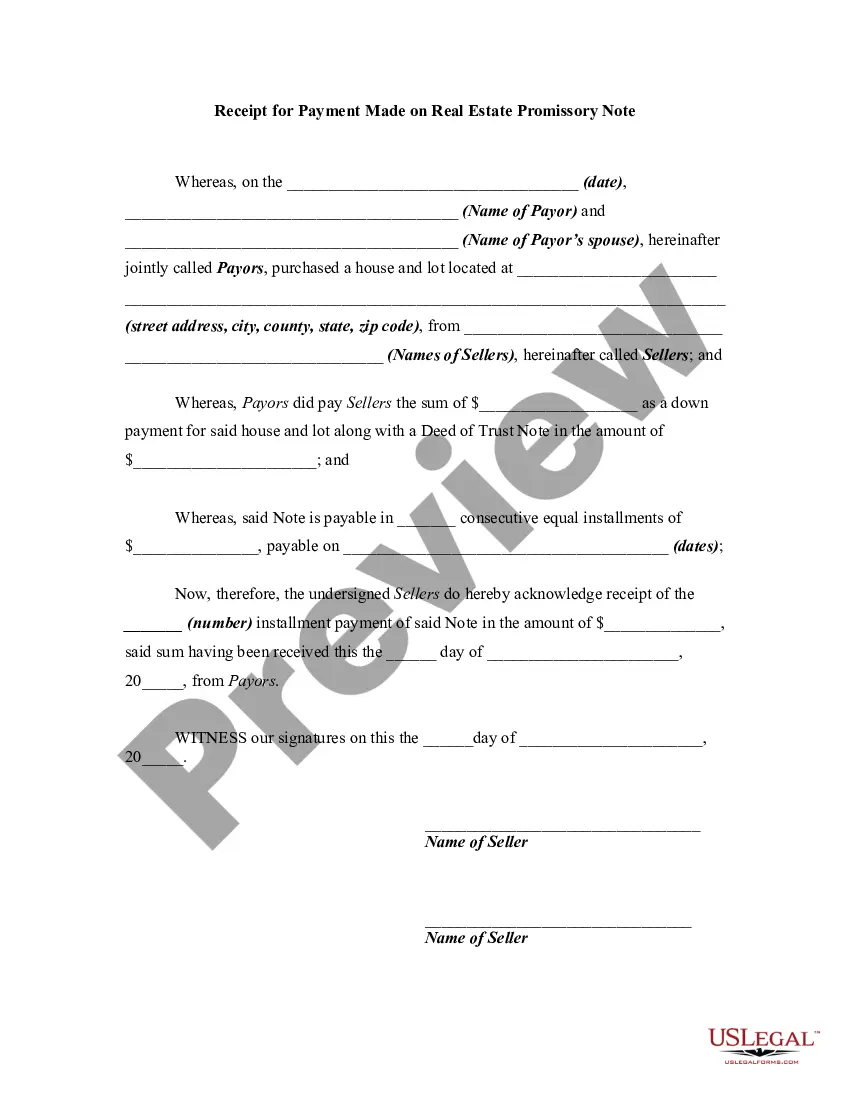
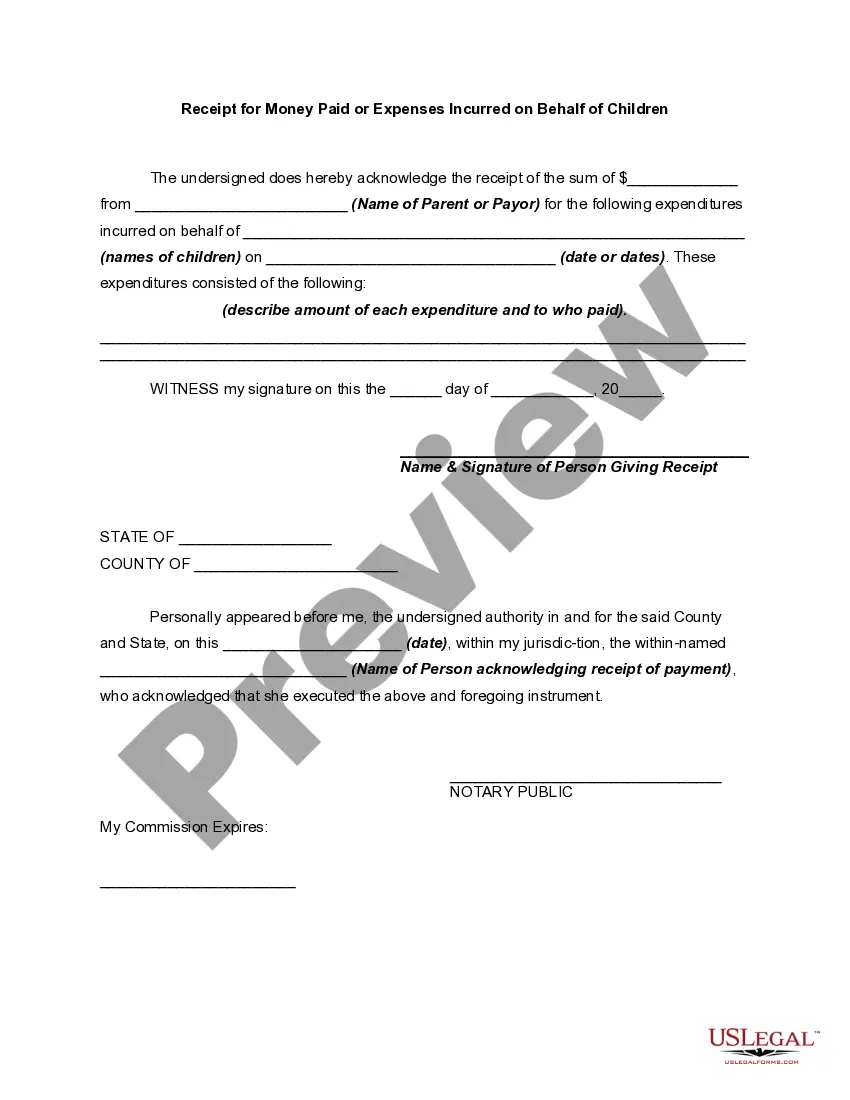
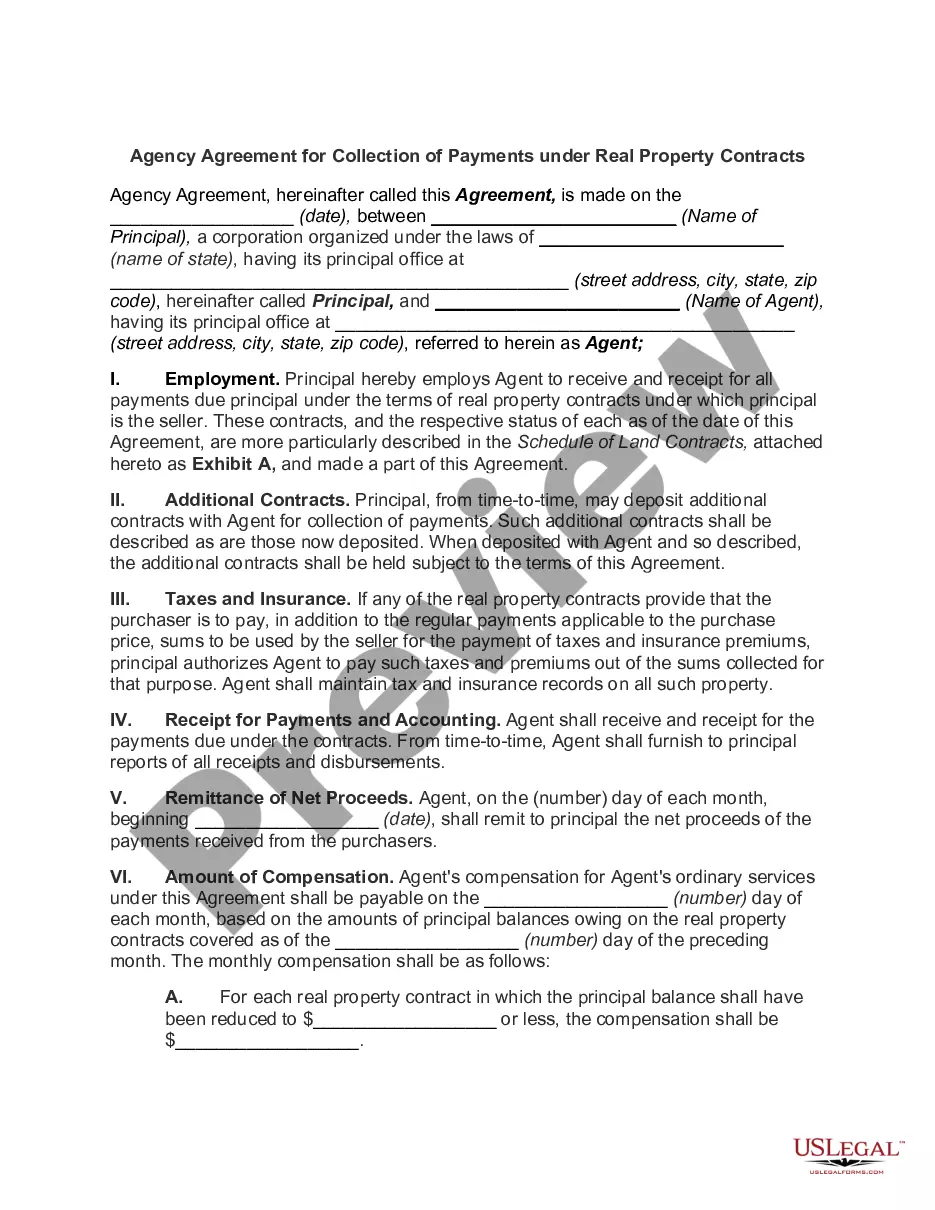
The Receipt for Money Paid on Behalf of Another Person is a legal document that acknowledges payment made by an agent on behalf of a principalâthe debtor or obligor. This form is essential for validating the transaction between the payee (creditor) and the agent, ensuring clarity on the payment's purpose and satisfying any outstanding debts. It serves as an important safeguard for all parties involved, distinguishing it from other receipt forms that do not involve an agency relationship.
Main sections of this form
- Identification of the payee (creditor) receiving the payment.
- Name and details of the agent making the payment.
- Information about the principal (obligor) who owes the debt.
- Specific amount received as payment.
- Confirmation that this payment fulfills the debt obligation.
- Signature fields for the payee and representing agent.
Situations where this form applies
This form is typically used in scenarios where an individual or entity wishes to make a payment on behalf of someone else. For instance, if a family member pays a debt for a relative, an employee pays a business expense on behalf of an employer, or if a friend covers costs for another friend, this receipt serves to document the transaction accurately. This verification can help prevent disputes regarding the origin and purpose of the funds involved.
Who needs this form
- Individuals making payments on behalf of others.
- Business entities handling payments for clients or employees.
- Family members or friends assisting with debt payments.
- Anyone who needs to document an agency relationship in financial transactions.
How to prepare this document
- Identify the payee by entering their full name.
- Fill in the agent's name who is making the payment.
- Provide the principal's name and their address details.
- Specify the amount being paid on behalf of the principal.
- Sign and date the form to validate the receipt.
Is notarization required?
This form does not typically require notarization unless specified by local law. Ensure to check local regulations to confirm the necessity of notarization for any agency-related transactions.
Get your form ready online
Our built-in tools help you complete, sign, share, and store your documents in one place.
Make edits, fill in missing information, and update formatting in US Legal Forms—just like you would in MS Word.
Download a copy, print it, send it by email, or mail it via USPS—whatever works best for your next step.
Sign and collect signatures with our SignNow integration. Send to multiple recipients, set reminders, and more. Go Premium to unlock E-Sign.
If this form requires notarization, complete it online through a secure video call—no need to meet a notary in person or wait for an appointment.
We protect your documents and personal data by following strict security and privacy standards.

Make edits, fill in missing information, and update formatting in US Legal Forms—just like you would in MS Word.

Download a copy, print it, send it by email, or mail it via USPS—whatever works best for your next step.

Sign and collect signatures with our SignNow integration. Send to multiple recipients, set reminders, and more. Go Premium to unlock E-Sign.

If this form requires notarization, complete it online through a secure video call—no need to meet a notary in person or wait for an appointment.

We protect your documents and personal data by following strict security and privacy standards.
Avoid these common issues
- Failing to accurately identify all parties involved.
- Not specifying the exact amount paid clearly.
- Omitting signatures from either the payee or agent.
- Incorrectly filling in the principal's details.
Why use this form online
- Immediate access to professionally drafted legal content.
- Easy download and editing options to customize as needed.
- Cost-effective solution compared to traditional legal services.
- Increased reliability by using standard legal formats.
Legal use & context
This receipt serves as important evidence in financial transactions involving an agency relationship. It outlines the responsibilities of the agent and principal, ensuring that payments are acknowledged and reducing the risk of disputes.
Key takeaways
- The Receipt for Money Paid on Behalf of Another Person confirms an agent's payment on someone else's behalf.
- Ensure all identifying details are accurately recorded.
- Using this form can help prevent misunderstandings between all parties involved.
Looking for another form?
Form popularity
FAQ
Fill in the name of the recipient. Write the name of the recipient of the money order in the pay to or pay to the order of field. Include your address in the purchaser section. Write the account or order number in the memo field. Sign your name in the purchaser's signature section.
No, you cannot make changes to a completed money order. Any form of alteration or correction will result in ineligibility for cashing.
Plan Before Endorsing a Check to Someone Else. Confirm the Person/Entity Will Accept a Signed-Over Check. Ensure the Person's/Entity's Bank Will Accept the Check. Sign the Back of the Check in the Top Section of the Endorsement Area. Write Pay to the Order of and the Third Party's Name Below Your Signature.
Legally, a purchaser's signature is not required for a money order to be negotiable since it has been already paid for in cash. The named payee must sign in order to receive the cash.
You are the purchaser and so you should write your current mailing address. Some money orders may use the words From, Sender, Issuer, Remitter, or Drawer. Putting your address allows the recipient (wherever they deposit the money order) to contact you if they want to confirm that it's real or if there is an issue.
To cash a money order, you'll need to first endorse it by signing your name on the back. You will also need to provide identification no matter where you're cashing your money order. If you don't have any ID, you can endorse the money order to someone else, like a sibling or friend, who does have an ID.
Banks will usually allow you to deposit checks or money orders into someone else's account for example, if you're giving a gift, helping a friend or family member cover bills, or paying someone back.You can also sign a money order over to another person so they can deposit the money order themselves.
Step 1: Fill in recipient's name. This is the name of the payee: the person or company receiving the payment. Step 2: Write your address on the purchaser line. Step 3: Add a memo or account number. Step 4: Sign the front of the money order. Keep the money order receipt. Drawbacks of money orders.
Money orders are made out to individuals or companies for a specific amount.Money orders can be purchased from such places as the U.S. Post Office, Western Union, Money Gram and even Wal-Mart. When you receive a money order, you must endorse it before turning it in for cash.