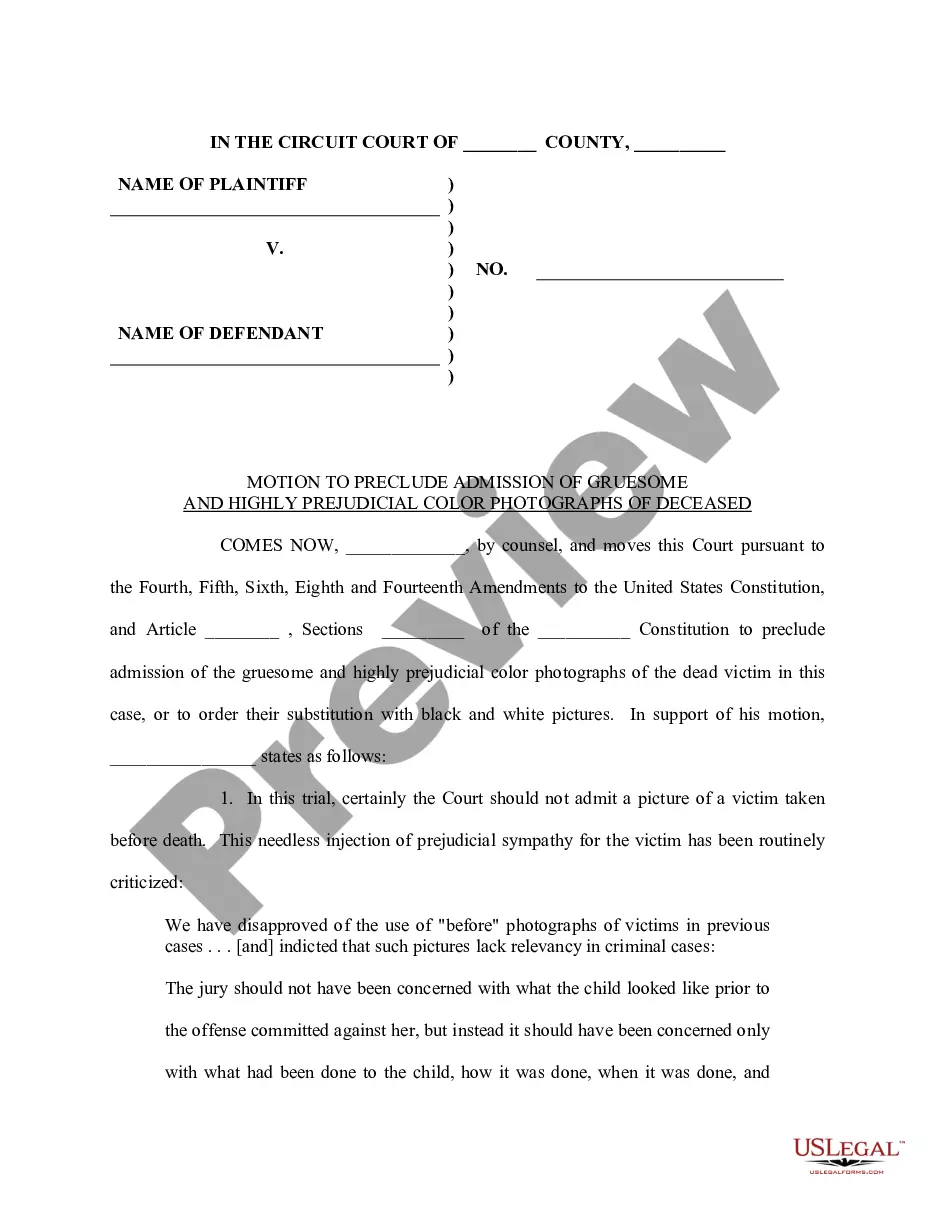
Motion to Preclude Admission of Gruesome and Highly Prejudicial Color Photographs of Deceased
Understanding this form
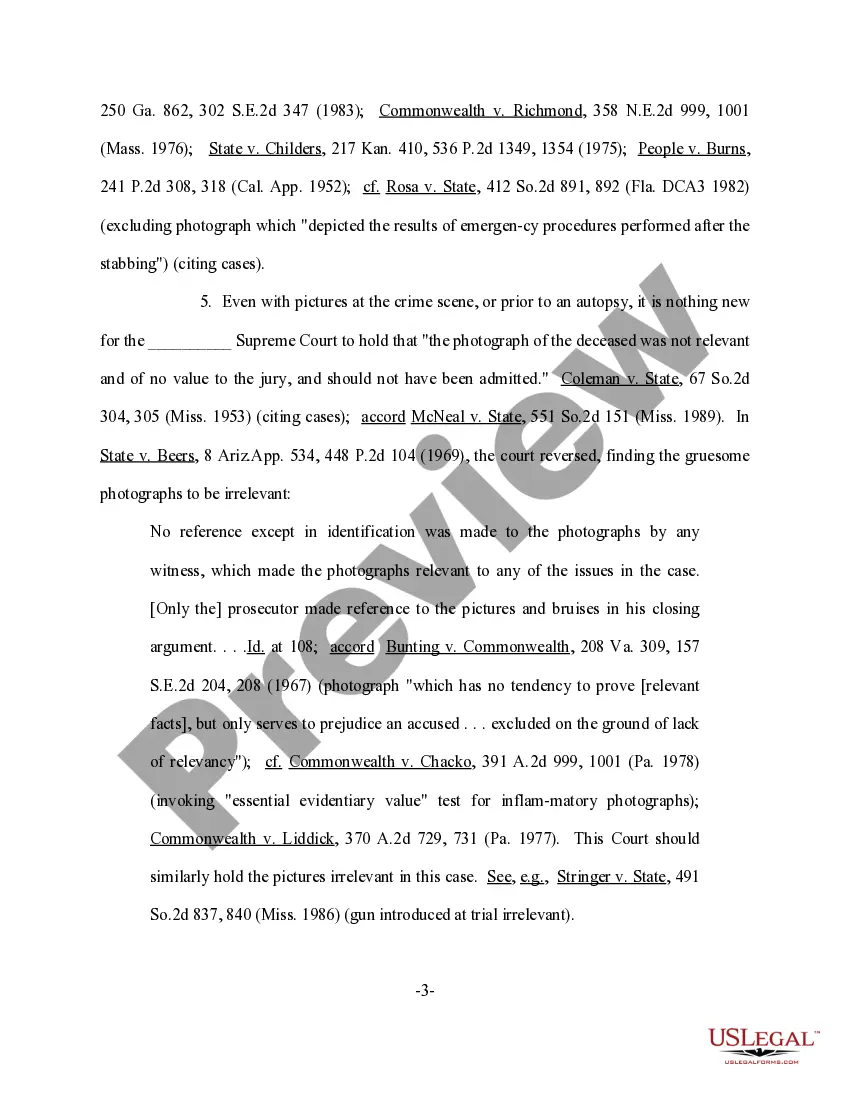
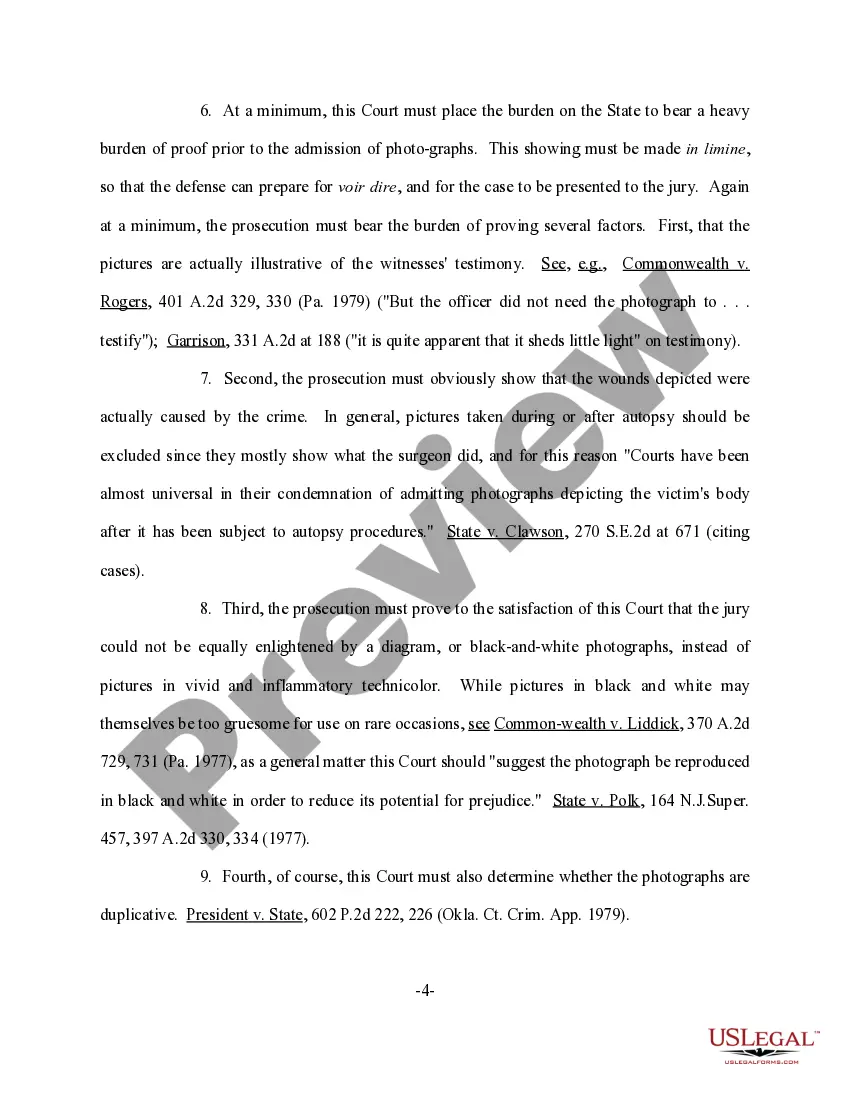
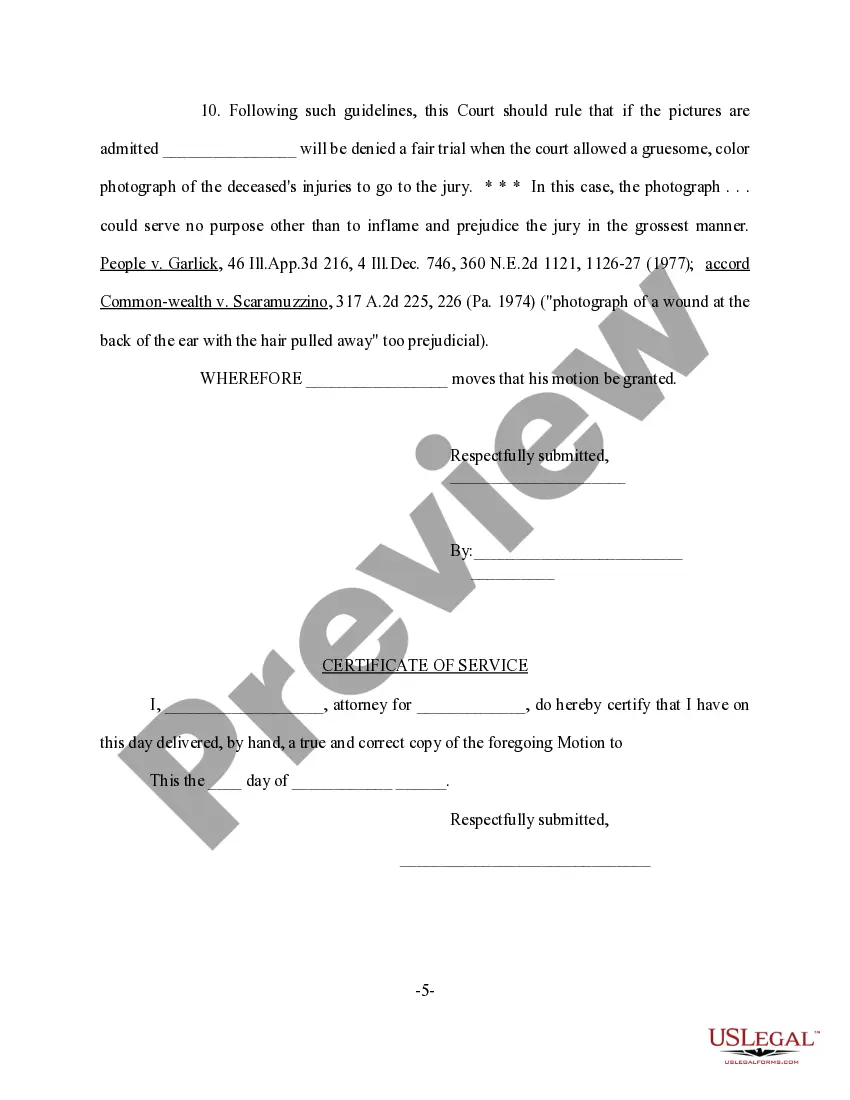
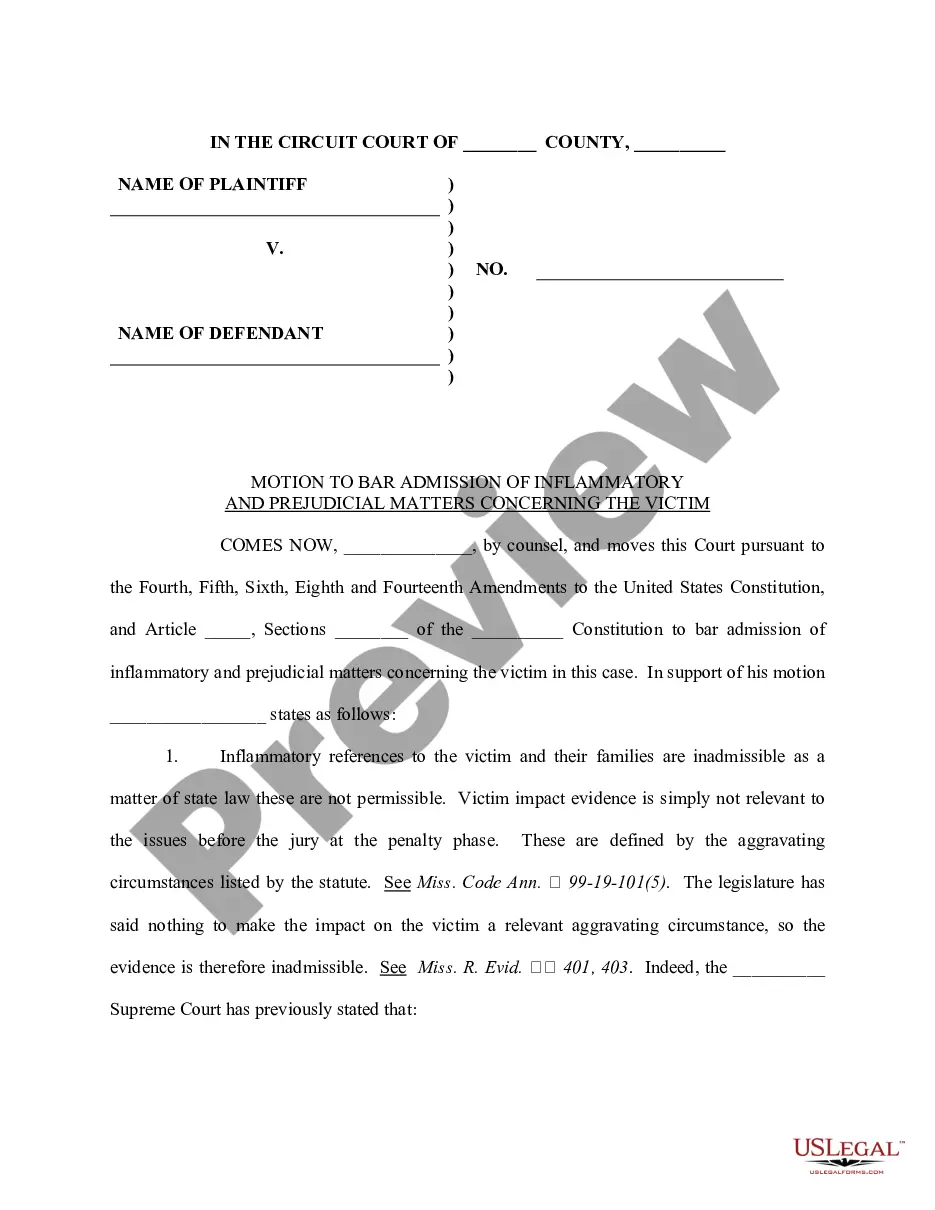
The Motion to Preclude Admission of Gruesome and Highly Prejudicial Color Photographs of Deceased is a legal document filed to prevent the introduction of emotionally charged images of a victim in a court trial. This motion is crucial to ensuring that the jury's decision is based on facts rather than emotional responses to potentially shocking imagery, which can cloud judgment and compromise a fair trial.
Key parts of this document
- Identification of the party filing the motion and their legal counsel.
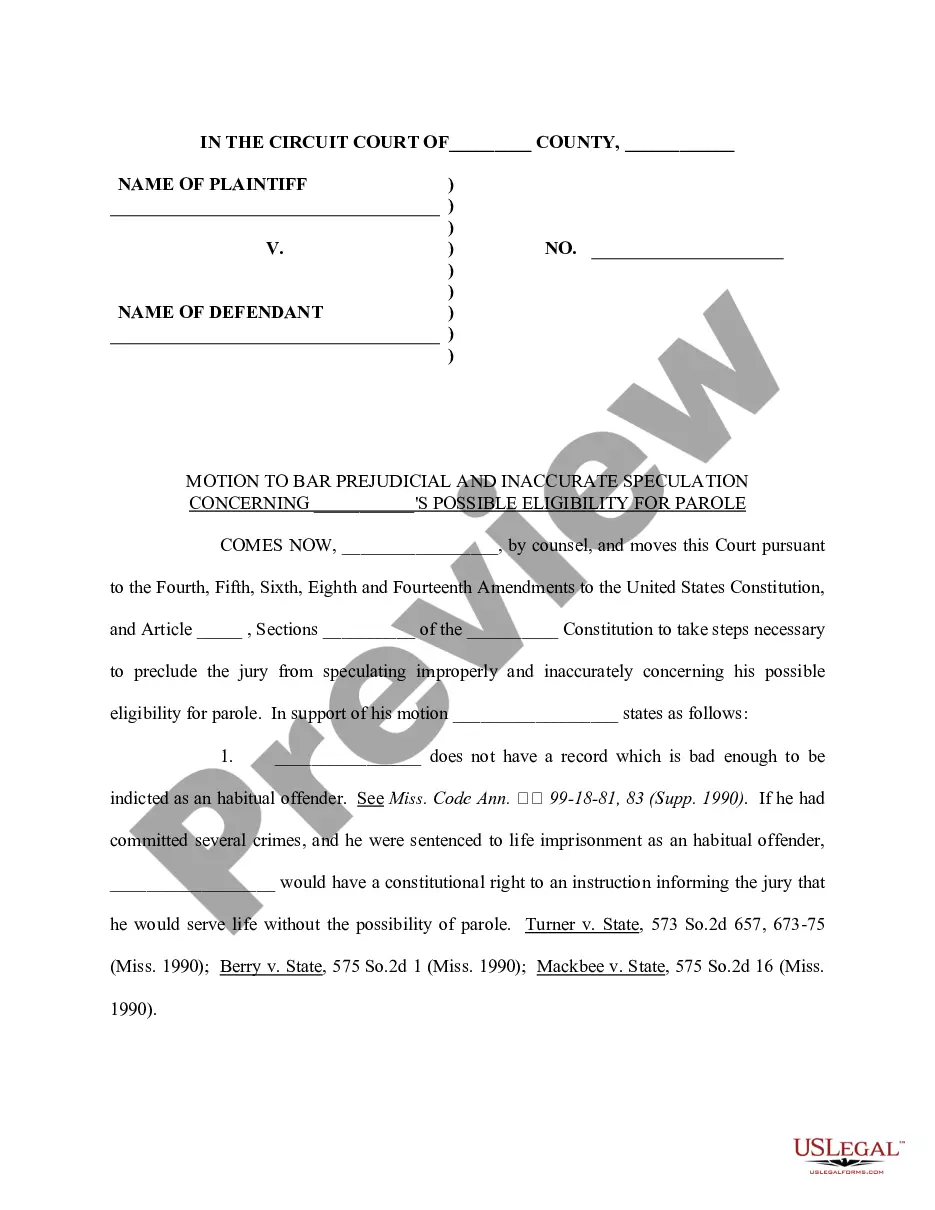
- References to specific amendments of the United States Constitution pertinent to fair trial rights.
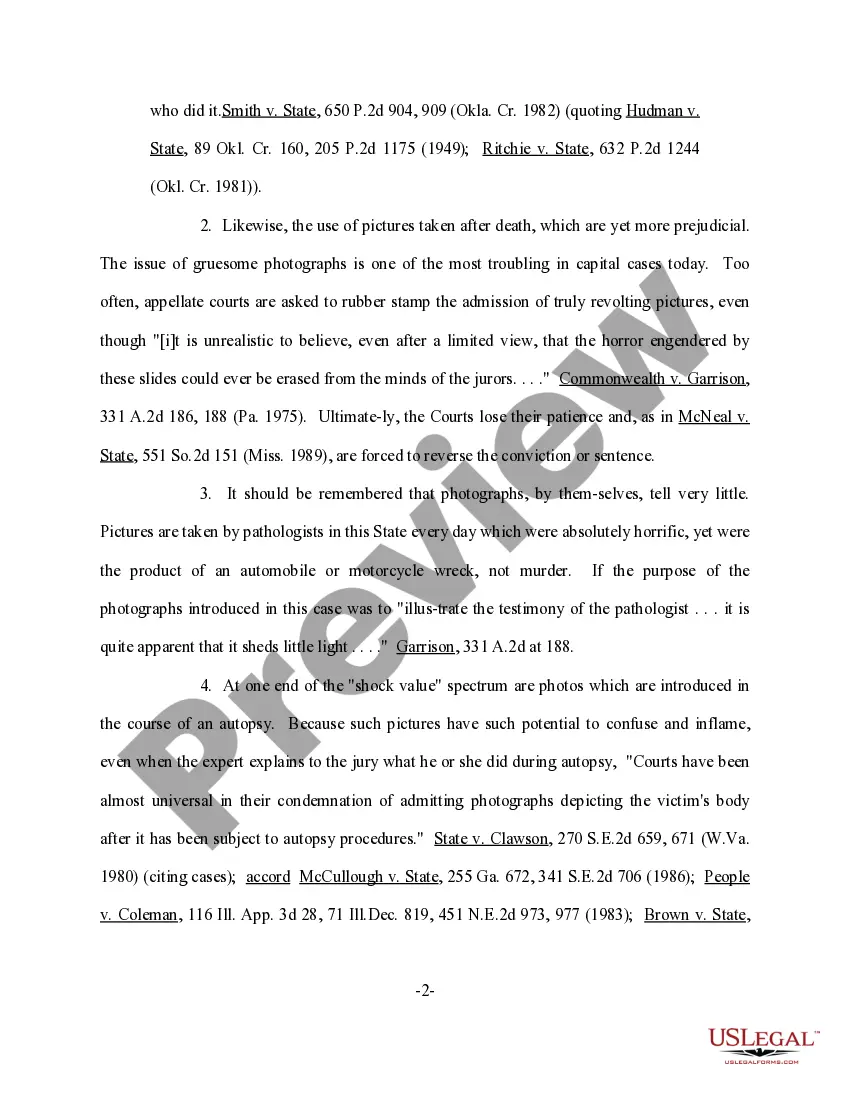
- Arguments supporting the motion, including precedents from relevant case law.
- Requests for the court's action, such as substitution of color photographs with black-and-white images.
- Certification of service to ensure proper communication with all parties involved.
When this form is needed
This form should be used in criminal trials where the prosecution intends to introduce graphic photographs of a deceased victim. It is particularly applicable in cases where such images may unduly sway the jury's opinion and detract from the impartial evaluation of the evidence presented.
Who needs this form
- Defense attorneys representing a client in a criminal trial.
- Prosecutors aiming to ensure fairness by evaluating prejudicial evidence.
- Legal practitioners seeking to safeguard the rights of defendants in capital cases.
- Victims' rights advocates interested in the ethical presentation of evidence.
How to prepare this document
- Enter the name of the party filing the motion and their legal counsel.
- Specify the constitutional amendments and state constitutional provisions being cited.
- Cite relevant case law that supports the argument against the admission of prejudicial photographs.
- Clearly request the court to substitute proposed photographs with less prejudicial options if applicable.
- Sign and date the motion, and prepare a certificate of service for notification of all parties involved.
Does this document require notarization?
In most cases, this form does not require notarization. However, some jurisdictions or signing circumstances might. US Legal Forms offers online notarization powered by Notarize, accessible 24/7 for a quick, remote process.
Get your form ready online
Our built-in tools help you complete, sign, share, and store your documents in one place.
Make edits, fill in missing information, and update formatting in US Legal Forms—just like you would in MS Word.
Download a copy, print it, send it by email, or mail it via USPS—whatever works best for your next step.
Sign and collect signatures with our SignNow integration. Send to multiple recipients, set reminders, and more. Go Premium to unlock E-Sign.
If this form requires notarization, complete it online through a secure video call—no need to meet a notary in person or wait for an appointment.
We protect your documents and personal data by following strict security and privacy standards.

Make edits, fill in missing information, and update formatting in US Legal Forms—just like you would in MS Word.

Download a copy, print it, send it by email, or mail it via USPS—whatever works best for your next step.

Sign and collect signatures with our SignNow integration. Send to multiple recipients, set reminders, and more. Go Premium to unlock E-Sign.

If this form requires notarization, complete it online through a secure video call—no need to meet a notary in person or wait for an appointment.

We protect your documents and personal data by following strict security and privacy standards.
Common mistakes
- Failing to adequately support the motion with relevant case law.
- Neglecting to file the motion in a timely manner prior to trial.
- Inadequate identification of the photos being challenged.
- Missing signatures or improper formatting as per court requirements.
Why complete this form online
- Easy access to a professionally drafted motion that saves time and effort.
- Downloadable and customizable to fit specific case needs.
- Available 24/7, allowing users to complete and file their motions at their convenience.
- Reduces the risk of errors by providing a structured format.
Legal use & context
- This motion is intended to uphold the defendant's right to a fair trial, emphasizing the need to avoid undue prejudice.
- Courts generally favor the exclusion of inflammatory photographs unless their relevance to the case is clearly demonstrated.
- Filing this motion serves as a crucial step in preserving the integrity of the judicial process.
Main things to remember
- The motion seeks to prevent the admission of prejudicial photographs in court.
- It helps ensure that verdicts are based on evidence, not emotional reactions.
- Available for use across all states, with general legal guidelines to follow.
- Defendants and their attorneys can utilize this form to protect the right to a fair trial.
Looking for another form?
Form popularity
FAQ
This motion is filed in a criminal trial to keep graphic color photos of a deceased victim from being admitted as evidence, protecting the jury from emotional influence and preserving a fair trial. It typically identifies the moving party and counsel, cites constitutional fair-trial rights, presents supporting authorities, and may request substitutions of color with black-and-white images, with proper service.
Typically, a photograph must be relevant, probative, and not unfairly prejudicial. This form argues to preclude a set of graphic color photos of a deceased victim when their prejudicial impact overwhelms their limited evidentiary value, and it may propose substitute imagery and reference related constitutional rights and precedent in its supporting sections.
Reasons include that the image is overly gruesome or prejudicial, lacks relevance, is duplicative, or could mislead the jury. The Motion to Preclude Admission of Gruesome and Highly Prejudicial Color Photographs of Deceased focuses on these harms and seeks exclusion or modification to ensure the evidence does not outweigh its probative value.
This form targets a specific kind of evidence—graphic color photographs of a deceased victim—by arguing they are not admissible when their prejudicial impact outweighs any probative value. It supports seeking exclusion or alteration (such as substituting with non-gruesome images) to maintain fair trial standards and prevent emotional manipulation of jurors.
Generally, courts assess whether the probative value of gruesome photographs is substantially outweighed by the risk of unfair prejudice, confusion, or undue delay. The form relies on that balancing concept to argue exclusion or modification of color photos of a deceased victim, often citing constitutional fair-trial rights and relevant precedent in its sections.
This form is specific to precluding color photographs of a deceased victim and explicitly contemplates substituting with black-and-white images when appropriate. Its key parts identify the filing party and counsel, reference fair-trial rights, present supporting authorities, and require service. That focus on color imagery and substitution distinguishes it from broader preclusion motions for photographs.