Letter of Intent to Sue
Understanding this form
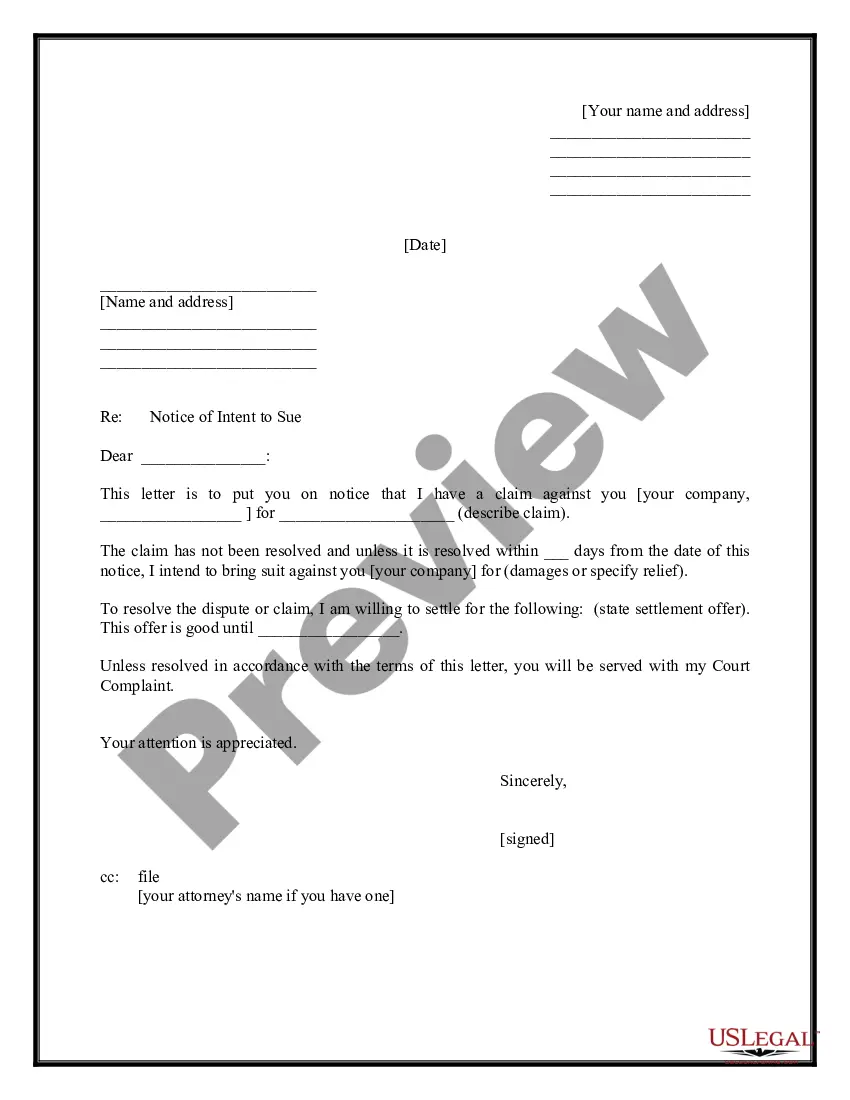
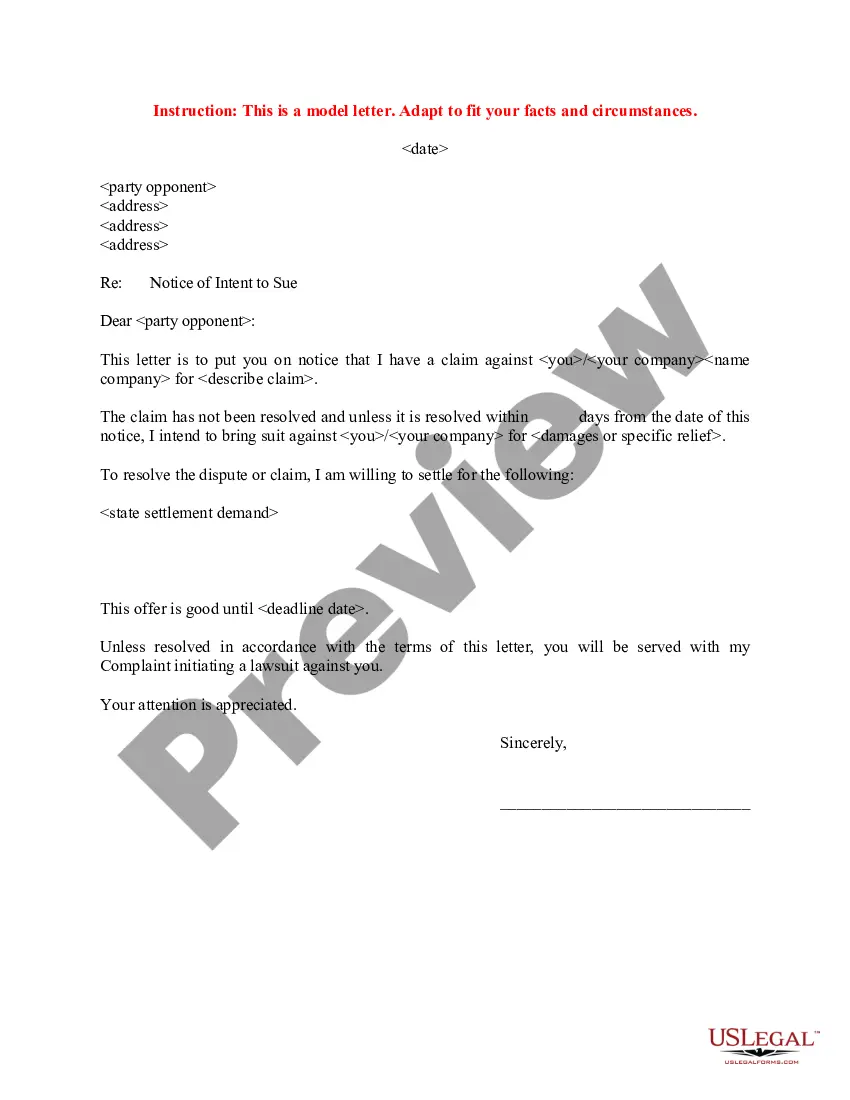
The Letter of Intent to Sue is a formal document that notifies an individual or business of an impending legal action. This form serves as a preliminary step before filing a lawsuit, allowing the parties to resolve claims amicably without escalating to court. It outlines the nature of the claim and provides a settlement proposal, differing it from other legal forms such as formal complaints or summonses.
Form components explained
- Date of the letter
- Sender's name and address
- Recipient's name and address
- Description of the claim against the recipient
- Settlement offer and deadline for resolution
- Signature line for the sender
When to use this document
This form is useful when there is a dispute that has not been resolved directly with the other party. It can be employed in scenarios such as unresolved business disagreements, contract breaches, or personal injury claims. By sending this notice, you formally communicate your intention to take legal action if the matter is not settled within a specified timeframe.
Intended users of this form
- Individuals seeking to resolve disputes prior to litigation
- Businesses wanting to settle claims with customers or partners
- Anyone who feels they have a valid legal claim but wishes to avoid court
Steps to complete this form
- Enter the date of the letter.
- Fill in your name and address clearly.
- Include the recipient's name and address.
- Describe the nature of the claim against the recipient succinctly.
- State your settlement offer and specify the deadline for resolution.
- Sign the letter and consider copying your attorney if you have legal representation.
Is notarization required?
Notarization is not commonly needed for this form. However, certain documents or local rules may make it necessary. Our notarization service, powered by Notarize, allows you to finalize it securely online anytime, day or night.
Get your form ready online
Our built-in tools help you complete, sign, share, and store your documents in one place.
Make edits, fill in missing information, and update formatting in US Legal Forms—just like you would in MS Word.
Download a copy, print it, send it by email, or mail it via USPS—whatever works best for your next step.
Sign and collect signatures with our SignNow integration. Send to multiple recipients, set reminders, and more. Go Premium to unlock E-Sign.
If this form requires notarization, complete it online through a secure video call—no need to meet a notary in person or wait for an appointment.
We protect your documents and personal data by following strict security and privacy standards.

Make edits, fill in missing information, and update formatting in US Legal Forms—just like you would in MS Word.

Download a copy, print it, send it by email, or mail it via USPS—whatever works best for your next step.

Sign and collect signatures with our SignNow integration. Send to multiple recipients, set reminders, and more. Go Premium to unlock E-Sign.

If this form requires notarization, complete it online through a secure video call—no need to meet a notary in person or wait for an appointment.

We protect your documents and personal data by following strict security and privacy standards.
Typical mistakes to avoid
- Failing to specify a realistic deadline for a response.
- Leaving out important details about the claim.
- Not properly addressing the letter to the correct recipient.
- Using vague language that may confuse the recipient about the claims.
- Overlooking to keep a copy for your records.
Benefits of completing this form online
- Immediate access to a professionally drafted document.
- Convenient download and editing options to suit your needs.
- Reliable templates designed by licensed attorneys, ensuring legal compliance.
Looking for another form?









Form popularity
FAQ
Choose the Right Letter of Intent Format and Layout. Research the Company Before You Write. Find 3 Ways You Fit the Position. Get Attention with a Strong First Paragraph. Explain Why You're Interested in Them. End Your Letter of Intent by Asking for Action. Sign off with a Professional Closing.
Consequences of Ignoring a Letter of DemandIgnoring a Letter of Demand can result in a chain of serious but avoidable consequence. A creditor who does not get back what he rightfully deserves will most likely commence a civil action in Court to claim for the same.
Step 1 Sender and Effective Date. (1) Sender's Name and Address; and. Step 2 Being Sent to and Reason for the Lawsuit. (3) Name of the Person or Entity to who the letter is being sent; Step 3 The Parties and Settlement Demand. Step 4 Governing Law and Signature.
Understand the Costs and Impact of Your Injuries In short, it's best to send a demand letter only after you (and/or your attorney) have taken a thorough look at the impact of your injury on all aspects of your life, and made a reasonable valuation of your injury claim.
A summary of the original incident with any factual disputes highlighted. Evidence to support the version of events provided in the Settlement Demand Letter. An outline of any relevant legal standards that apply to the matter. A settlement offer and terms/timeline for acceptance.
Once you've written your demand letter and sent it on to the insurance company, the response time may vary. Typically, you can expect an answer within a few weeks. However, sometimes this process can take as long as a few months.
Understand the claim. The first step is to carefully review the claim. Layout the terms. Be specific when offering a settlement. Include a tempting payout. The key is to make an appealing offer that still undercuts the original demand. Give a response timeframe.
Although they are not legally required, demand letters are frequently used in contract law, tort law, and commercial law cases. Most courts consider the recipient sending a demand letter as a measure of good faith to try to come to a resolution.
No, a demand letter is not necessary prior to filing a superior court limited/unlimited jurisdiction lawsuit in California.