Sample Letter for Request to be Retested
What this document covers
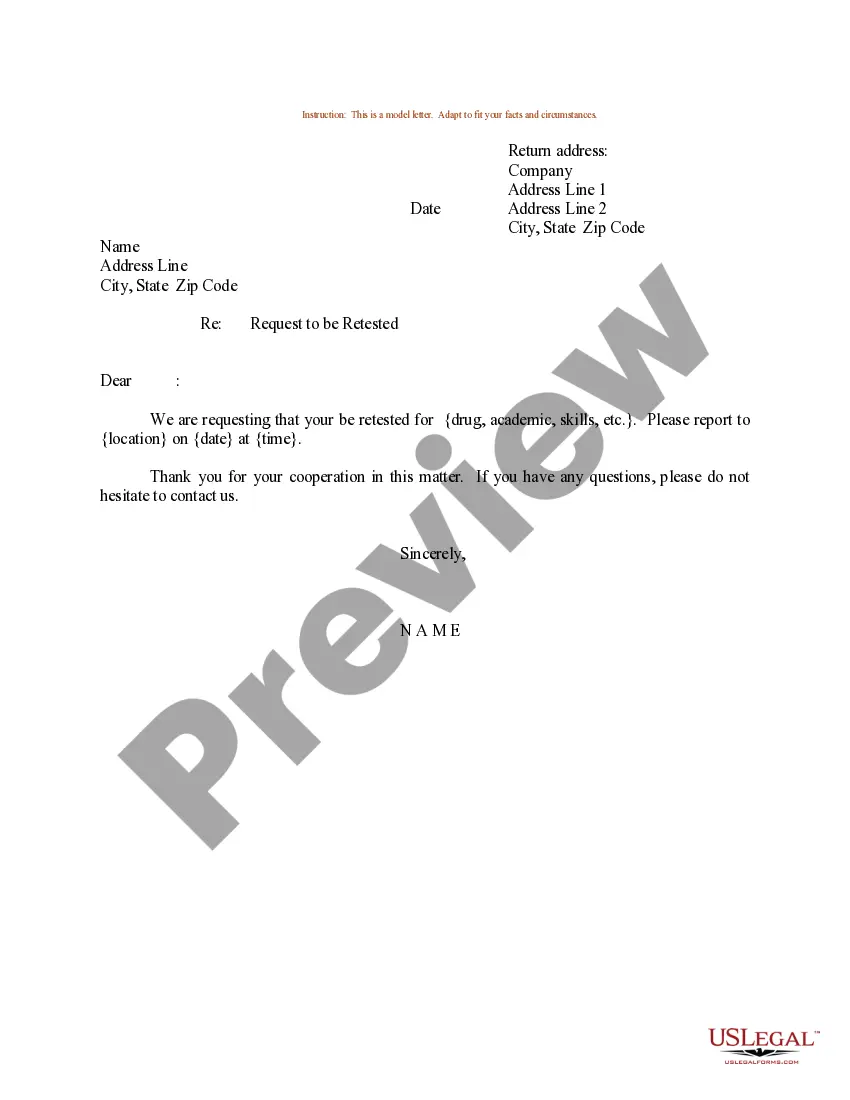
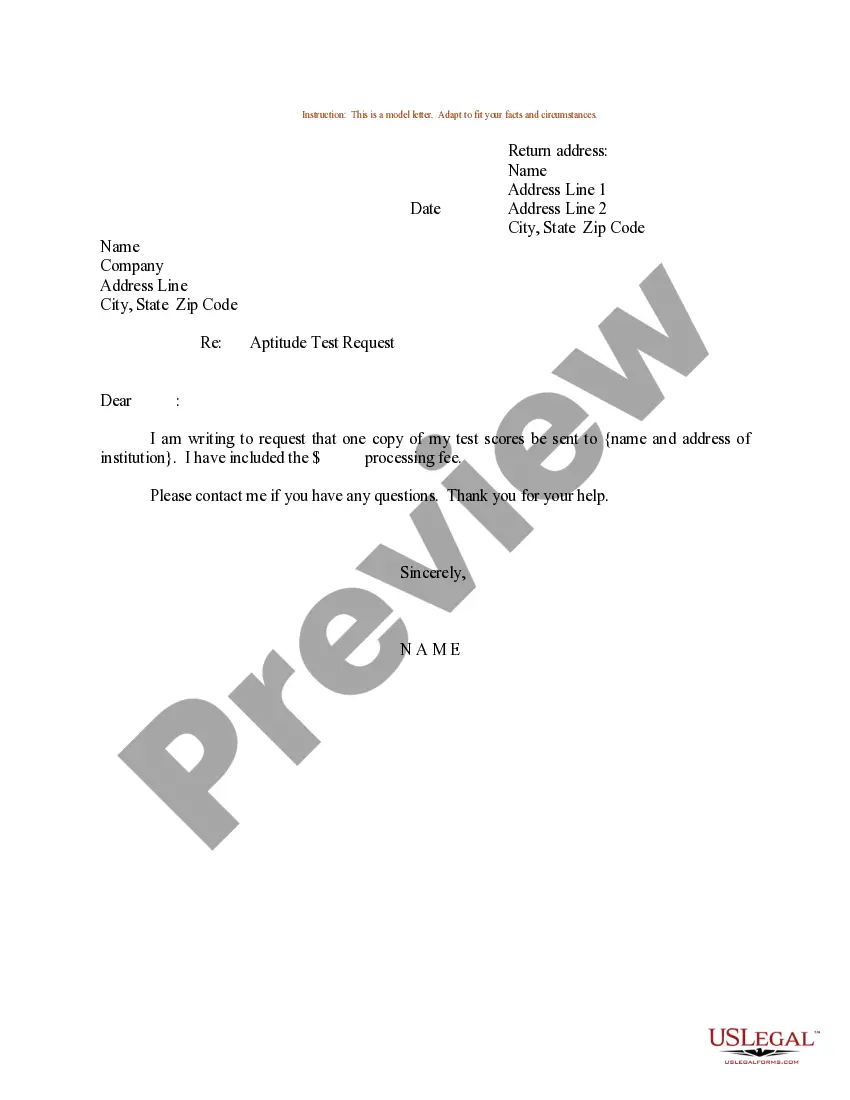
The Sample Letter for Request to be Retested is a formal document used to request a re-evaluation or retesting of a subject, such as an exam or a product. This letter serves as a significant tool for individuals or organizations seeking confirmation of previous results or outcomes. Unlike generic inquiry letters, this form provides a specific structure to convey your request clearly and professionally.
What’s included in this form
- Return address: Your contact information, including company name, address, city, state, and zip code.
- Date: The date on which the letter is written.
- Recipient's information: The name and address of the individual or organization to whom the letter is addressed.
- Subject line: Clearly indicates the purpose of the letter, specifically the request to be retested.
- Body content: Includes a polite request for retesting along with any necessary details to support your request.
- Signature: Space for your signature to authenticate the letter.
When to use this form
This form is suitable for various scenarios, including:
- Requesting a second chance to take a professional exam or certification test due to unforeseen circumstances.
- Seeking re-evaluation of laboratory tests or assessments that may have been contested.
- Communicating formally with institutions or organizations regarding concerns over previous results.
Who needs this form
- Students seeking to retake an exam for academic purposes.
- Professionals who need to re-certify or verify credentials.
- Individuals requiring retesting for health-related evaluations, such as medical tests.
- Organizations that manage testing and certification processes.
Instructions for completing this form
- Fill in your return address at the top of the letter.
- Insert the current date.
- Provide the recipient's details, including their name and address.
- Write a clear subject line indicating your intention to be retested.
- Compose the body, explaining your request and providing any necessary context.
- Sign the letter to confirm authenticity.
Does this form need to be notarized?
This form does not typically require notarization to be legally valid. However, some jurisdictions or document types may still require it. US Legal Forms provides secure online notarization powered by Notarize, available 24/7 for added convenience.
Get your form ready online
Our built-in tools help you complete, sign, share, and store your documents in one place.
Make edits, fill in missing information, and update formatting in US Legal Forms—just like you would in MS Word.
Download a copy, print it, send it by email, or mail it via USPS—whatever works best for your next step.
Sign and collect signatures with our SignNow integration. Send to multiple recipients, set reminders, and more. Go Premium to unlock E-Sign.
If this form requires notarization, complete it online through a secure video call—no need to meet a notary in person or wait for an appointment.
We protect your documents and personal data by following strict security and privacy standards.

Make edits, fill in missing information, and update formatting in US Legal Forms—just like you would in MS Word.

Download a copy, print it, send it by email, or mail it via USPS—whatever works best for your next step.

Sign and collect signatures with our SignNow integration. Send to multiple recipients, set reminders, and more. Go Premium to unlock E-Sign.

If this form requires notarization, complete it online through a secure video call—no need to meet a notary in person or wait for an appointment.

We protect your documents and personal data by following strict security and privacy standards.
Common mistakes
- Not including sufficient details about the reason for the retest request.
- Failing to proofread for grammatical or spelling errors.
- Omitting the recipient's address or contact information.
- Not providing your own contact information for follow-up.
Benefits of using this form online
- Quick and easy access to a professionally drafted template.
- Convenient editing options to personalize the letter to your situation.
- Immediate download, allowing you to send your request without delays.
- Prepared by licensed attorneys, ensuring legal compliance and effectiveness.
Looking for another form?


Form popularity
FAQ
Find out where to send your request. Ask your child's teacher who to send your request to. Write a formal letter. Be specific about why you're requesting the evaluation. Consent to your child being evaluated. Make sure the letter arrives. Follow up.
Put the date on your letter. Give your child's full name and the name of your child's main teacher or current class placement. Say what you want, rather than what you don't want. Give your address and a daytime phone number where you can be reached.
Let the focus be on the recipient. Your request letter should not be self-centered. Introduce yourself. If you are writing to someone you haven't spoken with in a long time, you must introduce yourself. Be straightforward. Be courteous. Don't threaten. Contact information.
Be polite and tactful. If you are asking for special consideration for something based on extenuating circumstances such as a medical issue, providing evidence in the form of a doctor's note may help. Simply stating that you should be considered for something is worthless without explaining why.
I am writing this letter to request a retest for the _________ (internal//external/weekly test/monthly test) exam which I missed on _______ (Date of exam) for the subject ___________ (Name of the subject) designed by __________ (Name of the teacher).
You start the email or letter by explaining what you are writing about (the topic/subject) and what the email's purpose is (i.e. you want to ask them some questions or for something). Then in the next section, you ask them the questions or requests.
Step 1: Starting a formal letter. Begin with the sender's name and address. Step 2: Writing a letter, formally. When writing a letter, you're ready to greet the person (or business) to whom you're writing. Step 3: Writing the body of a formal letter. Step 4: Ending a formal letter.
Explain precisely what your request is. Mention the reason for the request. Use polite language and a professional tone. Demonstrate respect and gratitude to the reader. The content of the letter should be official. You may provide contact information where you can be reached.
Put the date on your letter. Give your child's full name and the name of your child's main teacher or current class placement. Say what you want, rather than what you don't want. Give your address and a daytime phone number where you can be reached.