Contract of Sale and Leaseback of Apartment Building with Purchaser Assuming Outstanding Note Secured by a Mortgage or Deed of Trust
Overview of this form
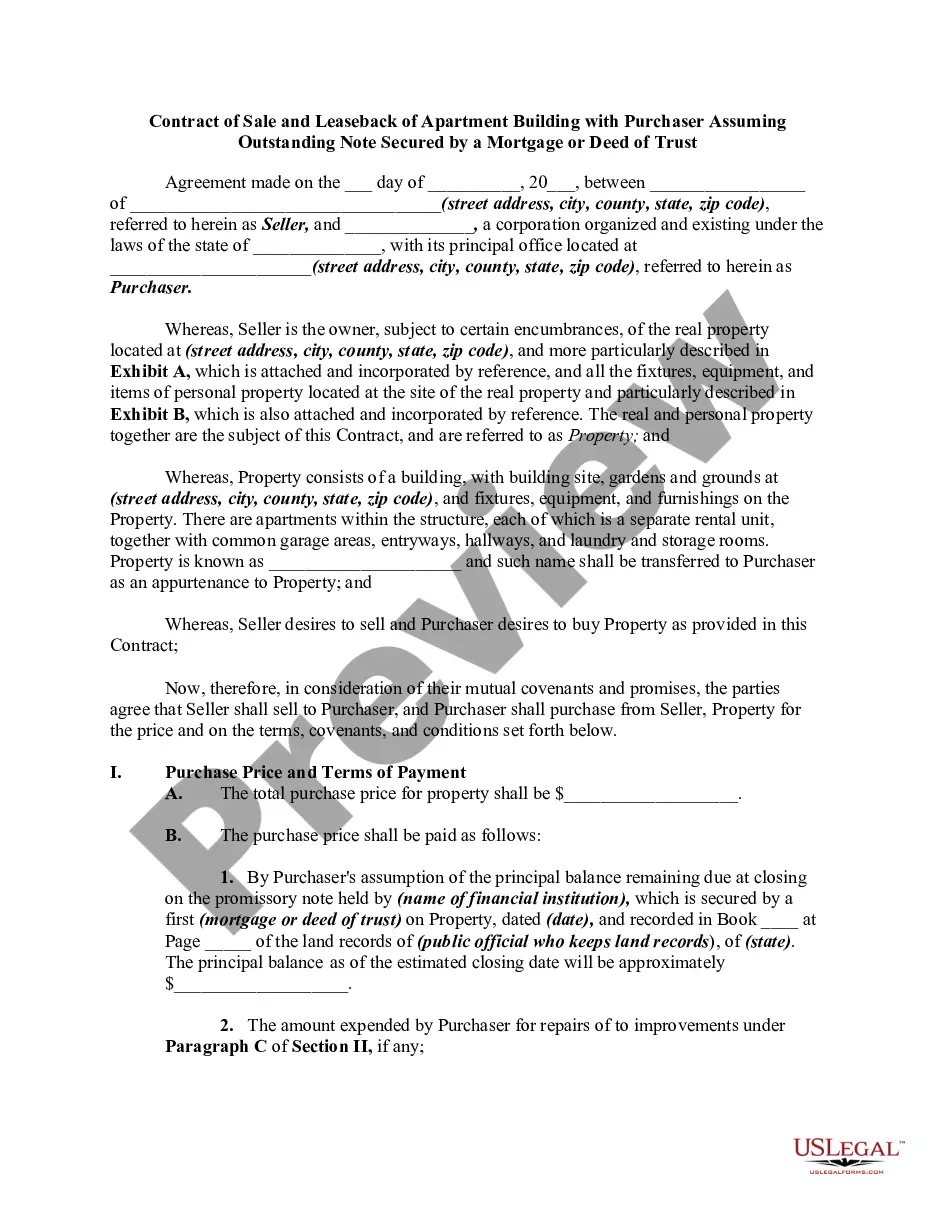
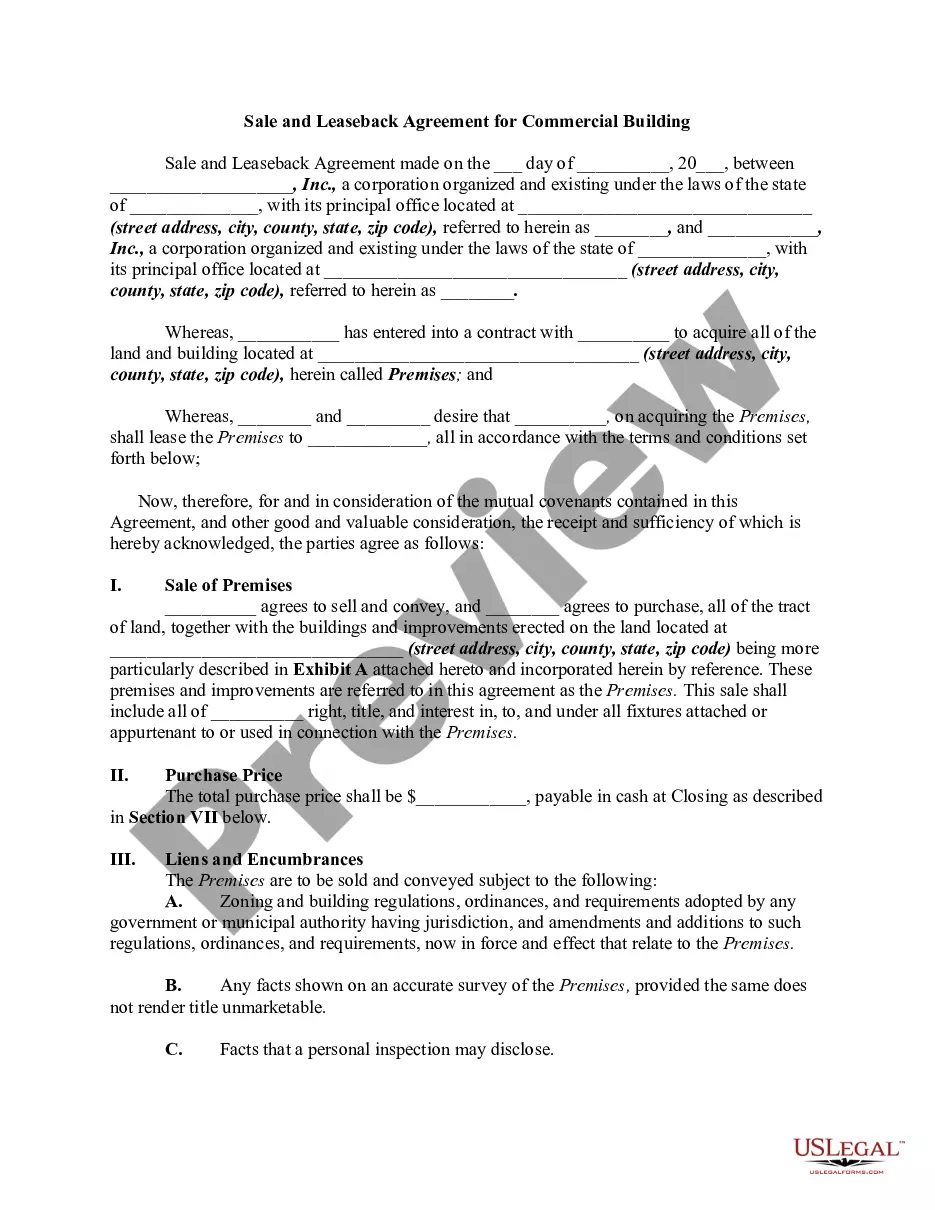
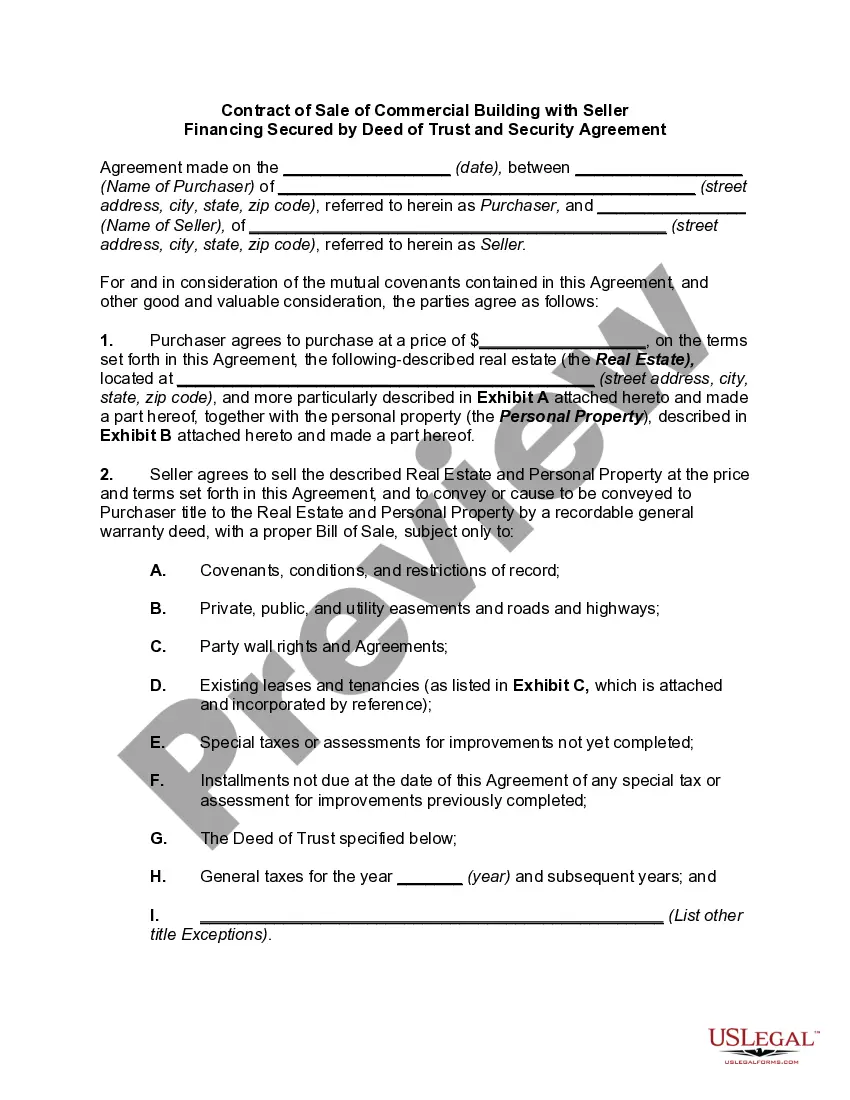
This form is a Contract of Sale and Leaseback of an Apartment Building. It formalizes the sale of an apartment building where the purchaser pays cash and assumes any outstanding mortgage. After the sale is completed, a lease agreement is established, allowing the seller to lease the property back from the purchaser. This form is distinct from standard sale contracts due to its leaseback component, wherein the seller retains possession of the property after the sale.
Form components explained
- Details of the seller and purchaser, including names and addresses.
- Description of the property being sold, including physical and legal descriptions.
- Purchase price and payment terms, including assumptions of existing debt.
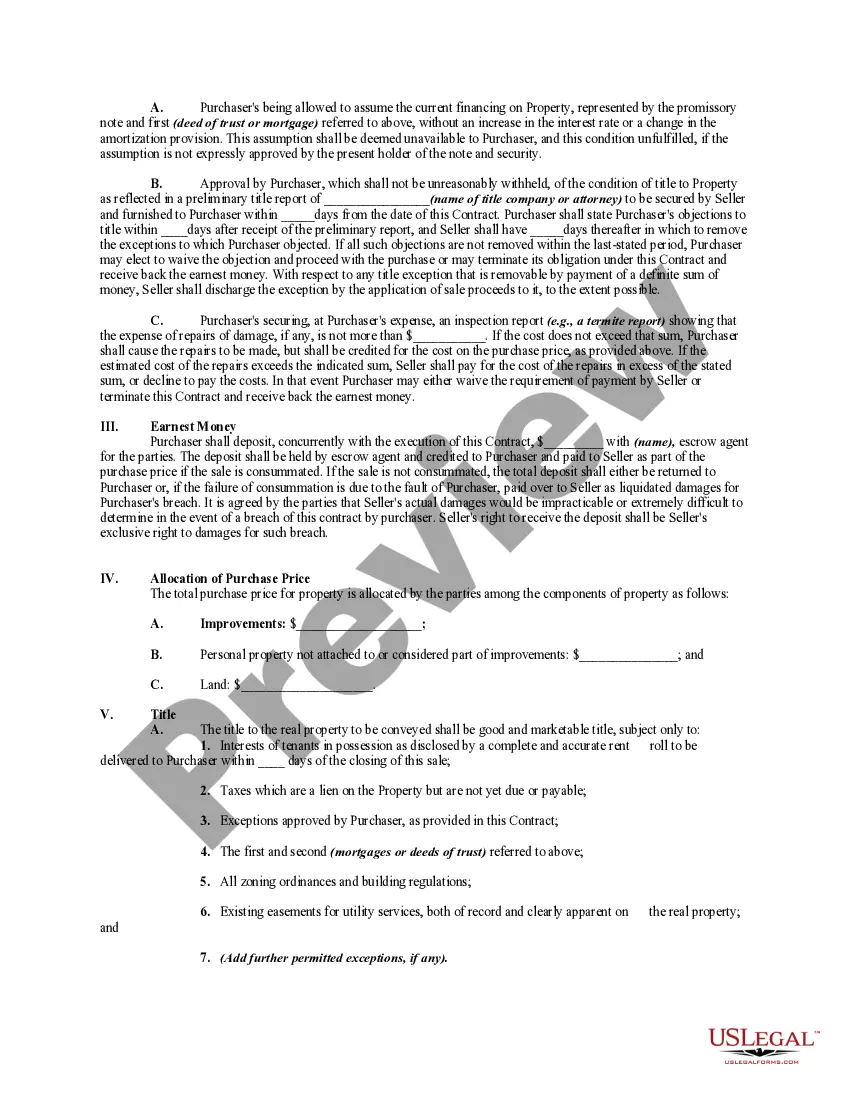
- Conditions that must be met for the purchaser's obligations to be valid.
- Provisions for the earnest money deposit and its handling.
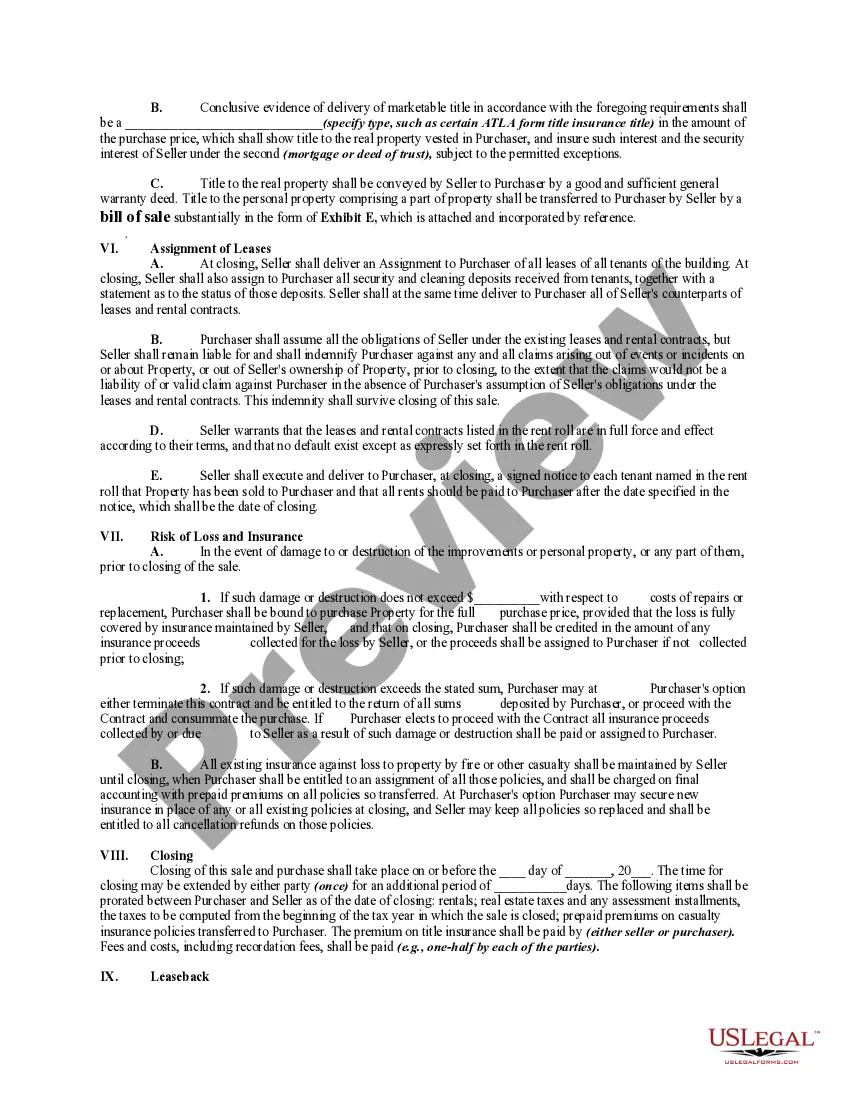
- Title and insurance requirements ensuring the transfer of ownership.
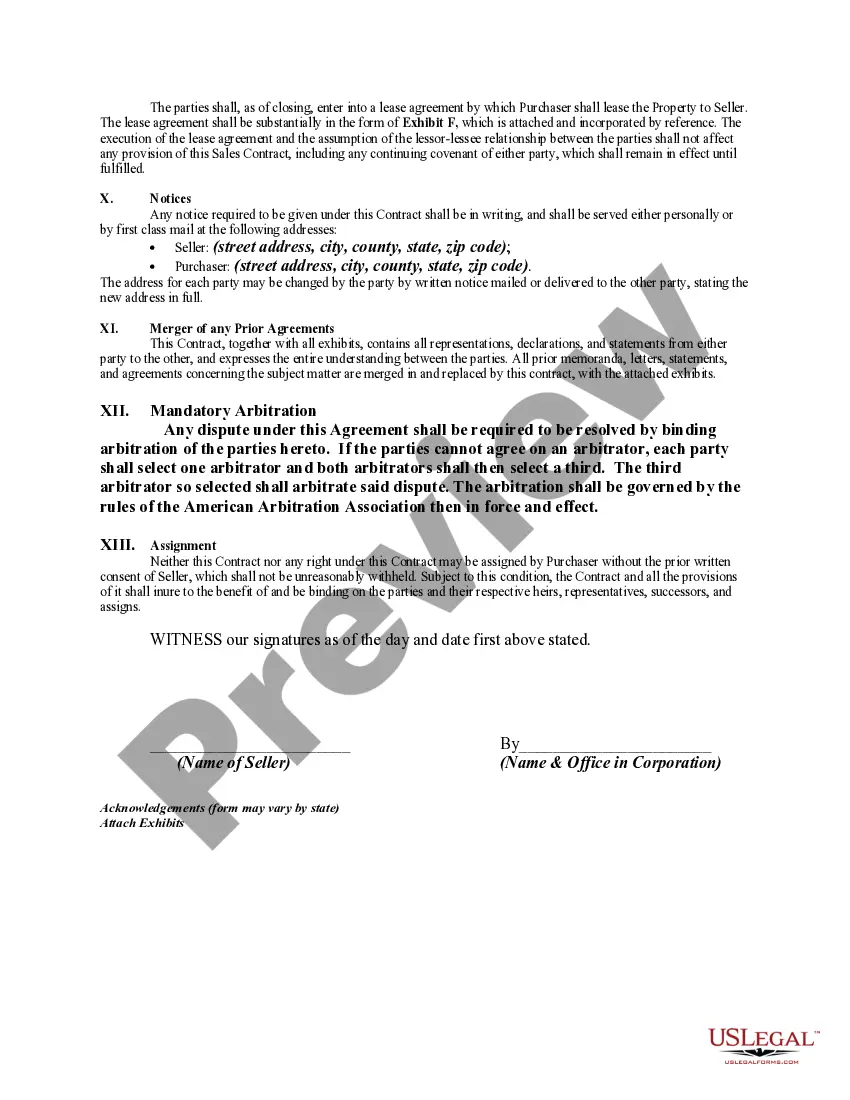
- Leaseback agreement terms allowing the seller to rent the property post-sale.
When to use this document
This form should be used when an owner of an apartment building wishes to sell the property while simultaneously entering into a lease agreement with the new purchaser. It is particularly useful for property owners seeking to free up cash while continuing to occupy their property. This scenario is common in commercial real estate transactions where owners aim to maintain operational control of the property after selling it.
Intended users of this form
- Property owners looking to sell an apartment building while retaining use of the property.
- Real estate investors interested in purchasing a property with existing tenants.
- Corporations or individuals managing cash flow while wanting to lease back their operational premises.
Completing this form step by step
- Identify and enter the names and contact details of the seller and purchaser.
- Clearly describe the property, including its physical address and any relevant legal descriptions.
- Specify the total purchase price and outline the terms of payment, including any assumptions of debt.
- List any conditions that must be satisfied for the agreement to be valid.
- Detail the earnest money deposit and its terms for return or forfeiture.
- Include signatures and dates from both parties to finalize the agreement.
Is notarization required?
This form does not typically require notarization unless specified by local law. However, parties may consider having the signatures notarized for added authenticity and to prevent future disputes.
Get your form ready online
Our built-in tools help you complete, sign, share, and store your documents in one place.
Make edits, fill in missing information, and update formatting in US Legal Forms—just like you would in MS Word.
Download a copy, print it, send it by email, or mail it via USPS—whatever works best for your next step.
Sign and collect signatures with our SignNow integration. Send to multiple recipients, set reminders, and more. Go Premium to unlock E-Sign.
If this form requires notarization, complete it online through a secure video call—no need to meet a notary in person or wait for an appointment.
We protect your documents and personal data by following strict security and privacy standards.

Make edits, fill in missing information, and update formatting in US Legal Forms—just like you would in MS Word.

Download a copy, print it, send it by email, or mail it via USPS—whatever works best for your next step.

Sign and collect signatures with our SignNow integration. Send to multiple recipients, set reminders, and more. Go Premium to unlock E-Sign.

If this form requires notarization, complete it online through a secure video call—no need to meet a notary in person or wait for an appointment.

We protect your documents and personal data by following strict security and privacy standards.
Common mistakes
- Failing to accurately describe the property, leading to potential disputes.
- Not specifying the conditions precedent, which may cause the contract to be unenforceable.
- Inadequate detailing of the payment structure, leading to confusion over financial obligations.
- Neglecting necessary signatures or dates, rendering the contract invalid.
Advantages of online completion
- Convenient access to the form at any time without the need for in-person appointments.
- Easy editing and customization to suit specific transaction details.
- Reliable templates drafted by licensed attorneys to ensure compliance with current laws.
- This contract is enforceable as long as it complies with local real estate laws and regulations.
- Proper execution and adherence to stipulated conditions are crucial for validity.
- Disputes arising from the agreement are subject to arbitration as specified within the contract.
What to keep in mind
- This contract allows for simultaneous sale and leaseback arrangements, which can benefit both parties.
- Completing the form accurately is crucial for avoiding legal issues in the transaction.
- Ensure that all terms and conditions are clearly articulated to prevent conflicts down the road.
Looking for another form?
Form popularity
FAQ
In a sale-leaseback, sometimes called a sale-and-leaseback, you can sell an asset you own to a leasing company or lender and then lease it back from them. This is how sale-leasebacks usually work in commercial real estate, where companies often use them to free up capital that's tied up in a real estate investment.
Compare the difference between the sale price of the asset and its fair value. Compare the present value of the lease payments and the present value of market rental payments. This can include an estimation of any variable lease payments reasonably expected to be made.
Compare the difference between the sale price of the asset and its fair value. Compare the present value of the lease payments and the present value of market rental payments. This can include an estimation of any variable lease payments reasonably expected to be made.
The buyer in a sale-leaseback reports rental payments as ordinary income as they are received over the lease term. In a loan transaction, the lender is taxed only on the interest portion of the payment and not on the amount that represents the repayment of principal.
THE NATURE OF LEASEBACKS A sale and leaseback, or more simply, a leaseback, is a contract between a seller and a buyer where the former sells an asset to the latter and then enters into a second contract to lease the asset back from the buyer.
More and more retirees are taking advantage of the leaseback option. It gives them the ability to continue living in the home they owned while having more money for retirement. And of course, it is good option for people who have suffered financial reverses due to job loss or other difficult circumstances.
The main advantages of sale and leaseback are that it enables businesses to release cash from existing items of value such as equipment, plant and machinery. The cash gained can be used for many purposes including business acquisitions or simply providing extra working capital.
Capital For Growth: The key benefit to a seller engaged in a sale-leaseback transaction is the ability to convert illiquid equity to spendable cash.