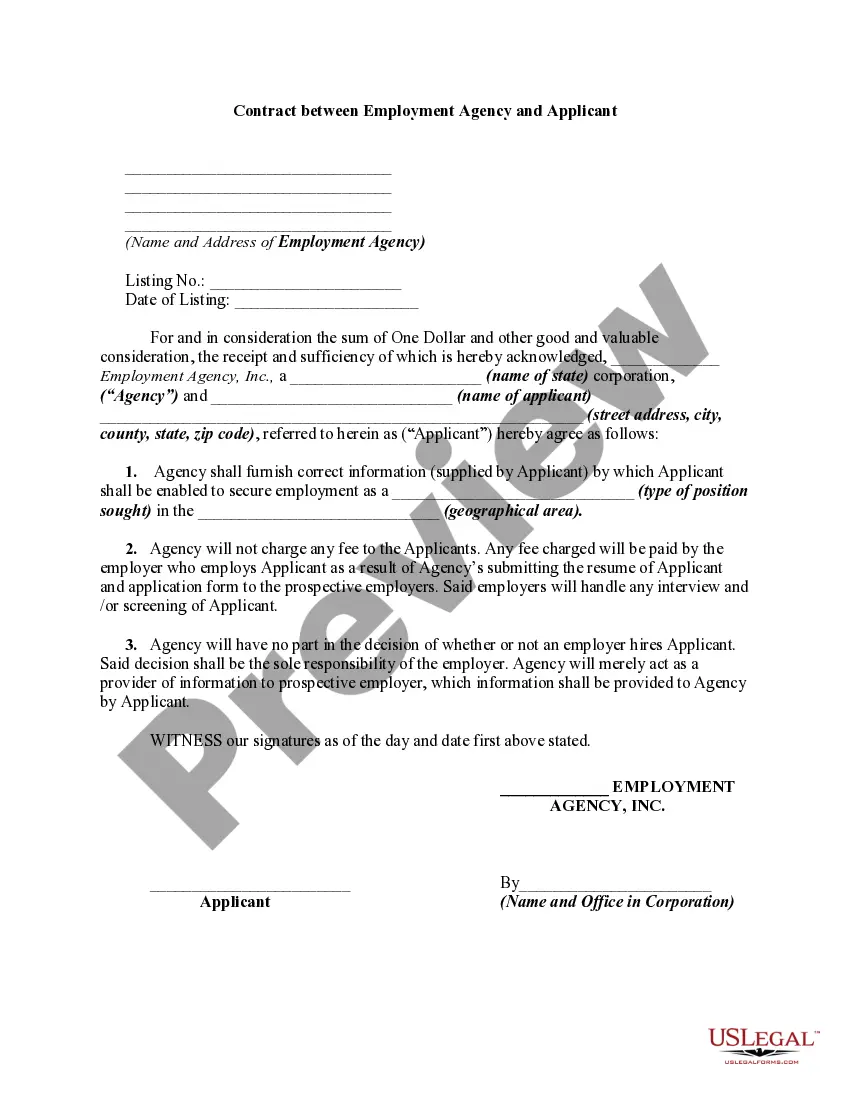
Contract between Employment Agency and Applicant
Overview of this form
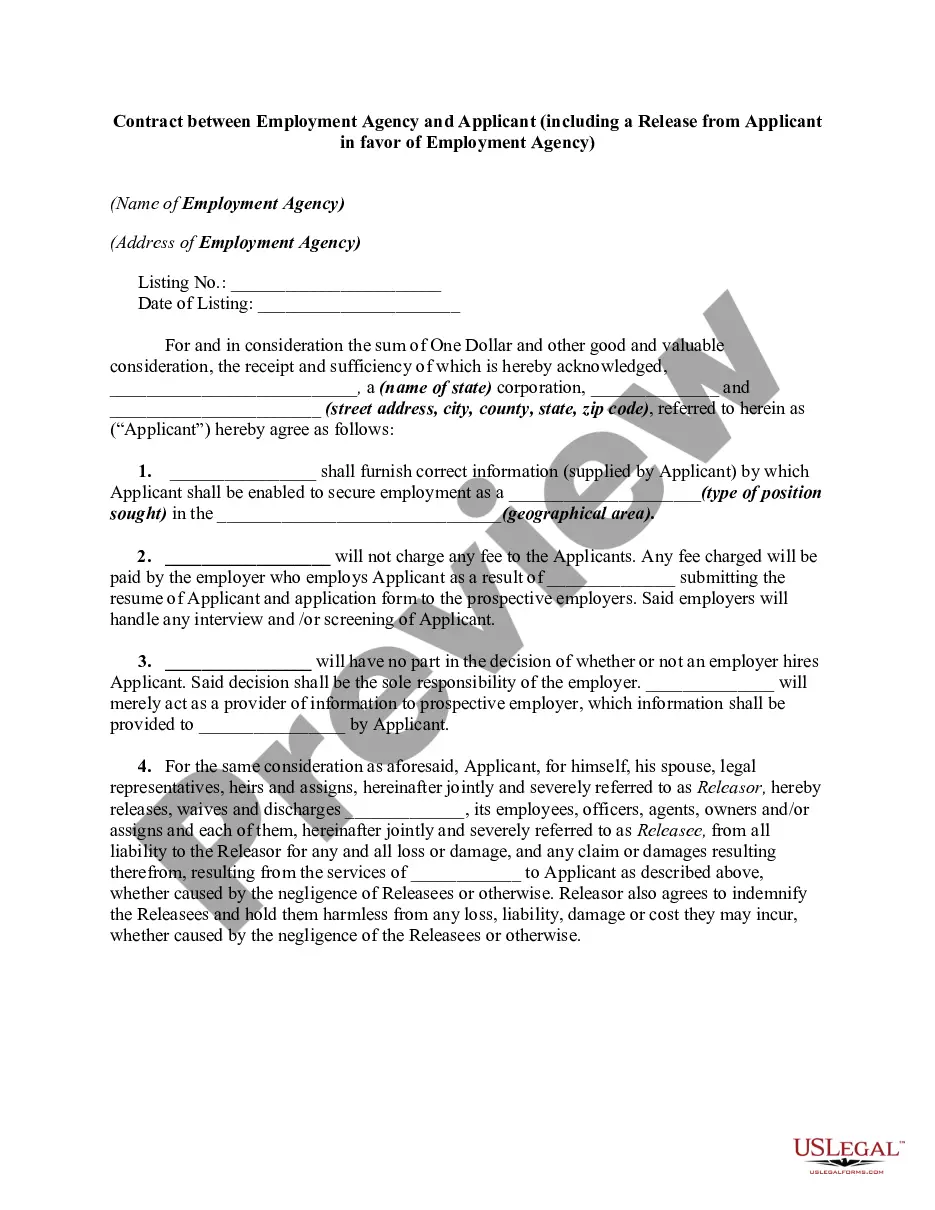
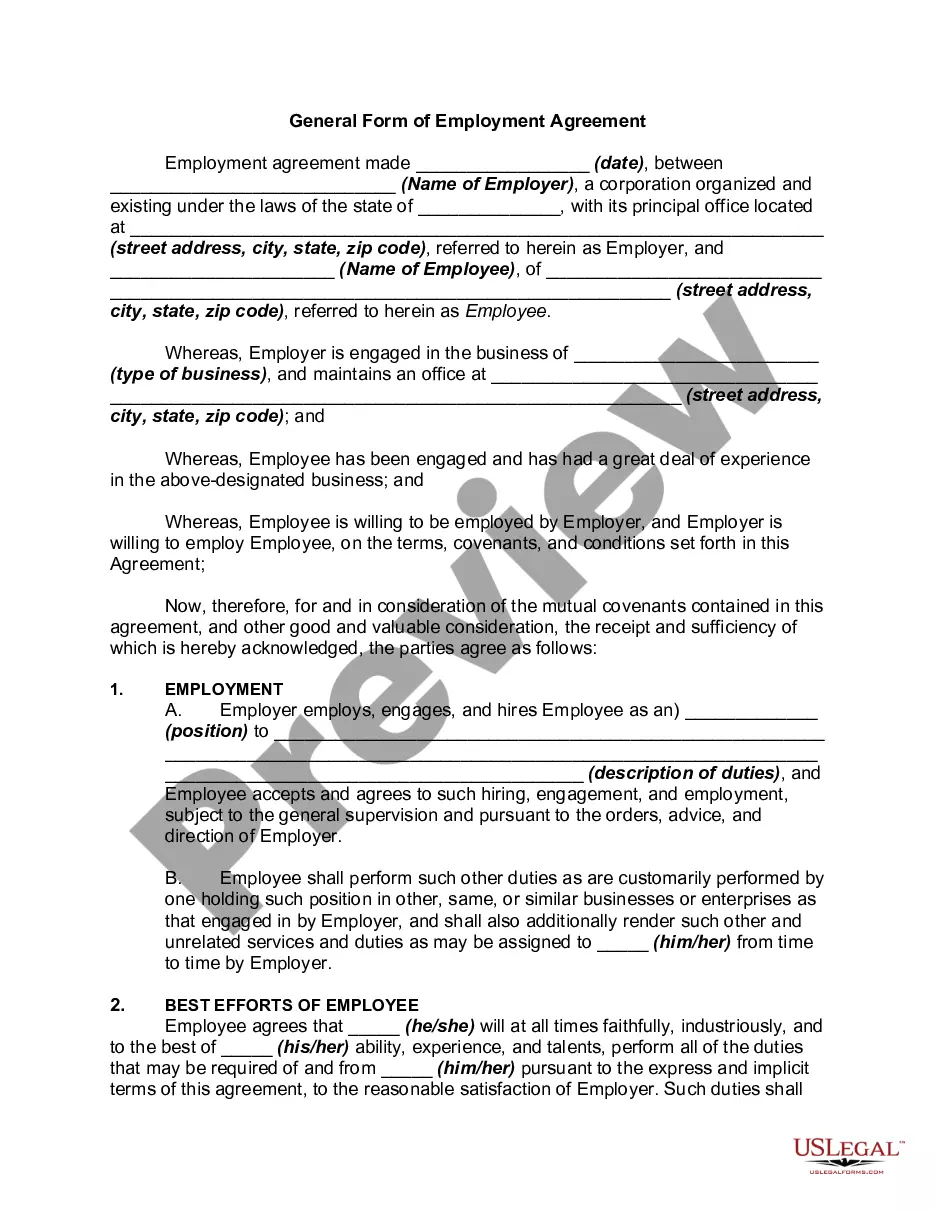
This form is a contract between an employment agency and an applicant, outlining the terms of service when seeking employment. Unlike other types of employment contracts, this specific agreement stipulates that any fees incurred are to be paid by the employer, not the applicant. It serves to define the responsibilities of the agency and applicant during the job placement process.
Form components explained
- Name and address fields for the employment agency and applicant.
- Listing number and date of listing to identify the contract.
- Clauses regarding the provision of information by the applicant.
- Statement confirming that the agency does not charge fees to applicants.
- Clarification of the agency's role in the hiring decision.
When to use this form
This contract should be used when an applicant engages with an employment agency to find a job. It is particularly useful in scenarios where the applicant seeks assurance that they will not be responsible for any fees, as those will be covered by the hiring employer. Use this form whenever you are ready to formally establish the relationship with the agency during your job search.
Who should use this form
This form is intended for:
- Job seekers looking to work with an employment agency.
- Employment agencies that facilitate job placements for applicants.
- Individuals who want clarity on financial responsibilities in the job placement process.
Completing this form step by step
- Identify and enter the name and address of the employment agency.
- Fill in the listing number and date of the listing.
- Name the applicant and provide their complete address.
- Specify the type of position the applicant is seeking.
- Obtain signatures from both the agency representative and the applicant. Ensure that the name and title of the agency representative are clearly indicated.
Notarization requirements for this form
This form does not typically require notarization unless specified by local law. You should ensure that all parties have signed it to validate the agreement.
Get your form ready online
Our built-in tools help you complete, sign, share, and store your documents in one place.
Make edits, fill in missing information, and update formatting in US Legal Forms—just like you would in MS Word.
Download a copy, print it, send it by email, or mail it via USPS—whatever works best for your next step.
Sign and collect signatures with our SignNow integration. Send to multiple recipients, set reminders, and more. Go Premium to unlock E-Sign.
If this form requires notarization, complete it online through a secure video call—no need to meet a notary in person or wait for an appointment.
We protect your documents and personal data by following strict security and privacy standards.

Make edits, fill in missing information, and update formatting in US Legal Forms—just like you would in MS Word.

Download a copy, print it, send it by email, or mail it via USPS—whatever works best for your next step.

Sign and collect signatures with our SignNow integration. Send to multiple recipients, set reminders, and more. Go Premium to unlock E-Sign.

If this form requires notarization, complete it online through a secure video call—no need to meet a notary in person or wait for an appointment.

We protect your documents and personal data by following strict security and privacy standards.
Common mistakes to avoid
- Failing to provide complete addresses for both the agency and the applicant.
- Not including the necessary signatures or filling in the title of the signatory from the agency.
- Overlooking the importance of specifying the type of position sought.
Why complete this form online
- Convenience of immediate access and download for completion at any time.
- Editability allows for customization to fit specific needs without starting from scratch.
- Reliability through being drafted by licensed attorneys, ensuring it meets legal standards.
Legal use & context
- This contract serves as a formal agreement outlining the relationship between the job applicant and the employment agency.
- It clarifies the fee structure, protecting the applicant from any obligations to pay fees.
- Employers are also informed of their responsibilities regarding hiring and interview processes.
What to keep in mind
- This form provides a clear structure for the relationship between an employment agency and an applicant.
- Applicants are ensured that they will not incur costs for the agency's services.
- Employers are responsible for paying the agency's fees upon hiring the applicant.
Looking for another form?

Form popularity
FAQ
Get it in writing. Keep it simple. Deal with the right person. Identify each party correctly. Spell out all of the details. Specify payment obligations. Agree on circumstances that terminate the contract. Agree on a way to resolve disputes.
Add employment details. Agreement to employers policies, rules & regulations. Mention position related responsibilities. Compensation package. Vacation contract. Employee benefits contract. Add probation period details. Performance reviews. Termination.
Types of Employment Contracts: Permanent employment, temporary employment and independent contractors.
Write the Title. When you proceed to type out your employment agreement, you should title your draft. State the Parties. Every employment agreement needs to clearly identify and state the parties. List Terms and Conditions. Outline Position Duties. Be Clear on Compensation. Add Other Clauses. Use These Contract Terms.
Explanation: In a contract of agency, the principal employs agent on his own behalf to represent him before a third person with or without the consideration to the agent. It is also important that the agent shall act as per the directions of the principal.
When one party delegates some authority to another party whereby the latter performs his actions in a more or less independent fashion, on behalf of the first party, the relationship between them is called an agency. Agency can be express or implied.
While the contract of agency has been very diligently explained under chapter 10 (section 182-238) of the Indian Contract act, 1872 and by the Hon'ble courts of justice, time and again; A contract of agency, in its essence, is nothing but a fiduciary relationship between two parties where one party (the principal)
Express Agency. Implied Agency. Implied agency arises when there is any conduct, the situation of parties or is necessary for the case.