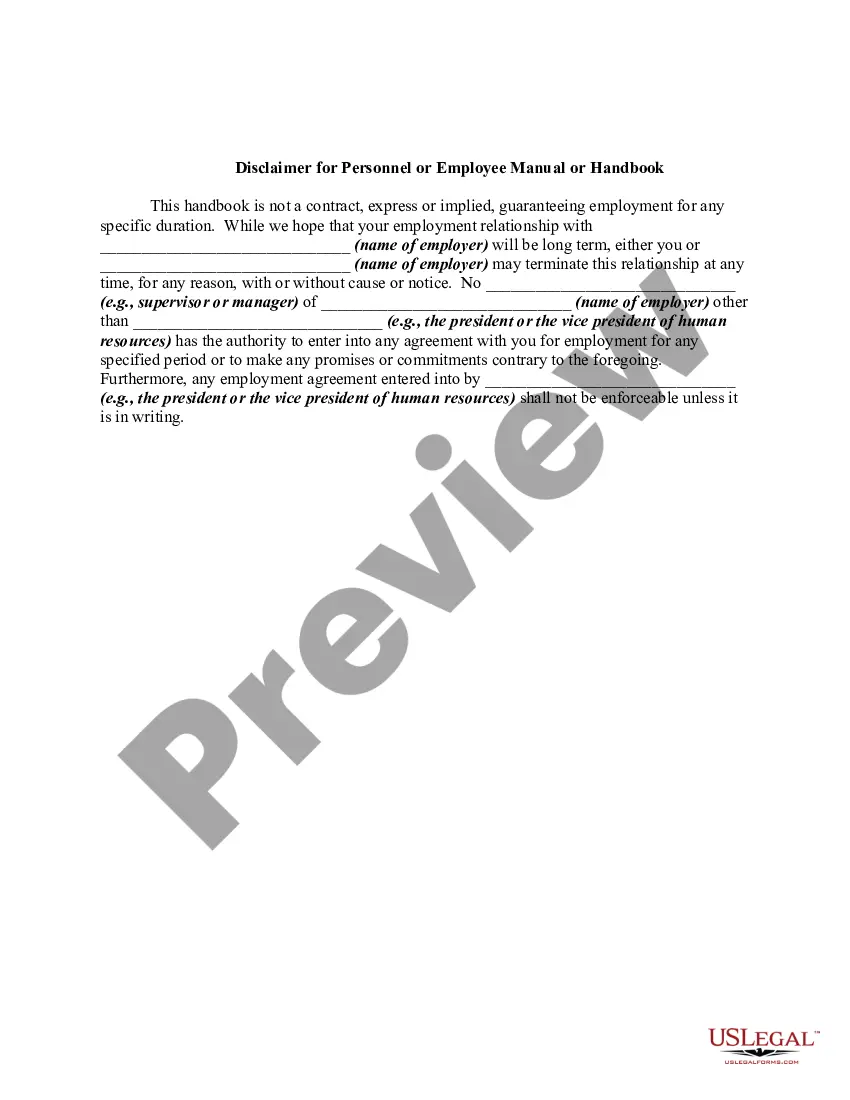
Disclaimer for Personnel or Employee Manual or Handbook
What is this form?
The Disclaimer for Personnel or Employee Manual or Handbook is a legal document that clarifies the employment relationship between employers and employees. Specifically, it states that the handbook is not a contract guaranteeing employment for a specific duration. This disclaimer is essential for ensuring that employers maintain the ability to terminate employment "at will," meaning either party can end the relationship at any time and for any reason. Unlike other employment documents, this form helps prevent potential misunderstandings about job security and employment terms.
Key parts of this document
- A statement indicating that the handbook does not constitute a contract.
- A clause confirming that employment is "at will" and can be terminated by either party.
- Details outlining who has the authority to make employment agreements.
- A requirement that any enforceable agreement must be in writing.


Common use cases
This form is typically used when creating or updating an employee handbook or personnel manual. Employers should include it to clarify the terms of employment and the at-will nature of the relationship. It is particularly important for organizations that want to minimize liability by reducing the risk of claims related to employment termination. Use this form whenever new employees are onboarded or whenever significant changes are made to personnel policies.
Who this form is for
Employers, human resources professionals, and managers should use this form to ensure their personnel manuals and handbooks are compliant with employment laws. It is essential for:
- Employers establishing clear expectations regarding employment duration.
- Companies updating or creating employee handbooks.
- Legal advisors drafting policies for their clients.
Completing this form step by step
- Identify the name of the employer and fill it in the designated spaces.
- Clearly state that this handbook is not a contract and reflects the at-will employment status.
- Specify the authority responsible for making employment agreements.
- Include any additional provisions that align with company policies or state regulations.
- Ensure that the document is signed where necessary to finalize it.
Is notarization required?
This form usually doesn’t need to be notarized. However, local laws or specific transactions may require it. Our online notarization service, powered by Notarize, lets you complete it remotely through a secure video session, available 24/7.
Get your form ready online
Our built-in tools help you complete, sign, share, and store your documents in one place.
Make edits, fill in missing information, and update formatting in US Legal Forms—just like you would in MS Word.
Download a copy, print it, send it by email, or mail it via USPS—whatever works best for your next step.
Sign and collect signatures with our SignNow integration. Send to multiple recipients, set reminders, and more. Go Premium to unlock E-Sign.
If this form requires notarization, complete it online through a secure video call—no need to meet a notary in person or wait for an appointment.
We protect your documents and personal data by following strict security and privacy standards.

Make edits, fill in missing information, and update formatting in US Legal Forms—just like you would in MS Word.

Download a copy, print it, send it by email, or mail it via USPS—whatever works best for your next step.

Sign and collect signatures with our SignNow integration. Send to multiple recipients, set reminders, and more. Go Premium to unlock E-Sign.

If this form requires notarization, complete it online through a secure video call—no need to meet a notary in person or wait for an appointment.

We protect your documents and personal data by following strict security and privacy standards.
Avoid these common issues
- Failing to clarify the at-will nature of the employment relationship.
- Not specifying who has the authority to modify employment agreements.
- Neglecting to have the disclaimer reviewed by a legal professional.
Why complete this form online
- Convenience of downloading and completing the form from anywhere.
- Editability, allowing for customization to fit the specific needs of the employer.
- Reliability, as the template is drafted by licensed attorneys to ensure legal compliance.
Legal use & context
- Establishes clear employment terms that protect employers from misinterpretations of policy.
- Affirms the at-will employment doctrine, reinforcing the employer's rights.
- Reduces the risk of disputes arising from presumed contractual obligations in the handbook.
Main things to remember
- The disclaimer ensures clarity regarding the at-will employment status.
- It helps protect employers from future legal disputes related to employment termination.
- Including this form in employee handbooks is crucial for managing expectations.
Looking for another form?
Form popularity
FAQ
Name and details of the person who is sending the letter. Name and details of the person/company to whom the letter is been sent (recipient) Date of sending the acknowledgement letter. The subject of the letter stating the reason for writing it. Statement of confirmation of receipt of the item.
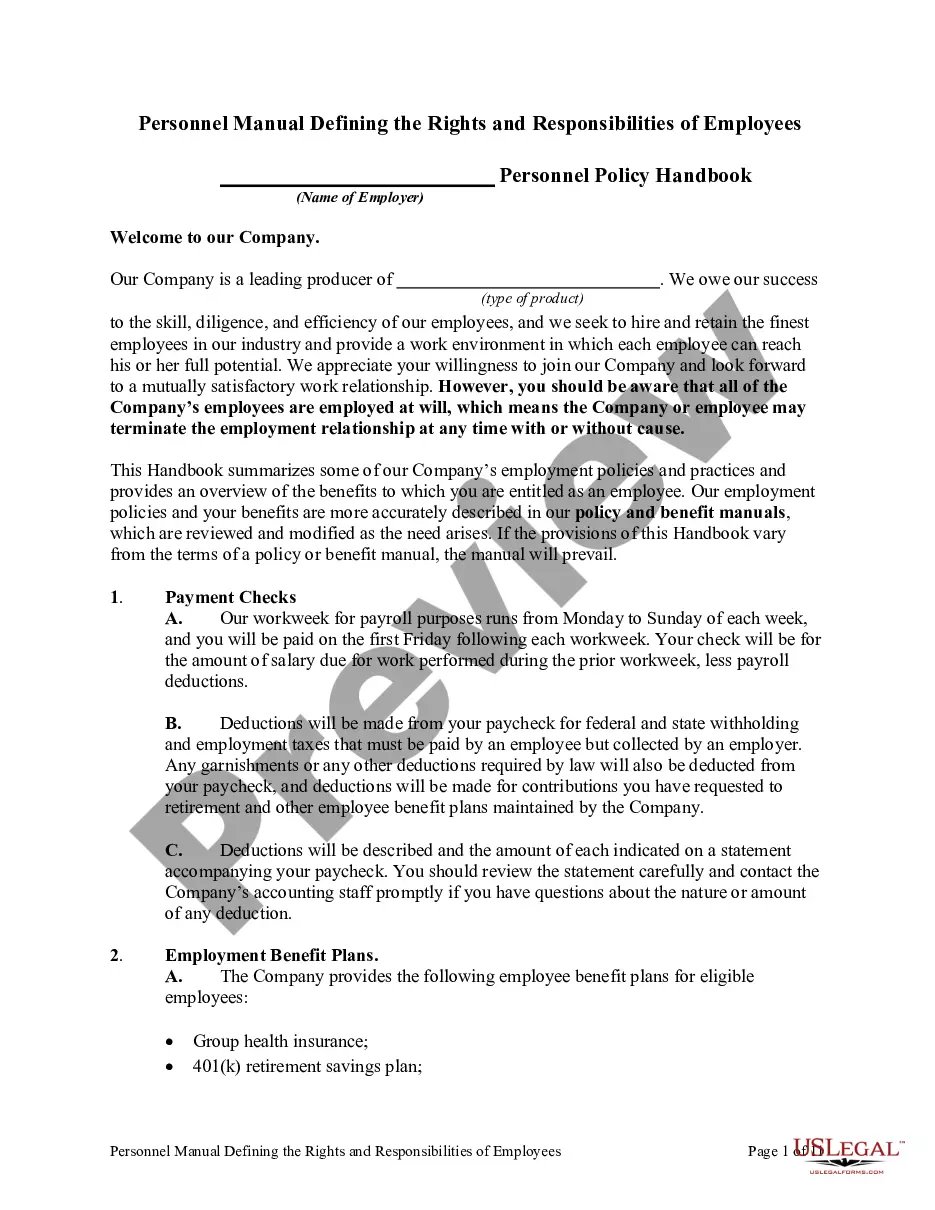
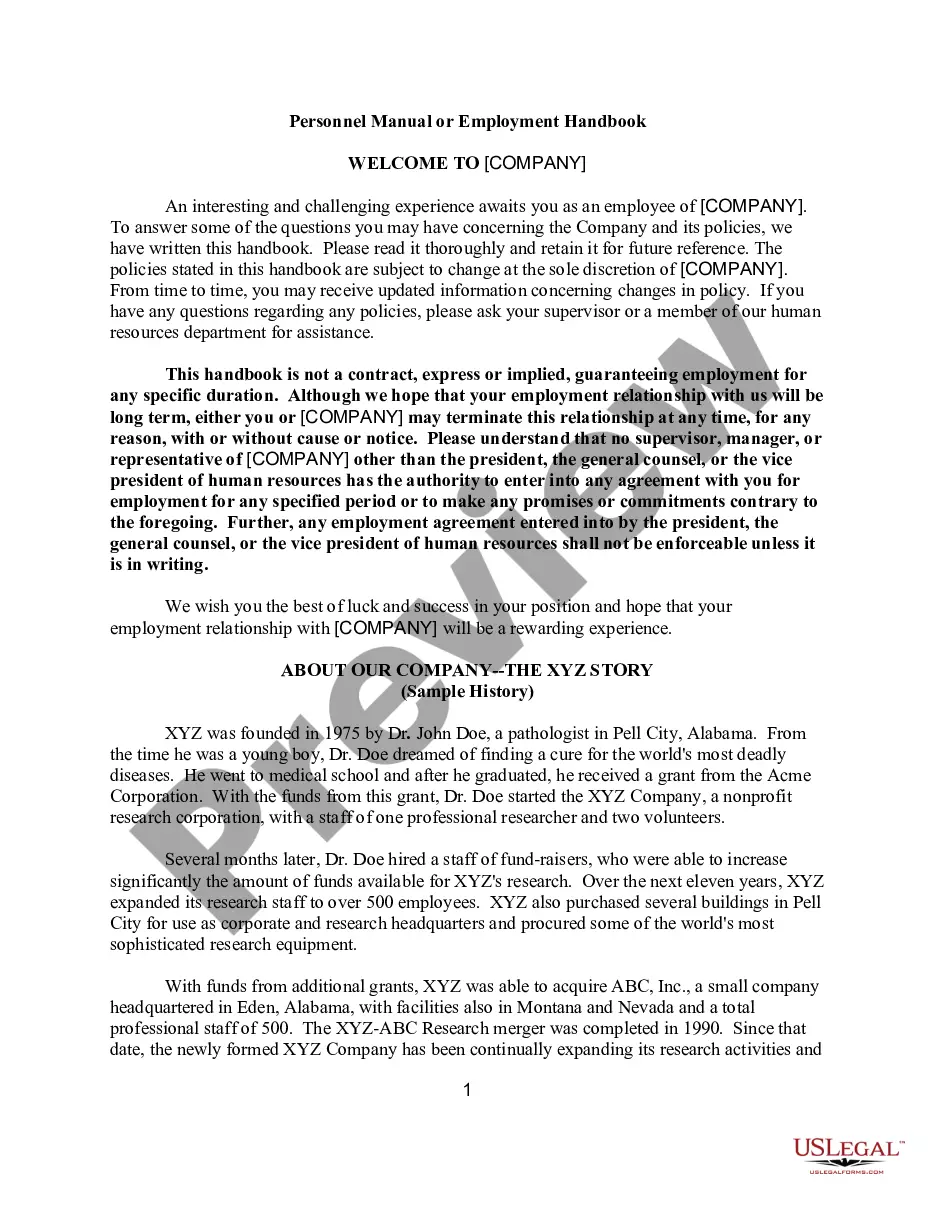
Introduces employees to your culture, mission and values. Communicates to employees what is expected of them. Educates employees about what they can expect from management and leadership. Helps ensure key company policies are clearly and consistently communicated.
Your company's history, mission, vision and goals. Your company's core values and culture. Human resources and legal information related to employment. Your company's policies. Employee benefits and perks.
Remember: people will read this. People will read the Acknowledgments section and it will impact themespecially the people who are in them. Start with a list of who will go in (by full name) Be specific for the important people. Be sincere in your thanks. Don't worry about length.
Use a company letterhead. Use electronic or paper letterhead. Write acknowledgment statement. Referring to the document by name, version number if applicable and state that the recipient has received the document. Sign and date. Explain the next step. Provide contact information.
Give Shout-Outs. Offer fun projects or professional/personal development opportunities. Take them to lunch. Distribute non-cash rewards. Loosen the reins. Throw a competition, party, or potluck. Encourage peer-to-peer recognition.
Unless the text of an employee handbook clearly indicates otherwise, an employee handbook can be considered a legally binding document between an employer and its employees.In most cases, courts consider an employee handbook to be an extension of the employee contract.
Refer to any previous conversations about the employment (if applicable). Express your acceptance of the job position given to you. Refer to the prior arrangements regarding your employment such as the terms and contract. Express your enthusiasm about the position.
Company culture, values, and a mission statement. Human resource and legal information as well as rights and obligations related to employment. Realistic expectations; both what the company expects to see from its employees and what employees can expect from the company.