Mutual Release of Obligations under Lease
Understanding this form
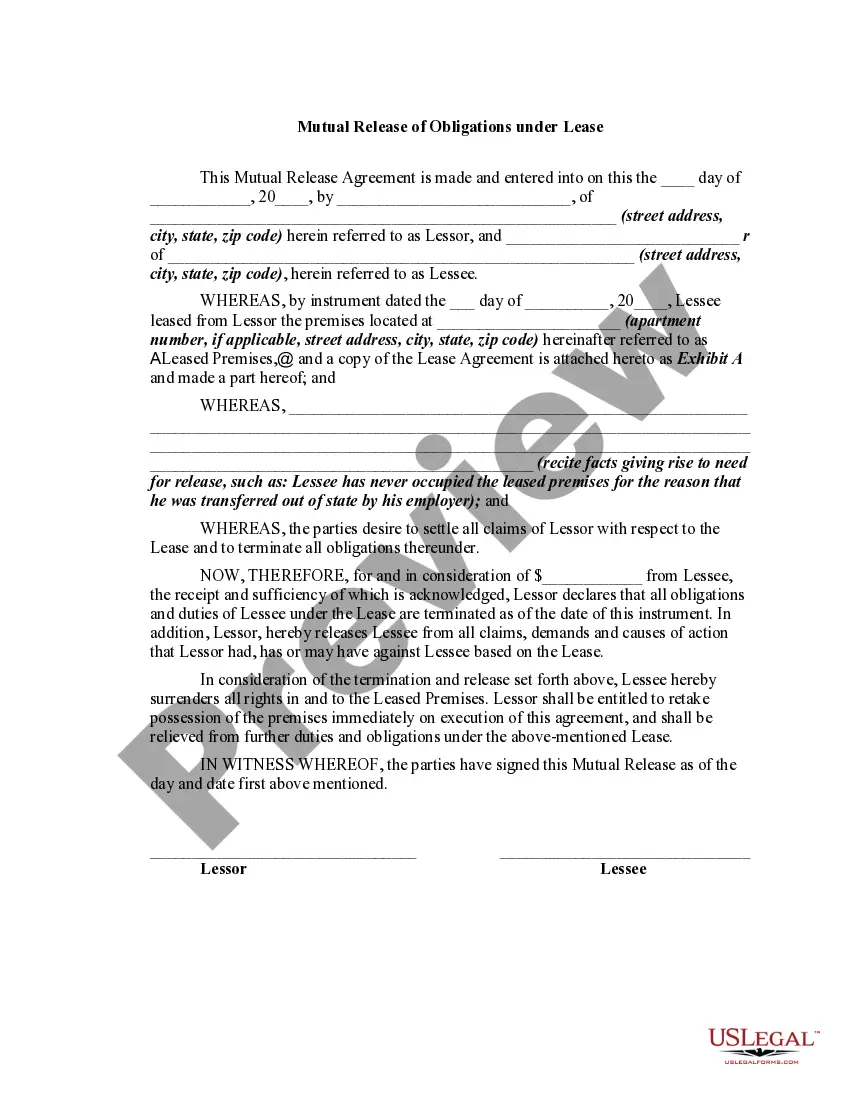
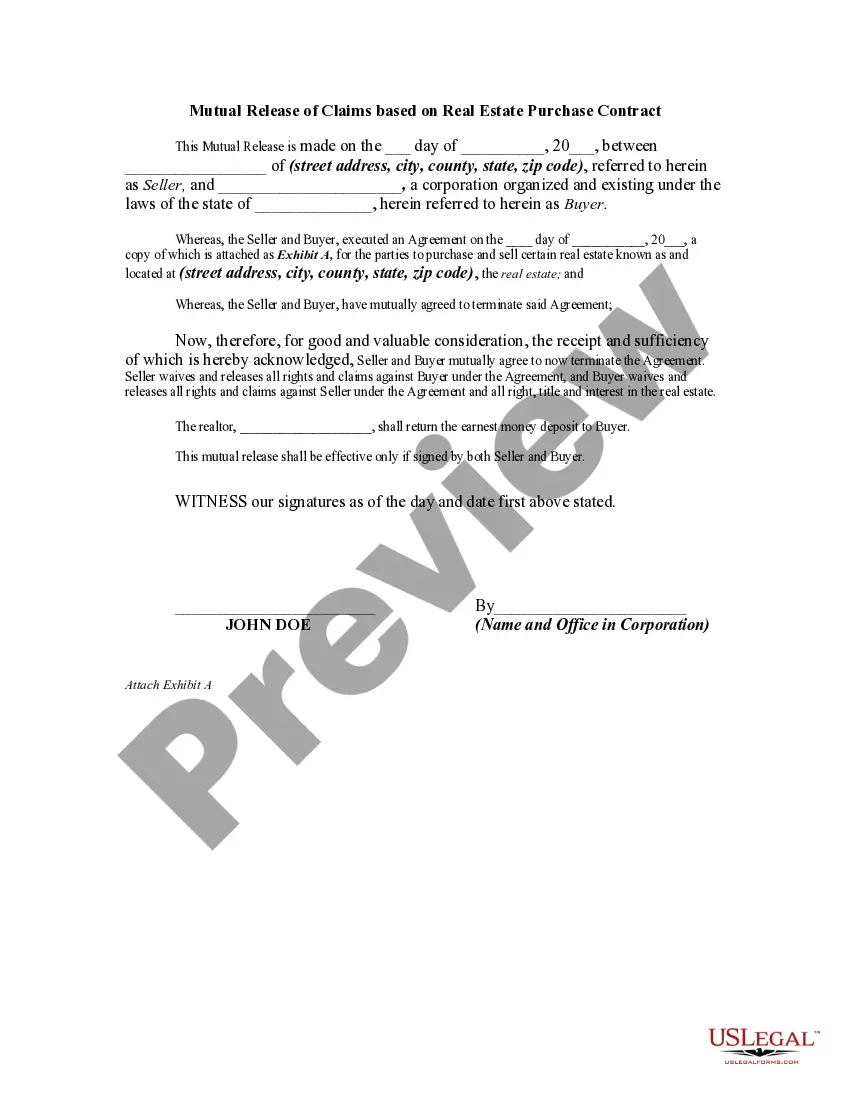
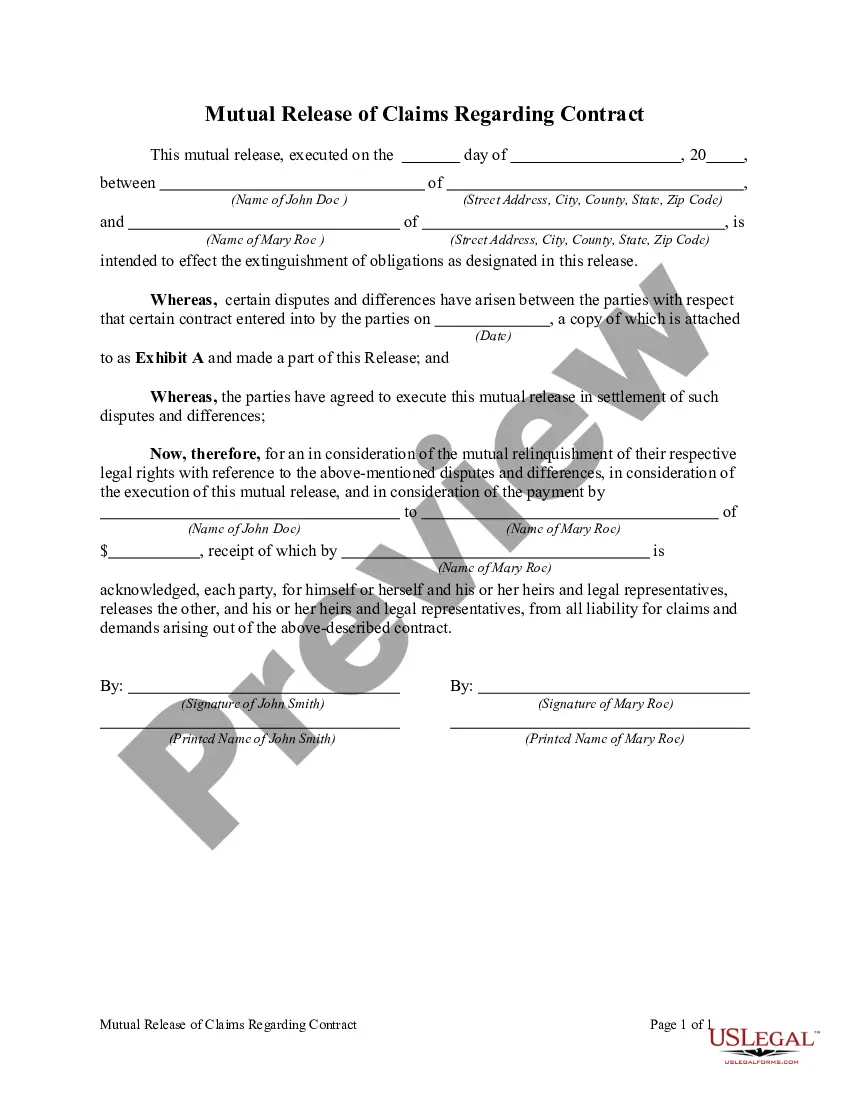
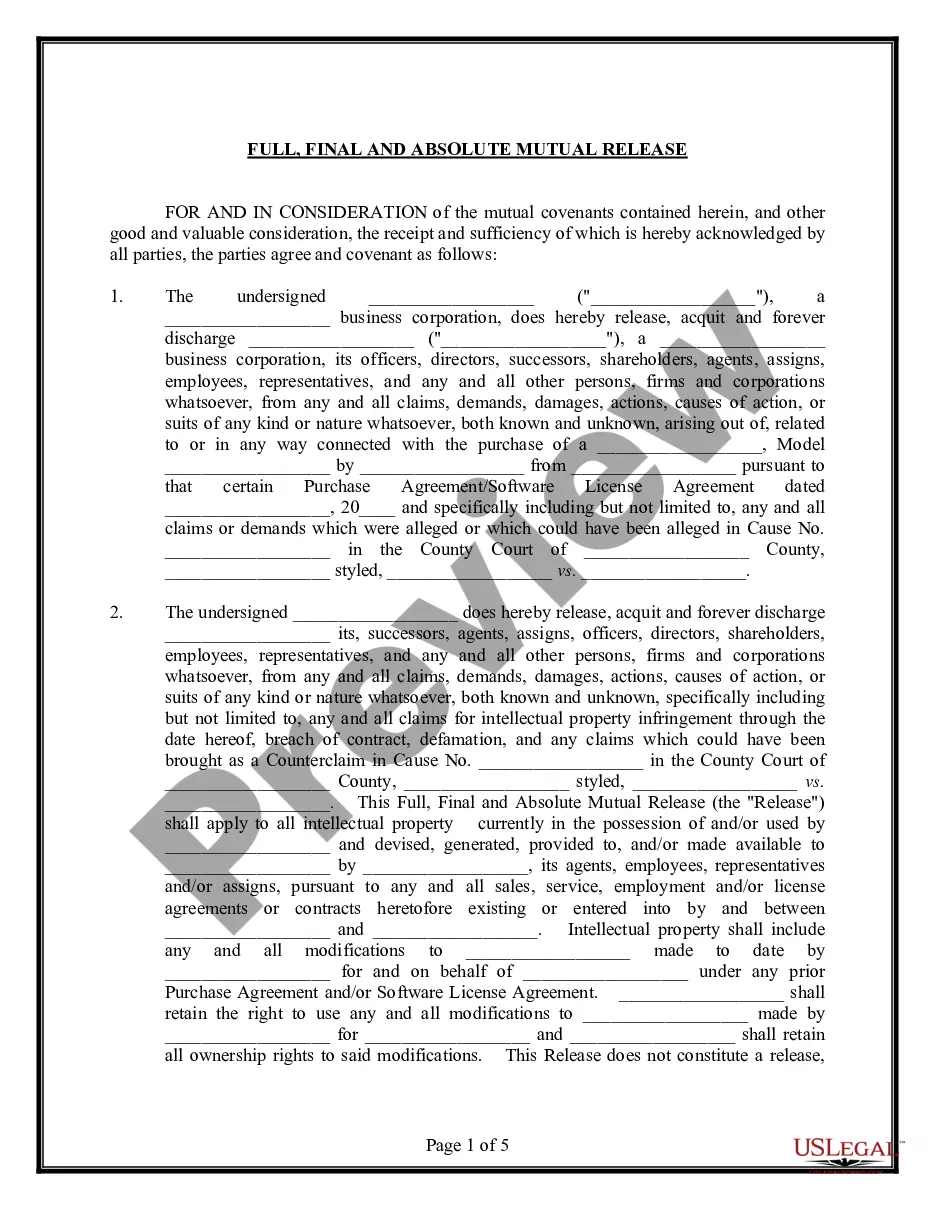
The Mutual Release of Obligations under Lease is a legal document that allows both the lessor (landlord) and lessee (tenant) to formally release each other from all obligations associated with a lease agreement. This form is particularly useful when the lessee is unable to fulfill their rental agreement, ensuring that the lessor can reclaim possession of the property immediately without further liabilities. Unlike other lease termination forms, this mutual release focuses on settling all claims between the parties simultaneously.
Main sections of this form
- Identification of the lessor and lessee, including their addresses.
- Description of the leased premises being released.
- Recitation of facts leading to the need for a mutual release.
- Effective date of termination of obligations under the lease.
- Mutual release of claims between both parties.
- Signature lines for both the lessor and lessee.
Common use cases
This form should be utilized when both the lessor and lessee agree to terminate a lease agreement before the lease term ends. Common scenarios include situations where the lessee has not occupied the leased premises due to relocation or other significant changes, and both parties wish to resolve their obligations amicably. Using this form ensures that neither party retains claims against the other after execution.
Who can use this document
- Landlords who wish to formally release tenants from rental obligations.
- Tenants who can no longer fulfill their lease terms and wish to terminate the agreement.
- Parties who agree to settle all claims related to the lease agreement.
Steps to complete this form
- Identify the parties involved by filling in the names and addresses of the lessor and lessee.
- Specify the leased premises, including the address.
- Describe the reasons for the mutual release in the designated section.
- Enter the consideration amount exchanged or any other terms agreed upon.
- Both parties should date and sign the document to finalize the mutual release.
Does this form need to be notarized?
This form usually doesn’t need to be notarized. However, local laws or specific transactions may require it. Our online notarization service, powered by Notarize, lets you complete it remotely through a secure video session, available 24/7.
Get your form ready online
Our built-in tools help you complete, sign, share, and store your documents in one place.
Make edits, fill in missing information, and update formatting in US Legal Forms—just like you would in MS Word.
Download a copy, print it, send it by email, or mail it via USPS—whatever works best for your next step.
Sign and collect signatures with our SignNow integration. Send to multiple recipients, set reminders, and more. Go Premium to unlock E-Sign.
If this form requires notarization, complete it online through a secure video call—no need to meet a notary in person or wait for an appointment.
We protect your documents and personal data by following strict security and privacy standards.

Make edits, fill in missing information, and update formatting in US Legal Forms—just like you would in MS Word.

Download a copy, print it, send it by email, or mail it via USPS—whatever works best for your next step.

Sign and collect signatures with our SignNow integration. Send to multiple recipients, set reminders, and more. Go Premium to unlock E-Sign.

If this form requires notarization, complete it online through a secure video call—no need to meet a notary in person or wait for an appointment.

We protect your documents and personal data by following strict security and privacy standards.
Common mistakes to avoid
- Failing to provide full names and addresses of both parties.
- Not specifying the leased premises clearly.
- Leaving out the effective date of the agreement.
- Forgetting to have both parties sign and date the document.
Benefits of completing this form online
- Instant download and access, allowing for immediate use.
- Editability enables customization to fit specific needs before printing.
- Created by licensed attorneys, ensuring legal reliability.
- User-friendly format for those with limited legal experience.
Legal use & context
- This form effectively terminates all obligations under the lease when properly executed.
- Both parties are released from future claims related to the lease upon signing this document.
- It serves to document the mutual agreement, providing legal protection to both parties.
Quick recap
- The Mutual Release of Obligations under Lease is crucial for ending lease responsibilities amicably.
- It helps prevent future disputes and clarifies the conclusion of the leasing relationship.
- Complete all sections carefully and ensure both parties sign the document.
- Consult local legal guidelines to ensure compliance and validity.
Looking for another form?
Form popularity
FAQ
In some circumstances, a tenant can break a fixed-term agreement early without penalty. A tenant can give 14 days' written notice to end an agreement early without penalty if: they have accepted an offer of social housing (e.g. from DCJ Housing)
Give the landlord/agent a written termination notice and vacate move out and return the keys according to your notice, and/or. apply to the NSW Civil & Administrative Tribunal (NCAT) for a termination order.
The lease release form (termination of lease obligation) is a legal document that by negotiation and financial settlement for monetary payment from the lessee to the lessor, discontinue the lease and both parties walk away from the previous agreement, held harmless from any further action.
Dear (Name of landlord or manager), This letter constitutes my written (number of days' notice that you need to give based on your lease agreement)-day notice that I will be moving out of my apartment on (date), the end of my current lease. I am leaving because (new job, rent increase, etc.)
Read your rental agreement. Talk to your landlord. Find a new renter. Consider termination offers. Be prepared to pay. Check with local tenants' unions. Get everything in writing. Seek legal advice.
Lease and release is literally the lease (tenancy) of non-tenanted property by its owner followed by a release (relinquishment) of the landlord's interest in the property. This sequence of transactions was commonly used to transfer full title to real estate under real property law.
Understand the potential penalties. The landlord tenant laws that allow you to break a lease are different from state to state. Check your lease. Talk to your landlord about breaking a lease. Offer to help find a new tenant. Consider subletting to avoid breaking a lease.
Dear Landlord, This letter will constitute written notice of my intention to vacate my apartment on date, the end of my current lease. I am doing so because explain the reason if you desire, such as a large increase in rent. Please recall that I made a security deposit of $______ on date.
Typically, California landlords charge a fee that's equal to one to two months' rent to end a lease early.