Contract or Agreement of Employment with Domestic Service Worker Who Lives and Works on the Premises
What this document covers
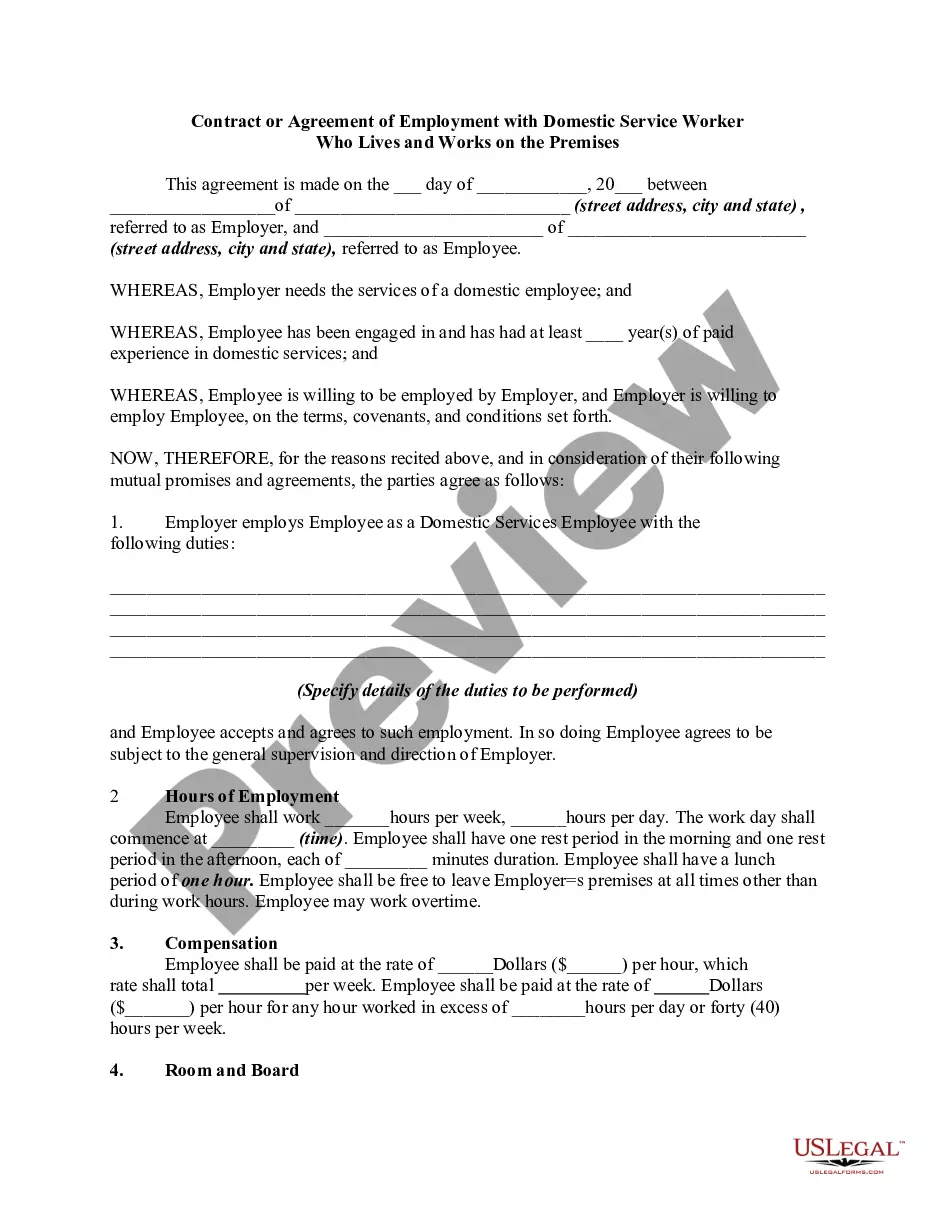
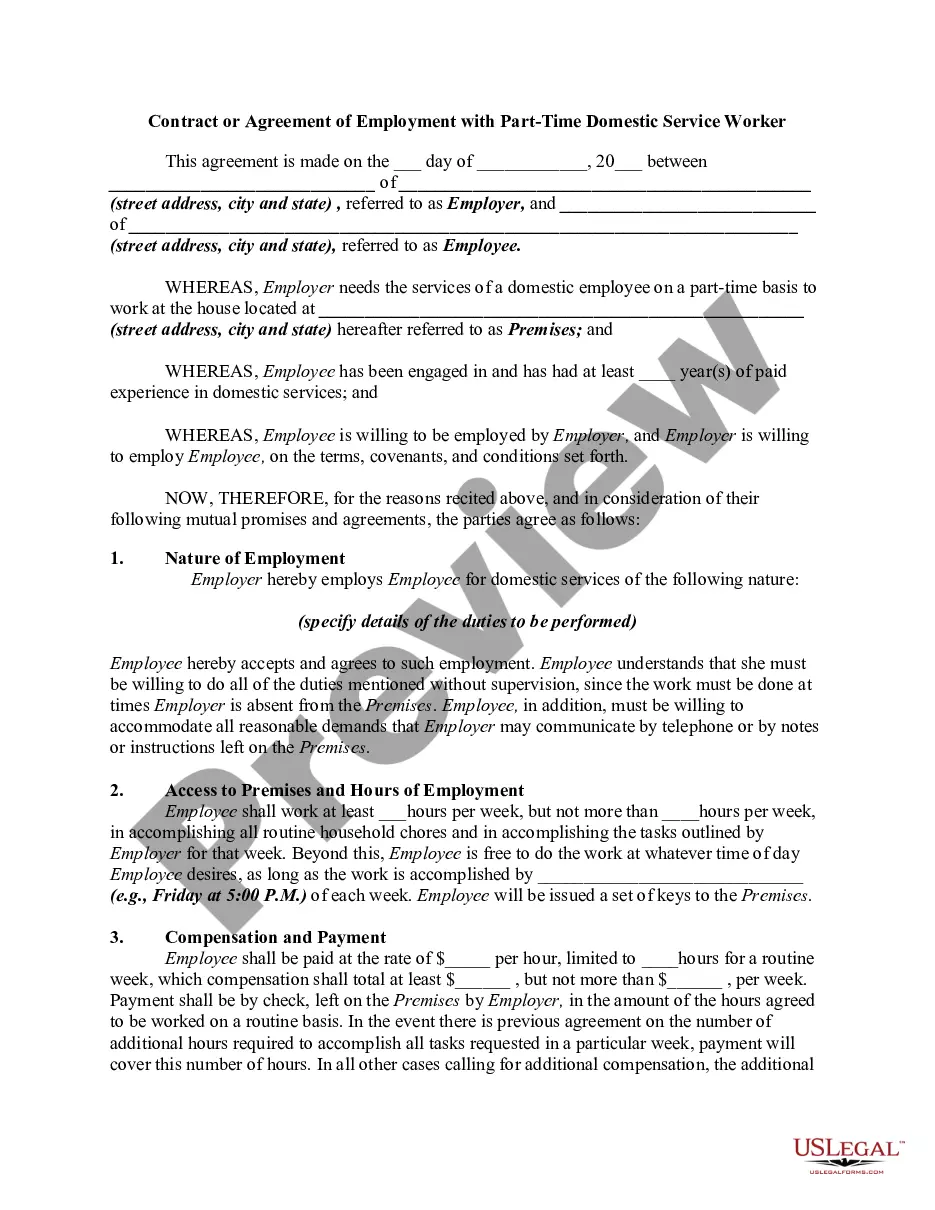
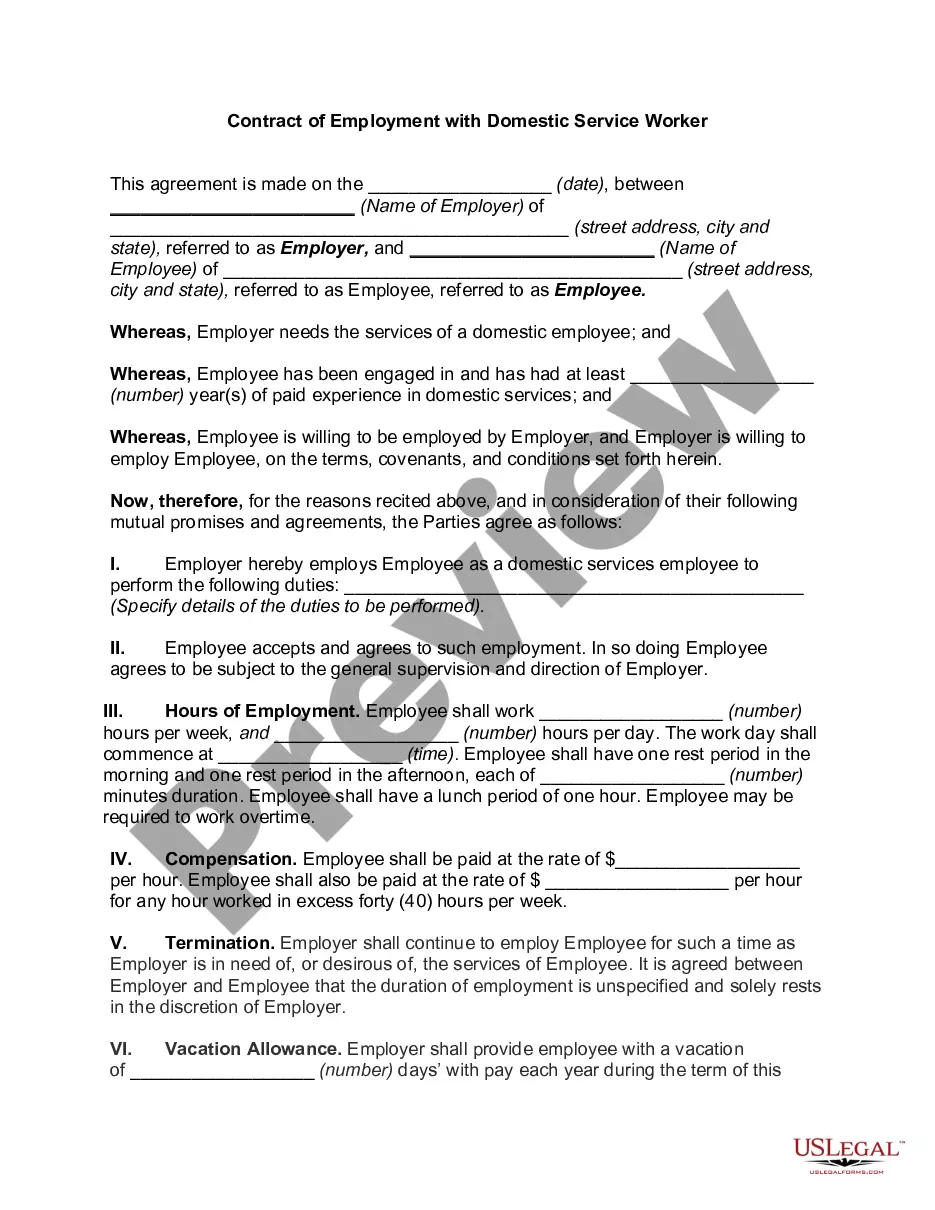
The Contract or Agreement of Employment with Domestic Service Worker Who Lives and Works on the Premises is a legal document that establishes the terms of employment between an employer and a domestic service worker who resides on the premises. This form sets out the rights and obligations of both parties, including job duties, working hours, compensation, and provisions for termination. It differs from other employment contracts by specifically addressing the living arrangements and unique conditions that apply to domestic workers living in the employer's residence.
What’s included in this form
- Identification of the employer and employee, including addresses.
- Details of the domestic services to be performed by the employee.
- Specifications of working hours, including breaks and overtime.
- Compensation details, including hourly rates and payment schedules.
- Room and board provisions provided to the employee.
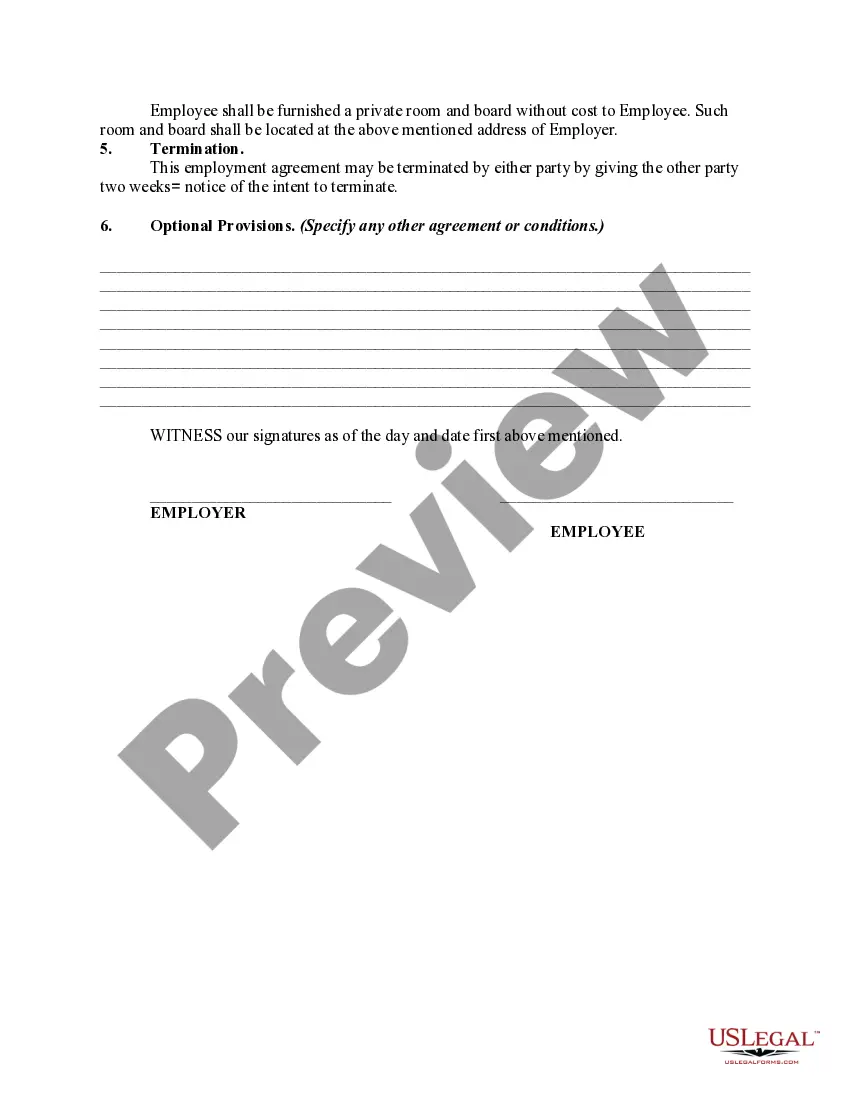
- Termination clauses, outlining notification requirements for ending the employment.
- Optional provisions for additional agreements.
When to use this document
This form should be used when hiring a domestic service worker who will live and work in your home. It is applicable in situations such as employing a housekeeper, caregiver, or nanny. The contract ensures that both the employer and the employee understand their rights and responsibilities, protecting both parties in the event of a dispute.
Who can use this document
- Homeowners or tenants seeking domestic help.
- Employers who wish to formalize the employment relationship with their domestic service worker.
- Individuals who require clarity on the terms of employment to prevent misunderstandings.
- Employees looking for a clear outline of their job duties and compensation.
Completing this form step by step
- Identify the parties involved by entering the names and addresses of both the employer and the employee.
- Specify the duties the employee will perform in the designated section of the contract.
- Enter the total hours the employee is expected to work per week and per day, including times for breaks.
- Fill in the compensation details, including hourly rates and payment methods.
- Describe the room and board arrangements provided to the employee.
- Complete the termination notice terms to establish how much notice is required if either party wishes to end the agreement.
Does this form need to be notarized?
This form usually doesn’t need to be notarized. However, local laws or specific transactions may require it. Our online notarization service, powered by Notarize, lets you complete it remotely through a secure video session, available 24/7.
Get your form ready online
Our built-in tools help you complete, sign, share, and store your documents in one place.
Make edits, fill in missing information, and update formatting in US Legal Forms—just like you would in MS Word.
Download a copy, print it, send it by email, or mail it via USPS—whatever works best for your next step.
Sign and collect signatures with our SignNow integration. Send to multiple recipients, set reminders, and more. Go Premium to unlock E-Sign.
If this form requires notarization, complete it online through a secure video call—no need to meet a notary in person or wait for an appointment.
We protect your documents and personal data by following strict security and privacy standards.

Make edits, fill in missing information, and update formatting in US Legal Forms—just like you would in MS Word.

Download a copy, print it, send it by email, or mail it via USPS—whatever works best for your next step.

Sign and collect signatures with our SignNow integration. Send to multiple recipients, set reminders, and more. Go Premium to unlock E-Sign.

If this form requires notarization, complete it online through a secure video call—no need to meet a notary in person or wait for an appointment.

We protect your documents and personal data by following strict security and privacy standards.
Common mistakes to avoid
- Failing to specify job duties clearly, which can lead to misunderstandings.
- Leaving out compensation details, including overtime pay rates.
- Not including provisions for termination, causing potential legal issues.
- Neglecting to update the contract if any changes occur in duties or working conditions.
Benefits of completing this form online
- Convenient access to the form for instant download and completion.
- Easy to edit and customize the document to fit your specific needs.
- Reliable templates drafted by licensed attorneys, ensuring legal adequacy.
- Time-saving option compared to traditional legal consultations.
Looking for another form?
Form popularity
FAQ
09 an hourThe National Minimum Wage Act that came into effect at the beginning of 2019 and is updated annually says domestic workers must earn a minimum wage of R19. 09 an hour from 1 March 2021. This is a basic wage so you cannot deduct any allowances from it such as accommodation, transport and food.
Title the employment contract. Give your employment contract a title so the person who reviews or signs the document understands what it is. Identify the parties. List the term and conditions. Outline the job responsibilities. Include compensation details. Use specific contract terms. Consult with an employment lawyer.
Paying your nanny a salary is against the law as they are a non-exempt employee who needs to be paid at least time and a half for overtime. The short answer is no. You can't pay your nanny a pre-set, flat-salaried amount for all hours worked in a week.
A. Live-in domestic service workers who reside in the employer's home and are employed solely by an individual, family, or household are exempt from overtime pay, although they must be paid at least the federal minimum wage for all hours worked.
09 an hourThe National Minimum Wage Act that came into effect at the beginning of 2019 and is updated annually says domestic workers must earn a minimum wage of R19. 09 an hour from 1 March 2021. This is a basic wage so you cannot deduct any allowances from it such as accommodation, transport and food.
Remember, domestic employment by definition is non-exempt employment. This means you cannot offer a salary that covers any number of work hours, but must pay overtime for hours worked above 40 in a week.
The low levels of remuneration among domestic workers is the result of a range of factors, including a large labour supply, undervaluation of domestic work and its contribution to society, the low bargaining power of domestic workers, the lack of representation in the sector, and frequent exclusion from labour
As of March 2020, the minimum wage for domestic workers is at 75% of the base R15. 57 per hour. Under the new proposals, a bump up to 88% of the 2021 base would make the new minimum for domestic workers R19. 09 per hour a monetary increase of 23%.
A. Live-in domestic service workers who reside in the employer's home and are employed solely by an individual, family, or household are exempt from overtime pay, although they must be paid at least the federal minimum wage for all hours worked.