Complaint for Violation of Civil Rights and for Wrongful Discharge and Failure To Rehire - 1st, 14th Amendments, US Constitution - Jury Trial Demand
What is this form?
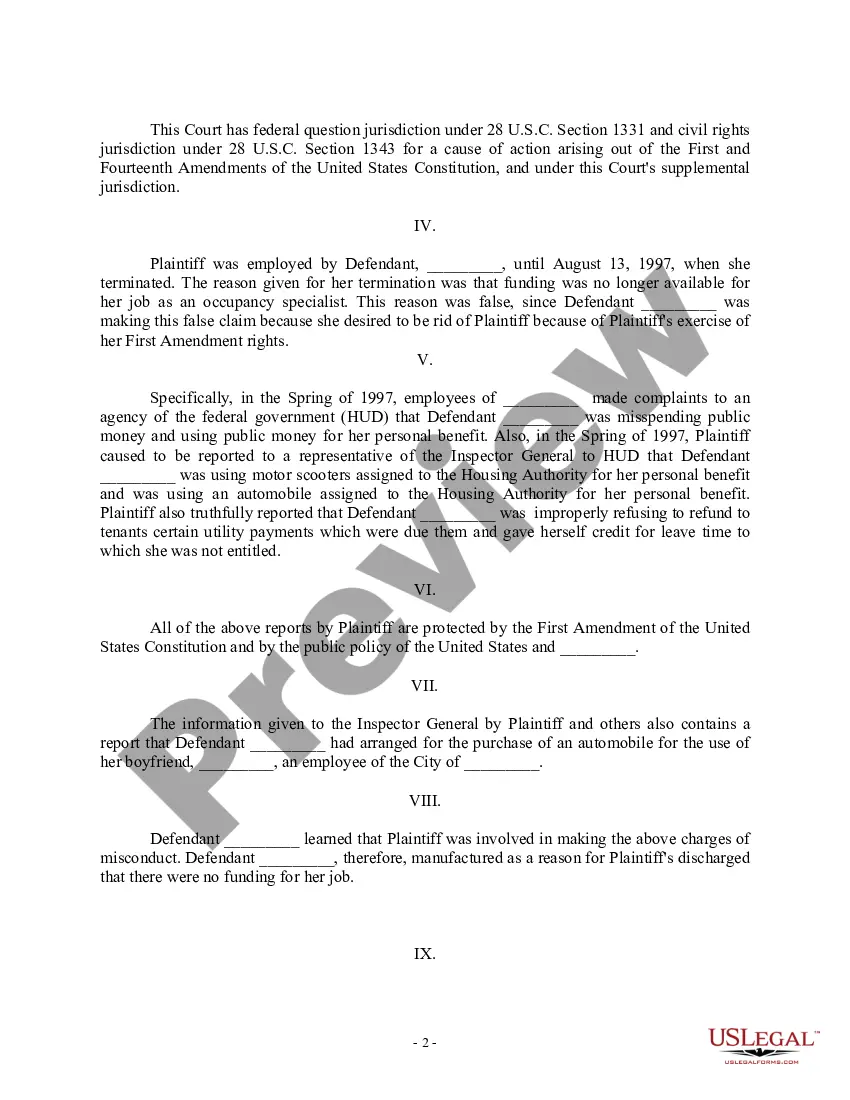
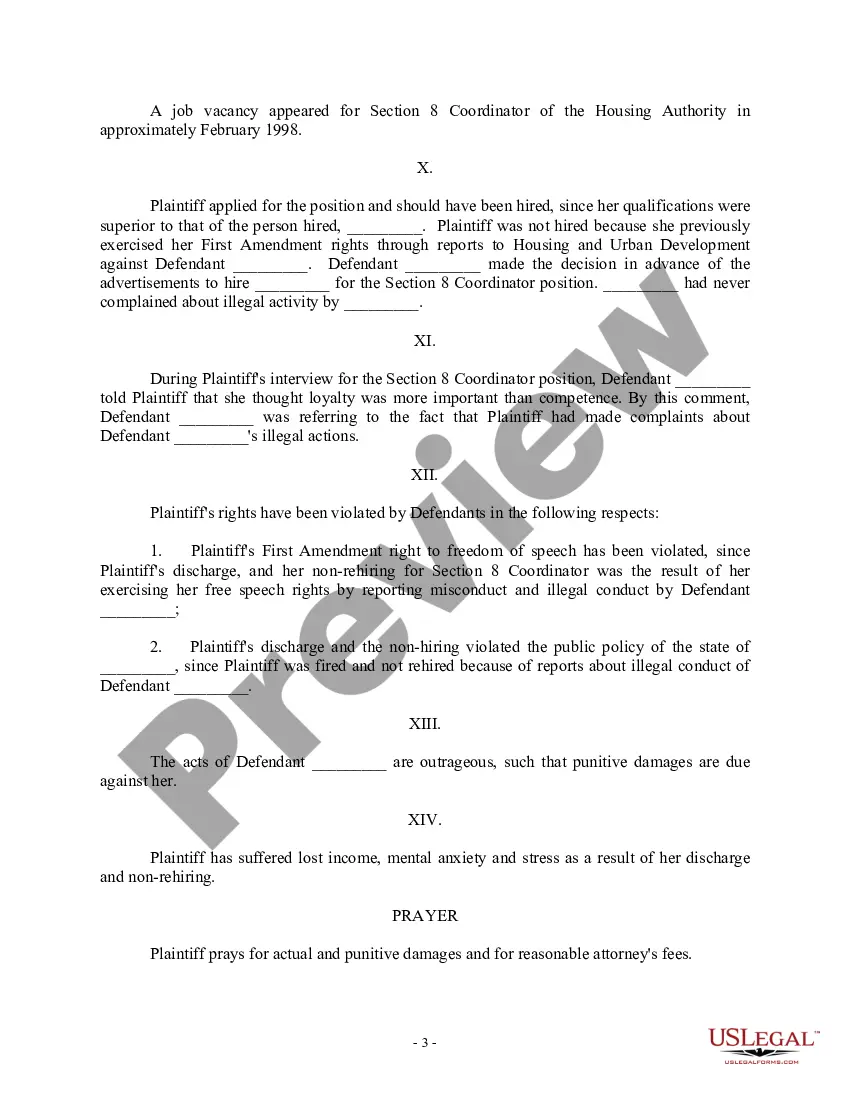
This form is a Complaint for Violation of Civil Rights and for Wrongful Discharge. It is specifically designed to address violations of the First and Fourteenth Amendments of the United States Constitution. This Complaint allows a plaintiff to file a lawsuit seeking damages for wrongful termination and failure to rehire, particularly when the actions relate to the exercise of free speech or other protected rights. Unlike other employment-related forms, this Complaint emphasizes constitutional violations and is typically prepared for civil rights litigation in federal or state court.
What’s included in this form
- Identification of the plaintiff and defendant.
- Statement of jurisdictional basis, including references to federal laws.
- Chronology of events leading to the wrongful discharge and failure to rehire.
- Allegations linking the defendant's actions to violations of constitutional rights.
- Claims for actual and punitive damages, as well as attorney's fees.
- Demand for a jury trial.





Common use cases
This form should be used by individuals who believe that they have been wrongfully discharged from their employment or not rehired due to exercising their rights under the First Amendment. Typical scenarios include cases where an employee has reported illegal activities, expressed free speech on public matters, or engaged in whistleblowing activities that led to retaliation by their employer.
Who can use this document
- Individuals who have been employed by a public entity or organization.
- Persons who suspect they were terminated or not rehired due to constitutionally protected activities.
- Individuals seeking to claim punitive damages against the employer.
- Those who wish to pursue legal action to recover lost income and other damages related to wrongful discharge.
Steps to complete this form
- Identify the plaintiff and provide their complete address.
- List the defendants, including their titles and addresses.
- Describe the events leading to the claims, ensuring to include dates and specific incidents.
- Clearly state the constitutional rights that have been violated and provide supportive details.
- Indicate the relief sought, including actual and punitive damages.
- Sign and date the Complaint to validate the filing.
Does this form need to be notarized?
This form does not typically require notarization unless specified by local law. It is advisable to check with local court rules to confirm if notarization is necessary for your specific case.
Get your form ready online
Our built-in tools help you complete, sign, share, and store your documents in one place.
Make edits, fill in missing information, and update formatting in US Legal Forms—just like you would in MS Word.
Download a copy, print it, send it by email, or mail it via USPS—whatever works best for your next step.
Sign and collect signatures with our SignNow integration. Send to multiple recipients, set reminders, and more. Go Premium to unlock E-Sign.
If this form requires notarization, complete it online through a secure video call—no need to meet a notary in person or wait for an appointment.
We protect your documents and personal data by following strict security and privacy standards.

Make edits, fill in missing information, and update formatting in US Legal Forms—just like you would in MS Word.

Download a copy, print it, send it by email, or mail it via USPS—whatever works best for your next step.

Sign and collect signatures with our SignNow integration. Send to multiple recipients, set reminders, and more. Go Premium to unlock E-Sign.

If this form requires notarization, complete it online through a secure video call—no need to meet a notary in person or wait for an appointment.

We protect your documents and personal data by following strict security and privacy standards.
Common mistakes
- Failing to provide complete and accurate information about the parties involved.
- Not clearly linking the allegations to the constitutional violations claimed.
- Omitting relevant details that support the claims of wrongful discharge.
- Neglecting to review state-specific statutes that may apply to the case.
Benefits of using this form online
- Convenience of downloading and editing the form at your pace.
- Access to templates created by licensed attorneys to ensure legal compliance.
- Easy tracking and storage of your legal documents.
Legal use & context
- This form is designed to address violations of civil rights in the workplace specifically related to wrongful discharge.
- It is important to assert claims within the statute of limitations applicable in your state, as delays can affect your ability to file.
- Using the correct legal terminology and accurately representing facts is crucial for the enforceability of your complaint.
Main things to remember
- This Complaint for Violation of Civil Rights serves to seek justice and compensation for wrongful termination based on constitutional rights.
- It is essential to document all relevant incidents and provide clear evidence of discrimination or retaliation.
- Understanding your rights and how to assert them through the legal system is critical for successful outcomes in civil rights cases.
Looking for another form?
Form popularity
FAQ
No Person shall be a Senator or Representative in Congress, or elector of President and Vice-President, or hold any office, civil or military, under the United States, or under any State, who, having previously taken an oath, as a member of Congress, or as an officer of the United States, or as a member of any State
Amendment XIV, Section 3 prohibits any person who had gone to war against the union or given aid and comfort to the nation's enemies from running for federal or state office, unless Congress by a two-thirds vote specifically permitted it.
No State shall make or enforce any law which shall abridge the privileges or immunities of citizens of the United States; nor shall any State deprive any person of life, liberty, or property, without due process of law; nor deny to any person within its jurisdiction the equal protection of the laws.
Passed by the Senate on June 8, 1866, and ratified two years later, on July 9, 1868, the Fourteenth Amendment granted citizenship to all persons "born or naturalized in the United States," including formerly enslaved people, and provided all citizens with equal protection under the laws, extending the provisions of
The 14th Amendment to the U.S. Constitution, ratified in 1868, granted citizenship to all persons born or naturalized in the United Statesincluding former enslaved peopleand guaranteed all citizens equal protection of the laws. One of three amendments passed during the Reconstruction era to abolish slavery and
The 14th Amendment to the U.S. Constitution, ratified in 1868, granted citizenship to all persons born or naturalized in the United Statesincluding former enslaved peopleand guaranteed all citizens equal protection of the laws. One of three amendments passed during the Reconstruction era to abolish slavery and
The 14th Amendment contained three major provisions: The Citizenship Clause granted citizenship to All persons born or naturalized in the United States. The Due Process Clause declared that states may not deny any person "life, liberty or property, without due process of law."
The Constitution confers on the U.S. Senate legislative, executive, and judicial powers.Finally, Article I, Section 3 also gives the Senate the exclusive judicial power to try all cases of impeachment of the President, the Vice President, or any other civil officer of the United States.