Texas Warranty Deed from Husband and Wife to Corporation
Overview of this form
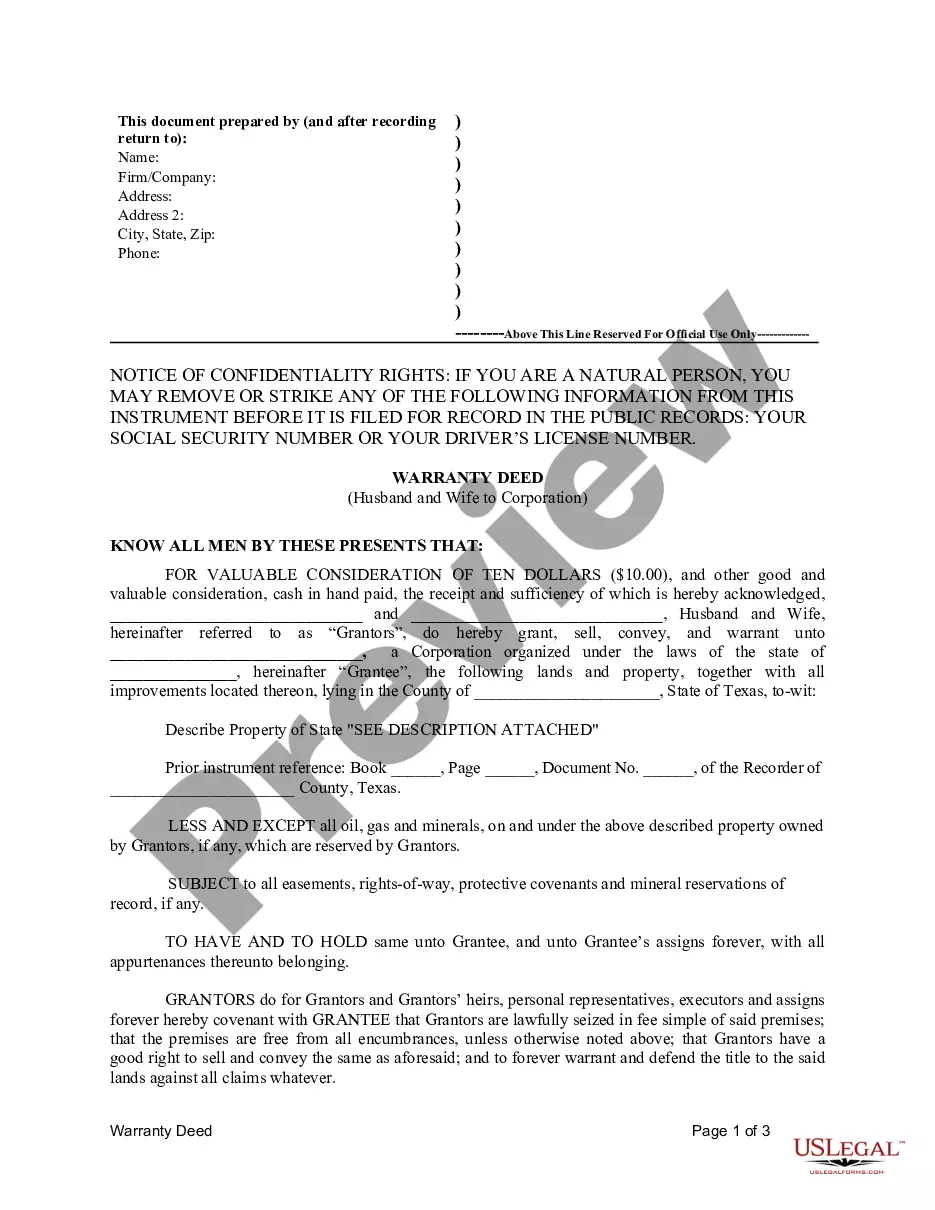
This Warranty Deed from Husband and Wife to Corporation is a legal document that allows a married couple to transfer property ownership to a corporation. This deed ensures that the grantors (husband and wife) are conveying their property while reserving any rights to oil, gas, and minerals beneath the land. This form is essential for property owners looking to formalize a transfer of real estate to a business entity.
Main sections of this form
- Identifies the grantors (husband and wife) and grantee (a corporation).
- Describes the property being conveyed.
- Includes a clause reserving rights to oil, gas, and minerals.
- States the lack of encumbrances on the property.
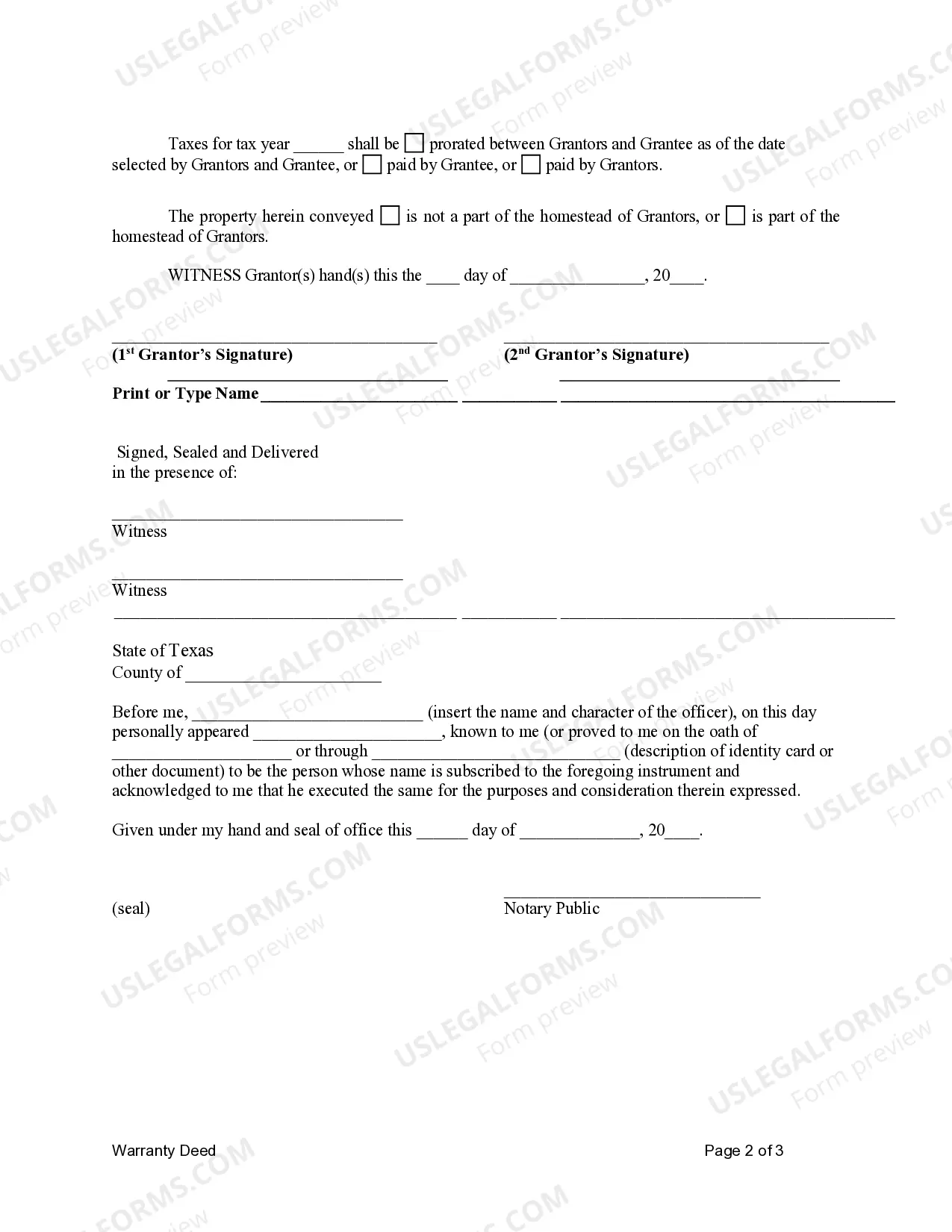
- Specifies the tax arrangements for the property transfer.
- Includes a witness and notary section for legal validity.




When this form is needed
This form should be used when a married couple wishes to transfer ownership of their property to a corporation, whether for business purposes, asset protection, or estate planning. It is necessary to legally document this transfer to ensure all parties have clear evidence of the ownership change and to protect against potential future claims.
Who should use this form
This form is intended for:
- Married couples wishing to transfer property to a corporation.
- Corporations acquiring real estate from individual owners.
- Individuals involved in property transactions that require formal documentation.
Completing this form step by step
- Identify and fill in the names of the grantors (husband and wife).
- Specify the name and legal structure of the corporation receiving the property.
- Describe the property clearly, ensuring to attach any necessary legal descriptions.
- Complete the sections on tax liabilities and easements as applicable.
- Sign the document in front of a witness and a notary public.
Does this form need to be notarized?
Yes, this form must be notarized to be legally valid. US Legal Forms offers integrated online notarization services, making it easy to complete the notarization process via secure video calls, ensuring reliability and compliance with legal standards.
Get your form ready online
Our built-in tools help you complete, sign, share, and store your documents in one place.
Make edits, fill in missing information, and update formatting in US Legal Forms—just like you would in MS Word.
Download a copy, print it, send it by email, or mail it via USPS—whatever works best for your next step.
Sign and collect signatures with our SignNow integration. Send to multiple recipients, set reminders, and more. Go Premium to unlock E-Sign.
If this form requires notarization, complete it online through a secure video call—no need to meet a notary in person or wait for an appointment.
We protect your documents and personal data by following strict security and privacy standards.

Make edits, fill in missing information, and update formatting in US Legal Forms—just like you would in MS Word.

Download a copy, print it, send it by email, or mail it via USPS—whatever works best for your next step.

Sign and collect signatures with our SignNow integration. Send to multiple recipients, set reminders, and more. Go Premium to unlock E-Sign.

If this form requires notarization, complete it online through a secure video call—no need to meet a notary in person or wait for an appointment.

We protect your documents and personal data by following strict security and privacy standards.
Common mistakes to avoid
- Failing to include a complete legal description of the property.
- Not reserving mineral rights if applicable.
- Inaccurate or incomplete witness and notary signatures.
- Leaving tax liability sections blank or incorrectly filled out.
Why use this form online
- Convenient access to legally vetted templates that save time.
- Editability to customize the form as per your specific needs.
- Reliable and secure downloading that ensures privacy.
Quick recap
- This Warranty Deed specifically allows a married couple to transfer property ownership to a corporation.
- It includes crucial legal protections and specifications regarding property rights.
- Ensure accurate completion and notarization to avoid any legal issues.
Looking for another form?
Form popularity
FAQ
Unlike most states Texas does not automatically recognize joint tenancies as having a right of survivorship. Instead the parties must agree, in writing, to include a right of survivorship.
Adding someone to your house deed requires the filing of a legal form known as a quitclaim deed. When executed and notarized, the quitclaim deed legally overrides the current deed to your home. By filing the quitclaim deed, you can add someone to the title of your home, in effect transferring a share of ownership.
Find the most recent deed to the property. It is best to begin with a copy of the most recent deed to the property (the deed that transferred the property to the current grantor). Create a new deed. Sign and notarize the deed. File the documents in the county land records.
In Texas, a married couple can agree in writing that all or part of their community property will go to the surviving spouse when one person dies. This is called a right of survivorship agreement. The right of survivorship agreement must be filed with the county court records where the couple lives.
Texas law allows you to completely cut your spouse out of your will, but only with regard to those assets you control, considered yours to devise in your will.
If you've recently married and already own a home or other real estate, you may want to add your new spouse to the deed for your property so the two of you own it jointly. To add a spouse to a deed, all you have to do is literally fill out, sign and record a new deed in your county recorder's office.
If you die without a Will, you are said to have died intestate. When someone dies intestate, Texas law lays out how the estate will be distributed in the Texas Probate Code.In the second common scenario, someone dies without a spouse but is survived by each of the children born to him or her during life.
On its face, an interspousal transfer grant deed or quitclaim deed between spouses involves one spouse foregoing or waiving any future interest he or she may have in the residence.
The laws in Texas surrounding intestate wills for married individuals without children are much simpler. The surviving spouse automatically receives all community property.If there are no surviving parents, siblings or descendants of siblings, the spouse gets the remainder of the estate's separate real property.