Tennessee Warranty Deed from Individual to a Trust

Overview of this form
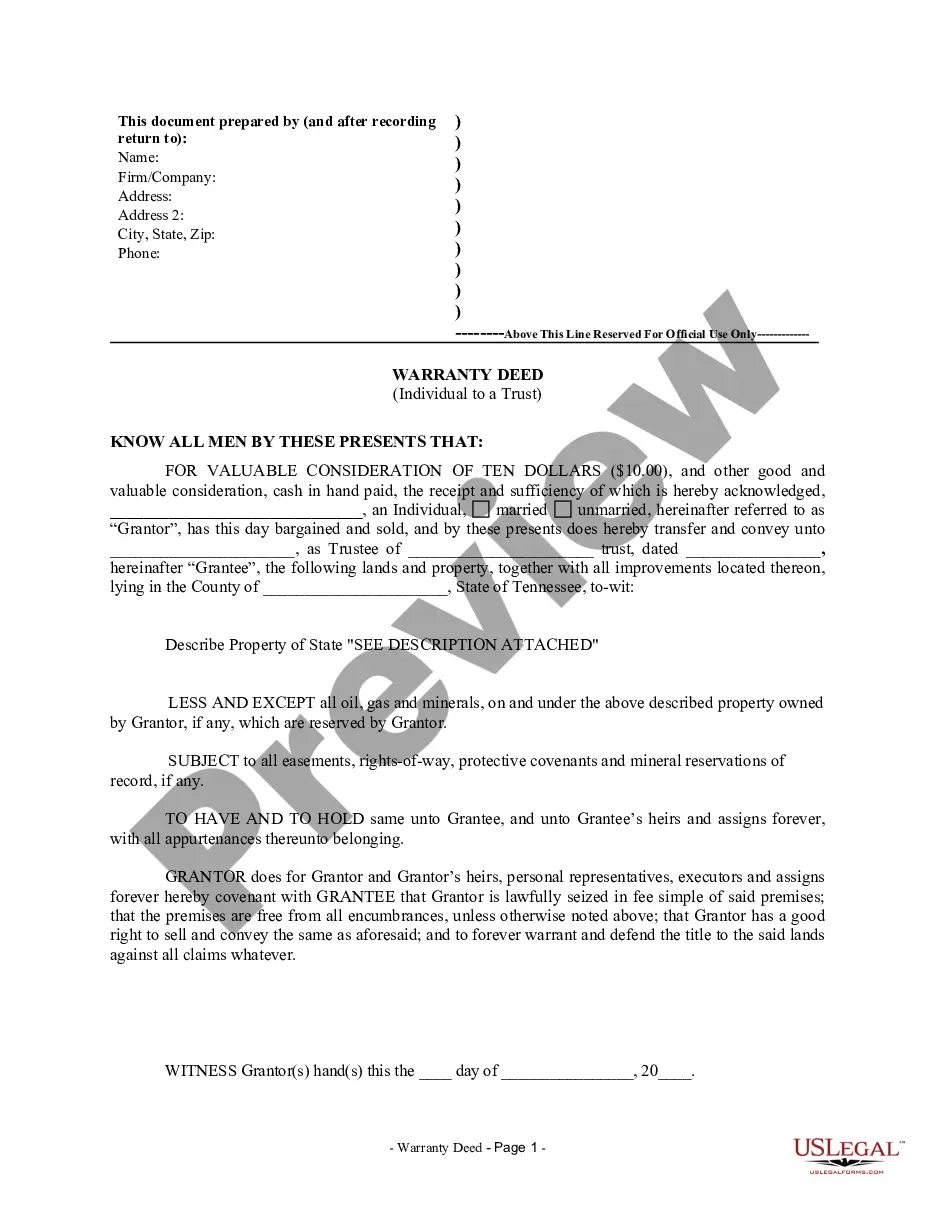
A Warranty Deed from Individual to a Trust is a legal document that facilitates the transfer of property ownership from an individual (the grantor) to a trust (the grantee). This form ensures that the grantor effectively conveys their property, while also reserving rights to any oil, gas, or minerals underneath. Unlike other deed types, this document specifically involves trusts, which are often used for estate planning purposes. It complies with the relevant state laws to provide a secure and legally enforceable transfer of ownership.
Form components explained
- Identification of the grantor (individual transferring property) and the grantee (trust receiving property).
- Description of the property being transferred.
- Reservation clause for oil, gas, and minerals, indicating that these rights remain with the grantor.
- Covenant ensuring that the grantor has the legal right to transfer the property and that it is free from encumbrances, unless otherwise stated.
- Signature fields for the grantor and for notarization purposes.







Situations where this form applies
This Warranty Deed should be used when an individual wants to transfer their property into a trust for purposes such as estate planning or asset protection. It's especially important when the grantor wishes to keep the management and benefits of the property within a structured trust arrangement while also protecting specific rights, like mineral claims. Using this form ensures that the transfer meets legal requirements and is executed properly.
Who this form is for
This form is intended for:
- Individuals looking to transfer real property into a trust.
- Trustees or beneficiaries managing assets in a trust.
- Those involved in estate planning or asset protection strategies.
Steps to complete this form
- Identify the grantor (individual) and the grantee (trust) by providing their full names.
- Describe the property being transferred clearly, referencing any attached descriptions.
- Specify any reservations regarding oil, gas, or mineral rights that the grantor wishes to retain.
- Sign and date the form in front of a notary public to validate the deed.
- Complete any additional notarization requirements as specified on the form.
Is notarization required?
Yes, this form must be notarized to be legally valid. Having a notary public verify the identities of the parties involved provides an additional layer of security and authenticity, helping to prevent fraud. US Legal Forms offers integrated online notarization services for your convenience, allowing you to complete the process securely from home.
Get your form ready online
Our built-in tools help you complete, sign, share, and store your documents in one place.
Make edits, fill in missing information, and update formatting in US Legal Forms—just like you would in MS Word.
Download a copy, print it, send it by email, or mail it via USPS—whatever works best for your next step.
Sign and collect signatures with our SignNow integration. Send to multiple recipients, set reminders, and more. Go Premium to unlock E-Sign.
If this form requires notarization, complete it online through a secure video call—no need to meet a notary in person or wait for an appointment.
We protect your documents and personal data by following strict security and privacy standards.

Make edits, fill in missing information, and update formatting in US Legal Forms—just like you would in MS Word.

Download a copy, print it, send it by email, or mail it via USPS—whatever works best for your next step.

Sign and collect signatures with our SignNow integration. Send to multiple recipients, set reminders, and more. Go Premium to unlock E-Sign.

If this form requires notarization, complete it online through a secure video call—no need to meet a notary in person or wait for an appointment.

We protect your documents and personal data by following strict security and privacy standards.
Typical mistakes to avoid
- Failing to include a complete and accurate property description.
- Not reserving specific rights, such as mineral rights, when applicable.
- Not having the deed notarized, which can invalidate the document in some states.
- Using outdated forms that do not comply with current legal standards.
Advantages of online completion
- Convenience of downloading and completing the form at your own pace.
- Editable fields allow for easy customization based on your specific needs.
- Access to templates drafted by licensed attorneys, ensuring legal compliance.
Looking for another form?

Form popularity
FAQ
A warranty deed protects property owners from future claims that someone else actually owns a portion (or all) of their property, while trustee deeds protect lenders when borrowers default on their mortgage loans.
How To Establish A Trust. You will need to retain an estate attorney to draft and execute your trust document. For a simple revocable or irrevocable trust, it may cost anywhere from $2,000 $5,000.
Take the signed and notarized quitclaim deed to your county recorder's office to complete the transfer of title into your revocable trust. Check in two to four weeks to ensure it has been recorded. Include the address of the property on the asset list addendum attached to your trust.
Obtain a California grant deed from a local office supply store or your county recorder's office. Complete the top line of the deed. Indicate the grantee on the second line. Enter the trustees' names and addresses.
A trustee deed offers no such warranties about the title.
The advantages of placing your house in a trust include avoiding probate court, saving on estate taxes and possibly protecting your home from certain creditors. Disadvantages include the cost of creating the trust and the paperwork.
To transfer real estate (also called real property) into your living trust, you must prepare and sign a new deed, transferring ownership. You can usually fill out a new deed yourself.
Determine the Current Title and Vesting to Your Property. Prepare a Deed. Be Aware of Your Lender and Title Insurance. Prepare a Preliminary Change of Ownership Report. Execute Your Deed. Record Your Deed. Wait for the Deed to be Returned. Keep the Property in the Trust.
In the context of a California mortgage transaction, a trust deed also transfer ownership. Only this time, the title is being placed in the hands of a third-party trustee, who holds the property on behalf of the lender and the homeowner-borrower until the mortgage is paid.