South Carolina Location Notice - Individual
Overview of this form
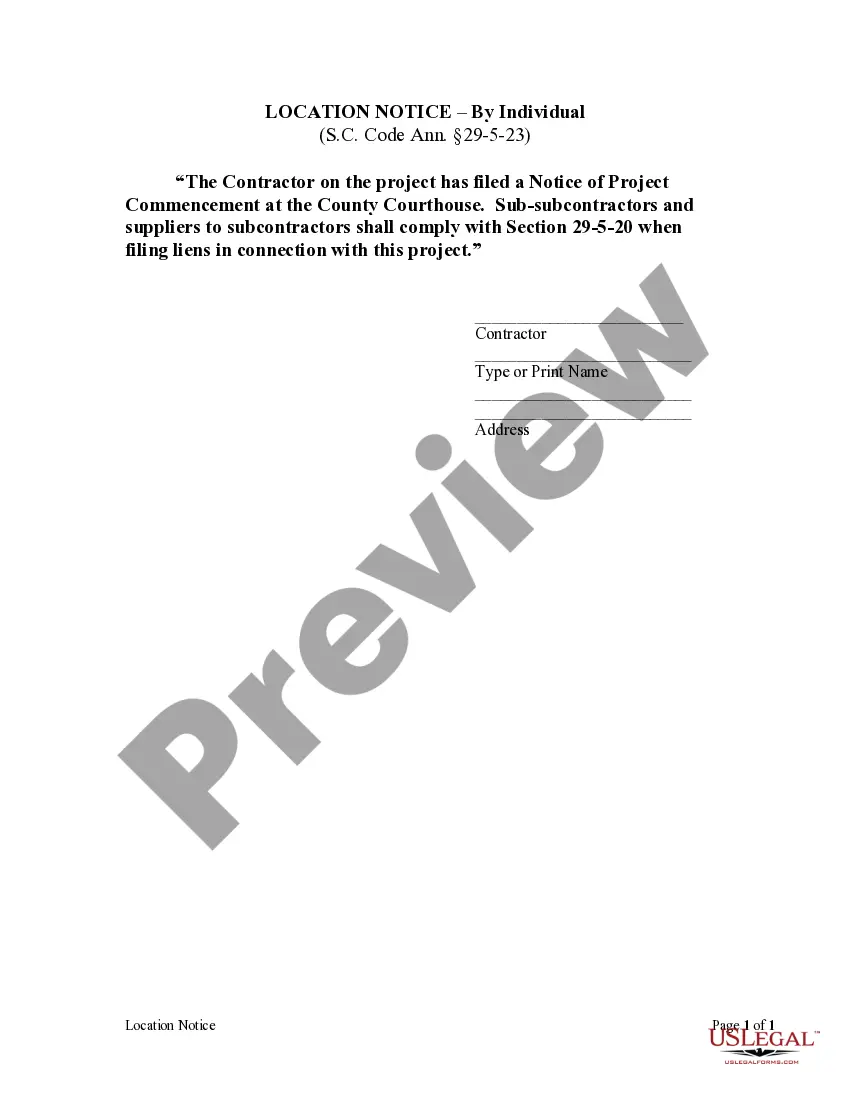
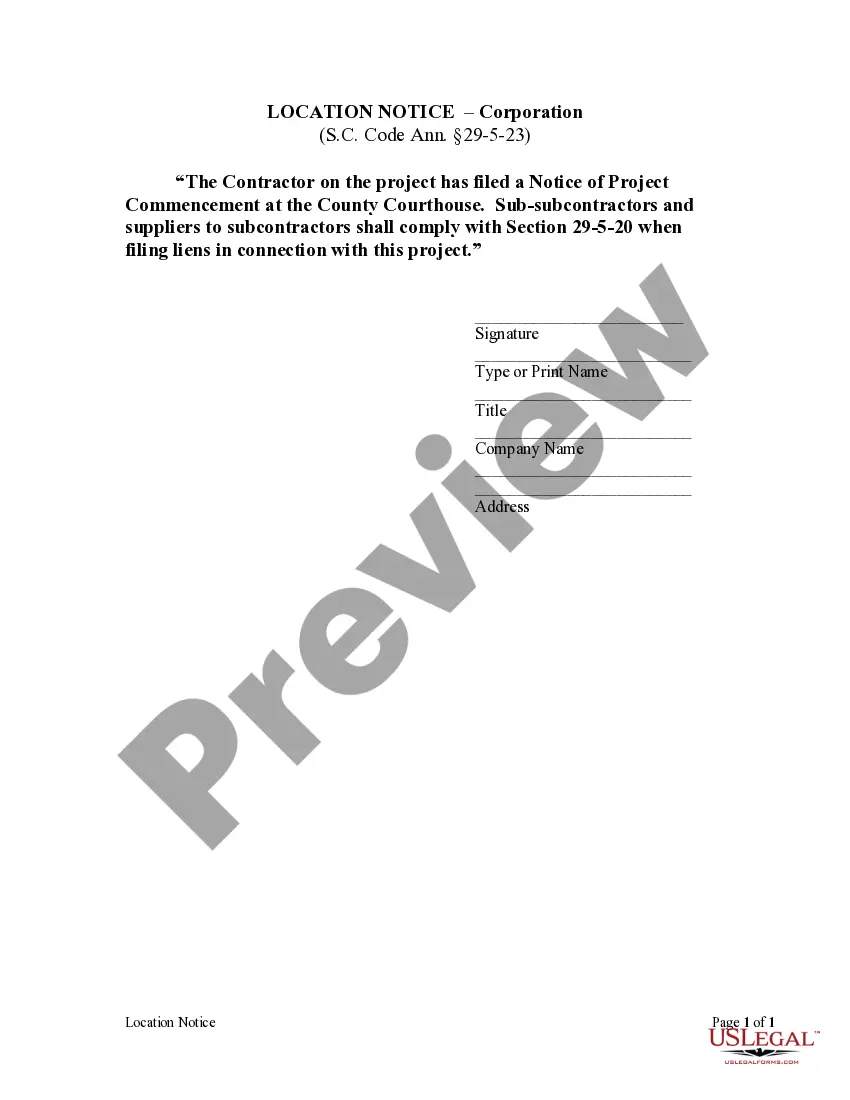
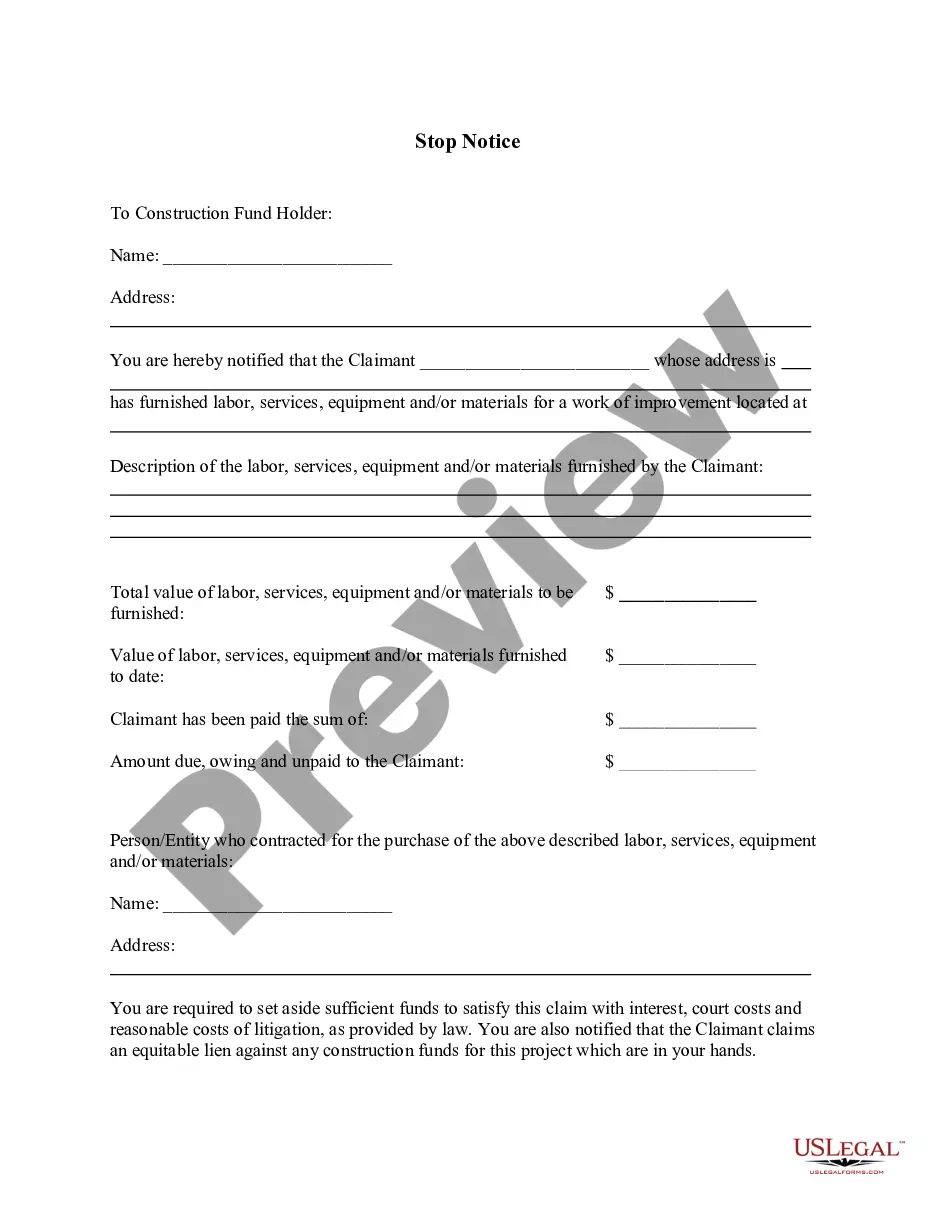
The Location Notice - Individual is a legal document that informs all relevant parties about the commencement of a construction project. This form is specifically designed to comply with South Carolina law and must be displayed at the job site. It serves to ensure that subcontractors and suppliers are aware of the contractorâs Notice of Project Commencement, thus supporting their rights regarding lien claims related to the project. This form helps in establishing legal transparency and fulfills specific requirements distinct from other lien-related documents.
Main sections of this form
- Announcement of the contractor filing a Notice of Project Commencement.
- Instructions for subcontractors and suppliers regarding lien filing compliance.
- Space for the contractorâs name and address.
When to use this form
This form should be used when a contractor initiates a construction project and is required to inform all relevant parties at the job site. It is particularly important for projects where subcontractors or suppliers may need to file liens to assert their rights to payment for services or materials provided. Utilizing this form helps prevent potential legal disputes related to unpaid services or materials in connection with the construction project.
Who needs this form
- Contractors managing construction projects who need to file a Notice of Project Commencement.
- Subcontractors involved in construction projects who require knowledge of filing liens.
- Suppliers providing materials or services for a construction project.
Completing this form step by step
- Clearly print or type the contractor's name in the designated space.
- Provide the complete address of the project site.
- Ensure all wording complies with the legal requirements specified in the form.
- Post the completed location notice at the job site for visibility to subcontractors and suppliers.
Is notarization required?
This form does not typically require notarization unless specified by local law. It is recommended to check local legal requirements to ensure compliance.
Get your form ready online
Our built-in tools help you complete, sign, share, and store your documents in one place.
Make edits, fill in missing information, and update formatting in US Legal Forms—just like you would in MS Word.
Download a copy, print it, send it by email, or mail it via USPS—whatever works best for your next step.
Sign and collect signatures with our SignNow integration. Send to multiple recipients, set reminders, and more. Go Premium to unlock E-Sign.
If this form requires notarization, complete it online through a secure video call—no need to meet a notary in person or wait for an appointment.
We protect your documents and personal data by following strict security and privacy standards.

Make edits, fill in missing information, and update formatting in US Legal Forms—just like you would in MS Word.

Download a copy, print it, send it by email, or mail it via USPS—whatever works best for your next step.

Sign and collect signatures with our SignNow integration. Send to multiple recipients, set reminders, and more. Go Premium to unlock E-Sign.

If this form requires notarization, complete it online through a secure video call—no need to meet a notary in person or wait for an appointment.

We protect your documents and personal data by following strict security and privacy standards.
Common mistakes to avoid
- Failing to properly display the notice at the job site.
- Omitting the contractorâs name or address.
- Not adhering to the specific wording required by law.
Benefits of completing this form online
- Immediate access to a legally vetted template created by licensed attorneys.
- Ability to edit and customize the form as needed for specific projects.
- Convenience of downloading the form instantly from anywhere.
Summary of main points
- The Location Notice is essential for notifying related parties about construction projects.
- Careful completion and display of the form are crucial to uphold lien rights.
- This form must be compliant with South Carolina specific requirements.
Looking for another form?
Form popularity
FAQ
The magistrate must determine whether a landlord-tenant relationship exists and what rent, if any, is due. The magistrate should, upon making a determination that rent is due, issue a written rule requiring the tenant to vacate the premises or to show cause within ten days why he should not be ejected.
To begin the eviction lawsuit in South Carolina, also called an ejectment action, the landlord must file an affidavit with the court. An affidavit is a sworn statement by the landlord that provides details on the reasons the tenant should be evicted. Once filed, the court will then issue an order to show cause.
In South Carolina, the Writ of Ejectment allows the county sheriff to remove the renter forcibly. Once issued, the renter will have five days to vacate the premises. Once evicted, you may find that the tenant has left behind some personal belongings.
To begin the eviction lawsuit in South Carolina, also called an ejectment action, the landlord must file an affidavit with the court. An affidavit is a sworn statement by the landlord that provides details on the reasons the tenant should be evicted. Once filed, the court will then issue an order to show cause.
A Notice to Quit is a formal legal document a landlord sends a tenant in an attempt to fix a lease violation. In most cases, before a landlord can formally file to evict a tenant, the landlord must first serve the tenant with a Notice to Quit. This Notice gives the tenant a chance to fix the issue.
Addresses. Date. Tenant names. Status and date of the lease. Why the eviction notice is served (clear and concise explanation) Date tenant must vacate the property. Proof of service or delivery of notice.
The date you're submitting your notice. The date you're moving. Information on your current home the address and the landlord's name. A statement declaring that you intend to leave the home. A straightforward statement that you're providing this letter, 30 days out, per your lease agreement.
The South Carolina Five (5) Day Notice to Quit (Non-Payment) is a legal notice requiring a tenant to pay past-due rent within 5 days or ejectment proceedings will be brought against them by the landlord.
In Columbia, South Carolina, an eviction normally takes from 30 to 45 days, and the cost can range from $100 to $1,200, depending on whether you use an attorney to help you through the process.