Rhode Island Warranty Deed to Separate Property of One Spouse to Both Spouses as Joint Tenants
What this document covers
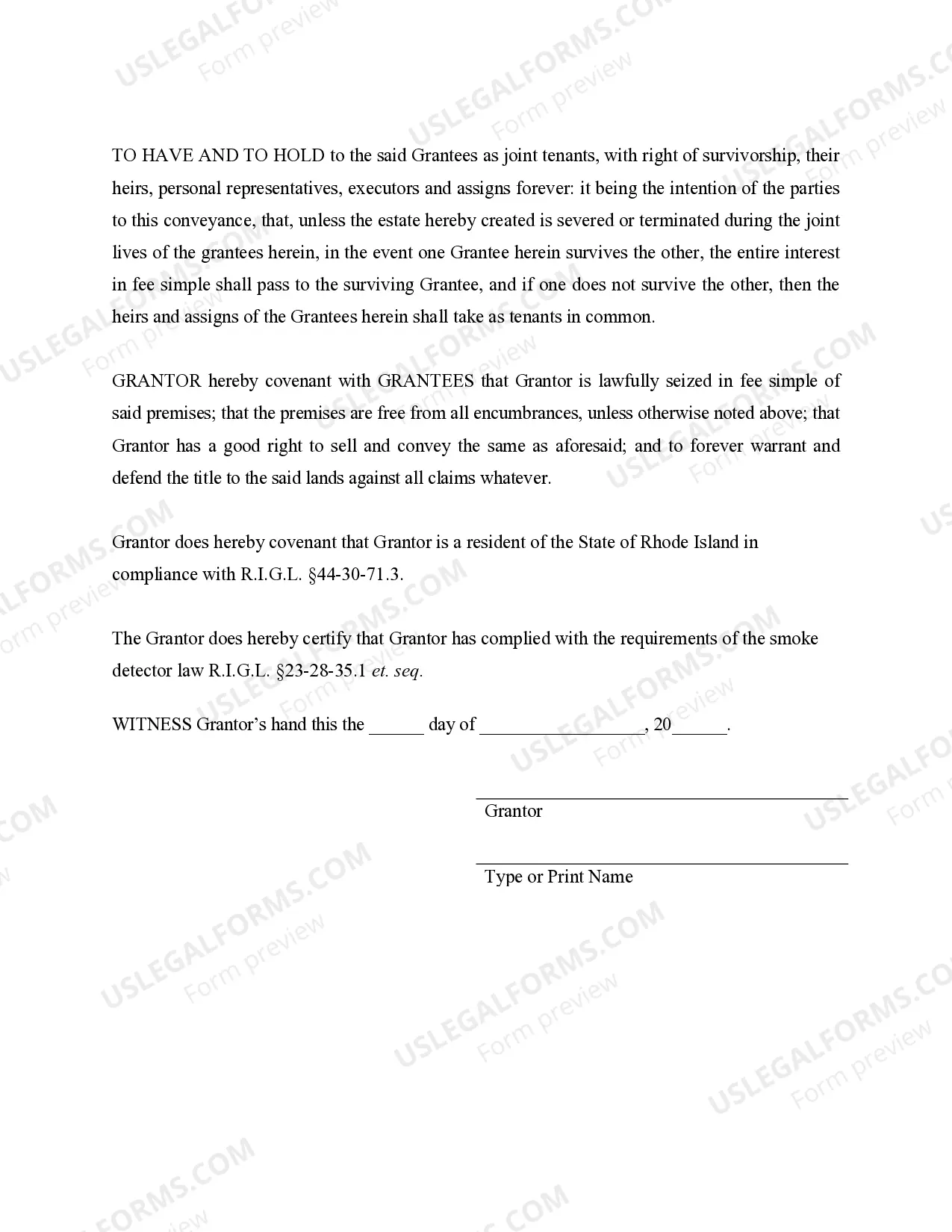
The Warranty Deed to Separate Property of One Spouse to Both Spouses as Joint Tenants is a legal document that allows one spouse to transfer property ownership to both spouses in a joint tenancy arrangement. Unlike a traditional deed, this form specifically caters to situations where the property is initially owned by one spouse but is to be jointly owned with right of survivorship by both spouses. This legal arrangement ensures that, in the event of the death of one spouse, the surviving spouse automatically receives full ownership of the property without the need for probate.
Form components explained
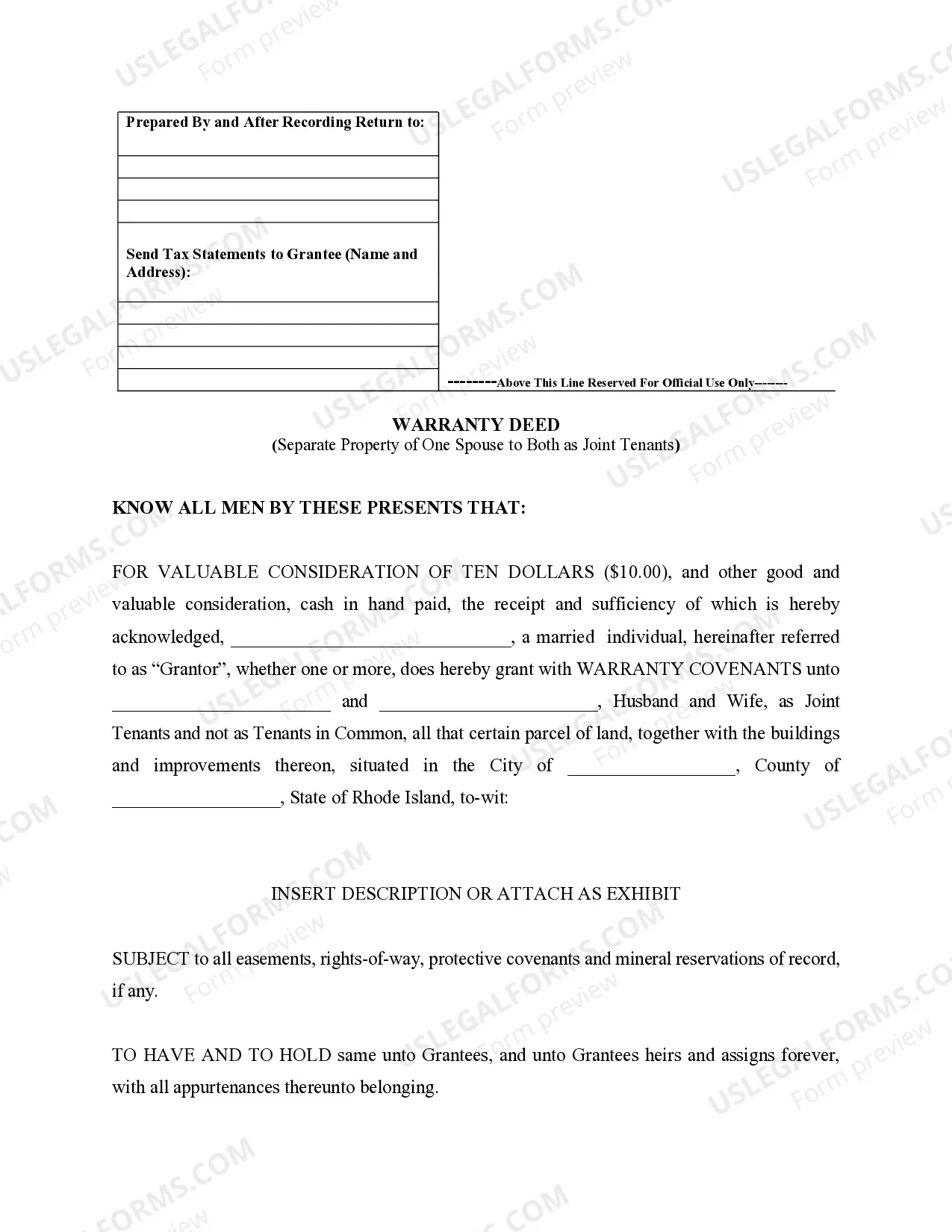
- Names of the Grantor (spouse transferring the property) and Grantees (both spouses receiving the property).
- Legal description of the property being transferred, including its location and boundaries.
- Statements confirming the Grantor's authority to transfer the property and that it is free from encumbrances.
- Details about the joint tenancy arrangement, including the right of survivorship.
- Signature section for the Grantor and any required witnesses.




When this form is needed
This form is commonly used when a married couple wishes to convert property that is owned solely by one spouse into joint ownership. This may occur during estate planning, following a marriage, or in situations where it is desired to simplify the transfer of property rights in the event of a spouse's death. Using this form is beneficial to ensure the surviving spouse automatically retains ownership of the property without the complications of probate.
Who this form is for
- Married couples wishing to consolidate property ownership.
- Couples wanting to ensure the swift transfer of property rights upon the death of one spouse.
- Individuals who own property separately and are looking to change the title to include a spouse.
Completing this form step by step
- Gather personal information, including full names and addresses of both spouses.
- Insert the legal description of the property being transferred.
- Ensure the declaration of the Grantorâs authority to transfer the property is accurately filled out.
- Sign and date the form in the designated areas.
- Consider having the document notarized if required.
Does this document require notarization?
This form does not typically require notarization unless specified by local law. It is advisable to verify any specific requirements that may arise based on the nature of the property or local regulations.
Get your form ready online
Our built-in tools help you complete, sign, share, and store your documents in one place.
Make edits, fill in missing information, and update formatting in US Legal Forms—just like you would in MS Word.
Download a copy, print it, send it by email, or mail it via USPS—whatever works best for your next step.
Sign and collect signatures with our SignNow integration. Send to multiple recipients, set reminders, and more. Go Premium to unlock E-Sign.
If this form requires notarization, complete it online through a secure video call—no need to meet a notary in person or wait for an appointment.
We protect your documents and personal data by following strict security and privacy standards.

Make edits, fill in missing information, and update formatting in US Legal Forms—just like you would in MS Word.

Download a copy, print it, send it by email, or mail it via USPS—whatever works best for your next step.

Sign and collect signatures with our SignNow integration. Send to multiple recipients, set reminders, and more. Go Premium to unlock E-Sign.

If this form requires notarization, complete it online through a secure video call—no need to meet a notary in person or wait for an appointment.

We protect your documents and personal data by following strict security and privacy standards.
Typical mistakes to avoid
- Failing to provide a complete legal description of the property.
- Omitting the signature of the Grantor.
- Not checking for encumbrances that may affect the property title.
- Not understanding the implications of joint tenancy versus tenants in common.
Benefits of using this form online
- Convenience of completing the form from home or any location.
- Ability to easily edit and save the form before finalizing it.
- Access to professionally drafted legal templates ensuring compliance with state laws.
- Time-saving by eliminating the need for in-person attorney consultations for straightforward matters.
Looking for another form?



Form popularity
FAQ
In California, all property bought during the marriage with income that was earned during the marriage is deemed "community property." The law implies that both spouses own this property equally, regardless of which name is on the title deed.
In estate law, joint tenancy is a special form of ownership by two or more persons of the same property. The individuals, who are called joint tenants, share equal ownership of the property and have the equal, undivided right to keep or dispose of the property. Joint tenancy creates a Right of Survivorship.
When one joint owner (called a joint tenant, though it has nothing to do with renting) dies, the surviving owners automatically get the deceased owner's share of the joint tenancy property.The surviving joint tenant will automatically own the property after your death.
In California, most married couples hold real property (such as land and buildings) as joint tenants with right of survivorship.For instance, many married couples share real property as joint tenants. This way, upon the death of a spouse, the surviving spouse will own 100% share of the property.
One of the main differences between the two types of shared ownership is what happens to the property when one of the owners dies. When a property is owned by joint tenants with survivorship, the interest of a deceased owner automatically gets transferred to the remaining surviving owners.
For example, joint tenants must all take title simultaneously from the same deed while tenants in common can come into ownership at different times. Another difference is that joint tenants all own equal shares of the property, proportionate to the number of joint tenants involved.
If you look at the registered title to your own jointly owned property and the text isn't shown on it, you own it as joint tenants. If it is there, you own it as tenants-in-common.
When a property is owned by joint tenants with survivorship, the interest of a deceased owner automatically gets transferred to the remaining surviving owners. For example, if four joint tenants own a house and one of them dies, each of the three remaining joint tenants ends up with a one-third share of the property.
Yes, it is legal in California for a joint tenant to encumber the property to obtain a loan without the knowledge or consent of the other.