Pennsylvania Last Will and Testament for Divorced Person Not Remarried with No Children
Understanding this form
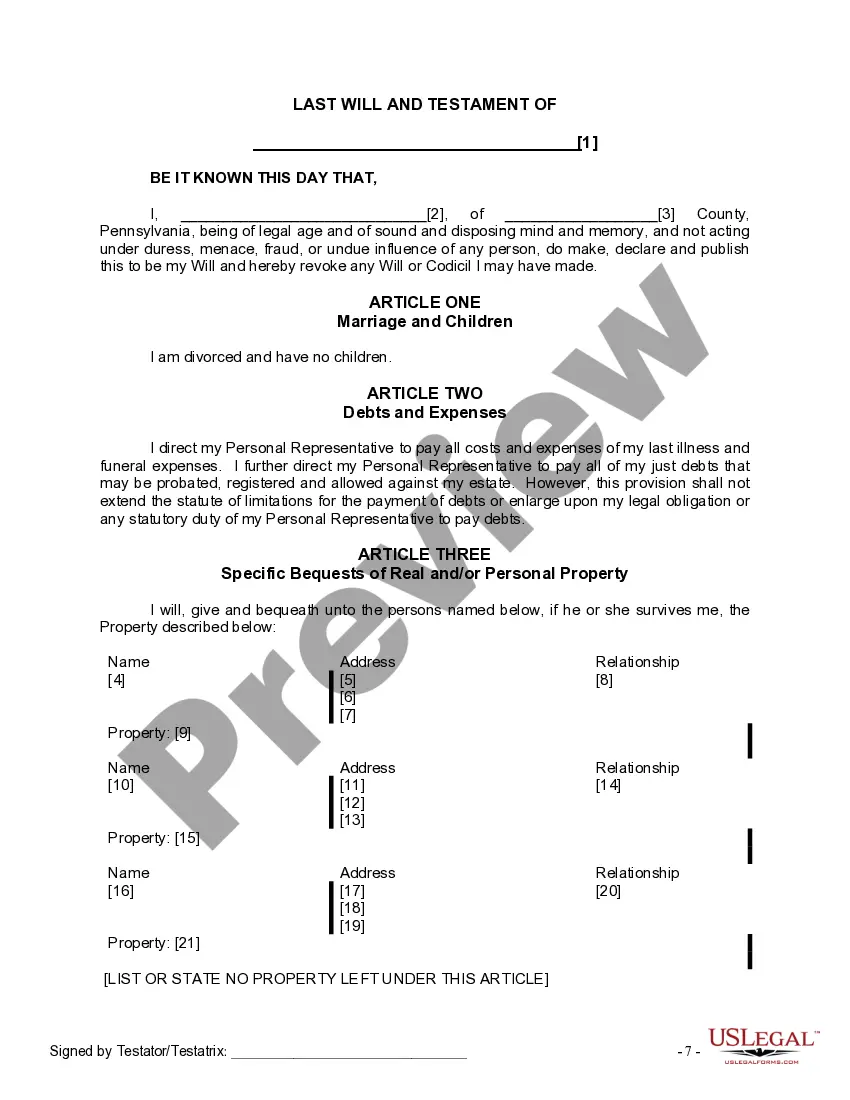
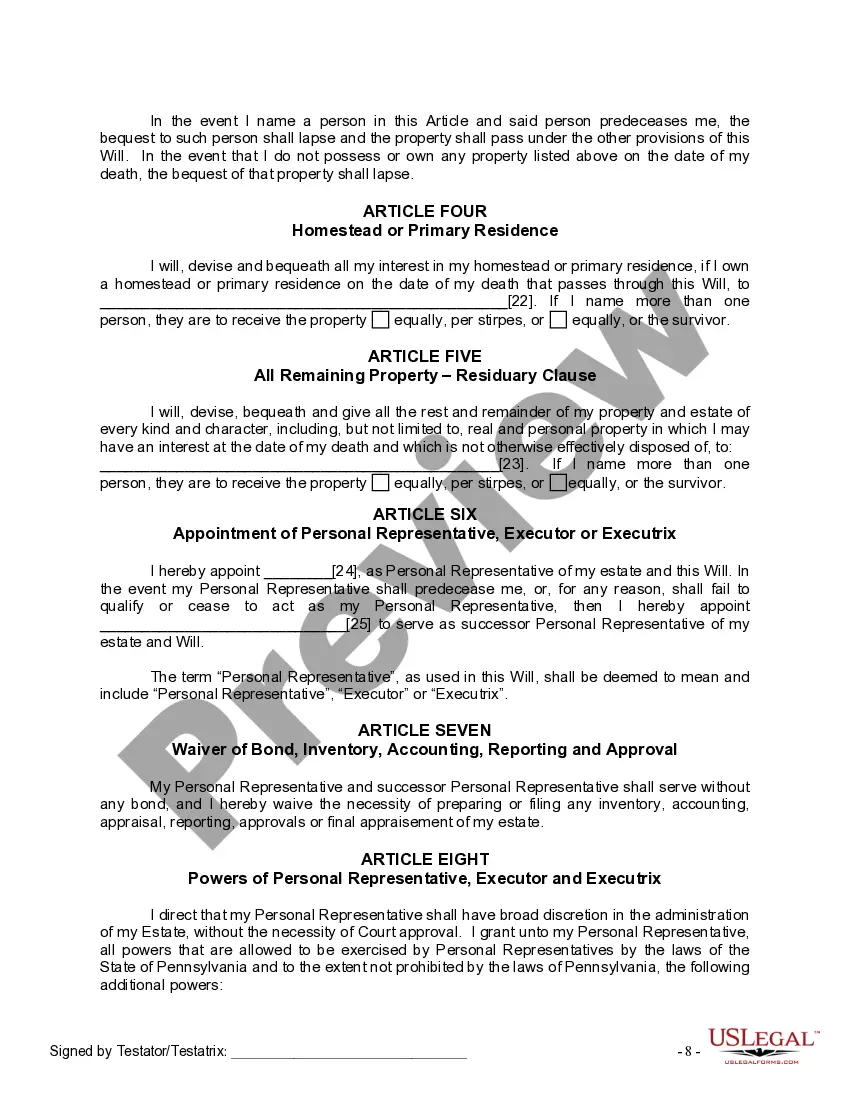
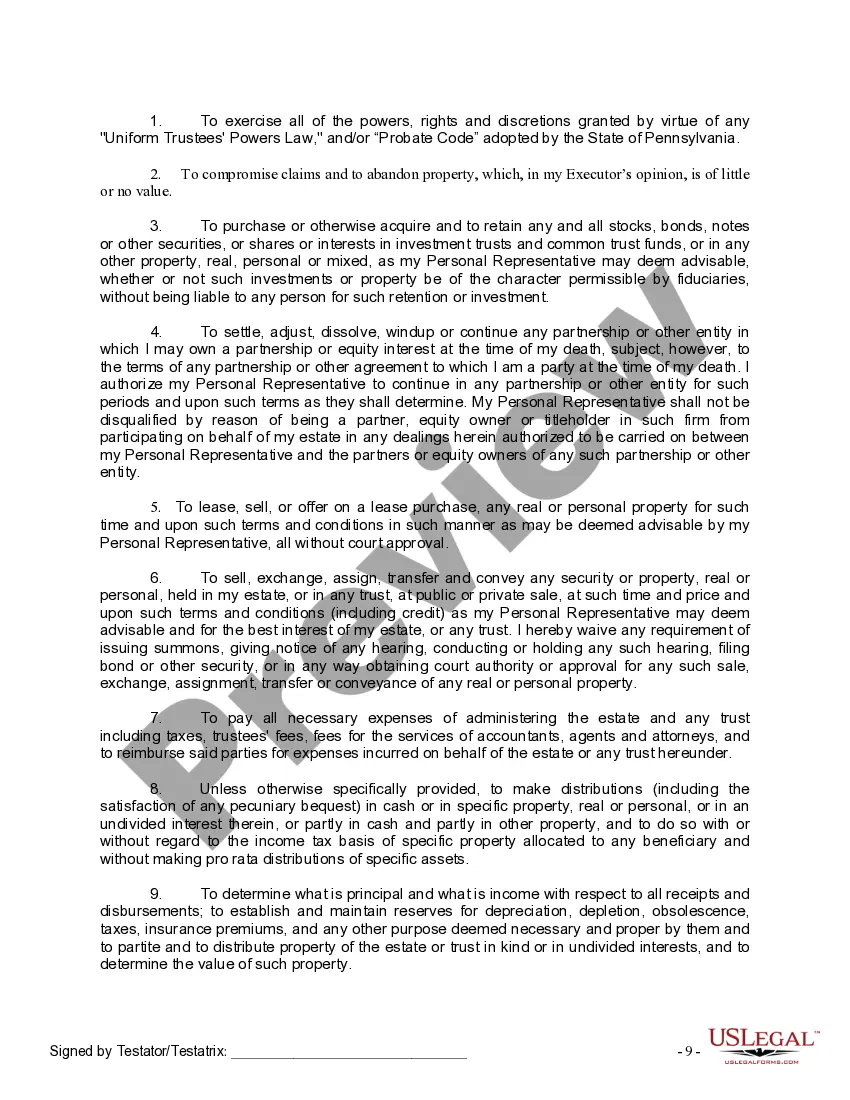
The Last Will and Testament for Divorced Person Not Remarried with No Children is a legal document that outlines how a person's assets and affairs should be handled after their death. This specific will is tailored for individuals who are divorced, do not have children, and have not remarried. It allows the testator to appoint a personal representative, designate beneficiaries for their property, and include various provisions according to their wishes. Unlike other wills, this one simplifies the estate management process for individuals in similar situations, ensuring that their assets are distributed according to their unique needs and circumstances.
Key components of this form
- Appointment of a personal representative to manage the estate.
- Specification of beneficiaries who will receive property and assets.
- Instructions for paying debts and funeral expenses from the estate.
- Details on how specific items of property should be divided.
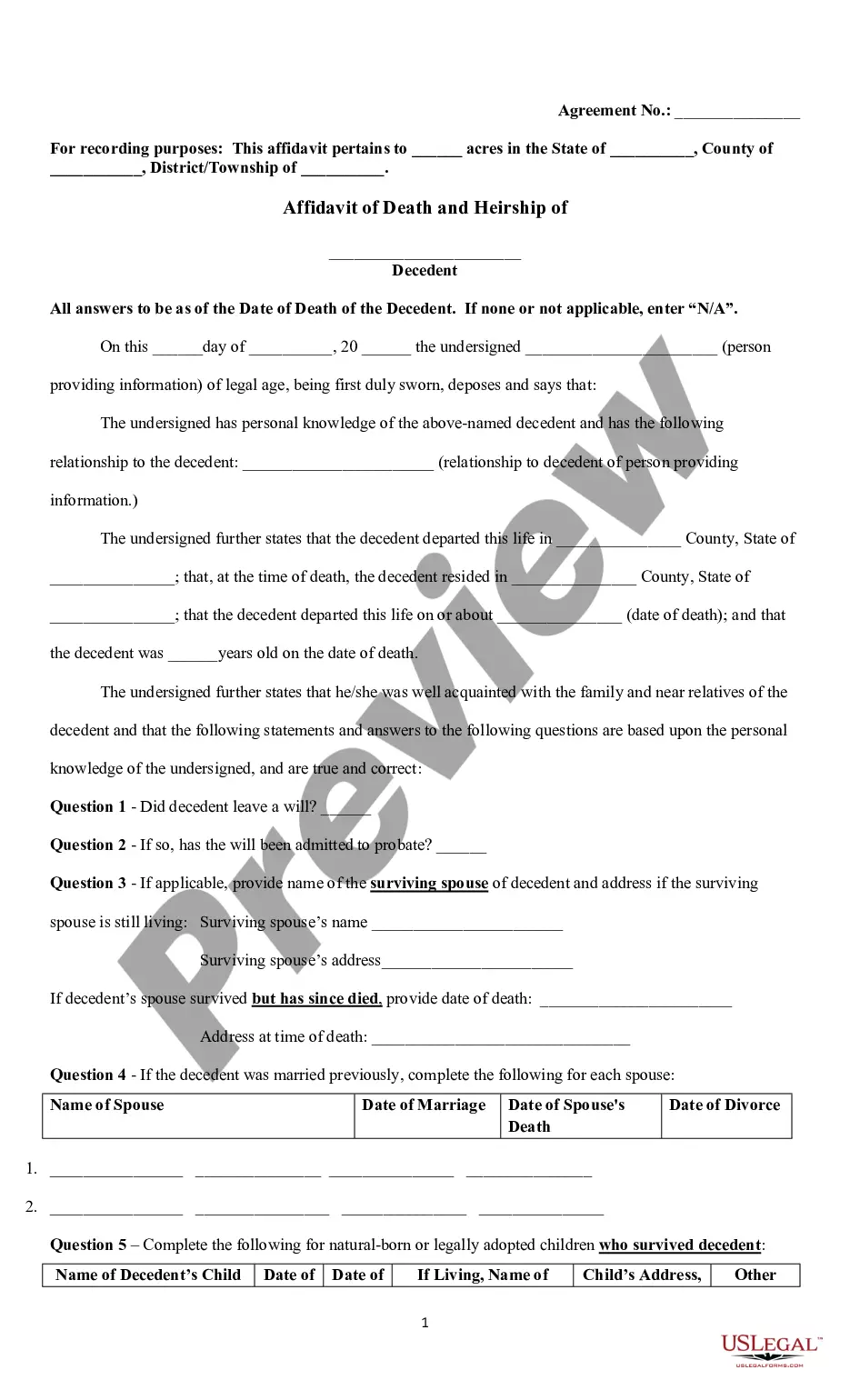
- A self-proving affidavit for streamlined probate processes.


Common use cases
This form should be used when a divorced individual, who is not remarried and has no children, wishes to clearly outline their final wishes regarding the distribution of their assets and the administration of their estate. It is particularly essential in cases where the individual has specific heirlooms or property they want to designate to particular friends or relatives.
Who should use this form
- Divorced individuals who are not currently married.
- Persons without children who want to specify their wishes regarding property distribution.
- Anyone looking for a straightforward way to manage their estate planning.
Completing this form step by step
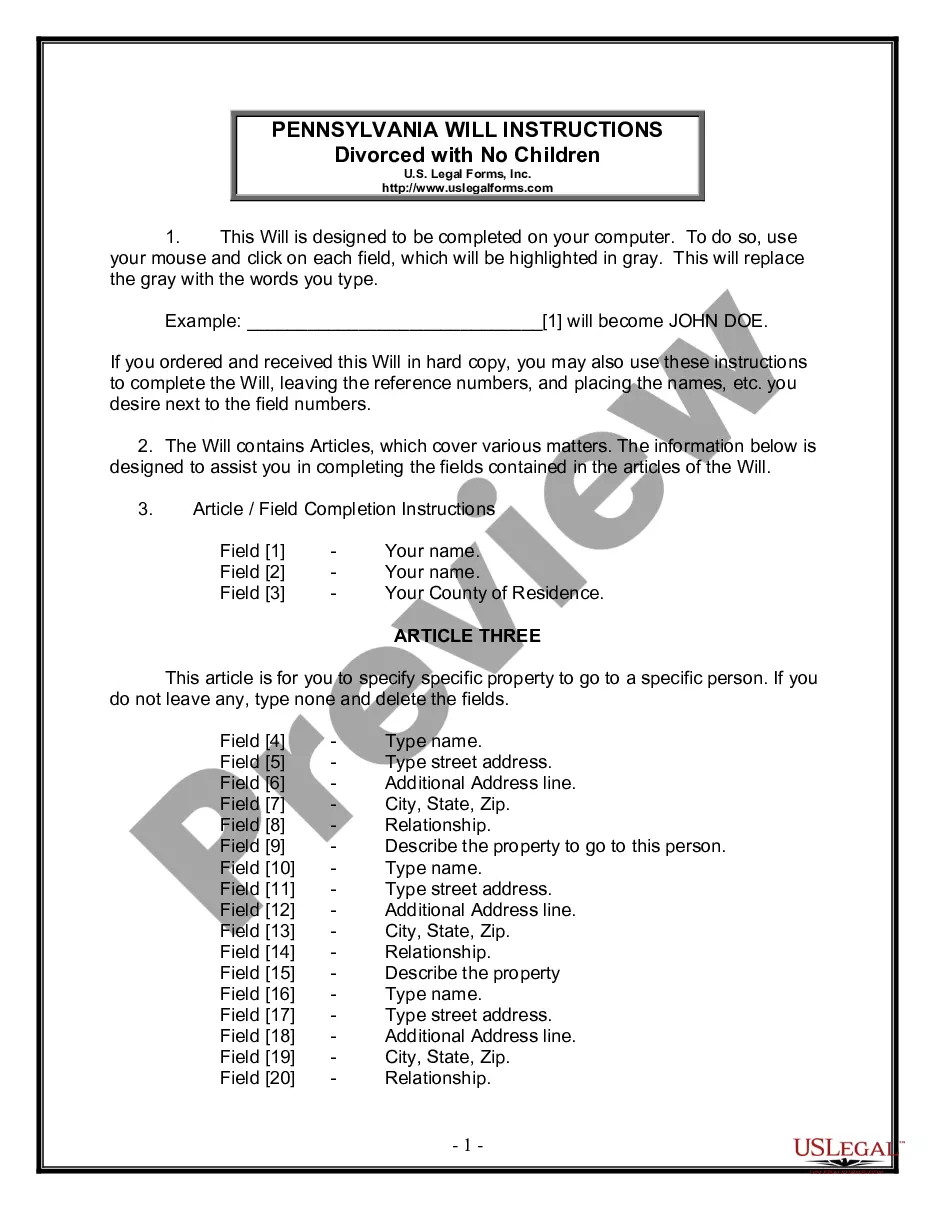
- Open the form on your computer and click on the highlighted fields to enter your details.
- Fill out your name, county of residence, and other personal information as required in the specified fields.
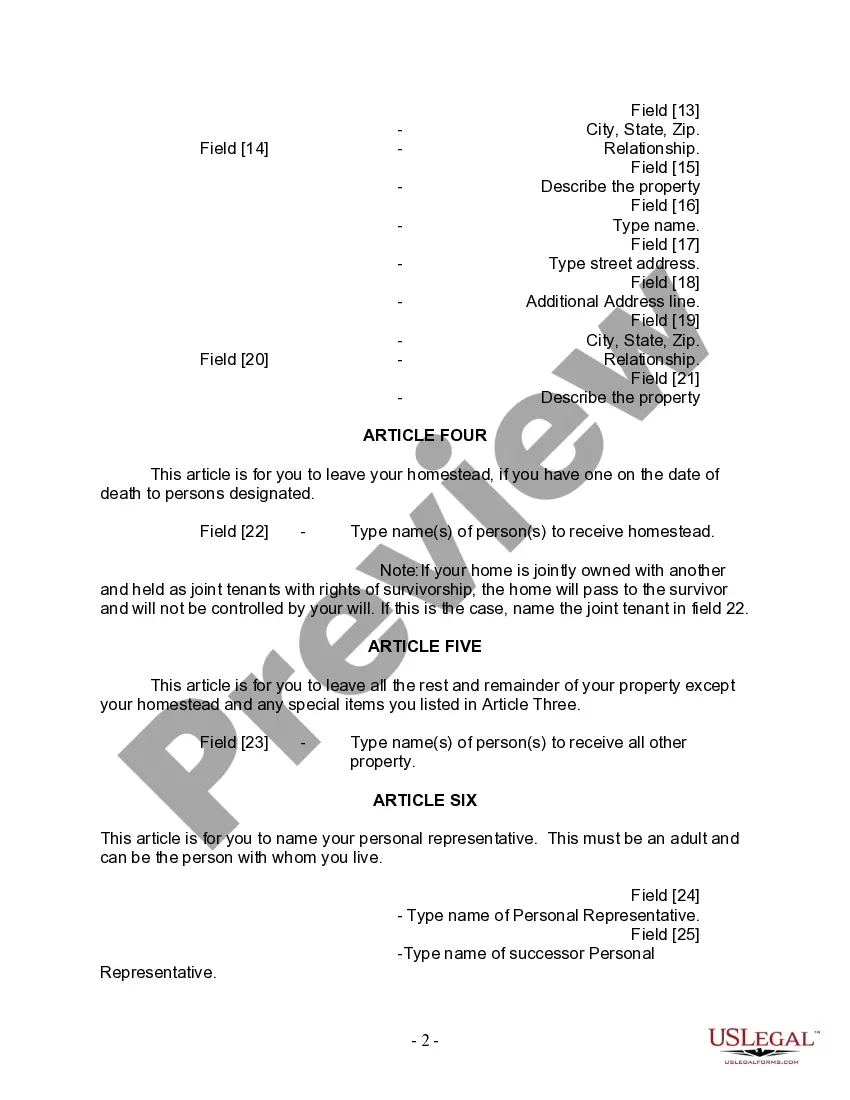
- Designate beneficiaries by specifying their names, addresses, and the property or assets they will receive.
- Identify a personal representative who will manage your estate once you pass away.
- Review the completed document for accuracy, ensuring all fields are filled out.
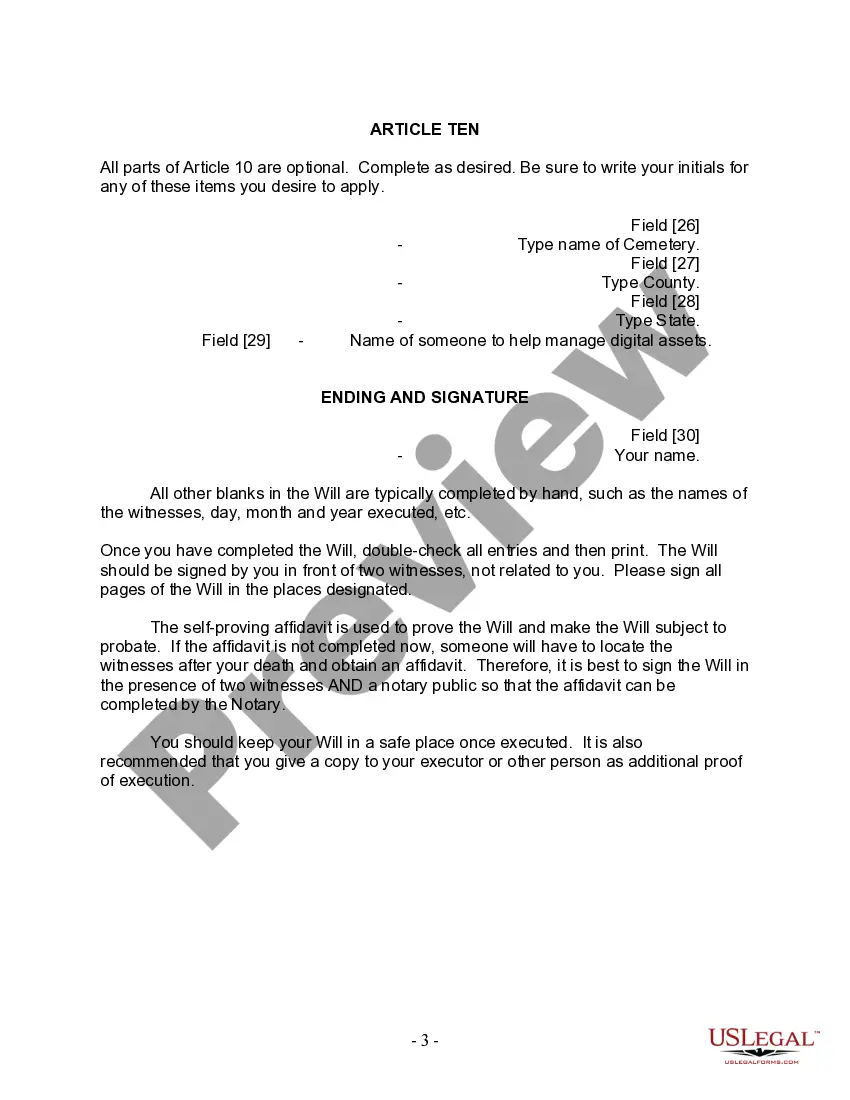
- Sign the will in front of two witnesses (not related to you) and, if desired, a notary to complete the self-proving affidavit.
Does this form need to be notarized?
This form must be notarized to be legally valid. US Legal Forms provides secure online notarization powered by Notarize, allowing you to complete the process through a verified video call.
Get your form ready online
Our built-in tools help you complete, sign, share, and store your documents in one place.
Make edits, fill in missing information, and update formatting in US Legal Forms—just like you would in MS Word.
Download a copy, print it, send it by email, or mail it via USPS—whatever works best for your next step.
Sign and collect signatures with our SignNow integration. Send to multiple recipients, set reminders, and more. Go Premium to unlock E-Sign.
If this form requires notarization, complete it online through a secure video call—no need to meet a notary in person or wait for an appointment.
We protect your documents and personal data by following strict security and privacy standards.

Make edits, fill in missing information, and update formatting in US Legal Forms—just like you would in MS Word.

Download a copy, print it, send it by email, or mail it via USPS—whatever works best for your next step.

Sign and collect signatures with our SignNow integration. Send to multiple recipients, set reminders, and more. Go Premium to unlock E-Sign.

If this form requires notarization, complete it online through a secure video call—no need to meet a notary in person or wait for an appointment.

We protect your documents and personal data by following strict security and privacy standards.
Common mistakes to avoid
- Not having the will signed by the required number of witnesses.
- Failing to include a self-proving affidavit, which can complicate the probate process.
- Leaving out important information about beneficiaries or specific bequests.
- Not updating the will after major life changes (like divorce or asset acquisition).
Advantages of online completion
- Convenient access to fill out and customize the will from home.
- Easy editing options, allowing you to make changes without starting from scratch.
- Document reliability, as templates are crafted by licensed legal professionals.
Legal use & context
- A will provides direction on how your assets will be distributed upon your death.
- Having a will can prevent intestacy laws from determining how your estate is divided.
- This document can streamline the probate process if completed properly and executed according to state laws.
Summary of main points
- The Last Will and Testament is essential for planning your estate if you are divorced, have no children, and are not remarried.
- Includes provisions for appointing a personal representative and distributing specific assets.
- Make sure to sign the document in front of the required witnesses and a notary for it to be valid.
- Using this form online simplifies the process and ensures compliance with legal standards.
Looking for another form?







Form popularity
FAQ
A valid will in Pennsylvania must be in writing, either typed or handwritten. Pennsylvania only accepts oral wills in very narrow circumstances. In all cases, the testator, or person drafting the document, must also sign it.
In some states, a will is self-proving when two witnesses sign under penalty of perjury that they observed the willmaker sign it and that he told them it was his will. If no one contests the validity of the will, the probate court will accept the will without hearing the testimony of the witnesses or other evidence.
When a Will is written in the handwriting of a decedent, it is a valid Will even if there are NO witnesses.California law presumes that holographic Wills are valid because they are written by the decedent in the decedent's own handwriting.
A self-proving affidavit is a notarized document that helps prove a will's validity and speed up the probate process. It's signed by the testator (will writer) and two witnesses, who confirm under oath that they saw the testator sign the will without any undue influence.
It must be in writing. Generally, of course, wills are composed on a computer and printed out. The person who made it must have signed and dated it. A will must be signed and dated by the person who made it. Two adult witnesses must have signed it. Witnesses are crucial.
A self-proving affidavit is a document, signed by you and two witnesses, that verifies under oath that your witnesses saw you sign your will and that it's legally valid. Generally speaking, your self-proving affidavit must be notarized, meaning you and the witnesses sign it in front of a notary public.
A self-proving affidavit is a notarized document that helps prove a will's validity and speed up the probate process. It's signed by the testator (will writer) and two witnesses, who confirm under oath that they saw the testator sign the will without any undue influence.
A will that is created in a way that allows a probate court to easily accept it as the true will of the person who has died. In some states, a will is self-proving when two witnesses sign under penalty of perjury that they observed the willmaker sign it and that he told them it was his will.
The Pennsylvania self-proving affidavit form is a legal instrument which acts as sworn testimony on behalf of two (2) witnesses and the Testator for the Testator's Last Will and Testament.Both witnesses must be impartial and, therefore, cannot be named beneficiaries themselves.