Pennsylvania Warranty Deed from Husband to Himself and Wife
About this form
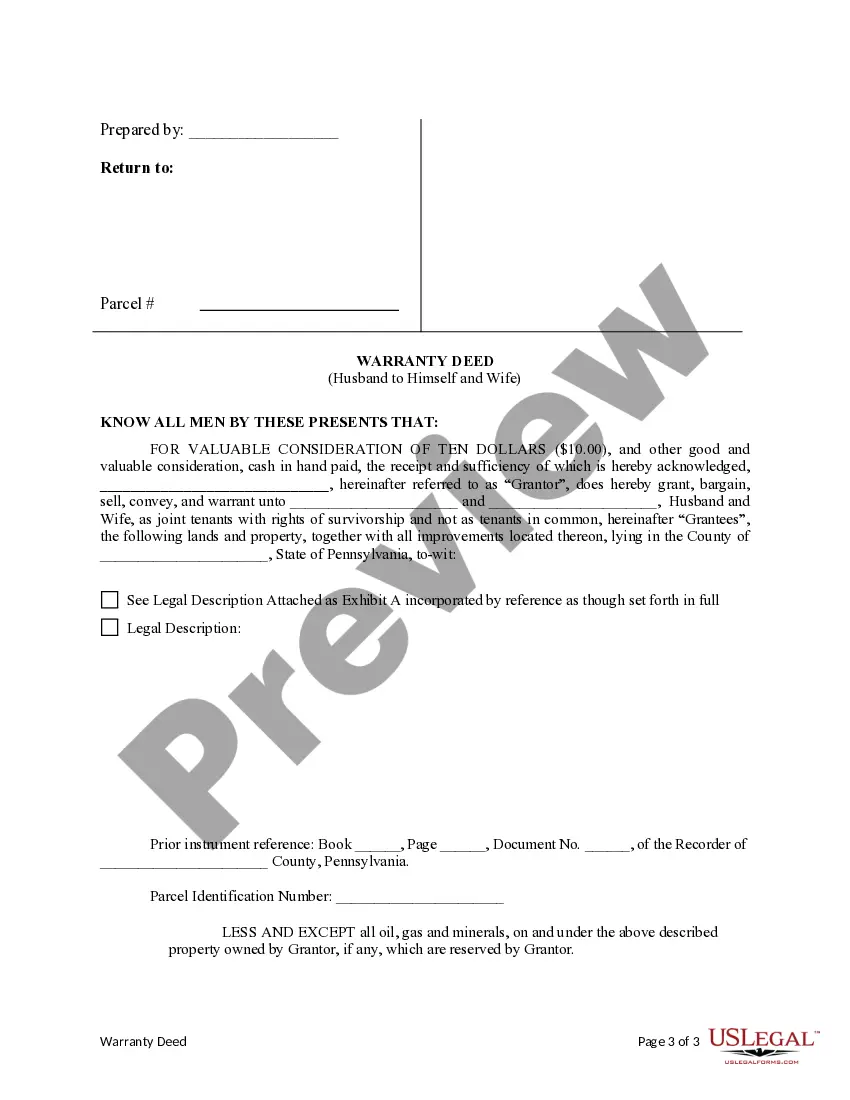
The Warranty Deed from Husband to Himself and Wife is a legal document used to transfer ownership of property from a husband to himself and his wife, establishing them as joint tenants with rights of survivorship. This deed ensures that both spouses have equal ownership rights, which is crucial for estate planning. Unlike other forms, this warranty deed includes specific provisions related to the reservation of minerals like oil and gas, offering essential protections for the grantor and clarity for the grantees.
Form components explained
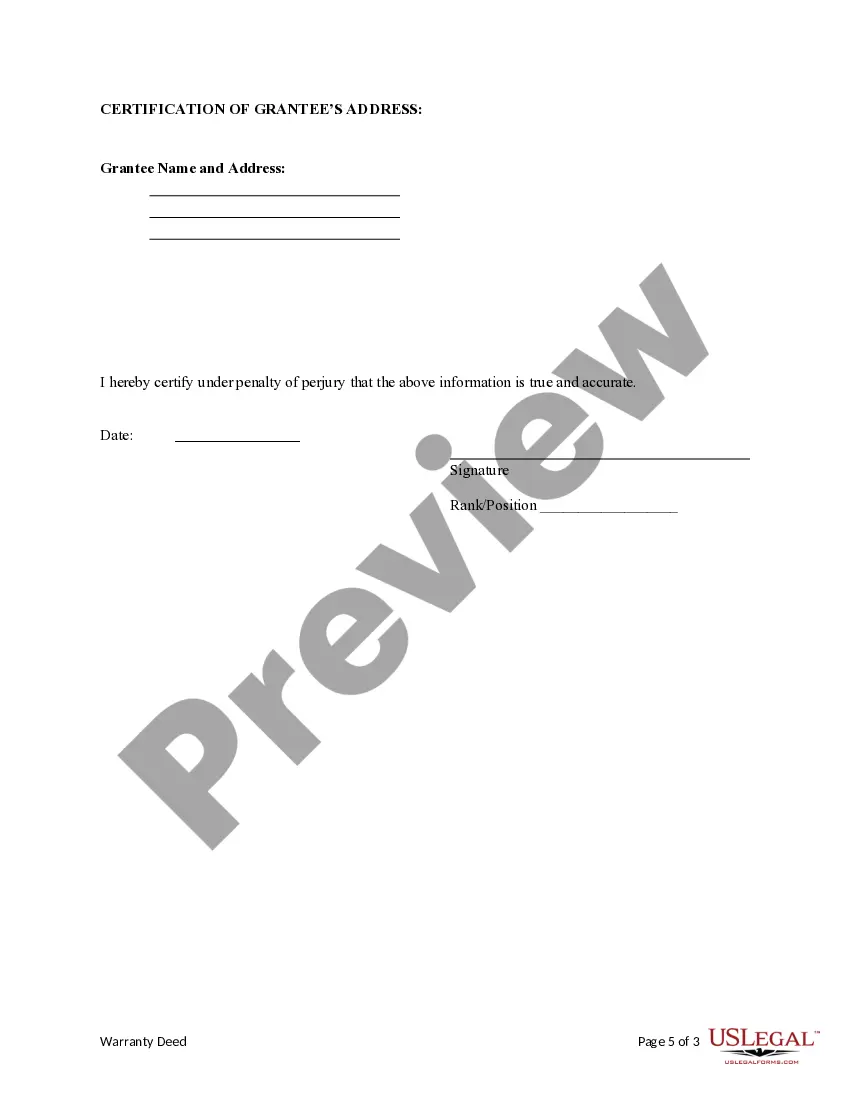
- Details of the grantor (the husband) and grantees (husband and wife).
- Description of the property being conveyed.
- Provisions for reserving oil, gas, and minerals beneath the property.
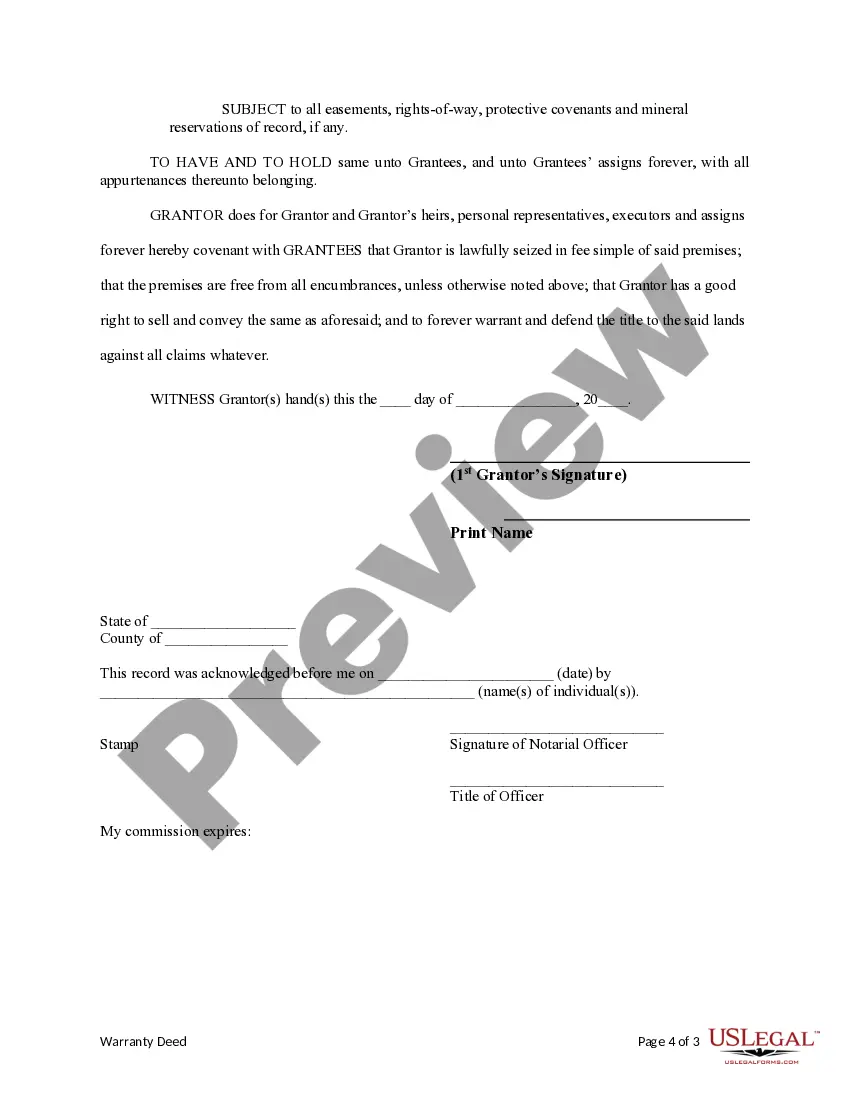
- Statement guaranteeing that the grantor holds clear title to the property.
- Signatures and dates validating the transaction.




Situations where this form applies
This form is typically used when a husband wishes to ensure that property he owns is transferred to himself and his wife as joint tenants. This can be relevant in scenarios such as marriage, adding a spouse to property ownership, or estate planning. It is suitable for protecting property from disputes after the grantor's death, as the joint tenancy feature allows the surviving spouse to inherit without complications.
Intended users of this form
- Married couples who own property individually and want to add the spouse to the title.
- Individuals planning their estate to ensure smooth transfer of property to a spouse.
- Homeowners in situations where they wish to clarify ownership rights and survivorship.
How to complete this form
- Identify the parties involved: the husband as the grantor and both the husband and wife as grantees.
- Clearly describe the property being conveyed in the appropriate section.
- If applicable, specify any reservations of oil, gas, or minerals.
- Ensure all parties sign the form and include the date of signing.
- Review for completeness and accuracy before filing.
Notarization guidance
This form does not typically require notarization unless specified by local law. However, it is recommended to notarize to ensure the legality and authenticity of the document, especially for property transactions.
Get your form ready online
Our built-in tools help you complete, sign, share, and store your documents in one place.
Make edits, fill in missing information, and update formatting in US Legal Forms—just like you would in MS Word.
Download a copy, print it, send it by email, or mail it via USPS—whatever works best for your next step.
Sign and collect signatures with our SignNow integration. Send to multiple recipients, set reminders, and more. Go Premium to unlock E-Sign.
If this form requires notarization, complete it online through a secure video call—no need to meet a notary in person or wait for an appointment.
We protect your documents and personal data by following strict security and privacy standards.

Make edits, fill in missing information, and update formatting in US Legal Forms—just like you would in MS Word.

Download a copy, print it, send it by email, or mail it via USPS—whatever works best for your next step.

Sign and collect signatures with our SignNow integration. Send to multiple recipients, set reminders, and more. Go Premium to unlock E-Sign.

If this form requires notarization, complete it online through a secure video call—no need to meet a notary in person or wait for an appointment.

We protect your documents and personal data by following strict security and privacy standards.
Common mistakes to avoid
- Failing to include a clear legal description of the property.
- Not signing the form correctly or missing signatures from both spouses.
- Omitting details about the reservation of minerals, if applicable.
Why use this form online
- Accessible: Download and fill out the form conveniently from home.
- Editability: Easily edit electronic documents for accuracy and completeness.
- Legal compliance: Forms are drafted to adhere to state laws, ensuring legal validity.
Quick recap
- A Warranty Deed from Husband to Himself and Wife establishes joint ownership of property.
- It includes provisions for survivorship and details about any mineral rights reserved.
- This document is a vital tool for marriage and estate planning, protecting the interests of both partners.
Looking for another form?







Form popularity
FAQ
A warranty deed guarantees that: The grantor is the rightful owner of the property and has the legal right to transfer the title.The title would withstand third-party claims to ownership of the property. The grantor will do anything to ensure the grantee's title to the property.
The State of Pennsylvania charges 1% of the sales price and the municipality and school district USUALLY charge 1% between them for a total of 2% (i.e. 2% X 100,000 = $2,000). By custom, the buyer and seller split the cost. 1% to buyer, 1% to seller; however payment is dictated by the sales contract.
If you've recently married and already own a home or other real estate, you may want to add your new spouse to the deed for your property so the two of you own it jointly. To add a spouse to a deed, all you have to do is literally fill out, sign and record a new deed in your county recorder's office.
To transfer property in Pennsylvania, you'll need to prepare and execute a deed and record it in the county where the property is located. If the transfer was in exchange for money, you'll have to pay transfer tax.
To officially prove ownership of a property, you will require Official Copies of the register and title plan; these are what people commonly refer to as title deeds because they are the irrefutable proof of ownership of a property. Note, this only applies to registered property.
A property deed, or house deed, is a legal document that transfers ownership of real estate from the grantor (seller) to the grantee (buyer). Property deeds are the legal tool of defining ownership. When a property or house is sold, the buyer and seller sign the deed to transfer ownership.
It's important to note that a warranty deed does not actually prove the grantor has ownership (a title search is the best way to prove that), but it is a promise by the grantor that they are transferring ownership and if it turns out they don't actually own the property, the grantor will be responsible for compensating
A warranty deed is a higher level of protection produced by the seller upon the real estate closing. It includes a full legal description of the property, and confirms the title is clear and free from all liens, encumbrances, or title defects. Most property sales make use of a warranty deed.Our title agents can help.
A warranty deed guarantees that: The grantor is the rightful owner of the property and has the legal right to transfer the title.The title would withstand third-party claims to ownership of the property. The grantor will do anything to ensure the grantee's title to the property.