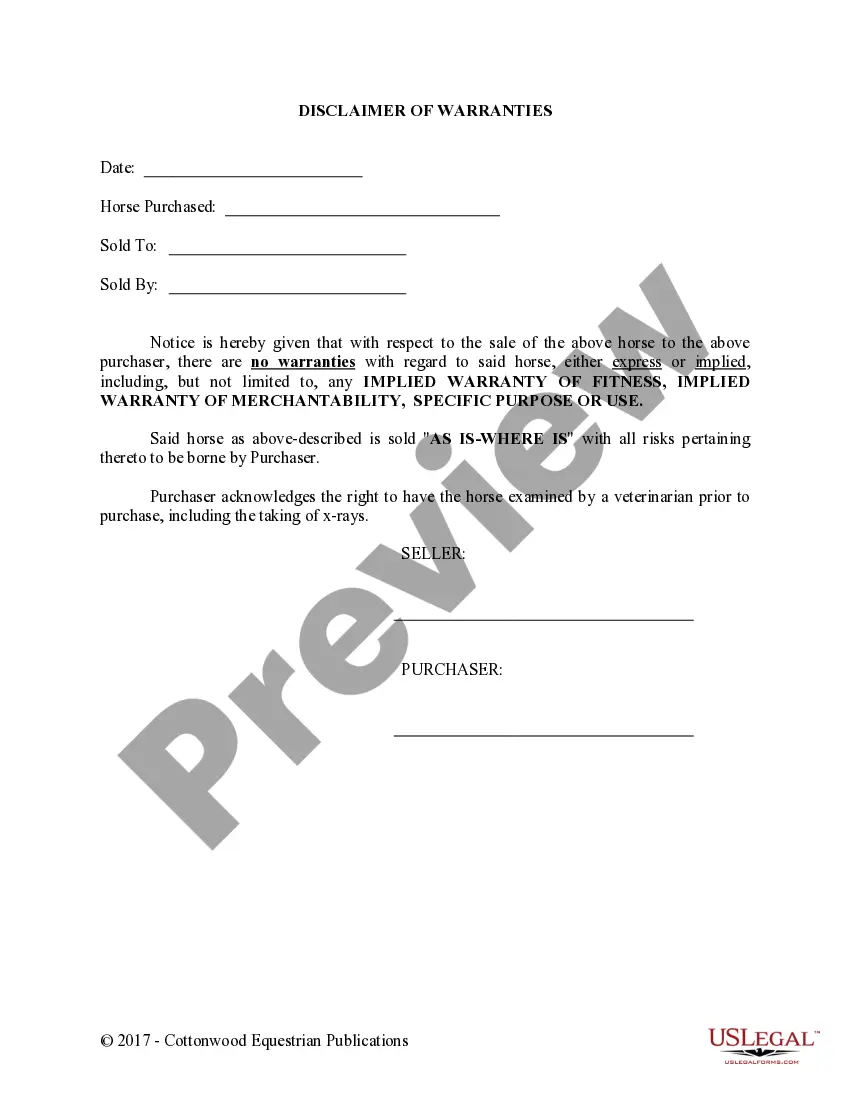
Oregon Warranty Deed for Separate or Joint Property to Joint Tenancy
What this document covers
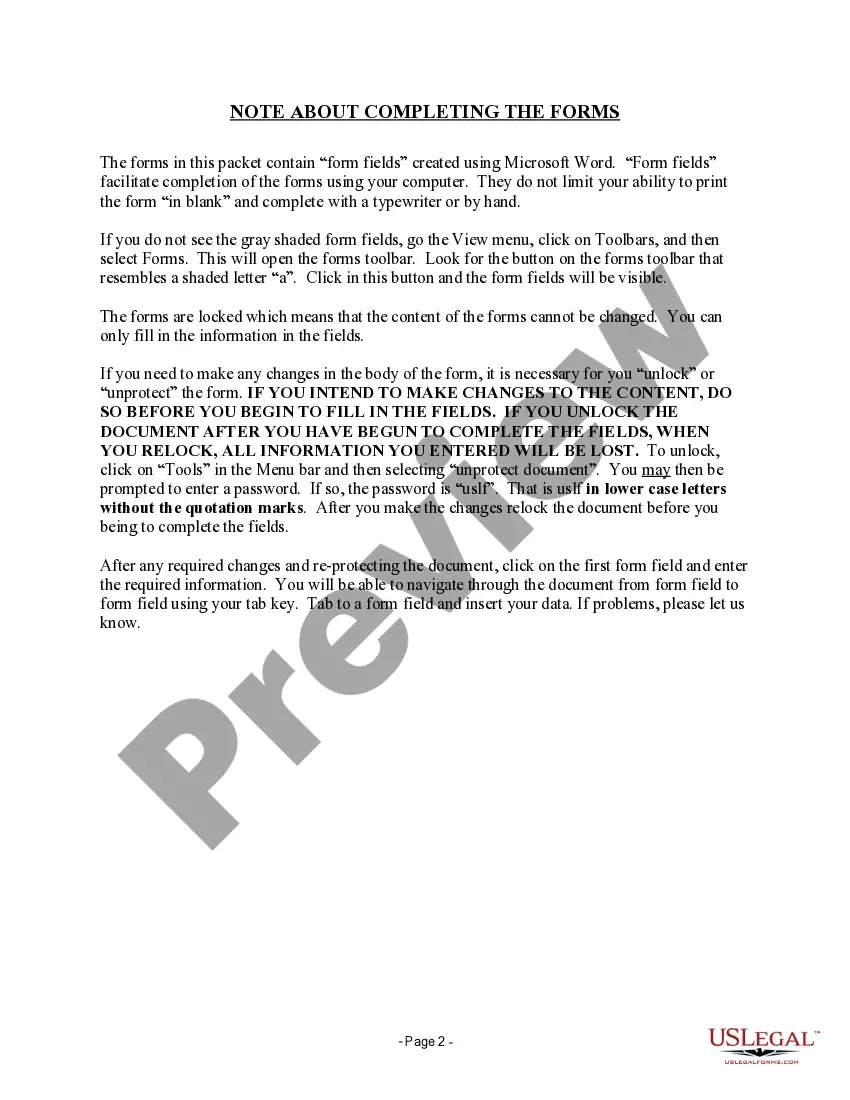
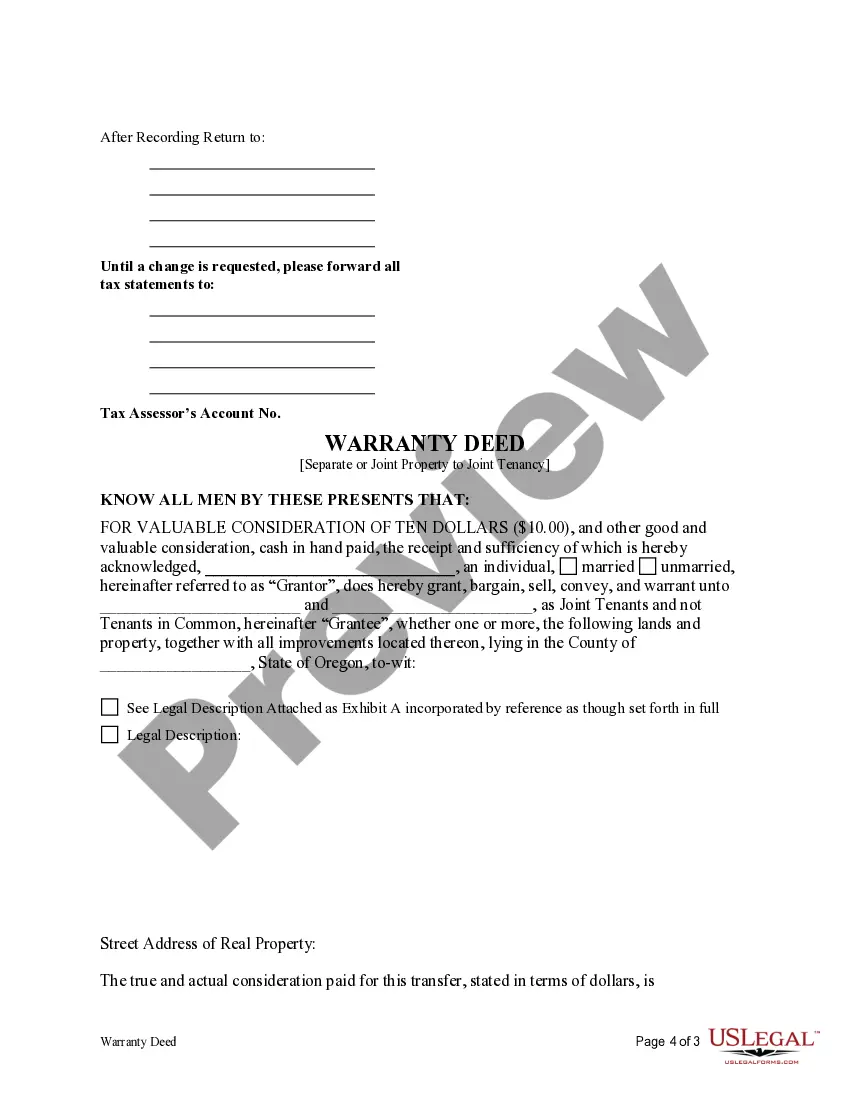
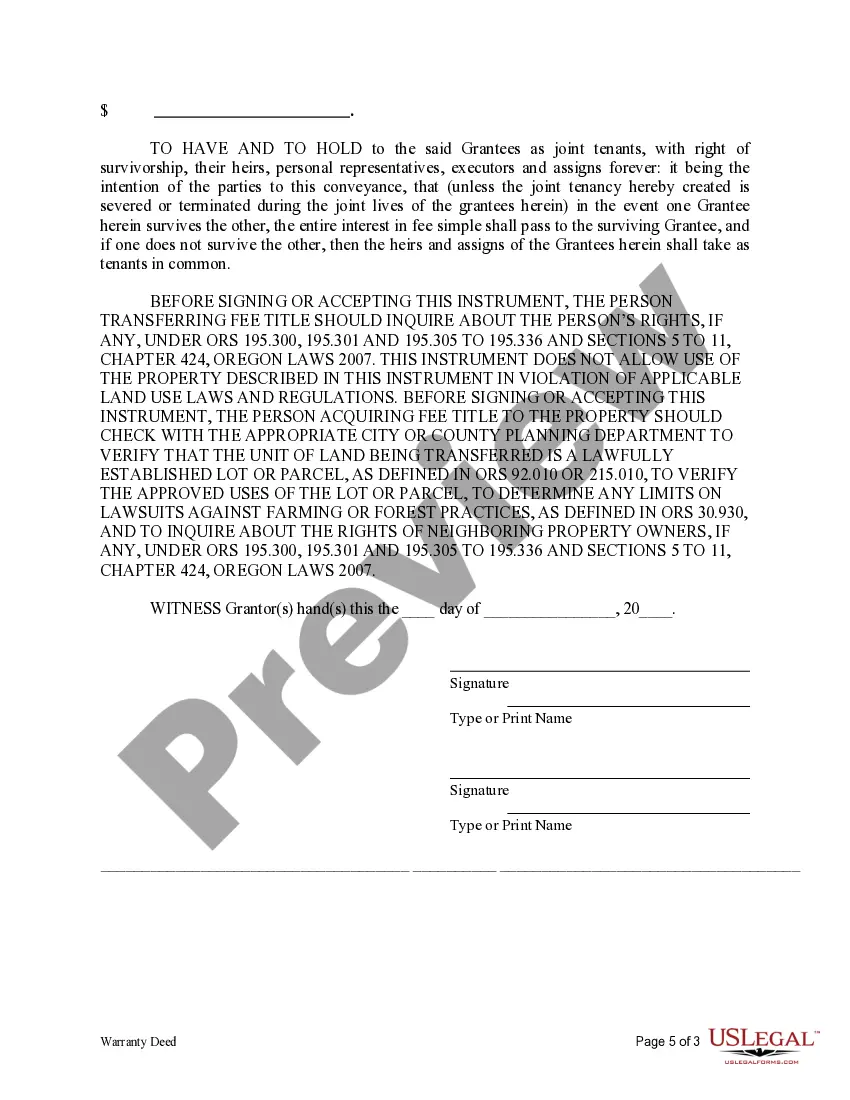
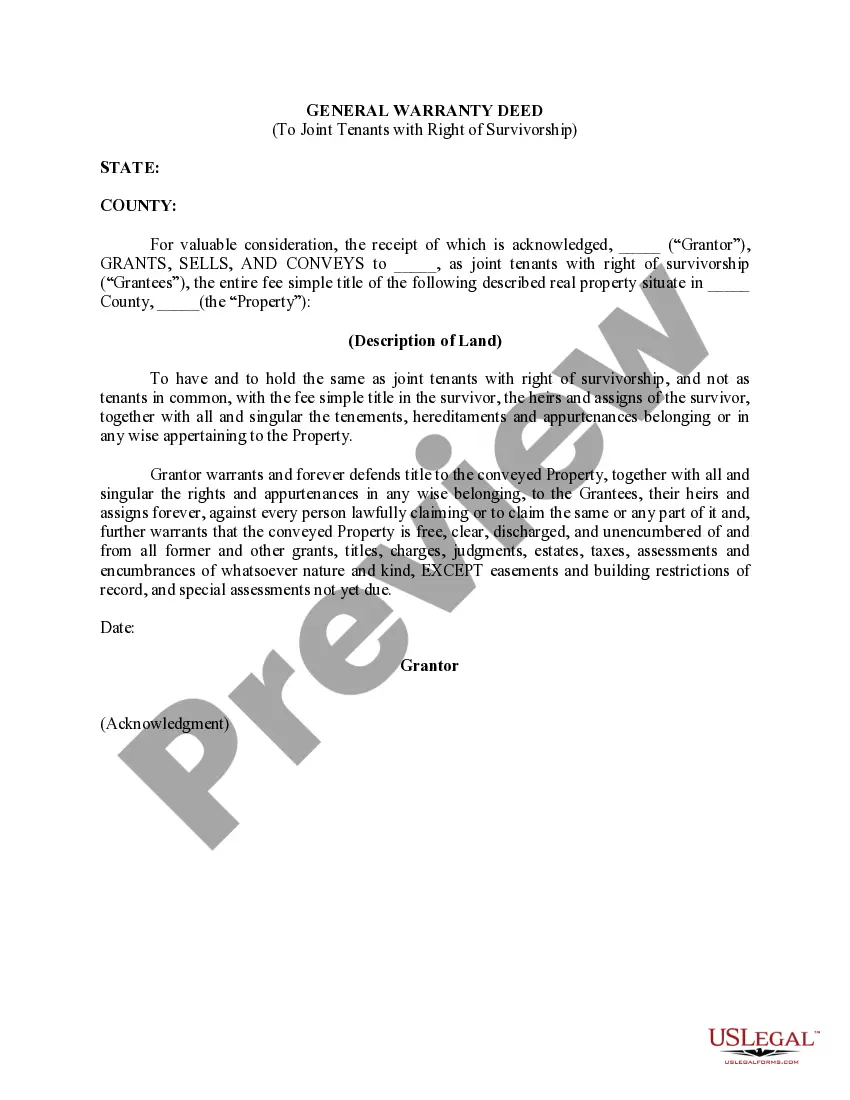
The Warranty Deed for Separate or Joint Property to Joint Tenancy is a legal document used to convert either separate or jointly owned property into a joint tenancy holding. This form facilitates the transfer of property ownership where two or more parties share equal rights and interests in the property. It is essential to distinguish this form from other types of deeds, such as quitclaim or grant deeds, which may not provide the same legal assurances regarding the transfer of ownership.
What’s included in this form
- Identifying the parties involved in the transaction.
- Describing the property being transferred.
- Specifying the type of tenancy (joint tenancy) being established.
- Including necessary legal disclaimers and requirements for the transfer.
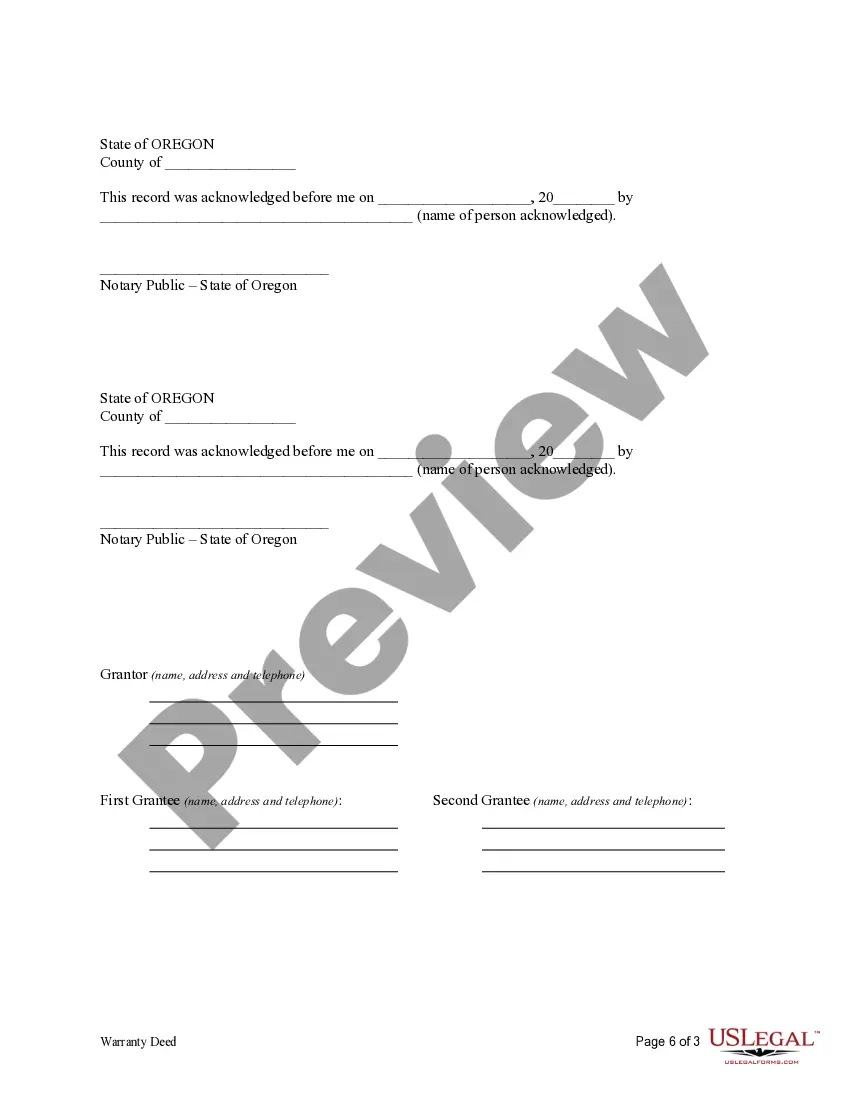
- Providing space for signatures and notarization, if applicable.


When to use this document
This form is useful in various situations, such as when married couples want to ensure that both parties hold equal ownership of a property, or when co-owners of a property wish to establish a joint tenancy for estate planning purposes. It is also applicable in situations where the previous ownership format needs to be changed to reflect the desire for equal rights in the property among owners.
Intended users of this form
- Homeowners who want to convert their property ownership structure.
- Married couples or partners seeking to establish joint ownership.
- Individuals inheriting property and wishing to formalize joint ownership with others.
- Co-owners of a property looking to agree on joint tenancy status.
Instructions for completing this form
- Identify all parties involved in the property ownership transfer.
- Provide a detailed description of the property being deeded.
- Clearly state the intention to create a joint tenancy.
- Complete all form fields ensuring accurate information is entered.
- Sign the document in the presence of a notary if required, ensuring all signatures are gathered.
Does this document require notarization?
This document requires notarization to meet legal standards. US Legal Forms provides secure online notarization powered by Notarize, allowing you to complete the process through a verified video call, available 24/7.
Get your form ready online
Our built-in tools help you complete, sign, share, and store your documents in one place.
Make edits, fill in missing information, and update formatting in US Legal Forms—just like you would in MS Word.
Download a copy, print it, send it by email, or mail it via USPS—whatever works best for your next step.
Sign and collect signatures with our SignNow integration. Send to multiple recipients, set reminders, and more. Go Premium to unlock E-Sign.
If this form requires notarization, complete it online through a secure video call—no need to meet a notary in person or wait for an appointment.
We protect your documents and personal data by following strict security and privacy standards.

Make edits, fill in missing information, and update formatting in US Legal Forms—just like you would in MS Word.

Download a copy, print it, send it by email, or mail it via USPS—whatever works best for your next step.

Sign and collect signatures with our SignNow integration. Send to multiple recipients, set reminders, and more. Go Premium to unlock E-Sign.

If this form requires notarization, complete it online through a secure video call—no need to meet a notary in person or wait for an appointment.

We protect your documents and personal data by following strict security and privacy standards.
Common mistakes
- Failing to accurately identify all property owners.
- Leaving blank fields that should be completed with essential information.
- Not obtaining notarization when required, leading to potential invalidations.
- Using incorrect legal descriptions of the property.
Advantages of online completion
- Convenience of filling out the form from home without needing to visit an attorney.
- Editability allows users to review and revise their entries easily before finalizing.
- Immediate access to legal forms drafted by licensed attorneys, ensuring compliance with state laws.
Summary of main points
- The Warranty Deed for Separate or Joint Property to Joint Tenancy allows for the conversion of property ownership into joint tenancy.
- This form is vital for couples or partners who want to ensure property transfer rights after death.
- Notarization of the form is required for legal validity.
Looking for another form?
Form popularity
FAQ
When two or more people own a home, either as a joint tenancy or tenancy in common, each person owns a share of the entire property. This means that specific areas of the house are not owned by one individual, but instead, are shared as a whole.
Which of these statements applies to both joint tenancy and tenancy by the entirety? The answer is the survivor becomes a severalty owner.A tenancy by the entirety may be terminated by the death of either spouse, and the surviving spouse then becomes sole owner in severalty. You just studied 20 terms!
Which statement applies to both joint tenancy and tenancy by the entirety? The last survivor becomes a severalty owner. A deed signed by one owner will convey a fractional interest. A deed will not convey any interest unless signed by both spouses.
The General Rule. In the great majority of states, if you and the other owners call yourselves "joint tenants with the right of survivorship," or put the abbreviation "JT WROS" after your names on the title document, you create a joint tenancy. A car salesman or bank staffer may assure you that other words are enough.
For one, if property is held in tenancy by the entirety, neither spouse can transfer his or her half of the property alone, either while alive or by will or trust. It must go to the surviving spouse. This is different from joint tenancy; a joint tenant is free to break the joint tenancy at any time.
What Are Tenants by Entirety (TBE)? Tenants by entirety (TBE) is a method in some states by which married couples can hold the title to a property. In order for one spouse to modify his or her interest in the property in any way, the consent of both spouses is required by tenants by entirety.
The simplest way to add a spouse to a deed is through a quitclaim deed. This type of deed transfers whatever ownership rights you have so that you and your spouse now become joint owners. No title search or complex transaction is necessary. The deed will list you as the grantor and you and your spouse as grantees.
With a Survivorship Deed in place, when one of the parties in a joint tenancy dies, the other party (or parties) takes over the deceased party's interest in the property instead of it passing to the deceased's heirs or beneficiaries.
What Is the Difference Between a Warranty Deed & a Survivorship Deed?A warranty deed is the most comprehensive and provides the most guarantees. Survivorship isn't so much a deed as a title. It's a way to co-own property where, upon the death of one owner, ownership automatically passes to the survivor.