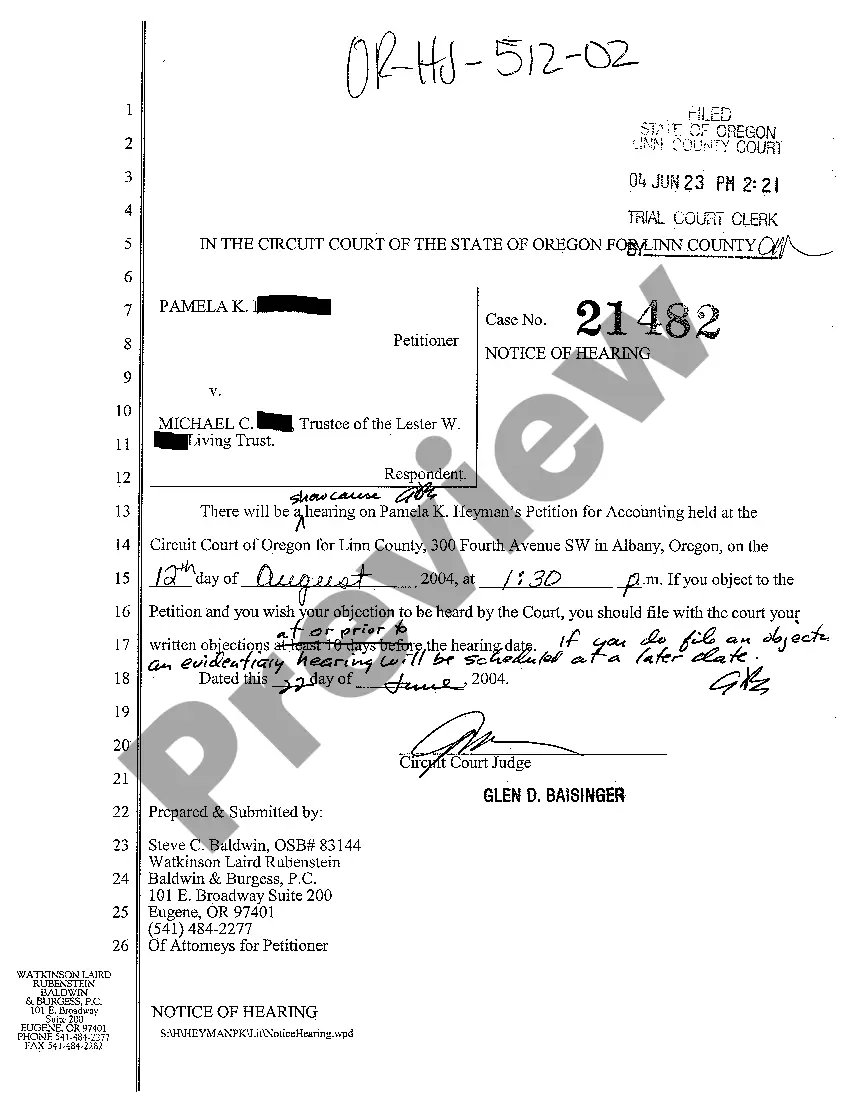
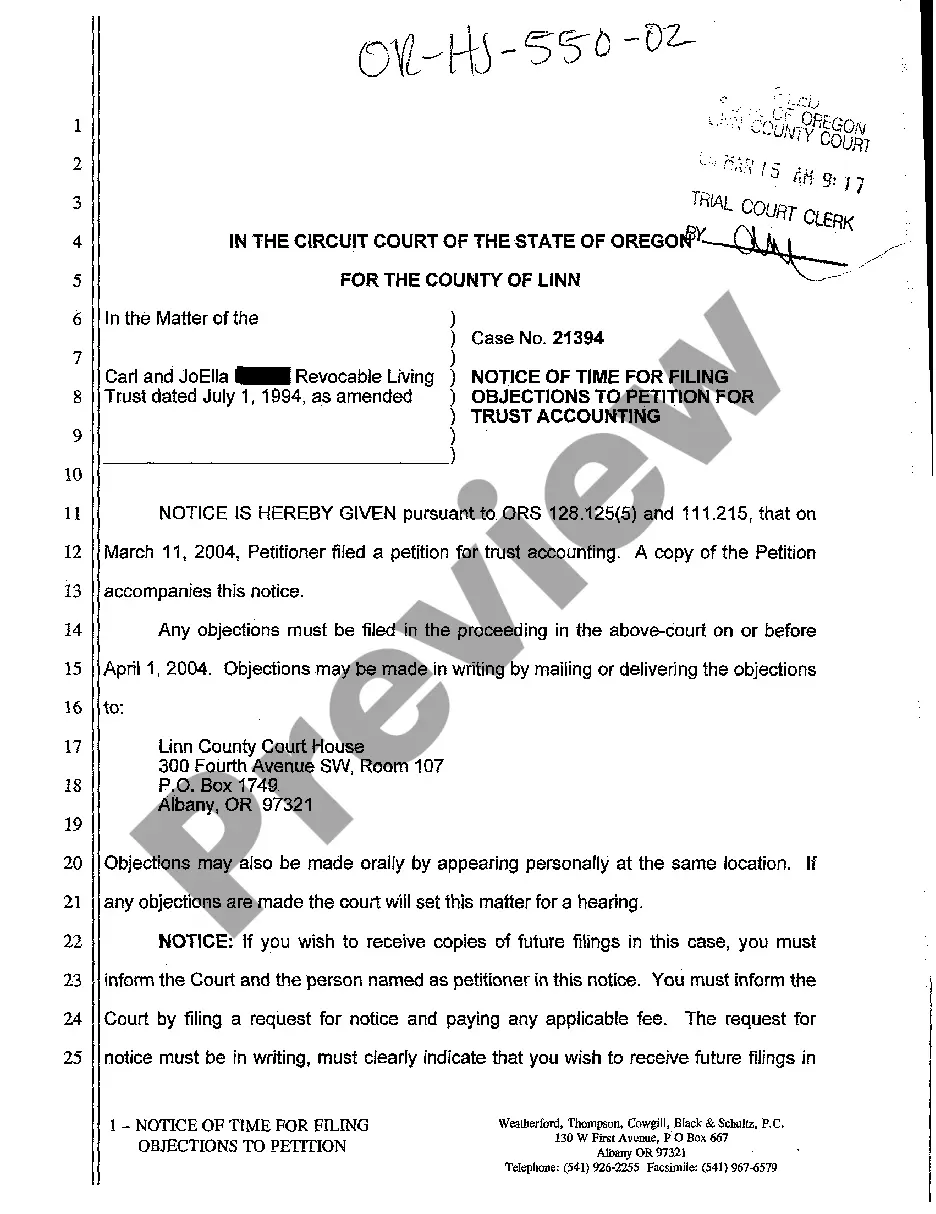
Oregon Notice of Hearing of Petition for Accounting
Description






How to fill out Oregon Notice Of Hearing Of Petition For Accounting?
The work with papers isn't the most straightforward task, especially for people who almost never work with legal paperwork. That's why we recommend making use of accurate Oregon Notice of Hearing of Petition for Accounting templates created by professional lawyers. It allows you to avoid difficulties when in court or dealing with formal organizations. Find the files you require on our website for high-quality forms and correct information.
If you’re a user with a US Legal Forms subscription, simply log in your account. Once you’re in, the Download button will immediately appear on the template web page. After accessing the sample, it’ll be saved in the My Forms menu.
Users with no a subscription can quickly create an account. Look at this brief step-by-step guide to get the Oregon Notice of Hearing of Petition for Accounting:
- Be sure that the document you found is eligible for use in the state it is necessary in.
- Verify the file. Make use of the Preview option or read its description (if readily available).
- Click Buy Now if this template is what you need or return to the Search field to find a different one.
- Choose a convenient subscription and create your account.
- Utilize your PayPal or credit card to pay for the service.
- Download your document in a required format.
Right after finishing these easy actions, it is possible to complete the form in your favorite editor. Check the completed information and consider asking a legal professional to review your Oregon Notice of Hearing of Petition for Accounting for correctness. With US Legal Forms, everything becomes much easier. Give it a try now!
Form popularity
FAQ
These are your last steps, usually completed after distributing the final income amounts, paying the last expenses, and filing the final tax returns. Final accounting should be done for non-probate and probate trusts. Obtaining remaindermen assent can protect you from a potential lawsuit.
A formal non-court accounting is done by the trustee and sent out to the trust beneficiaries. Such an accounting is done in the situation where there are no lawsuits or disputed court petitions involving the trust.
A judicial accounting is a financial inventory of assets, debts, income, expenditures, and other items, which is submitted to the court. A judicial accounting is used in various contexts, such as estate administration, divorce, partnership dissolution, and others.
Before distributing assets to beneficiaries, the executor must pay valid debts and expenses, subject to any exclusions provided under state probate laws.The executor must maintain receipts and related documents and provide a detailed accounting to estate beneficiaries.
Right to formal accounting: generally speaking, a trustee is required to provide a trust accounting at least annually, at the termination of the trust, and upon a change of trustees. Accountings are also required at the termination of a trust and upon a change of trustee. (See California Probate Code section 16062(a).)
Taxes paid, disbursements made to trust beneficiaries, and gains and losses on trust assets. Fees and expenses paid to advisors of the trustee, such as attorneys, CPAs, and financial advisors.
Typically, when trust lawyers refer to a formal accounting, we mean an accounting filed in probate court subject to court approval. Whereas an informal accounting is pretty much the same document that is not filed in court. More broadly, however, an informal trust accounting could be just about anything.
For starters, all current beneficiaries, income and principal beneficiaries, are entitled to an accounting of the trust assets unless, the trust actually waives that right. But if you are a current income or principal beneficiary of a trust, you are entitled to an accounting.